
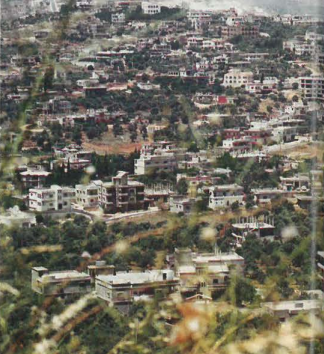
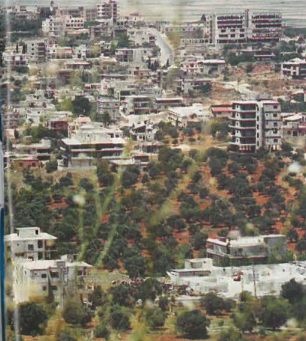
Liberated south Lebanon is slipping
back into rural tranquility. The purple-
topped tobacco plants sway in
the breeze, children play on abandoned
tanks and old men chew the fat under
posters of Hassan Nasrallah. The unspoiled
hills and coast astound visitors.
The quiet is broken only by the sounds of
reconstruction. Bulldozers, sporting the
colorful emblem of the Council of the
South, are out repairing roads and installing
pipes workmen are putting up electricity
poles. New palaces are under construction
others, left half-built during the years of
fighting, are finally being finished.
So will tourism and new housing drive up
land prices? Yes, say many. Expectation of
a real estate boom came almost immediately
after the Israeli withdrawal on May
24. Take Imad Saab, chairman of the
Lebanese Projects Establishment, based
in Kuwait, who told the Kuwait News
Agency: “I know a Kuwaiti businessman
who bought 120,000m² of land for only $2
per m² in the region of Iqlim Al-Toffah five months ago. Now the price per m² in this
region has soared to at least $15 per m².”
But how much of this is hype? Raja
Makarem, of consultants Ramco, is among
the skeptics: “This is daydreaming. Unless
people were selling under the value earlier,
nothing rises from $2 to $15 in five
months.” Ibrahim Murtada, a developer in
Tyre, is also unconvinced: “Some people are
spreading rumors that land is being bought
at $350 per m², but these are all lies.”
Murtada’s judgement is that good land in the
formerly occupied zone is worth between
$10 per m² inland up to perhaps $100 for
prime land near the coast at Naqoura.
The attraction of the coast has figured in
many of the optimistic scenarios for southern
real estate. But Naqoura remains an uncertain
prospect. It is nearly 90km often two hours
from Beirut, and as long as there is no
peace treaty with Israel, political instability
will always lurk in the background. In such
circumstances no one is likely to risk the
substantial investment required for a purpose-
built resort or even a large hotel, which
would usually require a minimum of ten
years to see any return on capital. It is difficult
to envisage anything like the $150 million
project for a 600-room hotel at Khalde
that has been drawn up by an Emirati group
represented by Faisal Awwad.
“There are just as attractive, and fairly
undeveloped, stretches of coastline much
nearer Beirut,” says Raja Makarem. He
cites a plot at Adloun, just south of Sidon,
fully 130,000m² with a 230-m coastal
frontage, that has been on the market for
months at $50 per m². At around $100, land
is available between Jounieh and Byblos, far
closer to Beirut than Naqoura, and with
ready access to the casino, nightclubs and
historical remains as well as beaches.
“Apart from perhaps land actually on the
beach at Naqoura, I doubt anything there
would fetch $100,” says Makarem. “If you
can buy land at Adloun for $50, why would
you go to the end of the world and pay $100
unless of course tourists come from
Israel. In time, with peace, I could see facilities
like a casino aimed at attracting people
to come from over the border, but clearly
that’s dependent on peace and normalizing
relations and that seems some way off.”
And that’s the coast. Inland, prices are
much lower. A 3-million m² plot at Rihane
was sold two years ago for just $3 per m²,
more expensive than Hermel but in line
with much of the Bekaa. Would it be worth
much more today?
Real estate prices are not independent of
general economic activity, which will remain
concentrated in Beirut. Banque Audi recently
estimated a 0.5% contraction in GDP in the
first quarter of 2000. And the outlook for the
southern economy is far from rosy. The government’s
$1.2 billion investment plan,
announced last month, is a target rather than
a commitment, and is dependent on Arab and
international loans: the government plan also
persists with the BOT model that is looked
upon unfavorably internationally.
In many of the Christian villages, Israeli
withdrawal may even depress land prices.
During the occupation, at least and probably
more over 3,000 people worked in
Israel, and another 3,000 received a
monthly paycheck from the South
Lebanon Army (SLA). That income is now
lost. In the SLA heartland around
Marjayoun and Qlaiya, many people have
fled to Israel and this cannot help but
weaken the economy.
Expatriate investment has figured as a
major target of post-war Lebanese governments,
seeking to tap the capital and intellectual
abilities of the 900,000 citizens,
almost one-third of the population, who
emigrated during the war. The expectation
is that returning Lebanese bring in money
saved abroad, and that they buy land and
build luxurious homes. But isolated
palaces will not regenerate the market as a
whole nor create an environment that is
conducive to investment.
“There is pent-up demand, with people
rebuilding the family home,” says economist
Kamal Shehadi. “But in the absence of
planning and zoning, there’ll be chaos. The
traditional villages that have kept their
character will be ruined by wannabe real-estate
developers.”
George Nur, who owns 5 million m² of land
a ten-minute drive inland from Naqoura,
believes that the potential of the land
depends on the government drawing up a
master plan that allows development and at
the same time protects the quality of the
region. “Unlike much of the country, it’s
not too late to save the South,” he says. “So
much of it is green, virgin. But can you find
me a buyer? I can’t believe anyone would pay
even $10 per m² for my land now.”
It is clear that the government will invest
capital although its record as a planner is
hardly convincing. The sites of schools, clinics
and other government buildings already
exist, and constructing them where they do not
is unlikely in itself to drive up prices.
Without planning the more professional
developers, says Ibrahim Murtada, will
keep well away: “I wouldn’t do anything in
the former occupied zone. It’s very difficult.
The government says it will allocate LL30
million for each person to reconstruct their
house. Instead they should build infrastructure,
introduce zonal planning and call
in contractors to build residential units.”
The South, after all, is one of the poorest
regions of Lebanon. Its main income is agriculture.
Tobacco is a major crop because of
state subsidies, but even this offers relatively
poor returns. This is not a recipe for rising real
estate prices, at least not between the immediate
positive effect of the withdrawal and a
peace treaty that opens up trade between
Lebanon and Israel. So while individuals will
build houses, corporate investment is unlikely.
“It’s risky,” says Ibrahim Murtada,
“because few people there have money.”
