
Imagine you are the chief executive officer of a major multinational company. Your core business is selling fast-moving consumer goods with a solid majority presence in all of the world’s major markets, but opportunities for further expansion are all but exhausted.
All that remains to conquer is divided into relatively small markets, which would demand extensive investment to break into, since you have no domestic presence there and will have to start from scratch. How do you solve this problem? Simple: you study the market you are targeting, identify the main players in your sector and acquire them. Objective achieved — with the added advantage of providing you with an existing market share, a proven distribution network and local production facilities to introduce your own brands to the market.
Heineken’s takeover
This was the exact tactic employed by Heineken International, a Dutch company and one of three main players on the global beer market. After successfully applying the procedure in small European beer markets such as Greece and Cyprus, the company decided to move onto the even smaller markets in the Middle East. In 2002, Heineken acquired Al-Ahram Beverages Company (ABC) in Egypt which, conveniently having bought out its only competitor El-Gouna in 2001, controlled 100 percent of Egyptian beer production. In Jordan, the country’s only brewery is now exclusively producing Amstel.
In September of 2002, Heineken moved on to Lebanon. Already owning a 10 percent stake in Brasserie Almaza after taking over the Dutch Amstel brand, Heineken acquired another 69 percent stake in one of Lebanon’s national symbols from the quarreling al-Jabr family who founded the brewery. Not satisfied with controlling a majority share of the Lebanese market — and also Syria, which has two state-owned breweries of its own but remains Almaza’s main export market — Heineken also bought Almaza’s only competitor, Laziza, in October 2003.
Lebanon’s annual beer consumption roughly equals the total volume consumed in 10 days at the Munich Oktoberfest
Malt monopoly
Laziza was soon turned into a brand of non-alcoholic malt beverages, which are successfully exported to the Gulf Cooperation Council market, leaving Almaza without any real competition in what is known as the “mainstream” segment of the beer market. Heineken’s own flagship brand was thereby well-placed to dominate the ‘premium’ or international segment, as it already does in other parts of the world.
Operating in this way virtually closes the market to other global players such as Carlsberg and Anheuser-Busch InBev who, unable to acquire any local producers, would be forced to either pay hefty transport and import costs, or invest heavily to set up local production from scratch.
Neither option would yield substantial returns, even over the long term, due to the negligible size of the market: Lebanon’s annual per capita beer consumption stands at a mere five liters, as compared to an average 75 liters in Europe. To put this figure in perspective, Lebanon’s annual beer consumption roughly equals the total volume consumed in 10 days at the Munich Oktoberfest alone. The fact that a sizeable proportion of Lebanon’s population are observant Muslims of course affects this figure.
As Almaza’s Marketing Manager Naji Nakouzi explains to Executive: “There are Muslim communities here who are very religious and don’t drink, and others that are more liberal [and do drink], which is why Ramadan does have an effect on our sales.”
Haytham Nasr, a member of the Gemmayzeh Development Committee (GDC), the body of bar and restaurant owners, confirms that the fasting month almost halves the bars’ turnover.
Spirited competition
Nasr confirms that Lebanon simply does not have a beer culture like Europe or America. Beer is seen as a beach refreshment, consumed in summertime, preferably freezing cold.
“In the average bar I estimate that beer makes up 30 percent of sales, at most. Spirits, whether pure or in cocktails, are the preferred drink of the Lebanese. In many bars and clubs beer is actually priced artificially high to discourage its consumption, as spirits and cocktails offer a higher profit margin.”
Nakouzi likewise argues that Almaza’s main competitors aren’t other beer brands but spirits.
“The only way we can enhance our profit margin in Lebanon is by increasing the overall per capita beer consumption, which we try to achieve by encouraging a beer culture,” he says. “We schedule our annual marketing campaigns a little earlier every year, so that beer consumption is now starting to increase in spring, whereas previously consumption didn’t reach its seasonal level until June.”
Nakouzi argues that Almaza welcomes new competitors such as 961, since they contribute to creating a beer culture in the country.
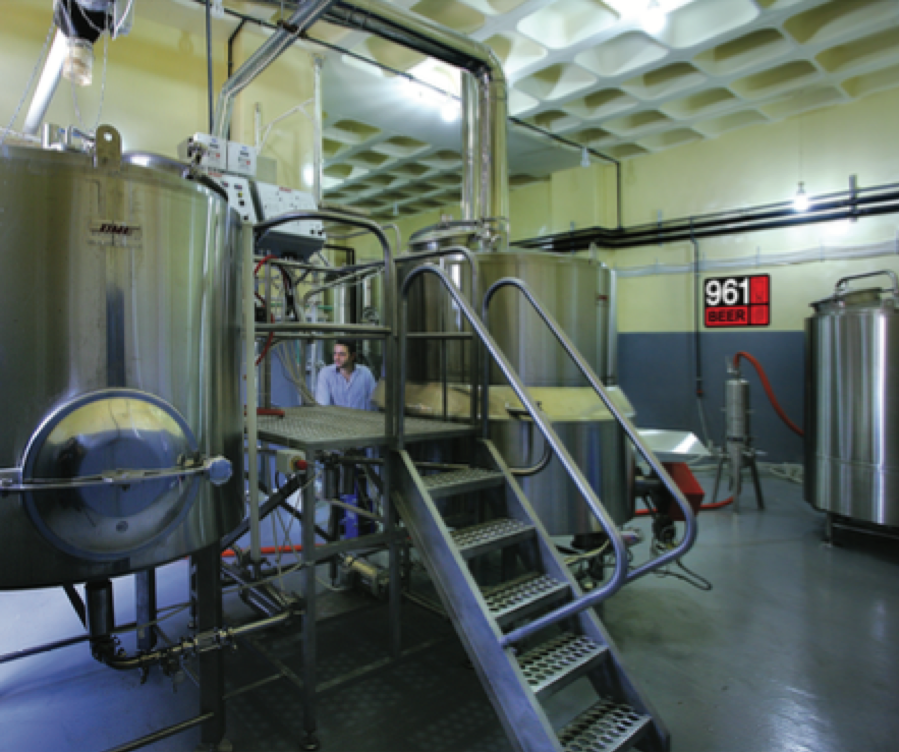
Called 961 after Lebanon’s international dialing code, the country’s newest mainstream brewery was founded in 2006. Despite a growing market share and increasing presence in Beirut’s bars, the fledgling firm’s entire output doesn’t exceed 0.5 percent of the 190,000 hectoliters of Almaza and Laziza produced annually at the famous brewery in Jdeideh.
Competition from 961 makes it untrue to say that Heineken controls the entire beer market in Lebanon, let alone claim, as some disgruntled bar owners do, that it holds a monopoly. There is also real competition in the international market segment — notably from Diageo-owned Corona Extra.
Quality brand
A bigger worry, says Nakouzi, is that 40 percent of Lebanon’s beer market is taken up by the low-end segment of strong canned beers sold mainly in retail outlets and currently dominated by the Turkish Efes brand.
“Although Heineken is a player in that market through our Rex and Meister brands, we prefer to profile ourselves as a quality brand offering,” Nakouzi says.
A truly Lebanese taste
Mazen Hajjar, 961’s chief executive officer, is a true beer enthusiast and a tireless promoter of his creation, which he estimates now makes up to 30 percent of beer sales in bars that carry the brand.
“The important thing for me is to offer…more choice,” he affirms. “We are introducing strong dark beers, including Belgian-style trappists and white beers, the kind that you don’t drink ice-chilled on a beach, but in the cold winter months in a warm bar. It is our arrival on the market that prompted Almaza to introduce its darker Pure Malt variety.”
Hajjar says 961 is a quintessentially Lebanese product; the company persuaded Bekaa valley farmers to grow Lebanon’s first hops crop. By comparison, Fadi Hojeily, quality manager at Almaza’s highly automated computer-controlled brewery for the last 11 years, says that the company imports most of its ingredients from the Netherlands.
“Every ingredient we use has to be approved by Heineken, not only for quality purposes, but also because the ingredients affect the taste of our beer,” he says. “We import the hops, barley, yeast and maize we use.”
In fact, the only Lebanese ingredient in Almaza is the water, which is treated in the plant before being added to the brewing mixture.
The only Lebanese ingredient in Almaza is the water, which is treated at the brewery before being added to the mix
Obstacles for new products
Hajjar identifies the major obstacle facing the introduction of new beer brands as being the prevailing practices in Lebanon’s supermarkets, which are reluctant to add new products to their range.
“In other countries, supermarket chains actually employ scouts who go out and look for local and regional produce, for unique brands to give a supermarket some character that distinguishes it from its competitors,” he says. “The Lebanese retailers do the contrary: they allot disproportionate shelf space to the major established brands and make new brands pay to get their products displayed in a corner of the bottom shelf. We were lucky to have a distributor who really believed in us or we still would not have made it to the supermarkets.”
GDC’s Nasr, who in addition to running a bar, also works as a marketing manager in a food and beverages firm, confirms Hajjar’s story: “If you want to get a new product listed, you have to pay huge fees. Shelf space is expensive too, and a two week promotion campaign with an off-shelf display in the five major supermarket chains in Lebanon will easily set you back some $10,000. Taken together, these factors mean you need a serious promotion budget just to get your product placed in the supermarkets.”
None of this, however, has dampened the enthusiasm of 961’s Hajjar, who recently announced a major new financial injection for the young company, enabling it to buy a second brewhouse and add extra fermentation tanks to increase output.
“We cannot keep up with the demand,” says Hajjar. “Everything we produce is sold out as soon as it enters the market. We still have a long way to go before achieving our full potential.”
