August 1990, Iraq invades Kuwait. Within days, Iraq is encircled in one of the most extensive economic blockades ever imposed on a country. Almost overnight, Lebanon loses what had traditionally been one of its most lucrative markets for manufactured goods. Iraq absorbed more than a quarter of Lebanese exports in the early 1970s and as much as 75% of transit exports. Even during the war, though statistics are not available, it continued to be an important destination for locally produced goods.
Four years after the Gulf War, relations between Beirut and Baghdad sank to a new low. When some Iraqi opposition members were assassinated in Beirut, the Lebanese government blamed Iraqi intelligence agents and promptly severed all diplomatic ties. With sanctions still intact, Lebanon sent a paltry $1,278 worth of textiles, probably donations of clothes, out of the more than $733 million in total exports, to Iraq in 1996.
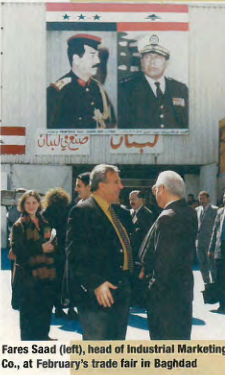
Fast forward to February 2000. Nasser Saidi, minister of economy and trade, accompanies a delegation of more than 93 Lebanese businesses and 250 businessmen to Baghdad, where he and his Iraqi counterpart, Mohammed Mehdi Saleh, open an exhibition of Lebanese industrial products. It’s the sixth exhibition in Baghdad involving Lebanese business in two and a half years and Saidi is the fourth Lebanese minister to visit.
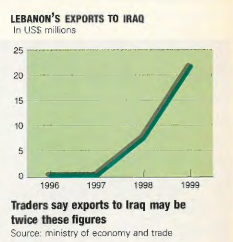
The port of Tripoli has been designated by the Iraqi government as a receiving station for an order of sugar exports to Iraq. Lebanese exports to Iraq are up to $22 million for 1999, making it the 12th most important export destination. But most businesspeople feel that these figures are underestimated and that much of the trade is not recorded on official statistics because it passes via a third country. The real number is probably double that figure and many expect it could double again by the end of this year.
Nearly two dozen Lebanese companies have opened offices in the Iraqi capital and warming relations have led to the restoration of diplomatic ties and the reopening of both countries’ embassies.
What happened? In the last few years, regional political developments have smiled kindly on Lebanese-Iraqi relations. Mounting sympathy in the Arab world toward Iraq’s plight and a sense that the time had come for the sanctions to be lifted has encouraged Arab states to reestablish trade links with Baghdad. For the first time in 15 years, Syria’s relations with Iraq have warmed and a common border for trade was opened, a move that no doubt gave Lebanon a green light to repair its own relations with Iraq. And, perhaps most significantly, growing international concern for the suffering of the Iraqi people prompted the United Nations (UN), in 1996, to start allowing Iraq to export a limited amount of oil in exchange for humanitarian goods.
By 1996, some of Lebanon’s business leaders were looking towards their eastern neighbor. Within one year, the first contracts were being signed and the first delegation of nearly 180 businessmen boarded buses and headed out across the Syrian desert to participate in the Baghdad International Trade Fair 1997. The rest is history.
Iraq is still under UN sanctions, and it must purchase the bulk of its imports using revenues generated from the yearly $11 billion in oil exports allowed under the oil for food program. Only $8 billion of that amount can be used to buy goods. But it is also a market of 22 million consumers with very few functioning industries of its own. Once again, Iraq is partly open for business and Lebanon’s struggling industries want a piece of the action.
Obegi Consumer Products, producers of such popular brands as Persil and Al-Wadi Al-Akhdar, is selling detergents there. Cosmaline Industries has been busy selling toiletries, while Uniceramic, Lebanon’s largest tile manufacturer, has struck its own deals.
Georges Ghorayeb, general manager of Lecico, manufacturers of sanitary ware and tiles, sees the Iraqi market as a salvation for his struggling business. He has seen profits shrink to zero in the last few years. Sales on the sluggish domestic market are down about 17% of what they were three years ago and a flood of cheap imports has resulted in a 40% drop in exports to his number one market – the Gulf. Just last month he signed his first contract with Iraq in over ten years to supply 10,000 pieces of sanitary ware – toilets, sinks and bidets – for about $250,000. Ghorayeb believes he could sell double that amount by the end of the year.
Before the invasion of Kuwait, Iraq accounted for about 30% of Lecico’s total revenues. If sanctions were lifted, he says, “I expect that the Iraqi market can absorb 1.2 million to 1.5 million sanitary pieces a year. We could get one fifth of that volume.”
Mohamed Ghaddar, managing director of Ghaddar Machinery, one of the country’s leading generator manufacturers, credits the Iraqi market for helping to turn around a rapid decline in sales. In 1994, while the local economy was booming, Ghaddar’s revenues were around $15 million. Facing a slump in local demand, revenues nosedived to $10 million in 1995 and down to $8 million the next year.
With the local market saturated with generators, Ghaddar looked for ways to beef up exports. He found salvation in Iraq. In 1997, he signed a $1 million contract with the Iraqi government and delivered the goods one year later. Last year, he sold $4 million worth of generators. His revenues shot up to $9 million in 1997, $12 million in 1998 and last year were back at $15 million. Ghaddar’s exports have increased from 5% of revenues in 1994 up to 60% in 1999. Iraq represents his largest foreign market, absorbing about 35% of exports. Next year, he aims to sell $10 million to $15 million worth of goods to Iraq.
But as good as it may seem, there are problems. Ghorayeb complains that margins are often as low as operating at cost. Ghaddar isn’t happy because of the bureaucratic barriers. All his deals have been with the Iraqi public sector. Since Iraq is still under sanctions, the contracts must be approved by committee 661 of the UN Security Council, whose job it is to ensure that what enters Iraq is truly for humanitarian purposes.
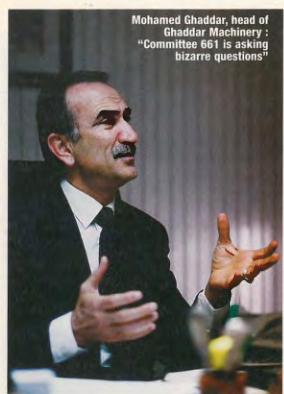
“They [committee 661] are asking bizarre questions. For example, they ask us why this engine has a nozzle. There are no diesel engines in the world that do not have a nozzle,” says Ghaddar. Contracts that should take three weeks for approval are taking months. Ghaddar says that more than $4 million of his contracts have been put on hold, one for more than a year and a half. Others complain of similar problems.
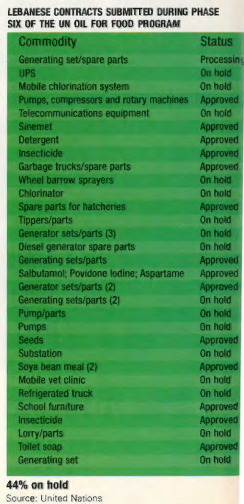
Last year Lebanese businesses submitted more than $70 million worth of contracts to the UN, according to Ghazi Yehia, secretary general of the Lebanese Industrialists’ Association. “But only $35 million actually went through, the rest got held. They didn’t get approved by committee 661,” he says. A list of contracts, submitted during phase six of the UN oil for food program, which started in May of last year and ended in November, showed that only 44% of 36 contracts from Lebanon had been approved. Most of the rest – including a number of generators – were put on hold. By contrast, for Egypt, 69% were approved. Repeated attempts to contact both the Dutch and US representatives of committee 661 for a response to these complaints proved unsuccessful.
But faults within the UN system are not the only problem. Certain industries have benefited from the Iraqi market more than others. Lebanese generators are selling briskly in Baghdad – representing as much as one third of exports – because they are in high demand and competitive with generators from other countries, says Ghaddar. But his generators are sold there with margins as low as 5%.
But for less value-added products, where factors like transportation and labor costs make a difference, local manufacturers are finding Iraq to be as tough a market to compete in as any. “Exporting to Iraq is very difficult. Prices are becoming competitive. Everyone is going to Iraq,” says Ziad Bekdache, general manager of Oriental Paper Products, who only recently started to look seriously at the Iraqi market. Prices are so low that if he starts trading with Iraq it will be at cost.
Countries neighboring Iraq have other advantages. Under the oil for food program, all Iraq’s petroleum exports must go through Turkey via a pipeline. But Jordan, the number one exporter to Iraq, has a protocol which allows traders there to barter goods directly for discounted oil, bypassing committee 661. There is also rampant smuggling of oil via Turkey and Iran. Lebanese companies do not have the privilege of accepting oil. “We cannot sell for oil because Syria would not allow it to go through,” says Abdul Wadoud Nsouli, president of Nsouli Trading Company.
Jordan also benefits from having a committee 661 office on the ground, says Fares Saad, general manager of the Industrial Marketing Company. That makes processing contracts much easier and quicker. Some Lebanese have exported to Iraq via Jordan for that reason, but the cost of shipping is higher: $2,500 to send a truck with 25 tons of goods compared with $1,500 to send a truck through Syria. For Bekdache that is too much to export paper.
He has plans to participate in an upcoming tender with the Iraqi government for 5,000 tons of notebooks. But with prices so competitive, he has no illusions about making money even if he wins contracts. “I am willing to sell at cost just to have a presence there,” he says.
That is prompting many to enter the market now. This year Lebanese business will submit more than $100 million worth of contracts to committee 661 for approval, says Yehia. Assuming that just half that amount is exported, Iraq will fall into Lebanon’s top four export markets. Last year, Saudi Arabia bought $71 million worth of Lebanese goods; the UAE bought $54 million, France $52 million and Switzerland $45 million.
But traders say that if sanctions were lifted, Iraq could absorb up to $250 million per year in Lebanese goods – close to 40% of total exports. “If sanctions are lifted we’d have a bigger share of the market and quicker procedures in fulfilling the contracts,” says Ghaddar. But the issue of sanctions will have to wait for regional political developments to smile kindly on Lebanon.
Breaking new ground
Fares Saad, general manager of the Industrial Marketing Company, could be called a trading
pioneer. If one person can be credited with opening Iraq in the last few years, it is him.
In 1996, when Iraq might as well have been the moon as far as most local traders were concerned,
Saad struck up a conversation with a delegation
of Iraqi businessmen at a foodstuff trade fair in Tripoli. “We
sent a letter to the Iraqi minister of commerce, saying that
we would like to participate in a trade exhibition in
Baghdad and see the return of relations,” he says.
One year later, in October of 1997, he organized and led
the first local delegation of traders to Iraq to participate in
the Baghdad International Trade Fair. “Ninety-one companies
participated and about 25 sold products at the
exposition. The Iraqi market was thirsty for goods.”
He has since organized the participation of Lebanese delegations
in five more trade fairs in Baghdad, three of them special
Lebanese trade exhibitions. It wasn’t easy. “At the time,
those in authority did not encourage us in regard to this
idea because Lebanon had cut relations, because of the
sanctions and because exports were tough and no one
could do it,” says Saad.
But the trade fairs have been one of the keys to the Iraqi
market in the last few years. Saad now has three goals:
the return of commerce between the two countries, the
restoration of Lebanese industry to its previous position
in the Iraqi market and an end to sanctions. “It’s not possible
to allow the Iraqis to live in such conditions,” he says.
He feels that he has achieved his goals. “Relations between
Lebanon and Iraq have been restored, the embassy has reopened, Lebanese industry
has returned to the Iraqi market and many contracts have been completed. And thirdly,
many Lebanese have gone to Iraq to protest against the sanctions,” he says. “Now the sanctions
have started to collapse.”