Lebanon’s rivers are once again roaring, swollen by spring
snowmelt in the mountains. This is an annual blessing. In
the parched Middle East, where water rights are so guarded
that countries will go to war to protect the smallest of tributaries,
Lebanon is an oasis. Having so much of what other countries in the
region need, one might expect that there’s money to be made in the
export of bottled water. Certainly, there is no shortage of companies
that are trying to tap into this potentially lucrative market.
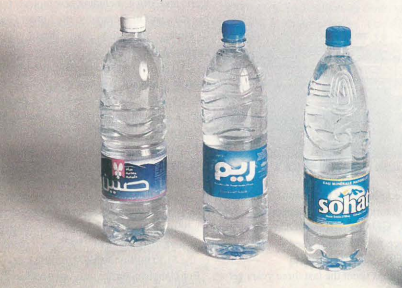
Sohat, Rim, Tannourine, Sabil, Nada and Sannine have invested millions
of dollars in the last few years to upgrade their factories. All
have converted from the use of opaque PVC bottles to the transparent
and exportable PET bottles. (Many countries have banned
the import of PVC bottles because they have been shown to pose
health risks). Water should be a booming business in Lebanon. But
the sad reality is very different.
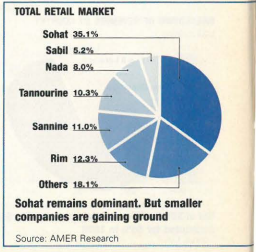
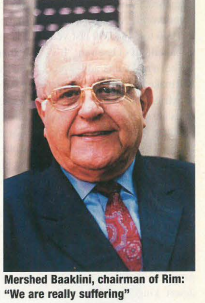
“Nobody is making a profit,” complains Mershed Baaklini,
chairman of Rim, the number two brand on the market, according
to AMER Research. Despite the big investments, those in the business
complain that there is little money being made. Unfortunately,
most companies in the water business are not nearly as transparent
as their new bottles. Sohat, the number one brand, Nada and Tannourine, declined to speak on the record. Rim, Sannine, Sabi! and Dynamic Concepts, a supplier of 19-liter bottles, were willing
to divulge limited information. But some facts are clear.
The combined production capacity of the companies is far greater
than the demands of the domestic market. About 7-8 million cases
of water are sold in Lebanon each year. “The production capacity is
at least double,
maybe triple that,”
says Salah Osseiran,
chairman of the four-year-old Sabi!, the
newest company to
enter the market.
Sabil’s capacity is 4
million cases a year,
but it’s currently running
at 1-1.5 million.
Rim can produce 6
million boxes a year
but is only selling
about 2 million.
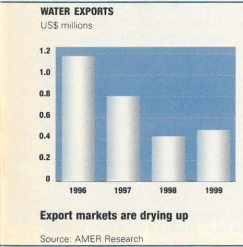
If the domestic market’s thirst is quenched, then there must be a market for exports in this arid region
of the world? Actually, no. Exports have dropped from $1.2 million
in 1996 to $481,000 last year. Production costs are increasing in
Lebanon, says Osseiran. “It’s very expensive here to export. Water
is not a real value-added product, so any marginal increase in cost
will make it uncompetitive,” he says. “We had opportunities to export
to Africa, but we couldn’t because it’s so competitive and our
costs are so high.” Sabil’s exports have dropped from 10% to 12%
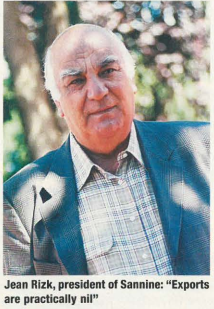
of output in 1996 to 5% to 6% last year. “Exports are practically nil. [Bottled Water] is bulky, heavy and cheap
and that makes the cost of exports high
compared to the price of the water,” says
Jean Rizk, president of Sannine.
The Gulf represents the most important
export market. Saudi Arabia purchased
$104,000 of Lebanese bottled water in
1999, or 21% of exports, and Kuwait consumed
$219,000, or 45%. But even in these
desert kingdoms, it’s hard to compete.
Believe it or not, says Osseiran, the Saudis are
able to produce bottled water less expensively
than the Lebanese by pumping from deep
wells. In 1980, there was just one water factory
in Saudi Arabia, but today there are
nearly 20. In Saudi supermarkets, a case of
Lebanese water generally costs double the
price of the local variety. “They have many
advantages that we don’t have,” says
Osseiran. “Their cost of utilities is one
fourth of ours. They pay 2 to 3 cents a kilowatt.
We pay 12 cents. They don’t have to pay
40% of each employee’s salary for social
security. They pay only 7%. They have land
that is less than nothing to buy in industrial
areas.” In addition, Saudi water companies
benefit from 20% customs tariffs on bottled
water imports. In addition to the usual taxes required of all businesses, water companies are obliged to pay a tax of
LL35 for every liter of water extracted, whether it’s used or not.
With too many swimmers in the pool, firms are desperate to survive.
Companies have been diversifying their product lines (see box) and
investing hundreds of thousands of dollars in splashy marketing campaigns.
At the same time, a fierce price war has developed, with firms
offering supermarkets up to 60 free bottles for every 100 purchased
in an effort to win market share. Instead of passing that on to the customer,
says Osseiran, shops are pocketing the difference and giving the lowest-priced brands better shelf space.
Supermarket prices range from LL500 to LL600
for 1.5-liter bottles.
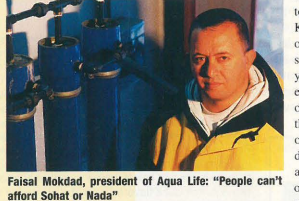
“It is a chaotic market,” says Michel Ghanem,
CEO of Rim. “Companies are dumping prices.”
So who will sink and who will swim? If the companies
themselves are to be believed, all could
drown. The some 200 to 300 unlicensed water
companies (no one knows for sure how many
there are) have become the scourge of the
industry (see box). Legal companies complain
that they are driving the legitimate players out of
business. That, despite the strict rules governing
bottled water. Based on government decree
1039, passed last summer, a water company
must have a factory that is ISO 9002 certified and
follows manufacturing procedures set by the
US Food and Drug Administration. Each company
must also have its own well or spring
located on no less than 1,000m to 1,500m of land,
a minimum investment of no less than $1 million. But the laws are
not being enforced.
Illegal companies dominate the 6-liter to 5-gallon market, which
represents more than a quarter of the total water market. Operating
out of street-level shops or garages, many provide no more than filtered
(sometimes unfiltered) tap water. Most distribute within their
own neighborhoods for prices as low as LL1,000 for a 20-liter bottle.
This has discouraged legitimate companies from entering a
very important segment of the market. Of the eight licensed companies,
only three sell 5-gallon water bottles: Mona Cool, Nahle and
Nada, which is sold by distributor Dynamic Concepts.
“We are really suffering from the little guys who are doing this
without a license,” says Baaklini. Rim is considering entering the
gallon business, but that will require an initial investment of
between $500,000 and $750,000 in bottles and equipment. “Illegal
companies are selling 19 liters for LL1,000,” he says. “I would have
to sell them for LL8,000.” Sabi! is also reluctant to enter the 5-gallon
market. Osseiran says: “The market is so uncontrolled by the
government that we have no appetite for further investment in this
country. We are the good guys, we follow the rules and these fly-by-night bunch of guys come and pay no tax, no fees, sell sickness
to people and nobody bothers to stop them.”
When Sabil opened,
illegal companies controlled
about 10% of the
market. Osseiran expected
the government to crack
down. “We never expected
it was so weak that it couldn’t
enforce its own laws.”
Sabil was expecting to
break even by 1999. Four
years later and revenues
have risen to $5 million,
but the company claims to
be losing money.
Dynamic Concepts is
one of the few licensed
companies taking on the
illegal ones. It intro-
duced 5-gallon containers in 1994.
“[Individuals and companies] used to buy 1.5-liter bottles from
supermarkets or small shops. We tried to convince the institutions
and companies that you can save by using the 5-gallon bottles,” says
Elias Barakat, commercial manager. “I have many examples
where big consumers of our products saved around 30%.” But business
soon started to turn sour. “When others saw that it has a good
rate of return, some started filling bottles without a license,” says
Barakat. “We were depending on the government to stop this, but
like everything in Lebanon, some are supported by politicians.” That
is the root of the problem, according
to the ministry of health.
Karam Karam, the minister of health,
ordered the Internal Security Forces to
shut down the illegal companies last
year, going so far as to blame influential
politicians for protecting these
outfits. Half a dozen were given
three months to get their house in
order and obtain a license. That
deadline was recently extended for
another three months. The rest were
ordered closed. About twenty were
shut down briefly, only to reopen.
Licensed companies say that the government has to make some
tough decisions, and that might involve stepping on some powerful
people’s toes. In the meantime, the number of illegal companies
has been on the rise.
A spokesman for the Internal Security Forces said it was up to the
ministry to take action against the illegal water companies. “It’s their
job to close these down, don’t they have inspectors?” he asked.
Osseiran is tired of the excuses. “Nobody in any government, not
this one or the other one, is willing to take a decision that might upset
any Tom, Dick or Harry,” he says. “Frankly, it might make sense for
all the legal companies to let the illegal ones work alone.”