
“Someone came and said he
wanted me to value a property
at $1,000 per m². I said I
wouldn’t, since it wasn’t worth that. He
went to a khabeer muhallaf ikary [sworn
expert on real estate], a big name, who
agreed to make the $1,000 valuation. There
are also examples where land is valued at,
say, $50 million for collateral, but when the
bank claims the land after default, it turns out
to be worth only $10 million.”
Raja Makarem — consultant and broker in
Lebanon and England for nearly 30 years —
smiles when he tells the stories, but he’s not
really laughing. In the post-war boom,
some saw mushrooming concrete as the
fruition of Lebanon’s love of free-market
entrepreneurship: anyone, it seemed, could
prosper in the unregulated real estate jungle.
In today’s landscape of unsold property,
silent building sites, and banks foreclosing,
the lack of regulation takes on a different
light. Suddenly, a new professionalism
seems to be needed, and yet professionalism
is next to impossible in a jungle.
Last year,
Georges Corm, the minister of finance, put
stagnation in real estate alongside public debt
and the balance-of-payments deficit as one
of Lebanon’s three most serious economic
problems. “If we don’t do anything about
them,” he said, “then the Lebanese should
not expect any growth in the future.”
Successful modern capitalism requires a
regulated market, and Makarem is not
alone in believing that the lack of regulation
is strangling Lebanese real estate. “The
sector is marked by several inefficiencies,
with a notable mismatch between supply
and demand,” noted an HSBC report last
summer. “Assessing the state of the market
is made difficult by a crucially lack of reliable
market information … Real estate transactions
in Lebanon are made more difficult by
heavy, time-consuming administrative formalities
and high costs. The aggregate of
local taxes, agent commissions, notary and
registration fees could be as high as 15% of
the property value.”
Living in a jungle, in other words, is
expensive. The lack of regulation — and
the consequent lack of transparency and professionalism —
pushes up prices.
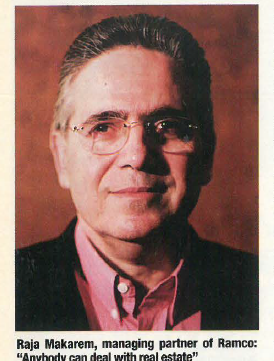
“Anybody
here — a porter, a driver, a doctor — can
deal with real estate,” says Makarem.
“People buy the wrong property at the
wrong price, or they buy something without
knowing about the restrictions, like zoning.
Clients look for a quick buck and don’t
want to pay for market research. People
avoid serious brokers: they say things like
‘this guy won’t budge from his 2.5%,’ so
they go to someone who’ll take half a percent,
and there are plenty of them — of
course they might be taking a huge cut
from the vendor. In the end, all this uncertainty
can make prices 10% to 20% higher.”
There are many examples of real estate
markets regulated both by law and voluntarily
by the industry. No one can deal in real
estate in the US without a broker’s certificate,
and they are legally liable for their actions.
The UK has no restrictions on who can deal
in real estate, but there is a code of practice
laid down by two professional associations
and a strict legal framework (see box).
Massad Fares, managing partner of
Prime Realty, argues that Lebanon needs a
real estate agents’ act to organize the profession:
“Other sectors here are regulated. A
financial broker, for example, needs a
license and the purchaser is bound by law to
pay a commission. This could be the case also
in real estate.”
Makarem suggests that the first
step is the establishment of a professional
body: “It should require basic minimum
knowledge of anyone wanting to become a
professional in the field. It might rule out people
with certain criminal records.” Those
approved would display a sign and adhere to
a publicly available code of practice and a
general fee structure.
The initiative, says
Makarem, must come from the industry: “It
has to start with us. The ministry of finance
should then become involved in drawing
up the regulations. Everyone should be
required to pay dues to the broker, as you can
only do the serious work if someone is paying
for it. But at the same time, the broker
should be held responsible for any breach of
the code of conduct.”
The only current qualified real estate
operatives in Lebanon are the so-called
sworn experts. There are over 700 such
appraisers, registered and approved by the
ministry of justice, who work for the courts
and offer services to the public. But their
only qualification is a high school or technical
school degree, or 15 years**’** practical
experience.
The appraisers’ methods, says
Massad Fares, are old-worldly and generally
based on comparisons — what “similar”
properties have sold for — rather than yields.
This means the appraisers do not examine
the potential of property, and consequently
portfolio holders are seeking better advice.
“The banks come to people like us, who are
more up to date,” says Fares. “We then
have the khabeer muhallaf sign our report.
A foreign bank will also tend to require an
auditor to sign the evaluation.”
The appraisers are involved in a wide
variety of transactions and are called on by
courts in cases of financial conflict. But they
are not held responsible for the accuracy of
their valuations. “In the UK, anyone who
makes a valuation is liable,” says Makarem.
“To do a valuation in Britain — or the United
States — you need professional indemnity
insurance. If you give the wrong advice and
someone suffers, they have to be compensated.”
In Lebanon, the legislation concerning
valuations is old, and ignorance of the law
is widespread. After more than 20 years in
business here, Makarem cannot recall a single
example of a valuer being sued.
Nothing is more basic in real estate than
square meters. Yet in Lebanon there is no
established way of measuring buildings.
Balconies and internal walls may or may not
be included: elevators, stairs, and technical
areas are sometimes counted in residential
properties.
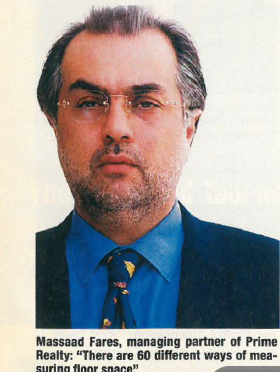
“All over the world, each country
has one way of measuring,” says Fares. “In
Lebanon they have 60 different ways.”
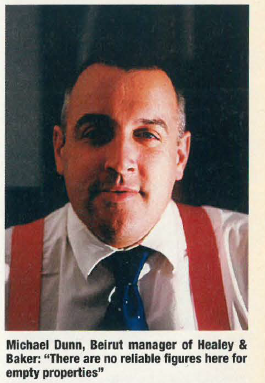
Landlords and developers generally include as
much as possible, says Michael Dunn, Beirut
manager of Healey & Baker: “The current system
of measuring gross external areas allows
vendors or landlords to ask a higher price
and to divert attention from what interests the
client — the floor area that can be used.”
With land, the more progressive brokers are
taking up the concept of BUA (built-up area,
the amount of floor space permitted on a plot
of land by building regulations), which is the
only effective way of comparing prices. Most
brokers still price plots not in BUA but in
square meters of land, even though allowable
floor space can vary in Beirut from 1.2 times
plot size in zone ten (parts of the coast) to six
times in zone one (parts of downtown).
Floor space and land prices are not the only
questionable statistics bandied around.
“People invent figures,” says Fares. “They
say, for example, that $7 billion worth of
property is idle. But if you think about it, the
banks wouldn’t lend half that amount. So the
figures need to be questioned: is a building
empty because the owner is away in the
Gulf, or is it for sale?”
Other, more optimistic,
statistics cited on empty property come
from studies carried out by the government’s
short-staffed central administration of
statistics in 1995 or 1996 and are a poor guide
to today’s market. “There are no reliable
statistics here on empty buildings,” concludes
Dunn.
As with empty properties, so with “average
prices”. Experts take the prices for specific
neighborhoods quoted in some journals with
a large pinch of salt.
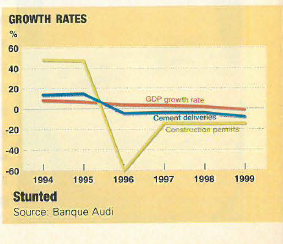
The stagnation of the
market since 1996 means that there are few
actual transactions in any neighborhood from
which to derive a meaningful market price.
In
Britain, large agents like the Halifax
use actual sales figures to compile regional
house-price surveys that are regularly published
in newspapers and, more thoroughly, in
specialized magazines.
In Lebanon, many
dealers claim that sellers and buyers regularly
report falsely low figures to the land registry
in order to minimize taxes — while at the
same time, the seller may circulate a falsely
high figure to enhance the development’s
standing amid potential buyers.
Figures for rents are distorted for a different
reason. Many owners still avoid
renting because of the history of state intervention
that fixed rents way below market
prices. Regulation can be harmful as well as
helpful.
The new law in 1992 (159/92) —
allowing landlords and tenants to agree
contracts freely — was a step in the right
direction, but it did nothing to change the
market distortion of older rents. Many of
these originate from days when the
exchange rate was LL3 to the dollar.
Proposals for reform have been bogged
down in parliament for many months and
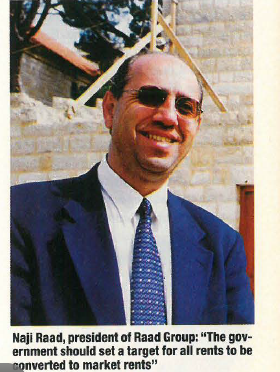
action is overdue, says Naji Raad, president
of Beit-Mery-based firm Raad Group: “The
old rents can be raised only by parliamentary
approval and then by very small percentages.
The government should set a target — five or
ten years — for all rents to be converted to
market rents. The politicians are scared of
disadvantaged people becoming homeless.
But there has to be a limit. Today, someone
paying $100 or $200 a year in rent might
have to be offered $20,000 as khlou (indemnity)
to leave. This is ridiculous. Setting a
time limit would give tenants and owners an
incentive to negotiate.”
But the tenant and landlord law is “still in
its infancy,” says Dunn, who feels the 1992
law “needs to be tried, tested and proven
before it’s fully accepted in the market.”
The
absence of law on leasing has led Solidere
to pioneer the practice in downtown,
including the first residential properties (Saifi)
and commercial property (170
Marfaa) to be leased with an option to buy.
While not providing an adequate legal
framework for a successful market, the government
does tax real estate transactions
highly. Although comparable to Egypt, the
transaction tax of 5.4% is much higher than
in the West. In England, the rate is just 1% on
properties up to £250,000 ($390,000), rising
to 3% on properties above £500,000
($790,000). In Kuwait, the tax is just 0.5%.
“It’s also 16% here for foreigners,” says
Dunn. “While 5.4% and 16% may not
sound like very high figures, if you pay $20
million for a property the tax is a lot.”
Fares believes that tax rates should be part
of a wider overhaul of the antiquated legal
structure. Many point favorably to the legal
change in the 1970s that allowed landlords to
claim service charges from tenancies, but it falls
short of its aim because of the lack of professional
management of buildings.
Without clearer and more effective regulation,
the industry is likely to struggle, even
if and when the economy and the regional situation
improve.
Meanwhile, real estate professionals
envy the banking sector, which is
successful partly because it is strongly
supervised by the central bank and the banking
control commission.
“Real estate is
every bit as important as banking,” muses
Makarem. “Or at least it could be.”
