I t was just over a year ago that Paul
Kimberley, the e-commerce consultant
commissioned by the ministry of economy
and trade to streamline procedures at the
Port of Beirut, stood before an assembly of
government officials and leveled with them.
“Lebanon,” he said at a trade efficiency
workshop, “has absolutely no choice – it
must reform its trade process.”
He was given a firm pat on the back by the
government. The ministry of economy and
trade promised to completely overhaul the
Port of Beirut’s antiquated trading procedures.
Already much had been done to try and
speed-up the movement of goods in and out
of the country. In the mid-l 990s, customs procedures
were streamlined. The antiquated
Brussels Tariff was replaced with the modem
Harmonized Tariff. Twenty-three customs
declaration forms were scrapped in favor of
the internationally recognized Single
Administrative Document. And, in 1997, a
computerized custom’s clearance system
called NAJM was introduced, which when
fully operational in 2001, will electronically
link together customs, the Port of Beirut and
individual traders. But despite Kimberley’s
strong words of encouragement and all that
has been done to tum the Port of Beirut into
a transport hub, formalities at the port
remain as difficult as ever. Red tape and
bureaucracy are still a vivid nightmare and
corruption remains the one staple that merchants
and traders can always count on when
doing business.
If the government is to be believed, it
should take no more than three to four days
to clear goods at the port. But, says Fadi
Abboud, chairman of the North Metn
Industrialists Association, it takes an average
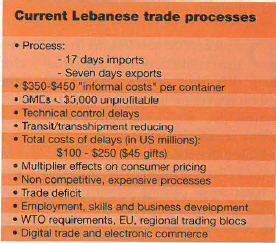
of 17 days. Businesses continue to pay a
range of fees such as the Free-In-Out (FIO)
charge of $175 and the $100 container fee.
What’s more, each ministry has its own
officials at the port checking for those
items that are forbidden from entering the
country. But there is virtually no coordination
between them. More than 20 signatures
are required to clear a container and officials
often become confused about what can and
cannot be brought into the country. A trader
is only allowed to start clearing his merchandise
once all original documents have
been presented and the merchandise
almost always arrives at the port long
before the original documents. This results
in costly delays because traders are only
allowed to keep their goods at the port for
two weeks free of charge. To speed-up the
process, says Abboud, huge bribes must
often be paid to port officials.
Exporting merchandise is just as tedious.
“The cost of shipping a 20-foot container
from Beirut to Marseilles, France, is $1 SO,
while the cost of putting the container on a
vessel originating from a factory ten miles
away is $600,” says Abboud. Government
and port taxes amount to $200, the FIO is
$150 and the clearing agent’s fee is $200.
“The clearing agent needs three days of
hard work just to get the container out of the
country,” says Abboud. “And this is in a
country where the minister of finance says
we should export or die.”
Not everyone is as critical of the system
as Abboud. Abdel Wadoud Nsouli, a member
of the Beirut Merchants Association,
says there have been some isolated
improvements at the port in the last couple
of years: “It used to take three hours to pay
import duties and get a receipt. Now it
takes a mere 15 minutes.” But he too is not
happy. The sluggishness of customs is one
of the biggest problems. “They still
observe antiquated, obsolete laws that date
back to the 1960s,” says Nsouli. Customs
authorities are given a free hand inside the
Port of Beirut to conduct inspections
whenever they deem it necessary, much
like policemen. “Customs should be at the
door, like in any other country, and not
enter the port,” says Gaby Moukarzel, the
trade efficiency project director at the
ministry of trade and economy. “All
transgressions can be dealt with later – after the
merchandise has gone through the gate.”
Currently, there are four phases in clearing
merchandise. First, a trader must
declare his goods. Then comes the inspection
phase, in which all of the business person’s
documents are checked for accuracy
and customs officials search his merchandise.
In the third phase, customs officials
calculate the amount the trader owes the
state. And in the fourth and final phase,
the trader pays for his goods and the merchandise
is released.
Salim Balaa, NAJM project manager at
the ministry of finance, acknowledges that
the current system is cumbersome. But, he
says, once the electronic customs system is
fully operational next year, traders will be
able to bypass some of these steps. “If the
trader places an electronic declaration and
the government is satisfied, he automatically
jumps to phase three, skipping the inspection
phase,” he says. “The trader will gain
speed, efficiency and time, and it will be
much harder for individuals to cheat or
rely on personal connections.”
Balaa’s scenario sounds wonderful on
paper, but odds are that it will take more
than high tech gizmotry to overhaul the current
system. Balaa himself is not 100% sure
that the NAJM system will end ~e red tape,
bureaucracy and corruption. “Even if customs
authorities and individual traders accept the
NAJM system and all transactions run
smoothly,” he says, “they still have to coordinate
their moves with the Port of Beirut.
This is where problems may arise.” If the port
does not follow the same rules and regulations
as the two other parties, the reforms will not be effective. Dubai serves as a
model of a well-functioning port, says
Balaa. There, a single body called the
cargo community, oversees the whole
trading process from A to Z. As a
result, shipments to Dubai are cleared
within 24 hours.
Many local traders are placing their
hopes on the Port Development
Group (PDG). This Lebanese-owned
company, operating as a joint venture
with the Dubai Port Authority, was
awarded a 20-year build-operate-and-transfer
(BOT) contract to manage
the facility back in 1998.
According to Henri Nammour, the company’s Assistant
General Manager, PDG is scheduled to take
over management of the port next year. But
some traders are doubtful that the situation
will improve. Moukarzel believes that the
PDG’s impact will be limited at best. He
fears that the company, sooner or later, will
run into the same government roadblocks
that LibanPost- the company charged with
revamping Lebanon’s postal service – and
the two cellular operators Cellis and
LibanCell are currently facing. PDG, he
says, wants to tum the Port of Beirut into a
trans-shipment hub. And since the firm will
be paid for each shipment that passes
through the port, its interest will be to move
goods as quickly as possible. The problem
is that the sluggish, free wielding customs
authorities could easily throw a spanker
into PDG’s system of operation – slowing
the flow of merchandise and cutting into the
company’s revenues.
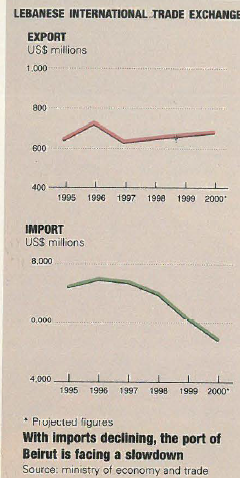
Already, business at the port is facing a
slowdown. A weak economy and the gradual
increase in customs duties over the last few
years have slowed the movement of goods
into and out of the facility. Since 1996, the
number of imports coming through the Port
of Beirut has fallen from $7 .5 billion to a projected
$6 billion by the end of this year. The
port’s future is, in many ways, tied to that of
the country. According to Abboud, that
leaves little reason for hope. “Investors are
running away from Lebanon because it has
gained a reputation as an anti-investor country,”
he says. “Things need to change quickly.
There is no time left, the entire country is
going bankrupt.