
The Ministry of Post and Telecommunications (MPT) was primed for a fight. Nothing less would do to rein in those unruly couriers. And fight they did, snarling and spitting like ornery camels in the desert heat. Striking out in defiance of a ministerial order to comply with an unfair tax, the couriers found themselves on the receiving end of a nasty government backhander that brought a stop to their operations. That wreaked havoc—however short-lived—on the business community as the couriers handle some 80,000 shipments monthly.
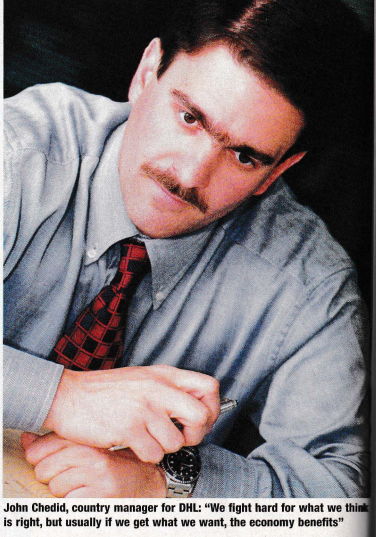
“Yes, we like to fight and yes we are rebels, and we fight hard for what we think is right,” says John Chedid, country manager of DHL, which controls 50% of the Lebanese market and dominates the international segment of the air express industry. “But usually if we get what we want, the economy benefits.”
The question is whether this round of the ongoing fight has really marked a victory for the couriers—whether they can hold the government to its promises.
Features
Couriers donned boxing gloves in the early morning hours of July 8, when express packages were stopped from entering or leaving Lebanon. The reason? The unpaid tax bill had reached about $8 million, with DHL alone responsible for $5 million—that’s besides payments made for social security and corporate taxes.
Along with its ultimatum to pay up or else, the ministry delivered an offer to lower the tax rate to $5.25 per kilo on inbound and $1.50 per kilo on outbound documents only. That would have reduced the outstanding bill considerably. But it was still higher than the $6 rate on inbound that the couriers had been fighting for years before Issam Naaman, the minister responsible, slapped on the extortionist rate of $12 per kilo on all inbound and outbound items on June 1, 1999. That was the move that instigated the non-payment game.
The tax would have represented two-thirds of the entire $12-million market. Excuse me? A government that attempts to extract 67% of an entire industry in the form of a tax is doing nothing less than ensuring a knockout. The tax has been justified as a way of making up for what the state loses in terminal dues—compensation for an inequitable flow of mail between two countries—because of the couriers’ operations. Hence the higher taxation on inbound, although couriers actually generate money on outbound.
Few would have wanted to be in Jamal Moulawi’s shoes, the director general of the MPT. He had inherited a mess, and was told to sort it out. After the air express industry shut down for a few days, a compromise was reached. Back taxes are to be paid at $5.25 on inbound only in three installments by the end of the year, while the new rate will be $3.75 on inbound only until legislation can be prepared for the sector.
“It looks like a good deal; as a temporary measure it’s OK,” says Kamal Shehadi, an economic consultant. The agreement reduced outstanding taxes to about $2.2 million, according to Moulawi.
While United Parcel Service (UPS) sees the new agreement as a fair one considering the poor state of the treasury, most couriers aren’t satisfied. “No, it’s not a good deal, because we want to be treated as the air express industry is in other countries,” says Hassan Hajjar, general manager for Federal Express in Lebanon. “We prefer no tax. And if the government insists on a tax we would prefer a VAT-like tax that is passed onto the customers and not taken from our pockets. We can no longer afford to pay hundreds of thousands of dollars.”
The couriers aren’t allowed to pass the levy onto customers. The unfriendly environment has made it hard to turn a profit. Last year DHL’s losses totaled $440,000 based on the $6 rate and would have sunk to $4.5 million with the $12 rate. With the latest agreement, Chedid expects to break even or turn a small profit.
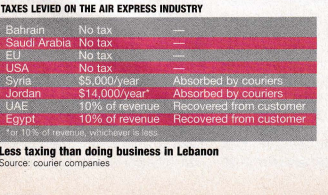
Welcome to business in Lebanon. Lebanon is the only country to levy such a tax. A few countries in the Middle East charge a licensing fee, but at a more reasonable level (see table). According to Shehadi, even a licensing system is unwarranted.
The good news is that Moulawi appears to follow a similar line of thinking. He intends to push for an overhaul of how the sector is regulated. Any license, he says, will involve a nominal fee. “We want the market to be open to everybody,” he says. “The couriers will play an important role, especially with the growing e-commerce activities.”
Moulawi has also insisted on changing LibanPost’s contract, which gives the Canadian-run consortium the right to collect the taxes as part of their revenues. But until the contract is officially amended, that’s not guaranteed. LibanPost will continue to control express shipments—something the couriers aren’t particularly happy about.
The justification is to ensure that these companies aren’t doing any remailing. “It’s an odd situation. I don’t think LibanPost should be doing this control at all,” says Shehadi. “It adds another layer of bureaucracy, and it’s a waste of time and money.”
Some of the couriers’ bruises, however, have been self-inflicted. They have often had difficulty in finding common ground. And bickering within the industry was not unusual—be it in dealing with the ministry or in trying to broker deals with LibanPost to partner up on its Xpress Post service.
This time their stance was more or less united as UPS was the lone courier to break ranks, agreeing to the government’s first proposal and returning to work two and a half days before the others.
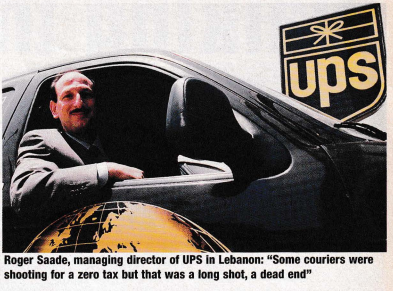
“Some of the couriers were shooting for a zero tax, but that was a long shot, a dead end,” says Roger Saade, managing director for UPS in Lebanon. “Negotiations were going well, so we decided not to suspend services. The customer shouldn’t suffer.”
Nonetheless, most couriers were disappointed by UPS’s decision. Hajjar believes that a united stance would have brought the tax down further, possibly to zero or enabled them to have it replaced with a licensing fee.
“UPS took a decision that was definitely not in the long-term interests of the industry and customers,” says Chedid. “I don’t know how you can justify that.”
Infighting aside, the couriers will have no shortage of battles ahead. The government has acknowledged that the air express industry lies outside the state mail monopoly—oh, what a revelation!—and has agreed to follow up with new legislation for the sector. The deal received the cabinet’s stamp of approval to give assurance that any advances wouldn’t be undone with a change of ministers.
But rarely is anything guaranteed in Lebanon. And until the government delivers something concrete and official, these will remain little more than promises.
“It would be a real disaster if we had to go through the same steps with each cabinet,” says Mourad Aoun, general manager of Skynet. “The frustration of conducting business in this country is strong enough. We don’t want to go through that hell again.”
It wouldn’t be the first time commitments and promises haven’t been kept. DHL invested $2 million to build airside facilities with a bonded area that was ready last October. Despite promises from this government and the previous one, customs officials have still not been stationed there (see “Down and out in Beirut,” January 2000). While Beirut recently became the transit point for DHL shipments to Jordan, the bonded area will have to be operational to become a real transshipment point.
“The government shouldn’t cringe at investments like this and requests to have an in-house customs staff,” says Chedid. “And only when our competitors have done the same will the economy feel the full benefit of what we can do.”
Another broken promise also involves customs. Last November customs dusted off the antiquated 1959 law governing the former Directorate General of Post, Telephone and Telegraph to stop the couriers from clearing packages over 20 kilos as express items. Full customs formalities make these packages slower and costlier to clear, regardless of the goods’ value. This is an added headache to a customs system that is already outdated and laden with bureaucracy.
And despite government promises to find a resolution to that problem, nothing has changed eight months later. It is even unclear whether the customs issue will be resolved with the anticipated new legislation.
“The government doesn’t do anything unless they are pressured,” says Hajjar. “They’re always breaking promises. Time means nothing to them.”
