It seems everyone is talking about a peace
dividend these days. Despite their rather
lukewarm first encounter and the subsequent
Israeli raids on Lebanon, there is little
doubt that the chances of Israel, Syria and
Lebanon reaching a settlement are closer
today than in the last five years. Talk of stable
and open borders has been whetting the
appetites of Lebanon’s business community,
long awaiting the economic boost that would
turn this dormant economy around. No one
seems to be more excited than those in the
tourism industry.
With the dark shadow of war no longer
casting its pernicious gaze on the region,
some tour operators expect the Levant to
become what Spain became in the 1970s, or
the Mediterranean coast of Turkey in the
1980s. According to estimates, more than
30 million tourists will visit the Middle East
per year once there is peace — nearly double
current levels. Lebanon, even by the most
conservative estimates, could see a tripling
of tourist numbers.
“I’ve met a number of
international hotel chain executives who say
that Lebanon will be like Singapore when
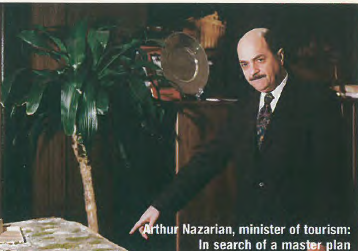
there’s peace,” says Arthur Nazarian, minister
of tourism. “One who visited recently said
that three years after peace, he expects 6
million visitors per year.” A paltry 673,000
tourists came last year, excluding an estimated
1 million Syrians.
Already, tour operators are privately talking
of running day trips from Beirut to
Jerusalem, of driving all the way to Cairo in
a day. Not long from now we may be scuba
diving in the Sinai in the morning, lunching in
Tel Aviv in the afternoon and spending the
evening partying at a Kaslik nightclub.
“A peace deal would be wonderful. You can’t
have tourism without peace,” says Riad al
Khouri, an economist and director of the consulting
firm Middle East Business
Associates. Khouri, who has written extensively
on tourism, feels that Lebanon could
conceivably become the most important destination
in the Mediterranean basin, second
only to the French Riviera.
“But in fact, it will probably turn into a
hell hole,” he warns. “The Lebanese are
going to shoot themselves in the foot just as
they have done so many times. So long as you
can tear down a forest and build some ugly
apartments, that is going to destroy tourism.”
His assessment is harsh, but it may serve as a
wake-up call. Lebanon, he warns, may have
some fantastic archaeological sites and stunning
scenery, but that alone will not turn it into an
attractive destination. Unless serious changes
are made to the way the country is managed
— from its hotels, to its zoning regulations, to
its environment — visitors will not flood in like
they did in the 1960s and 70s just because the
guns have fallen silent. That will require
more than the signatures of a few leaders on
a peace settlement.
But Lebanon does have great potential as a
tourist destination. “We have a niche of
everything,” says Pierre Ashkar, head of the
hotel owners’ association. “We don’t have the
best sea, but we have the sea. We don’t have
the best mountains, but we have the mountains.
Ski resorts, we have. Summer resorts, we
have.”
The problem is that the beaches have been
polluted and many annexed by property
developers; the mountains are riddled with
ugly quarries and strewn with garbage; the
archaeological sites are often unorganized and
poorly managed. Lebanon does have some
very smart hotels, although fewer than before the
war, and a very good international airport. But
other countries in the region have hotels that
are just as attractive and are equipped with
bigger airports.
Today, Egypt has taken over the role that
Lebanon had in the 1960s and 1970s, absorbing
half of all visitors to the
region. “A tourist has a thousand choices. If he
comes to Lebanon and gets ripped off, he’s not
going to come back,” says Khouri.
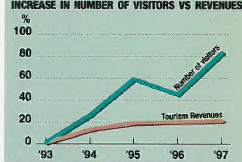
In a study completed two years ago for the
Lebanese Center for Policy Studies, Tarek
Chemali and Michelle Toumah showed that
while visitor numbers and tourism revenues
have been gradually rising since the end of the
war (see graph), the sector is underperforming.
Between 1988 and 1997, the number of
tourists visiting the Middle East increased
from 8.3 million to 14.8 million and revenues
more than doubled, from $4.2 billion to $8.6
billion. There has been similar growth in
Lebanon in the number of visitors, from
310,743 in 1993 to 568,276 in 1997. But
tourism revenues have only increased by
20%, from $600 million to $719 million.
The sector’s share of GDP has declined, from
7.9% in 1993 to 5.5% in 1996, though these
figures do not include Syrians. That’s quite a
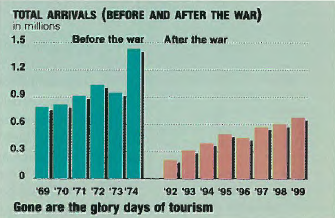
different story compared to 1974, when
Lebanon was the number one destination in
the region. More than 1.4 million tourists
visited that year, a figure that doubles if
Syrians are included, according to the ministry
of tourism. Tourism revenues accounted for
almost a quarter of Lebanon’s GDP and 40%
of the tourism revenues for the Middle East.
The study clearly indicates that while there is an
increasing number of visitors to Lebanon,
they are spending less money. One can
speculate as to why: people’s stays are becoming
shorter, the bulk of the visitors
are of Lebanese descent who stay with the family
rather than in hotels, high-spending
business tourists are not coming. What seems
clear is that most are not coming for
classical tourist purposes.
In 1997, for example, a mere 8% of tourists
visited Baalbek, Lebanon’s most famous cultural
site. “You get walk-ins, there are visitors from the Gulf,
people of Lebanese origin who come and go,
but this is not tourism,” says Myrna Bustani,
co-owner of the Al-Bustan Hotel.
There is no doubt that the fighting in the
south is a major factor. But Fadi Saab, a
member of the board of the National Council
of Tourism in Lebanon, estimates that the
number of visitors could increase by three to
four times even without a peace deal if simple
measures were taken to make the country
more attractive.
“We are trying to entice the
government to put together a master plan for
the tourism sector,” he says, furnishing a list
of areas that need improvement. Lebanon, he
said, needs proper road signs directing
tourists to popular destinations. At archaeological
sites, signs explaining the history and
significance of the location are needed.
The quality of service at hotels and travel offices
needs to be brought up to the prices being
charged. Attractions need to be better promoted
by the ministry of tourism and the private
sector. Pollution levels on the coast and
in the mountains need to be reduced and the
garbage cleaned up. More and better-trained
tour guides are required.
“It is not sufficient to say come and visit
Baalbek or Byblos. If you go to any of the other sites, they are not well
organized. People like senior citizens cannot
visit the Byblos castle for safety reasons. And
we must make a better effort to communicate
the history of these sites,” says Ghassan
Matar, a tourism consultant who has worked
with the ministry of tourism.
Addressing these matters will require coordination.
Promotion requires coordination
between the ministry of tourism, hotels and
travel agencies. Environmental preservation
requires a concerted effort from the ministry
of interior, ministry of environment and individual
municipalities.
But the sad reality, says
Saab, is “that coordination
among different parties is lacking, a
master plan is lacking and a global policy is
lacking.”
A 2,000-page
master plan was written
in 1996 at a cost of
roughly $800,000,
according to Matar,
who was involved in
writing the document. It included a comprehensive
strategy to attract tourists, dealing with
everything from environmental cleanup to
regulating the hotel sector. But it was never
implemented. “It was difficult to execute,
because there were so many other ministries
involved,” says Nazarian.
With that plan effectively dead, another
plan was drawn up a couple of years later at a cost
of about $750,000 by the US-based Stanford
Research Institute and funded by the United
States Agency for International Development.
It singled out tourism as
one of the areas where
Lebanon had a competitive
edge and suggested
ways to improve the
sector. Unlike the first
plan, some action has
been taken to implement
the recommendations
of this one.
The Center for Research and
Development at the
Lebanese American
University was charged
with writing a website
and is composing a
database for the ministry
of tourism. LAU
will assist in drawing up
a new curriculum for hospitality and
tourism for technical schools and in drawing
up new guidelines for hotel rankings.
Current guidelines date back more than 30 years and
tend to concentrate on the size and amenities
offered rather than quality. The government
has also reactivated the National Council of
Tourism Board, which was disbanded in
1992. But progress has been slow, says
Georges Nicolas, director of the research center.
Many recommendations will require
action from various ministries. “But I don’t
think there has been a lot of movement,”
says Nicolas.
Meanwhile, the ministry of tourism, which
plays the central role in promotion and regulation
of the trade, receives minimal funding
and lacks qualified personnel. Its budget this
year is just $4.5 million, less than one tenth of
a percent of the total budget allocated to ministries.
What’s more, its share of the budget has
decreased by nearly 50% since 1994. “In
order to make the government more effective,
we need qualified people and we can’t get
them without paying,” says Nazarian. Bigger
budgets, he adds, might come if there is
peace. But without the bigger budgets now,
implementing any plan will be difficult.
Those within the industry continue to wait
and dream. When asked what is required to
bring in visitors, Pierre Ashkar’s response was
simply “Peace. That’s it.”
Anticipation of a settlement
is prompting investment. Even
though occupancy rates hover below 50% during
most of the year, more hotels are being
built, including a number of big international
chains. Mövenpick, the Ritz-Carlton, the
Four Seasons and possibly the Sheraton are on
the way.
It seems that almost everyone is
gambling that a peace dividend is just around
the corner. “I don’t think that we should wait
till the external factors are opportune before
we tackle the internal factors,” says Saab.
“We should get ready to advance as much as
possible on what’s within our control. If we
have a goose that lays golden eggs, we
should make sure that the goose is properly fed
and cared for so that it will continue to lay
golden eggs. In reality, we are starving that
goose and we will end up not only losing the
golden eggs but also the goose itself.”