
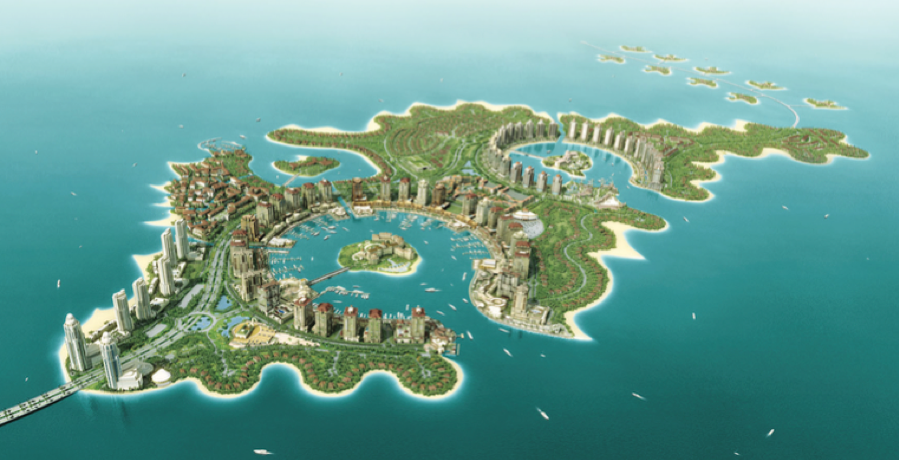
Access to Qatar’s busiest real estate development site is tightly controlled. Trucks, buses, and cars rolling across a dusty dam have to pass checkpoints before they can reach what for a few more months is a feast only for the eyes of engineers and connoisseurs of construction work in progress.
Past the security cerberuses, visitors encounter an orderly maze of infrastructure and buildings in every stage of construction, from anchoring of foundations for residential towers to a finished power substation. The Pearl-Qatar, or TPQ in the jargon of people involved, is the domain of the United Development Company (UDC), one of the country’s leading private sector enterprises.
The first of The Pearl’s towers — out of 66 being built — will be ready for tenants once Qatar’s oppressive summer heat has passed for this year, according to the UDC engineers working at the site.
To be that challenging and thrilling a task, it has to be a new island — what else, one is tempted to ask, given that island building has shaped up into a sort of coastal obsession in the Gulf. With 16 million cubic meters of earth moved in less than three years after the start of the project (8 million cubic meters were dredged from the shallow waters in the immediate area, another 8 million were trucked in from elsewhere), The Pearl-Qatar island has been put vis-à-vis the Qatari capital Doha.
Marvel in the making
Engineering of the island involved meeting technical and environmental challenges as well as accommodating sales interests by increasing the number of apartment towers and undertaking a spectacular ceremony of flooding the surrounding areas that had been blocked off from the sea during an early phase of the project.
The most demanding task, however, was to make it all come together. “We have about 15 districts on the island and each has its own theme of design, like pieces in a jigsaw. It represents a universal world,” chief engineer and construction manager Abdulrahman Jawhari said. “The biggest challenge is to make all these elements come together and make them fit.”
The task was made no less challenging by the fact that UDC, while being the master developer of TPQ, has pursued a path of farming out parcels and aspects of the project to over 60 partner firms whose involvement Jawhari described as ranging from over a billion Qatari riyals ($275 million) to a few million but which all have to fit with UDC’s set of standards and development guidelines for the Pearl.
The esthetic perception of the Pearl will vary from visitor to visitor and no one today can reliably predict if the long-term role of man-made islands in the quest for a livable planet will be positive, detrimental, or negligible. On the investment side, TPQ fits the pattern for a mega-plus project where cost is not the first consideration in all decisions. From initial cost forecasts of $2.5 billion, the project value estimations have moved up to a range of between $7.5 billion and $9 billion, insiders say.
Seen in context of both Qatar’s national development ambitions and the corporate growth aspirations of UDC, the TPQ project is pivotal beyond its financial aspects and earnings potentials.
As for national ambitions, Qatar is driven. The peninsular country in the Gulf does not kid around when it promotes itself on the airwaves as building the world’s fastest growing economy. Per capita, the citizens of Qatar enjoy a world-leading nominal GDP whose phenomenal double-digit annual growth has been forecasted to continue unabatedly in the next three to four years.
Qataris also bear tremendous inflation which will reduce the purchasing power gains — but at a projected total GDP scratching at the $100 billion mark in 2011 and with a population of 1.2 million people (Economist Intelligence Unit estimates), there will be many wealthy residents.
This economic wonder was and will be propelled by gas exports, the larger hydrocarbons sector, and related industries. In consequence, the country’s planners have to find ways to deal with the challenges of increasing financial wealth of their citizens and to work on economic efficiencies. An image of having world-class residential and commercial real estate landscape and the successful creation of tourism destinations would help in meeting these national needs.
The Pearl has a significant tourism and boutique retail angle. According to Hussam Ahmed, the manager in charge of retail development at TPQ, the average daily inflow of visitors to the hospitality and retail areas on the island (which will feature a 2.5km waterfront promenade with up market retail and restaurants in the first-to-be-inaugurated Porto Arabia section of the island) is calculated at 25,000 to 30,000 persons, stipulating a multiple of Qatar’s population in annual visitors.
Catering to a customer range
In addition to the high-end boutiques in its fanciest quarters, other retail areas on the island are set to tickle younger and broader lifestyles and cater to wider audiences. “We are not branding The Pearl as upscale destination; although we have higher percentages [of high-end retail], we are addressing different levels,” Ahmed said, adding a reference to the government’s goals in developing tourism in Qatar.
Qatar’s real estate development activity is intimately linked to the emirate’s state interests, ruling family, and political class. The dominant real estate companies with the largest development projects — the Lusail project on land near to the Pearl — and those with the highest market capitalization on the Doha Securities Market are state-owned and state-backed enterprises.
UDC vowed unequivocal alignment with Qatar’s development aims under the “directives and wisdom” of the emir, Sheikh Hamad Bin Khalifa al-Thani, as the message of UDC chairman Hussain Ibrahim Alfardan stated in the company’s 2007 annual report — a 130-page compendium of the highest gloss whose every page is made from paper so heavy that it would be suited as magazine cover or for printing an invitation card to the most lavish of dinner parties.
In the same report, UDC announced a net profit of $94.5 million in 2007 (38% up year-on-year). It listed partnerships with Belgian, Turkish, Spanish, UAE-based, and Qatari companies in joint ownership of subsidiary companies that are active in construction materials and services, tourism operations, real estate management, utilities, wastewater treatment, and petrochemicals manufacturing.
Several of the joint ventures were born during the work on TPQ and address needs that serve the project. The dredging activities for the new island inspired a partnership with a Belgian specialist company; the resultant joint venture firm, MEDCO, is now a major contender for dredging and land reclamations in the region.
When addressing an estimated cement need of around 3 million tons for TPQ, UDC teamed up with Belgium’s Besix for a ready-mix joint venture. As the issue of operations for the various marinas with over a 1,000 berths around the island arose, UDC in 2007 found a partner in a Spanish firm, Ronautica. For managing real estate, UDC has recently entered a new venture with Asteco, a property management firm headquartered in Dubai.
There is a special potential that can be assessed for Qatar Cool, the Qatar District Cooling Company established in 2003 as joint venture between UDC and the regional pioneer in district cooling, Tabreed of the UAE.
The firm’s first plant started operations in 2006 with capacity of 30,000 tons of chilled water in Doha’s West Bay office and residential district. This year, a second plant in West Bay and the first two phases of a massive district cooling plant on The Pearl will become operational, adding 37,000 tons capacity in West Bay and about 60,000 tons in TPQ, said Qatar Cool general manager Fayed Khatib.

Looking ahead
By 2009, the integrated plant on the Pearl will be at full capacity of 130,000 tons, making it the world’s largest district cooling facility, he added. Serving air conditioning and cooling needs from a central plant is a strong business model for Qatar where 60 to 70% of a building’s annual power consumption goes to mitigating the impact of the country’s hot and humid climate.
Qatar Cool claims 40% to 60% lower power consumption per client than decentralized units in each building would incur, saying its solutions offer benefits to Qatar’s economy and environment as well as allowing customers to reduce capital expenditure on oversized individual cooling systems and associated costs, including insurance.
At a startup capital of $2.75 million in 2003, Qatar Cool was a small initial investment with low risk that has grown into a joint venture with $82.4 million capital and net profits of $2.9 million in 2007 which are projected to grow at rate of 80-100% in 2008. “Our revenues and profits will keep multiplying,” said Ahmad Chehadeh, Chief Financial Officer of Qatar Cool, and clarified that this expectation is alone from the existing schemes and does not include eventual new projects.
The company is learning and collecting data that will serve as basis for optimizing its operations and development of new solutions. Although it does not presently use alternative energy sources, it has a great interest in processes that conserve energy and has already achieved substantial efficiency gains from studying and improving its own production processes, the company’s managers said.
One day, UDC and its partners in Qatar Cool could even reap technology leadership benefits from the experiences and skills that Qatar Cool has begun accumulating in the operation of remote cooling schemes in a very hot climate. Even before such lofty hopes will be tested, the cooling firm is a definite asset for future projects that UDC will compete on. As Khatib said, “Having Qatar Cool in their portfolio, UDC has a nice selling point in future projects by being able to offer complete solutions.”
