
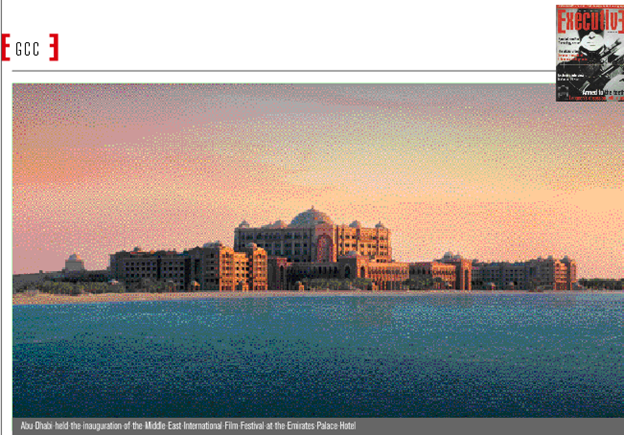
Last month, Abu Dhabi held the inaugural edition of the Middle East International Film Festival (MEIFF). It was an intentionally lower-key affair than its glitzy, red-carpet counterpart which takes place every year in Dubai, and was somehow dwarfed by the immensity of the venue. So long were the walking distances, so empty some of the corridors and so thick the carpet in the labyrinthine interior of the Emirates Palace hotel that you occasionally felt as if you were on the set of The Shining as opposed to the Abu Dhabi corniche.
Whilst there was no Jack Nicholson, the organizers certainly managed to ship in — no doubt with the help of substantial financial inducements — some big Hollywood names. Veteran Hollywood producer Harvey Weinstein was in attendance, and Paul Haggis, whose writing credits include Casino Royale and Crash, was recruited to give a master class on screenwriting.
In fact, although some interesting films were screened, including the first feature-length title by an Emirati filmmaker, the event was designed to be more about business than entertainment. One of its main purposes was to spearhead a high-profile drive to set up Abu Dhabi as a filmmaking and financing center for the region, with screenings running in parallel with a Film Financing Circle, which brought together local financiers, middlemen, directors and producers from around the world.
Abu Dhabi has also set up a Film Commission and a Film Fund, with a remit of investing local money into new productions, whilst a New York film school will open a branch of its academy in the city next year. And, a couple of months ago, the newly-formed Abu Dhabi Media Company — which is set to launch a new English-language daily paper early next year — signed a huge deal with Warner Bros to build a 6,000 acre theme park, studios and cinemas in the city.
Does it make good business sense?
So is this just another Gulf state spending its excess energy spoils in a high-profile and seemingly highbrow manner, or does it actually make business sense? Will profitable and critically acclaimed films actually be made here?
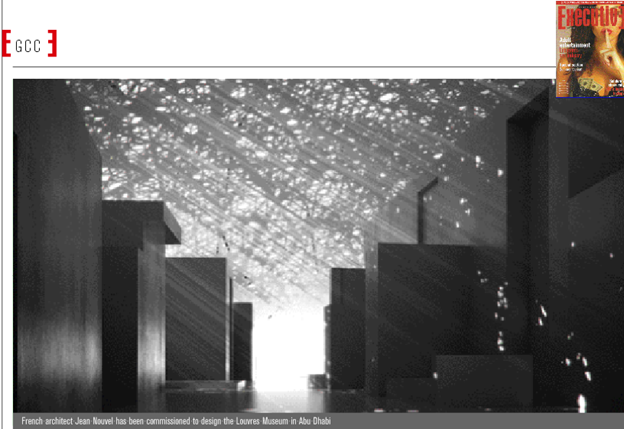
It’s worth noting that cinema is far from being the only art form being pushed in Abu Dhabi. The emirate is spending millions, if not billions of dollars in trying to turn itself into a “hub” — to use the parlance of many UAE development projects — for culture. For instance, it has signed costly and controversial deals with two of the world’s best-known museums, the Louvre and the Guggenheim, to establish offshoots on an island close to the city center, and last year also attracted the Sorbonne to set up a campus.
These kinds of efforts are easy to criticize, as many in France did, for example, when they heard that their beloved Paris museum had apparently sold its soul, and its name, to an oil-rich Gulf state, which they perceived as importing art into a cultural desert.
Many are just as cynical about the emirate’s attempts to get into films. Motivation is one of the main questions being asked. Does Abu Dhabi want to create a new breed of home-grown Emirati artists, writers and filmmakers, or does it want foreign films to be made in Abu Dhabi? Offering enticing grants and subsidies to filmmakers to shoot in the UAE’s capital will surely attract more films to be made here, but that doesn’t mean that these films will be any good, or will make money. Investing in films is not like investing in real estate.
More to the point, film-making has a far longer history, pedigree and locale in other parts of the Arab world, most notably Egypt, Tunisia, Morocco and Lebanon, than the near non-existent nature of the industry in the Gulf. Saudi Arabia, home to the region’s largest potential audience, doesn’t even have any cinemas, whilst many ask whether genuinely challenging or controversial films about the Gulf — of which there is certainly not a glut — can be made in Abu Dhabi.
Does Abu dhabi want to create a new breed
of home-grown emirati artists, writers and filmmakers?
What it takes to succeed
To succeed, the emirate will need to find a niche where it can offer a competitive advantage, perhaps in terms of easy access to finance and use of brand-new, world-class studios. It could also become the location of choice for foreign filmmakers needing to shoot on site in the region but without the security risk associated with other, more gritty parts of the Middle East. Some sequences in The Kingdom, for instance, were shot in Abu Dhabi because Dubai had apparently refused to give permission after being unhappy with the way it was portrayed in Syriana. Indeed, many might argue that the big push towards culture is simply another episode in the decades-long rivalry between Abu Dhabi and Dubai. The latter, short on oil reserves, has aggressively made a name for itself in trading, tourism and constructing lots of very tall buildings. Abu Dhabi, with more than enough spare cash to spend on new projects, is pouring money into sectors where it thinks it can have an edge on its neighbor and, more importantly, make itself known for more than just its wealth. Film and media is one way of doing that, as long it’s done for the right reasons
