
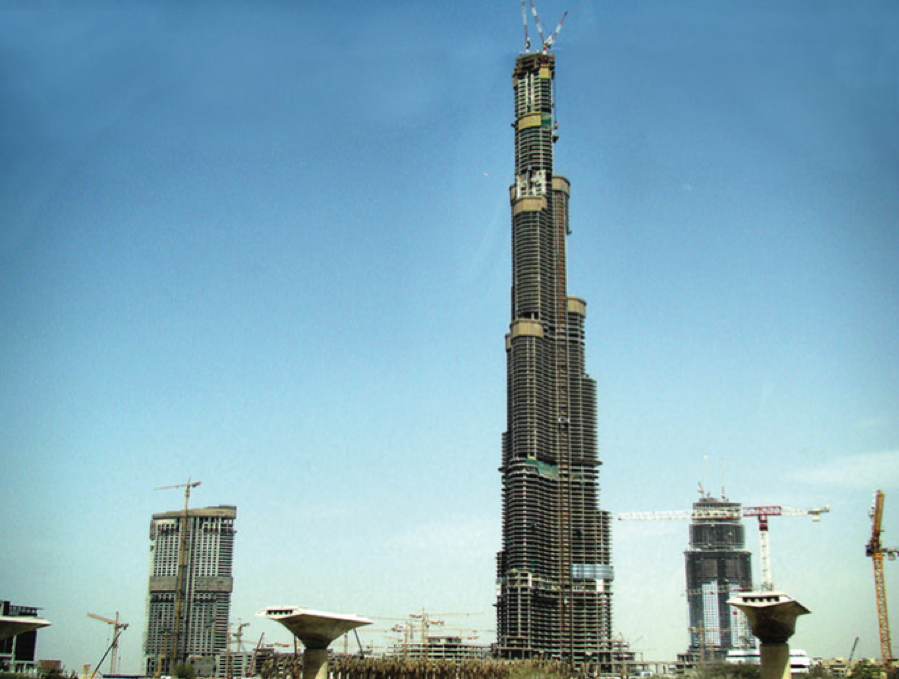
Apparently the sky is not high enough for the world’s 13th richest man, Prince Al-Waleed bin Talal al-Saud. The multi-billionaire, whose fortune Forbes estimates at $20 billion, last year bought a $320 million double-decker Airbus A380 to serve as his “Flying Palace”.
Now, according to UK-based news reports, Middle East Economic Digest and al-Saud’s Kingdom Holding company website, he is looking to build a very tall building in Jeddah. Rumor has it that the tower will be a mile high. That is 1,600 meters, or just a little over one and a half kilometers. It would be more than twice the height of Burj Dubai, which is currently the tallest man-made structure on earth.
But the prince, Kingdom Holding, and the contractors and companies involved in what Kingdom Holding calls, mysteriously, “The Jeddah Project,” are keeping very quiet about it. Only a single press release on the company’s website, from September 2007, hints of the projects existence. It states the “investment value of the project is estimated at 50 billion Saudi Riyals ($13.4 billion) upon completion,” and it will include “a colossal sky scraper with a surrounding area for other facilities.”
MEED reported in February 2008 that London-based Hyder Consulting is working on a mile-high tower somewhere in the Middle East, but would not confirm where, or for whom.
And in March 2008, the British newspapers Sunday Times and the Daily Mail reported the tower is a reality, and have gone so far as to print pictures and name London-based ARUP Consulting as working on the project. When contacted about the pictures, ARUP replied that the firm is “unable to confirm that we are working on a mile-high building. However, what we can confirm is that we are not working on the building depicted by the Sunday Times and the Daily Mail.
Other firms named in the press release as consultants, contractors and designers refused comment or did not return calls, including US-based Bechtel and Pickard Chilton, and Canadian firm HOK.
How feasible is it?
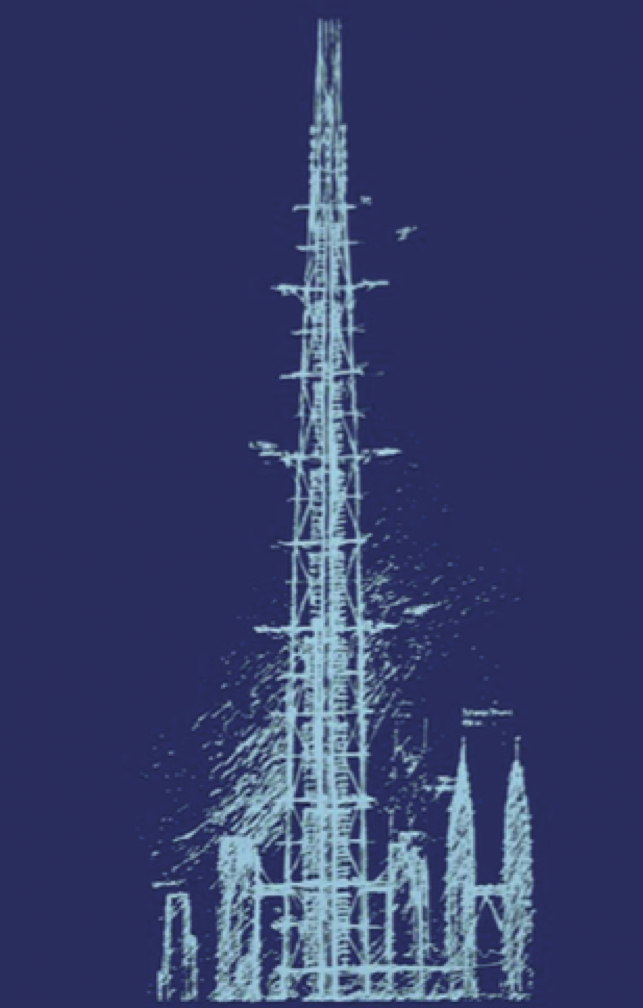
Architects have proposed mile-high towers for decades. Frank Lloyd Wright designed the gigantic “Illinois” tower in 1956, but it was never built. Until now, the technology to build and operate such a structure simply was not available or too costly. But with today’s technology, and the Burj Dubai pushing the limits and dreams of both architects and wealthy Gulf rulers, what would it take to build one a mile high? David Scott, Chairman of the Council of Tall Buildings and Urban Habitat and structural engineer and principal at ARUP, said he could talk about building a mile high tower “theoretically,” but said he was unable to comment on any specific project in Saudi Arabia. He said the biggest challenge in the construction process would be “getting materials up there.”
“Concrete would obviously be pumped up,” he said. “If you wanted to go up say two miles, you would just have different pumping stations so that you pump the concrete into another hopper, and pump it up again.”
The same technique would be used for cranes, says Peter Weismantle, Associate Director at Skidmore, Owings and Merrill and project architect and technical director on the Burj Dubai tower. He said tower cranes could be “jumped” up the building, using the structure itself for support. The construction might even “use helicopters to place specific elements at high levels.”
“In many cases, because of the great height, lifts would be accomplished in two or more stages,” he explained of the design.
But what about when the tower is complete? Is it practical or efficient to live and work in a mile-high building? How do building managers pump water to the top, and what about washing the windows?
Practical implications extreme height
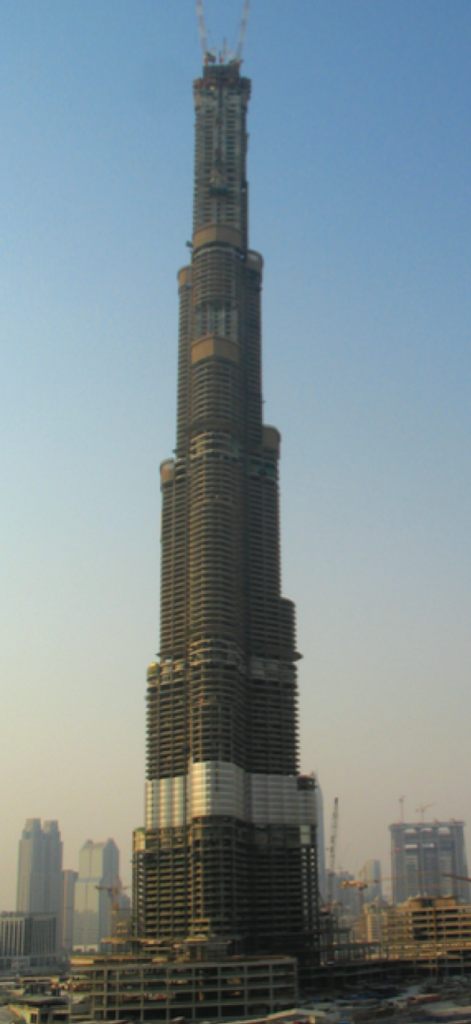
To start with, designers of towers like the Burj Dubai and the current ‘tallest building’ record holder, the Tapei 101 in Taiwan, have to incorporate numerous maintenance and “mechanical” floors to service the building. Every eighth floor in the Tapei 101 is a such a “mechanical” floor. The Burj Dubai has at least 11 floors out of 160 reserved for this purpose. These floors house elevator equipment and motors, fixed window washing equipment, and water relay stations to pump water up to the higher floors.
As designers must plan for the mechanics of the building, they must also plan to efficiently get people to their destinations. Weismantle coauthored a report last year, titled Burj Dubai: An Architectural Technical Case Study, that states the tower can be likened to a “small vertical city.”
Around 20,000 people may live, work and be visiting the Burj Dubai at any given time. Thus, designers created three different entrances on different sides of the building, for different uses: one entrance for the hotel, one for residents, and one for corporate offices and tourists. Those three “use areas” are then arranged in clusters in the building. The hotel is located on the lower floors, residences on the middle, and offices toward the top. Hence the elevator systems located at each entrance are planned to efficiently channel people to similar destinations.
And that’s where the elevator planning comes in. The Burj Dubai will have 56 elevators, and the longest elevator shaft in the world, at 500 meters, or 132 floors. But an elevator has not been invented yet that can travel the entire height of the building. The weight of the cables would be too great. Weismantle said the only way to serve all the floors of a mile-high building would be to design a “transfer system, connecting elevators serving separate sections of the building. The building [would] utilize high-speed, nonstop ‘shuttle’ elevators bringing passengers to ‘sky lobby’ floors where they transfer to ‘local’ elevators serving the floors in between.”
Another way to increase efficiency would be to install double-decker high speed elevators, which have been used in skyscrapers for years. Both Scott and Weismantle say speed is not a problem. High rise elevators can currently travel at around 10 to 18 meters per second. That means, in a straight shaft with no transfers, modern elevators can travel one mile in one minute and forty seconds to two minutes. However, to insure passenger comfort (especially to prevent uncomfortable ear popping), the elevator would need to be pressurized if traveling upwards of 12 meters per second.
Scott says elevators without cables are currently in the experimental stages, and may be available in the future if a mile high tower is built. These elevators would use magnetic levitation instead of cables. This would allow for both longer elevator shafts (because there are no cables), and could permit several elevators in the same shaft.
Blowing in the wind
A mile high tower may have more than 300 stories. Scott says wind forces would be “massive,” creating “wobbling” of the structure. This could cause people living or working on the top floors to get motion sickness. One way to dampen the wind affect is to create “outrigger” buildings that help stabilize the structure at the base. Also, at the top of the building, electronic movement sensors can be combined with a giant steel ball to dampen the affects of the wind.
The Tapei 101 addresses the “wobbling problem” with a 606 ton steel ball suspended from the 92nd floor, to counteract the wind forces. Two other 4 ton balls on the 60 meter spire act as stabilizers, and are dampened by springs at the spire’s base.
Emergency a mile high
After the tragedy at the World Trade Center on September 11, 2001, architects and building designers have studied ways to evacuate buildings more rapidly. That means using elevators for evacuation, and thus certain elevators in the Burj Dubai will be insulated and reinforced to be used as “lifeboats” in an emergency. The high speed elevators would arrive at emergency evacuation points quickly, then descend with passengers, then quickly ascend again to pick up more evacuees.
According Weismantle and his colleagues’ Burj Dubai Report, the “estimated time to fully evacuate the building using stairs and ‘lifeboat’ emergency service was reduced by 46% from that of using stairs alone.” This would be one option to increase the evacuation speed on a mile-high tower.
And while the emergency procedures may never be needed, but in the dusty, humid and sun baked Gulf climate, the mile high tower will definitely need to be cleaned — and often. The Burj Dubai designers tackled this problem by placing the majority of the burden on three window cleaning “machines” running along fixed tracks on the outside of the building’s facade.
Each machine will have “jib arms” that can reach up to 36 meters, allowing it to clean windows to the left and right. Burj Dubai designers estimate it will take 6 to 8 weeks to clean the entire building — meaning a building twice that size would probably take twice as long.
The reasons for building a mile-high tower are many: to gain publicity, bragging rights and to put a city on the map. For architects and engineers like Scott, it is a chance to push the limit and achieve higher than anyone else.
“If I was lucky enough to be asked to design a building like that, I think it would be a great challenge,” he said. “And I think it certainly can be done.”
