
Twenty years ago, I first landed in Dubai when I was sent on assignment by Agence France Presse to cover the “tanker war” which was raging out in the middle of the Gulf. In short, the Iranians were bent on punishing all of the Arab Gulf states for supporting their arch enemy Iraq. As a result, all ships that entered though the Straits of Hormuz were at risk of being attacked by Iranian speed boats using small arms fire and rocket propelled grenades The Iranian objective was to disrupt the flow of oil and other maritime activity in the region.
To counter this threat, the US navy, along with its coalition partners, amassed a naval flotilla of warships to protect Kuwaiti registered oil tankers as they transited the Gulf to pick up and deliver the worlds’ most precious cargo. Unfortunately for most of the ships, the only ones that were guaranteed protection were those Kuwaiti tankers whose flag had temporarily been swapped for an American flag. All other ships in the Gulf remained fair game. Everyday I boarded my helicopter with a CNN news crew and flew out over the waters to photograph burning cargo ships and oil tankers. My month-long stay lasted for almost two years.
That was then
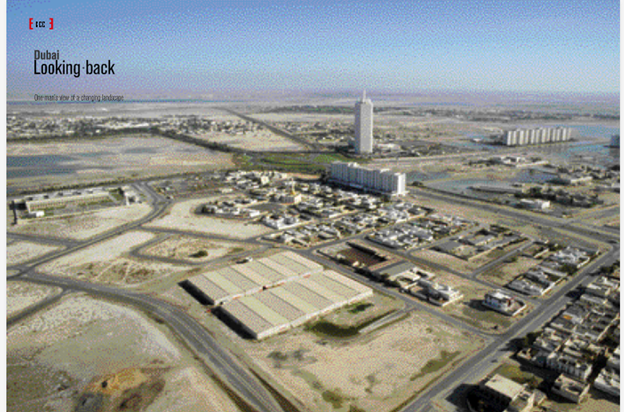
That first night I flew into Dubai I remember looking out of the plane’s window and seeing this futuristic building on the edge of the water all lit up in the night sky. I was met at the airport by my colleague, who I was replacing. On our way out of the airport I asked about the building I had seen. He suddenly turned to me and said, “Guess what my friend, that’s the brand new Hyatt Regency hotel and apartment complex and, as of today, your new home!”
I must say I felt quite privileged to live in one of the newest and most expensive pieces of real estate in Dubai at the time. Before that I was living in a one bedroom apartment in the center of Cairo with my only view being the wall of the building next door. Now, suddenly I found myself in a very spacious two bedroom flat on the 22nd floor with a view to the sea on one side and the city of Dubai on the other. From my windows I could see no other building; I was too high up. Apart from the Hyatt, the only other noticeable building at that time was Dubai’s World Trade Center, just off Sheikh Zayed Road. It stuck out like a thumb in the desert.
On my daily helicopter flights out over the Gulf I would always look down and marvel at the wide open empty spaces. Since there was very little in the way of real estate development, the only distinguishing characteristic about Dubai was the creek winding its way from the sea into the desert with the souqs of Bur Dubai and Deira on either side. Other than that, the only other landmarks were the Hyatt and the World Trade Center. Even our helicopter pilots would use these two buildings as reference points when communicating with the Dubai tower.
They also served as landmarks for motorists driving around Dubai. Wherever you were in the emirate you could always see at least one of the two structures. Today, you would hardly know they are there.
so much has changed in 20 years that i feel i’m in a completely different country
This is now
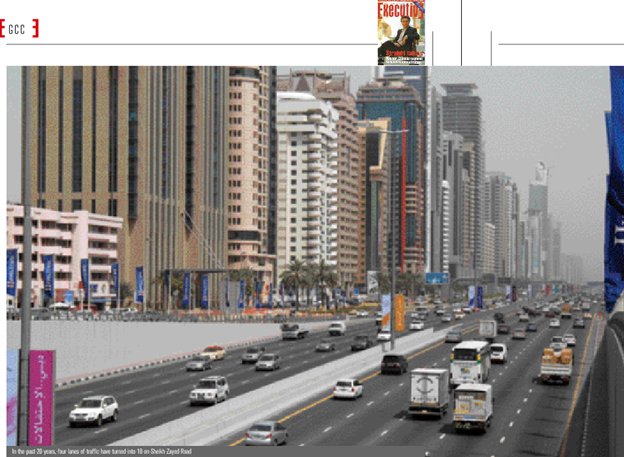
I returned to Dubai with my family last year. The first thing I did after leaving the airport was search the skyline for these two reference points. I looked in vain. So much as changed in 20 years that sometimes I feel I’m in a completely different country.
Twenty years ago Sheikh Zayed Road was four lanes (two lanes in either direction) connecting Dubai with the capital Abu Dhabi. Once you got on to the road and passed the World Trade Center you were in the middle of the desert until you reached the capital. A friend of mine used to work at Gulf News, one of the Emirates’ first newspapers, and one of the first businesses to relocate out on Sheikh Zayed Road. Across the road there was the Metropolitan Hotel that was particularly famous among Americans because it had a baseball diamond and hosted tournaments for American expatriate baseball teams in the Gulf. Occasionally, I would meet them in the hotel bar, the Red Lion, and I was amazed each time I went out there how far away the place was from anything else. Driving back into town late at night was always a bit risky because there were hardly any other cars on the road and the trucks felt they owned the tarmac.
Recently, I had an appointment at Gulf News. I had heard about the changes along Sheikh Zayed Road but it wasn’t until I drove back out there that the extent of Dubai’s real estate construction boom sunk in. To start with, when coming from Sharjah, you don’t notice crossing the Dubai creek bridge anymore because everything has become so big and wide and crowded that all your attention is focused on the road in front of you and the cars darting in and out all around you. On Sheikh Zayed Road, the four lanes have now expanded into ten, sometimes fourteen, lanes with fly-overs, bridges and underpasses along the entire stretch. On either side of the freeway there are new shopping malls, compounds and skyscrapers, including world’s tallest building and largest shopping complex, both still under construction. Gulf News is still in the same location except that they have moved into a bigger building next door and the Metropolitan with the baseball diamond has had a facelift. Both have been long overshadowed by everything else sprouting out of the desert landscape.
Dubai is expanding at such an alarming rate that before long the sight of open desert will become a rarity. In the past, one had to travel over long stretches of sand in order to reach civilization. In the future, we will have to do the reverse; drive through an endless concrete jungle before we can reach the sand.
