
The Turkish national football team found itself in the unlikely position of semi-finalist in the European Championship before being despatched homewards in a display that illustrated Germany’s lack of sentimentality. Despite currently playing some largely irrelevant extra time, a similar result is on the cards for Turkey’s bid to gain another European trophy — accession to the EU.
On June 17, the EU opened two new “chapters” of accession talks with Turkey at the fifth Turkey-EU Intergovernmental Conference in Luxembourg. Eight of the 35 chapters have now been opened since Ankara became an official membership candidate in December 2004. So far one, on science and research, has been closed and 15 suspended, ostensibly over Turkey’s refusal to allow ships and airplanes from the Republic of Cyprus, an EU member state, into its ports and airports.
France, with German support, has been particularly active in blocking the advancement of negotiations. “I do not believe Turkey belongs in Europe, and for a simple reason, which is that it is in Asia Minor,” French President Nicolas Sarkozy stated during one election debate. If his only complaint is geographical, he could call for Cyprus’s expulsion from the Union. Sarkozy’s opposition to Turkey’s quest for European glory is as big a stumbling block as the German footballers.
France took over the six-month rotating presidency of the European Union on July 1. While three more symbolic chapters are expected to be opened before December — as a sign of French “goodwill” — they are unlikely to be crucial to accession. That same French “goodwill” also saw in June the rejection by the senate of a bill that would have made a national referendum on Turkish EU membership mandatory. The bill made no mention of Turkey but since it covered any EU applicant with a population of more than 5% of the current EU total it doesn’t take a statistician to figure out who the intended target was. Such thinking, at the time, would have required a French referendum on Britain’s accession.
Accession obstacles
Turkey’s population of around 75 million is equal to more than 10% of the EU’s. Conveniently, that of Croatia, which is at a similar stage in chapter negotiations as Turkey, but is predominantly Christian and on the European mainland, is less than 1%.
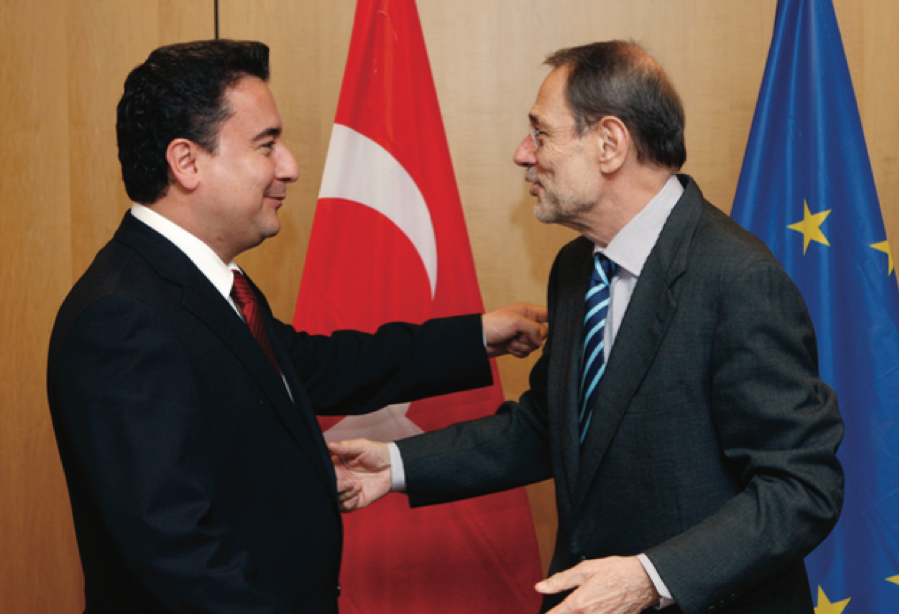
Putting on his perpetually brave front in the face of eventual elimination from the competition, Turkish Foreign Minister and Chief EU Negotiator Ali Babacan has put a positive spin on developments, saying that “we expect that our accession process will be advanced during the French presidency.” That seems as likely as the country’s footballers getting to the next World Cup final. This doubt stems not only from opposition within the EU and the national side’s erratic goalkeeper but a growing sense that Turkey itself is losing its drive to join the Union.
An extra dimension to the accession saga was added on June 12, when voters in the Republic of Ireland rejected the proposed Lisbon Treaty. This treaty was, in effect, a slightly rehashed version of the European Constitution that was rejected by Dutch and French voters in the 2006 EU poll.
Stemming from the Irish vote, there are two separate though not conflicting arguments against imminent Turkish membership.
One, posited by Sarkozy, is that further EU expansion is impossible without ratification of the treaty. Lisbon’s advocates have said it is a necessity to promote the smooth functioning of the expanded Union. “I would find it very strange for a Europe of 27 that has trouble agreeing on workable institutions to agree on adding a 28th, a 29th, a 30th, a 31st, which would definitely make things worse,” Sarkozy said on June 19.
German Chancellor Angela Merkel, who is at best skeptical of Turkish EU accession, has supported Sarkozy, saying that “the Nice Treaty limited the (European) Union to a membership of 27 states and for me it is unthinkable that we would change one area of the Nice Treaty without looking at the whole of the Lisbon treaty.”
Sarkozy’s insistence on sidelining Turkey’s bid might assuage the fears of the French electorate (which is rapidly falling out of love with him) over a “flood” of immigrants from new members. On the other hand, also to Sarkozy’s advantage as an advocate of the treaty, it is a mechanism for bullying pro-enlargement treaty-skeptical countries such as Britain and some Eastern European member states into bolstering support for the revised constitution.
The second argument takes the line that the popular rejection of Lisbon in Ireland and the Constitution in France and the Netherlands is indicative of a growing sense of “enlargement fatigue”. This view holds that citizens of “Old Europe” are uneasy about EU expansion and its concomitant migration and administrative complexity. They voted against EU proposals to demonstrate their wish to put further enlargement on hold. Therefore it would be going against the public’s wishes to press on with Turkish accession negotiations.
There is likely to be a grain of truth in this argument — France’s voters are quite enlargement-averse and Holland’s citizens are increasingly uneasy about Muslim immigration in particular. However, this argument is also a little too convenient, as it allows Europe’s politicians to avoid other reasons for their citizens’ doubts about the treaty.
Second thoughts
These include general misgivings about the EU itself: the Union is increasingly seen as unaccountable, remote and expensive. A ream of stories about some Members of the European Parliament (MEPs’) handling of their official expenses in the run up to the Irish vote increased suspicions of corruption. Furthermore, a significant part of the European electorate is wary of the EU’s direction – British voters fear over-regulation, while some in France and, for example Denmark, suspect the Union will force looser labor protection and the dismantling of the welfare state.
There is arguably a third way in which Ireland’s ‘No’ vote could act against Turkey’s accession. From the point of view of Turks who are skeptical about the benefits of EU accession, the possibility of the EU riding roughshod over the wishes of one of its member states is not appealing. Turkish people tend to be strongly independent and would be reluctant to cede their country’s sovereignty to a monolithic, steamrollering EU.
On the other hand, Turkish columnist Semih Idiz has argued, Ireland’s rejection of Lisbon could actually benefit Turkey, by encouraging the formation of a “two-speed Europe” in which some countries moved towards greater integration and others retained greater independence. The theory would be that Turkey could more easily join “slow Europe” without its European voting rights diluting the influence and development of the “fast stream” — which would likely include France and Germany.
The problem with this argument is twofold: not only has no major European leader lent support to the “two speed” principle, or outlined how it would work, but it seems unlikely that even in the event of it being applied that adversaries of Turkish membership would drop their opposition entirely.
Amid the heat generated by Ireland’s vote, and looking beyond the forced smiles in Luxembourg, another factor is being overlooked: Turkey’s changing attitude to the EU.
A Eurobarometer poll last year found that only 49% of Turks considered EU membership “a good thing.” While admittedly only 25% identified accession as “a bad thing,” this feeling is growing as the negotiation saga plays out. Only 26% of Turks now expect their country to join the EU, and 54% agreed that EU global leadership would be “undesirable.”
More to the point, the government’s ardour may also be waning. There are rumors of a split between Europhile leaders such as Babacan and President Abdullah Gül and an influential faction which believes that the time has come for Turkey to focus on developing its ties with the Middle East, the Turkic countries of Central Asia and Russia. Prime Minister Recep Tayyip Erdogan is said to be of the latter opinion. Erdogan has been making visits to the Gulf states to court investment and to offer the services of Turkish companies in developing the region.
Some Turks compare the opportunities for their firms to expand in the fast-growing economies of the Middle East and Central Asia, and the opportunities for becoming a regional leader, to the prospect of being a much-delayed, spayed and mistrusted member of the EU, and know what they would rather plump for. It is also a much more achievable goal than dreaming of a major international football trophy.
