
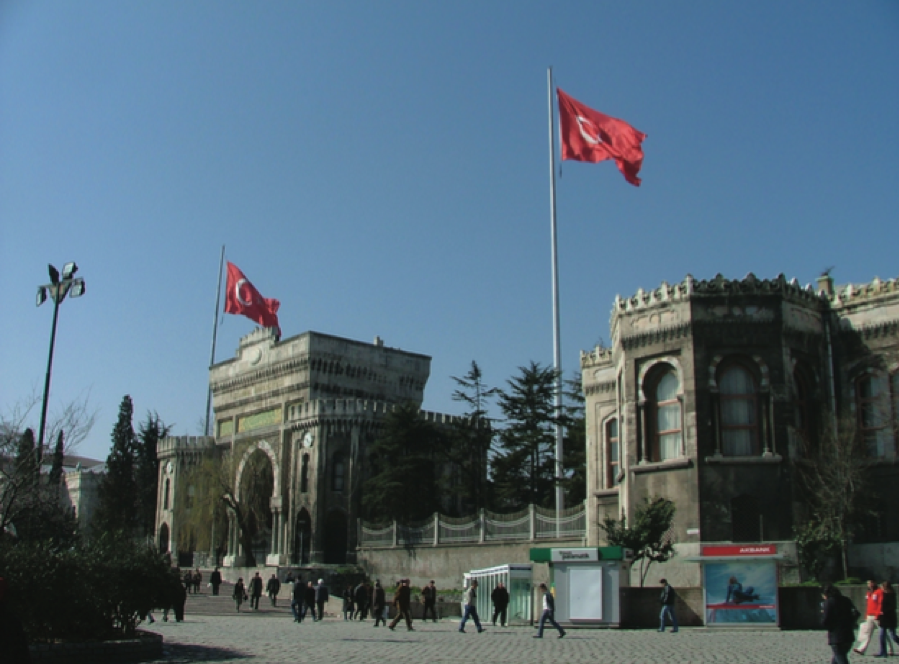
One of the best-selling English-language books on Turkish politics is Turkey Unveiled by Nicola and Hugh Pope. Any updates may make them question the title. On February 9, Meclis (the Turkish parliament) voted through constitutional changes lifting the ban on wearing headscarves in public universities by 411 votes in the 550-seat house. To get the required two-thirds majority, the ruling Justice and Development Party (AKP) controversially depended on the support of the ultranationalist National Action Party (MHP), the third largest group in parliament. What was in it for the MHP has not yet been revealed.
While opinion polls say the move is supported by more than 60% of the electorate, the headscarf has been a point of bitter contention between Islamists of all stripes, and ardent secularists, who include the influential army and the largest opposition party, the Republican People’s Party (CHP), which traces its lineage back to Ataturk. For those in favor of lifting it, the ban was an elitist law which prevented the devout from going to public universities, entrenching the social and economic divisions that have been an (often unspoken) reality for much of Turkey’s modern history. For those that support the ban, there is an array of anxieties. Some fear that girls who prefer not to wear the headscarf will be subject to peer pressure to do so. Others worry that it may be a step down the road to blurring the absolute separation of mosque and state. There are even some who view it as the harbinger of restrictions on other behavior, such as drinking alcohol.
The headscarf ban is seen by many as a guarantor of the secularism of Turkey’s educational system. Furthermore, the symbolism of headgear in Turkish history should not be underestimated. Founding father Kemal Ataturk famously banned the fez because of its Oriental connotations (giving European milliners the perfect chance to offload their unfashionable, unsold homburgs). Ironically, the fez had been introduced to Turkey to replace the turban by the modernizing Sultan Mahmud II.
Security is not threatened
However, the more ardent secularists may prefer not to mention the fact that the constitutional articles just repealed were not laid down by Ataturk at all, but by a military junta in 1982.
The day the vote to lift the ban passed there were no security incidence — and certainly none of the “chaos” predicted by a headline in Turkey’s best-selling newspaper, Hurriyet. Protests were vocal — but small — compared to the demonstrations held by secularists last year, when Prime Minister Recep Tayyip Erdogan was reported to be considering contesting the presidency.
As Erdogan pointed out, with oblique reference to Hurriyet’s headline, while tensions are running high over the headscarf issue, compared to other moments in the republic’s history, the law has passed largely without disturbance.
Prophecies of a return to the street warfare and political killings that bedevilled periods of the 1970s were unlikely, given that the two groups involved this time — moderate and conservative Islamists on one side and secular, social-democratic middle-classes on the other — are less prone to violence than the far-right “Grey Wolves” and student radicals of 30 years ago.
Erdogan has repeatedly stressed the AKP’s commitment to secularism and pluralism. “Nobody will force anybody to cover [her head] in this country,” he said on February 17, 2008. “If such things happen, we will fight against this with all of our institutions.”
The somewhat muffled response to the actual passing of the amendments may indicate that the opposition has largely conceded defeat. The AKP’s economic record has robbed the CHP and others of the opportunity to attack its competence. The timing of the headscarf issue was no accident. More than that, and given public support for lifting the ban, the opposition risked looking more and more like an out-of-touch elite from the big Western cities. It must now look for other battles to fight, perhaps looking at where the AKP has had more limited success, such as in eliminating pockets of poverty in some areas, and moving forward on EU accession.
Even before its crushing defeat at the polls, there was a consensus forming that the CHP’s leader since 1992, Deniz Baykal, very briefly (four months) deputy prime minister and minister of foreign affairs in the mid-1990s, should step aside. Some new blood (and new arguments) in the CHP could help it regain its pre-eminence, and recent events may hasten even the limpet-like Baykal’s departure.
Meanwhile the alliance over February’s Meclis vote and the recent military incursion into Iraq has taken the wind from the sails of the ultranationalists of the MHP, though the party will want its pound of flesh for supporting the AKP. The government, for the meanwhile, looks stronger.
Another reform — or change, depending on how it is viewed — the AKP is keen to push through is an overhaul of Turkey’s system of local government. Currently, the country is divided into 81 provinces, which are then subdivided into municipalities and city municipalities. The government proposes increasing the minimum size of a municipality, and giving more independence to provinces. The government would devolve control of education, healthcare and religious affairs to provincial level.
Istanbul’s administrative reform
Istanbul currently contains more than 70 local administrative units, making a complex mosaic, which, some say, leads to a somewhat inefficient method of government in a country which has only recently thrown off the slight that it is ungovernable. Thus the national government has drawn up plans to consolidate some of the districts, particularly those in which the population has changed considerably in recent years. While these plans appear to make administrative and democratic sense, some allege that they are designed to gerrymander Istanbul’s electoral districts in favor of the AKP in the run-up to the local elections.
Perhaps most controversial is the proposed division of the municipality of Kadikoy on the Asian side of the Bosphorus. Kadikoy is a bastion of the opposition Republican People’s Party (CHP), the second largest party in parliament, and renowned for its staunch secularism. It also has a large population of members of the Alevi sect of Islam. Alevis as a whole have been staunch opponents of the AKP, accusing the party of Sunni chauvinism and attempts to co-opt them into neutered community organizations.
Opponents of the Kadikoy split say that the government is trying to dilute the CHP’s effective vote by dividing it between AKP-dominated areas. Furthermore, there are fears about the proposed move of the central bank headquarters to the district from Ankara, which critics say will lead to the establishment of a financial district overwhelming the residential area. An unspoken concern for the CHP may also be that AKP voting bankers will move to Kadikoy and the surrounding suburbs. The proposed local government reforms have been almost drowned out of the news agenda by the headscarf issue, which is indicative of the symbolic importance of the latter in Turkish politics.
Another area that could be affected by these events is Turkey’s application to join the European Union. In 2007, progress slowed considerably. One of the main issues was the suspension of several “chapters” of negotiation over accession by the EU due to Turkey’s refusal to open its ports to ships registered in the Republic of Cyprus; the opposition of France’s President Nicolas Sarkozy, amongst others, has been another blow. There has also — indeed, consequently — been a significant weakening in the Turkish electorate’s support for accession; a majority are now opposed, according to most polls.
EU membership
Partly perhaps due to the symbolism of the headscarf question, the government has vocally restated its commitment to EU membership, with President Abdullah Gul declaring 2008 “the year of Europe,” a call echoed by some of the Cabinet. “Turkey cannot turn back from the point we have reached in regard to civilization, modernization and Westernization,” said Meclis speaker Koksal Toptan, the second ranking official in Turkey’s state hierarchy and an AKP moderate. “There will be no change here. Turkey cannot give up on its target of membership of the European Union, which is part of its Westernization and modernization process,” he added.
There may be AKP internal politics at play here. There are rumors that Erdogan is losing enthusiasm for the European project. Gul, on the other hand, though previously seen by some as Erdogan-lite, is portrayed as staunchly pro-accession. Whether this is a sign of factions developing in the previously impressively united and disciplined AKP, or a case of “good cop, bad cop” is uncertain. But despite enthusiasm from Toptal and EU chief negotiator Ali Babacan, traction on European accession will be minimal without movement on Cyprus. Greek Cypriot voters unceremoniously turfed out the hardline President Tassos Papdopoulos in the first round of the presidential elections. That could have paved the way for a thaw in the iceberg dividing the two parts of the island. The accession to the Greek Cypriot post of the Communist Demetris Christofias after the second round of polls on February 24 could have eased the way to some progress, though he could scarcely be described as enthusiastic for reunification, despite his most recent words. Not wholly negative is perhaps a more fitting description. In any case, Erdogan may well have made the concept academic. Lifting the headscarf ban and under suspicion of trying to fix local administrative reform in his favor will hardly endear him to opponents of Turkish entry into the EU. The Turkish prime minister appears to have bigger domestic fish to fry and observers could be forgiven for thinking that his own enthusiasm for accession has sunk to the same level as that of the European Turkosceptics.
PETER GRIMSDITCH is editorial director at the Oxford Business Group.
