How likely is Lebanon to default on its
loans? More than you might think,
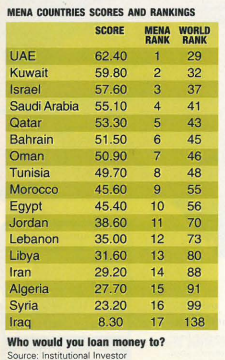
says US magazine Institutional Investor. In
its semi-annual survey of the creditworthiness
of 145 countries, it ranked Lebanon 73rd
worldwide and 12th out of 17 countries in the
Middle East and North Africa. The survey
ranks countries on a scale of zero to 100, with
100 representing the least chance of debt
default. Lebanon scored 35, below the
regional and global averages of 42.64 and
40.9 respectively. Lebanon placed ahead of
regional countries such as Libya, Iran and
Algeria but fell behind Sri Lanka and El
Salvador on a global basis. The highest
ranking in the Middle East and North Africa
went to the UAE with 62.4. “Lebanon has
never defaulted on a loan, even during peak
war times,” says Ziad Maalouf, vice president
of Middle East Capital Group. He adds
that although rating agencies like S&P,
IBCA and Moody’s have not given
Lebanon an investment grade rating, they
also haven’t changed their three-year credit
rating stance of BB-.
Facts
or fiction
about the
Casino?
There have been conflicting
reports in the
media about troubles at the
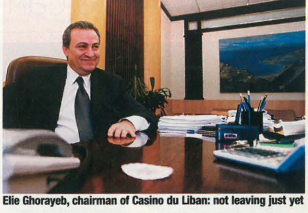
casino. The board of directors of the Casino du
Liban reportedly asked chairman Elie
Ghorayeb, who was appointed in March
1999, to resign or face being ousted at the
upcoming general assembly. But according to
one board member, the request was not made for
Ghorayeb’s resignation. “If anything it
would have to be a political decision and not
ours,” he says.
Another mid-April report claimed that
Georges Corm, minister of finance, had
demanded $80 million in unpaid taxes and
fines from the casino. It said that the casino
must pay 30% taxes on revenues generated
from slot machines. The article also warned
that, as a result, auditors Deloitte & Touche
expected the casino to record a loss of $4 million
to $5 million in 1999 and that some
$45.2 million were owed in taxes on slot
machines since 1997. Another publication
quoted board members and auditors as saying
that the earlier article was incorrect. What’s the
truth? “The casino and the ministry of
finance have conflicting opinions on slots. The
latter wants to impose a fee similar to other
gaming fees at the casino, rather than the
fixed fee they used to impose,” says a board
member. The casino had announced preliminary
pre-tax profits of $19.5 million in 1999,
a 50% increase over 1998.
Niche player
Al-Mawarid’s strategy of investing in
retail products, IT and human
resources is starting to pay off. The bank’s
profits increased 26.9%, from $878,000 to
$1.1 million (unaudited) last year. Total
assets jumped 31.9% to $266.9 million,
and deposits grew to $213.4 million, a
27% increase.
Its focus on retail banking, the bank
moved aggressively into credit and debit
cards (it just launched MasterCard free of
charge), has created growth in fee-based
income, up 60.5%. Its interest income
increased 30%, while loans grew by
28.5%. “As a medium-sized bank, it is trying
to be a solid niche player,” says
Nicolas Photiades, senior vice president at
Thomson Financial BankWatch. “It is
working to rely more on a recurrent fee-based
income stream as a normal bank
should operate, while the majority of
medium-sized banks depend mostly on T-bills.”
At the end of last year, Thomson
Financial BankWatch gave Al-Mawarid a
B+ for senior debt rating and LC-2 for
short-term local currency debt rating. But
Al-Mawarid still has a major challenge
ahead: By moving into retail banking, it has
to compete with top-tier banks.
The Innovator
Last month Banque Audi again proved to
be the leader in innovation. It offered
$100 million worth of ten-year bonds, the
first company in the Middle East to issue a
note with this length of maturity. It coincides
with the bank’s buyback of $100 million worth of
its notes, which were scheduled to mature
next year. Audi paid slightly above the
market price. Those who held Audi’s paper
were given the chance to reinvest in the new bond before fresh investors came in.
According to Audi, its objective was to
contain its outstanding debt and lengthen the
time required to repay the entire loan.
But one question remains: When will
Audi’s aggressive approach pay off? Last
year its profits dropped 11%. The recurrent
fees and commissions generated from new
products along with the bank’s heavy
expansion will start generating results in
2000, says Fadlo Choueiri, project officer
at Arab Finance Corporation (AFC).
AFC’s recent report ranked Audi’s GDRs
“outperform”, one notch below “buy.” The
finance house predicts earnings to reach
$41 million, up 8%, and it expects its
GDRs to climb from $20.5 to $23.45 by
year-end. ABN AMRO, however, recommends
“hold,” saying the sluggish economy
will limit growth. It expects earnings to
increase 4%. According to AFC, Audi
shares, currently trading on the Beirut
Stock Exchange for $26.5, are overpriced.
The 2000
challenge
There were mixed results for
Lebanon’s banks during the first quarter
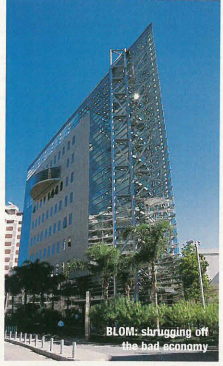
of 2000. Banque du Liban et d’ Outre-Mer
(BLOM), the largest by assets and
deposits, is still managing to shrug off
harsh economic conditions. In the first
quarter, its profits climbed 14.5% compared
to the same period last year. Last
year’s profits grew by 19.97%, above the
average of some of the 15 leading banks,
which saw a 3.7% decrease in profits.
Analysts attribute BLOM’s success to conservatism
and cost control. But the bank is
also making a move in retail banking.
According to Samer Azhari, general manager,
the bank’s non-interest income
increased 25% in the first quarter. Arab
Finance Corporation and ABN AMRO
recently gave BLOM’s GDRs a “buy”
ranking. AFC’s target price is $33.20, up
from the current trading price of $24.75,
while ABN AMRO calculates the target
price at $30. “We continue to favor BLOM as a speculative play for the short term,”
says Ghassan Medawar, financial analyst
for Middle East and North Africa at ABN
AMRO.
On the other hand, Bank of Beirut’s
(BoB) first quarter profits fell 15.8%. This
follows a 27% surge in profits for 1999.
According to BoB, the slump came partially
from non-recurrent expenditures, amortization
and goodwill related to its merger
with Transorient Bank last year, plus the
recent tax hike. It claims that without those
factors, its profits would have increased 6%.
Ciments Blancs in
the red … again
Ciments Blancs, reeling from the slump
in the construction sector, registered
losses of some $564,000 last year, down further
from $372,000 in 1998. The quantity sold
declined slightly from 74,800 tons to 72,000
tons, and losses increased by 35%. “During
the last 15 days of 1998, there was fierce competition
between us and Cimenterie du
Moyent Orient (CMO), and we had to reduce our prices by some $30, which caused a
devaluation of our stock of some $240,000,”
says Georges Ghosn, general manager. If you
take that devaluation out of the $564,000, you
end up with losses of about $324,000, similar
to 1998 figures. A subsidiary of Seament
Group, CMO has been refurbishing its factory
at a cost of $25 million to be able to produce
up to 400,000 tons.
Foreigners
welcome
National Bank of Canada has taken a
15% stake in one of Lebanon’s top-tier
financial institutions, Banque Saradar. The
$22 million purchase will raise Saradar’s
capital from $70 million to $90 million.
“Banque Saradar is set for expansion,” says
Elie Saliba, NBC’s general manager in
Beirut. NBC, the sixth largest bank in
Canada with $70 billion in assets, hopes to
expand its presence in Lebanon. “Foreign
banks cannot compete with well-established
local banks,” says Saliba. And foreign banks
face limits when it comes to expanding their
branch networks. Buying into Lebanese
banks can also be a launching point into the
region. In 1998, the International Finance
Corporation paid $11 million for a 10%
stake in Saradar. It is strong in corporate and
private banking and wants to acquire or
merge with another bank to boost retail
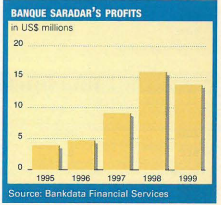
activities. Still in the top ten for profits, its
earnings dropped over 13%, from $15.8 million
in 1998 to $13.6 million last year.