Y ou don’t have to pick up a copy of
the National Enquirer to know
that insurance firms are going to
bed with banks these days. The megamerger
of Citicorp and Travelers Insurance
Group created the $700 billion giant
Citigroup almost two years ago, and
helped precipitate the blurring of lines in the
US financial sector – a trend that was
already well established in Europe.
France-based insurer Axa, for example,
has an asset management portfolio of $700
billion, making it the fourth-largest money manager after Union Bank of Switzerland,
Fidelity and Credit Suisse.
Here in Lebanon, the business of banks and
insurance companies is also coming closer
together, albeit on a smaller scale. “It’s the
future. People are looking for a one-stop
shop, and banks are creating a sort of financial
supermarket,” says William Salem,
head of marketing for SNA, the first insurance
firm to start selling insurance in banks.
SNA has created a worldwide group accident
policy, which it sells to banks, and has
developed a complete line of retail insurance
products that are sold at Banque Audi and
BBAC, both shareholders in SNA.
At least ten banks have started their own
insurance companies while others are buying
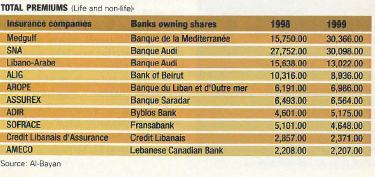
into existing insurers. Banque du Liban
et d’Outre Mer is a major shareholder in
Arope; Byblos Bank owns all of ADIR;
Banque Audi has a I 0% stake in Societe
Nationale d’ Assurance (SNA) and is finalizing
its recent acquisition ofLibanoArabe.
So what do these profit-driven partners get
out of this love affair? Insurers are the first to
benefit. Banks throw a constant stream of
business their way. Insurance companies
that are owned by banks are guaranteed captive
business. Before granting a loan, a bank
usually requires a client to purchase one or
more policies. These policies virtually
ensure that a bank will get back its money. A
personal loan is accompanied by life or disability
insurance. Car loans must come with
automobile insurance. A housing loan generally
comes with life insurance as well as fire
or natural disaster policies. “This is our
bread and butter,” says Fateh Bekdache,
general manager of Arope insurance.
“Everyday the bank’s branches are open, I’m getting cash business,” he adds. In 1999,
at least a third of Arope’s $5.5 million portfolio
was captive business, policies that
BLOM clients were required to buy.
Most of the insurance pobcies that are
sold through banks, such as life, fire and
marine, are the most profitable forms of
coverage. At least half of ADIR’s $5.2 million
portfolio in 1999 was in life, and the
firm’s earnings were $1.6 million.
Insurance companies that rely on banks for
business are also able to lessen their
reliance on the volatile and high-risk market
for medical coverage. “We’re not interested
in hospitalization,” says Jean Hleiss, general
manager of ADIR. “Others are building
their market share on [hospitalization] and
that’s why they are losing.” But medical
policies account for 33% of Arope’s business.
Although a third of that is BLOM’s medical group, the insurer’s heavy reliance
on health coverage has taken its toll on
profits. Out of $5.5 million in revenues in
1999, earnings were less than $475,000.
Insurers receiving captive business from
banks do away with long collection periods
and receivables. Collection problems have
contributed to the collapse of more than one
insurance firm. With banks, all payments are
made in cash. The insurer has no receivables.
At least 80% of ADIR’s portfolio comes
from Byblos Bank, which pays upfront.
“When BLOM issues a loan, they take the
money for the insurance from the customer
and give it to me,” says Bekdache. “We get
paid ahead and the balance is always zero.”
And by relying on a bank for business,
there are no broker’s charges. ”The commission
rates in our business are very high,”
says Bekdache. “I don’t have to pay that for
business coming from the bank.” Many brokers
are not reliable payers. They tend to
demand extended payment terms for clients
and, says Joseph Issa, lawyer for Middle
East Assurance and Reinsurance Company,
“some brokers don’t pass on everything
they collect from the clients. They pay the
money they’ve collected in parts even
though the client has paid up.” At the same
time, brokers often transfer portfolios from
one company to another every time they
find a better deal. “If you depend on a broker
who has a very large portfolio and he
decides to leave, you have a problem,” says
Bekdache. Arope has already reduced its
broker-based business from 33% of its total
sales to less than 20%.
The banks also benefit from the relationship
by getting a share in the profits. Byblos
Bank is entitled to the $1.6 million in earnings
made by ADIR. BLOM gets 90% of Arope’s profits. “We look at it as an investment,
a diversification of the bank’s products,
which leads to additional profits,”
says Faisal Nsouli, head of research and
development at Byblos Bank. “We rely
heavily on life and homeowner policies.
Having a bank-owned insurance company is
more efficient and more reliable.” At the
same time, banks are able to tailor insurance
products for their clients. A fi vi::-year pt::rsonal
loan can be guaranteed by a life insurance
policy for the same period.
But there are downsides to the bank-insurance
company connection. An insurer that
depends solely on a bank to provide it with
business is restricting its own growth. And in
the insurance business, as your portfolio
grows, your risk diminishes. “It’s not healthy
to depend on the bank all the time,” says
Bekdache. “Direct business will generate
more for you.” About a third of Arope’s total
revenues, or $1.8 million, came from direct
sales in 1999. ADIR is also considering stepping
out of Byblos Bank’s shadow and
expanding into direct sales. “We are seeking
to increase our market share as well as
exploring new markets,” says Hleiss.
There are those who believe that this type of
marriage between banks and insurers denies
consumers the basic right to choose to do
business with another insurance company.
”Banks are actually pushing clients to buy
insurance from companies, which are either
theirs, or with which they have made
arrangements,” says Abraham Matossian,
chairman of Al-Mashrek. “It’s a package deal
and the client cannot refuse. Bancassurance is
important abroad, but the client is not obliged
to accept what the bank offers. He can either
accept what’s offered or go with another
insurer. Here there is no choice.”