SOLIDERE
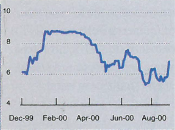
The general investor sentiment
toward the Lebanese GDRs
remains unchanged with local and
foreign investors waiting for the
upcoming elections for an efficient
macroeconomic policy. Solidere’s
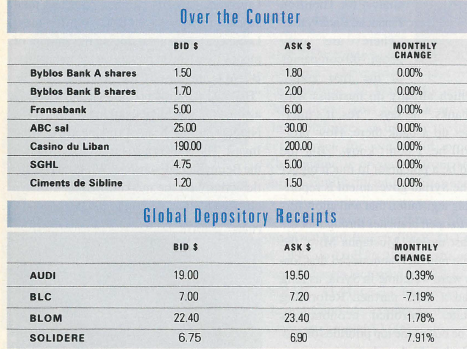
GDR rose 15.28% to $6.225 (14/7)
as investors perhaps smelled a bargain,
only to fall back 3.61 % to $6
(21/7), then again drop 7 .5% to$ 5.55 as the economic condition worsened
with no signs of relief from the depressed real estate sector (28/7).
By early August, Solidere’s GDR edged up 0.9% to $5.6, as prince Al
Walid reconsidered plans to build a $250-million Four Seasons hotel,
as well as a residential apartment complex in downtown Beirut (4/8).
AUDI
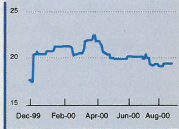
Audi’s GDR was no different than
the rest of the GDRs or for that mat-
25
ter the economy in general with the
macroeconomic conditions still on 20
the downside and political instability
due to the elections putting the economy
on hold. Audi’s GDR was 15
priced at $19 .18 ( 14/7) and remained
there for a week (21/7).
By the end of July, news from the ministry of finance on the state of the
public deficit discouraged investors even more, driving Audi’s price
down 1.2% to $18.95 (28/7). Nevertheless, Audi regained some of its
losses as it was chosen as the best bank in Lebanon. It rose 1.58% to
$19.25 (4/8), and stayed at that level till mid-August (11/8)
BLOM
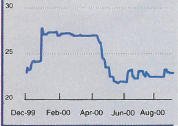
BLOM’s GDR held firm this
month despite several negative
economic reports by S&P, EIU
(Economic Intelligence Unit) and
the ministry of finance, which
pushed most of the Lebanese
GDRs listed on the international
down as foreign investors
interest was slowly fading.
BLOM’s GDR remained at $22.5 for the second half of July
(14/7)(2117)(28/7), mirroring the stagnation of the local economy. It
then edged up 2.22% to $23 ( 4/8).
By mid-August, BLOM’s GDR lost $0.1 to $22.9 as investors cashed
in the gains (l 1/8)
BLC
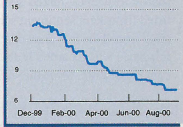
BLC’s GDR had the poorest perfor- 15
mance among all the GDRs losing
almost 7 .5% of its value in the past 12
four weeks. BLC’s GDR fell 0.32%
to $7.65 (14/7) as the economy 9
showed little growth and debt servicing
exceeding public revenues 6
for the first time, with the deficit
sp~nding ratio reaching 53% in the
first half of the year. Investors’ fear from a possible S&P downgrade was
revived, sending BLC’s GDR down 0.65% to $7.6 (28/7). A report from
the Economic Intelligence Unit (EIU), warning about the deteriorating
economic conditions pushed all the GDRs down; BLC dropped 6.58% to
$7.1 (4/8) and remained there (11/8).
MOROCCO
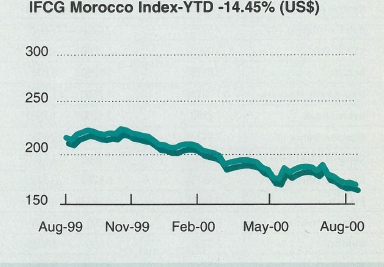
Moroccan equities conti1’°ed to head south, breaking the
~ey 700-point psychological level as weak macroeconomic
performance and lack of foreign funds continued
to weigh negatively on sentiment. The highlight of the
month was the listing of mining company Managem,
which managed to add some interest to an otherwise quiet
market. Managem stole the limelight, outperforming its
parent holding ONA Group, and accounting for a big
chunk of trading activity.
EGYPT
The Cairo Stock Exchange continued to lose ground, suffering
another month of severe losses with institutional
investors remaining mostly on the sidelines. The lack of positive
economic news and continuous pressure on the pound
has caused the market to decline almost 40% so far this year.
Trading activity was mostly concentrated in the telecom sector
with the successful closing of Orascom Telecom’ s ( OT)
IPO, which was 1.7 times oversubscribed. OT’s attractive
pricing (EP55.568) prompted many investors to sell stakes
in MobiNil (-3%) and invest instead in the new issue.
JORDAN
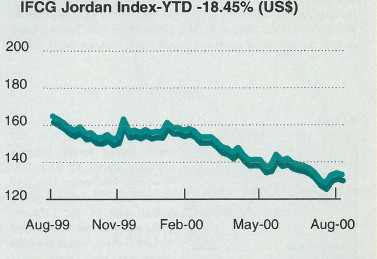
Investors at the Amman Stock Exchange welcomed the
modest rebound in share prices at the end of July following
weeks of consecutive declines. The small upturn was
primarily driven by an impressive rise in the Arab Bank
shares. However, mixed semi-annual results for most
listed firms kept sentiment subdued with the index hovering
around the 140-point psychological level. Mixed performance
was recorded in the insurance, industrial and
banking sectors, while the services sector lost ground