
In the middle of January, Solidere

- Lebanon’s real-estate giant –
released a list of projects that it
had been pursuing throughout the
past year. The firm confirmed
that it had completed the final
Jun-99 Aug-99 Oct-99 Dec-99 Feb-00 phase of infrastructure work and
finished the renovation of 90% of
ancient buildings in the downtown area. Solidere also confirmed
continued advanced work on the Saifi residential project, as well
as the initiation of environmental work by the US firm Radian
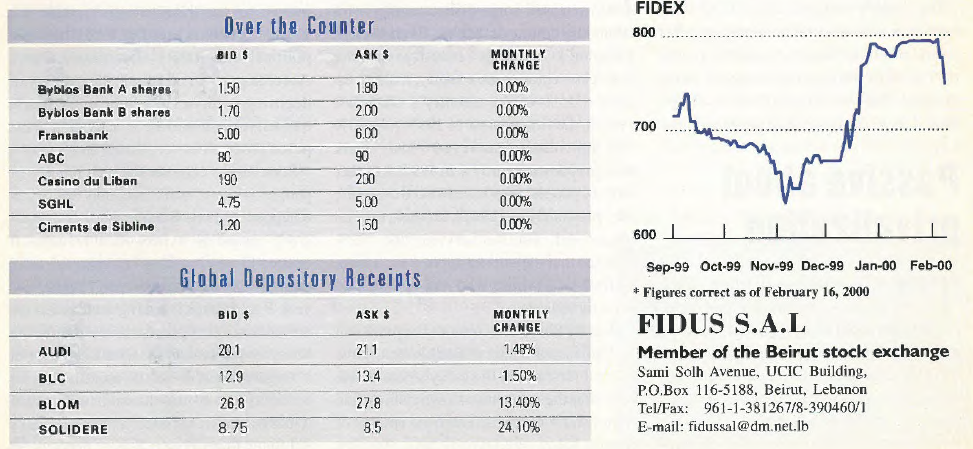
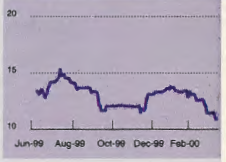
International on the Normandy landfill. Solidere’s GDR witnessed
much fluctuation in January, whereby its price varied
between a low of $8.7 and a high of $8.8.
BLC
Banque Libanaise pour le
Commerce enjoyed a rather rocky
month that saw it subdued by negative
sentiments following its declaration
of 1998 profits of a loss of
$4.3 million.
The bank attributed the loss to a
$16.5 million increase in provisions
and doubtful loans, which
amounted to $24.1 million.
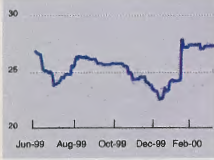
The Bank’s GDR suffered throughout the month, whereby its price
spiraled downwards, dropping consistently from $13 on January 17,
2000, to a low of $10.85 on January 16, 2000, representing a 19.8%
drop in the GDR’s price.
BLOM
Lebanon’s largest bank in terms of
assets and customer deposits,
Banque du Liban et d’Outre Mer
SAL, declared net profits of
$70.43 million for 1999, a 20%
rise over 1998 results. Return on
Average Equity stood at 28.6%
while return on average assets was
1.46%. Total assets reached $5.08
billion, up 10.9% from 1998. Customer deposits amounted to $4.33
billion, a 12.2% rise year-on-year, while loans rose 12.49% to
$1.107 billion. BLOM announced that the results were due to a conservative
lending policy, cost containment and the launch of retail
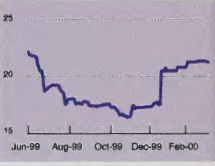
products and services. Merrill Lynch reaffirmed its long-term “Buy”
recommendation for the stock and it also announced that it expects
the bank’s income from retail products to grow significantly in 2000
compared to fees generated from loans and trade finance.
AUDI
Bank Audi SAL, one of Lebanon’s
top five banks, declared consolidated
net profits of $38.1 million in
1999, an 11.3% decrease from 1998
adjusted figures. Return on average
equity stood at 17.1% while return
on average assets was 1.23%. Total
assets reached $3.246 billion, up
9.88% from 1998. Customer
deposits reached $2.69 billion, an
11.07**%** rise year-on-year and loans rose 0.27% to $862.2.
The Bank attributed the decrease in results to the prevailing economic
recession as well as to the cost of expansion and development.
Following the Bank’s annual earnings results, Merrill
Lynch raised its medium-term opinion on Bank Audi’s GDR from
Neutral to Accumulate, and recommended the stock as a long-term
“Buy”.
MOROCCO

A surge in turnover, led by block deals, failed to pull the
Casablanca Stock Exchange (CSE) out of negative territory
last month with year-to-date losses totaling 4.8%.
The bourse was occasionally led higher by gains posted
by the subsidiaries of the conglomerate ONA Group.
However, these gains were short-lived as the market
succumbed, driven by losses in major stocks including
Ciment du Maroc, Samir, and SMI. Although the surge in
trading activity indicates potential signs of recovery, the
market is still in need of more liquidity to be injected by
large local and foreign institutional investors to pull it out
of the doldrums.
EGYPT
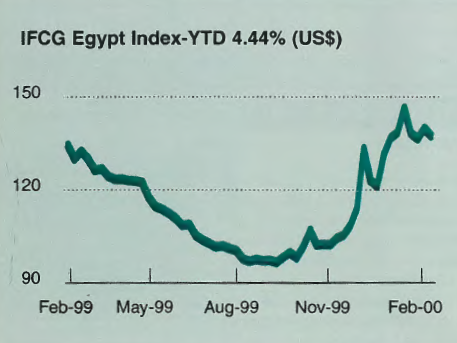
Strength in the cement sector and renewed interest in a
score of blue-chip issues, along with news of falling inter-bank
rates, consolidation and privatization in certain sectors, propelled
the Cairo Stock Exchange (CSE) into positive territory.
Several reports pointing to the privatization of Telecom
Egypt with an initial tranche of 10% slated for the second half
of 2000 also added positive sentiment to the market. The stabilization
in inter-bank rates at around 15% alleviated concerns
of a rising interest rate environment following the US
Federal Reserve’s decision to hike the overnight borrowing
rate by 25 basis points in early February.
JORDAN
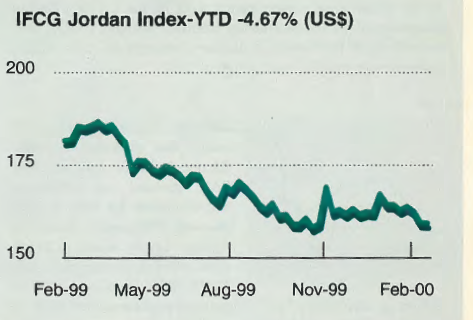
The Amman stock exschange recorded substantial losses
on the back of steep declines in leading industrial and
banking blue chips. The banking sector led the decline as
the heavyweight Arab Bank share lost ground after
announcing a marginal rise of 0.9% in 1999 net profit to
$225.6 million, triggering a selling spree among foreign
funds. In the industrial sector, the Jordan Phosphate
Mines Co. dropped steeply dragging the whole sector with
it. However, trading activity was strong thanks to the government’s
continued divestiture of its holdings in Arab
International Hotels as part of its privatization drive.
