How does someone establish and
operate an insurance firm in the
saturated Lebanese market? Better
still, why would someone want to? Large
firms such as Income, Phoenix, and Mesir
have already folded and others are having to
merge, be acquired, or close down thanks to
tighter regulation of the industry by the ministry
of economy and trade. For example,
51% of Société d’Assurance Française was
acquired by Assurance Générale Française
while AXA is the new owner of 51% of
Société Libano-Française.
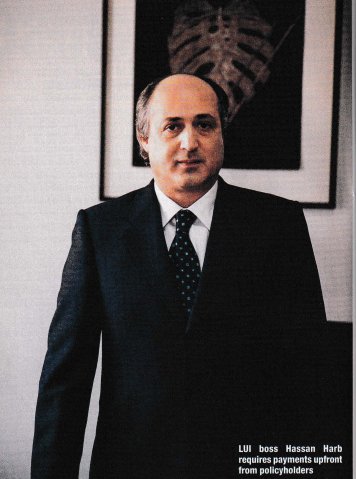
Judging from the progress he has made so
far, someone with the answer may be
Hassan Harb, CEO of Lebanese United
Insurance (LUI). New not only in the
insurance market in Lebanon, but also in the
business as a whole, his company raked in
premiums of around $1.7 million in its first
six months of operation, and is on track to
meet its projected target of $3.35 million in
its first full year of operation. Compare
this to American Underwriters Group,
another fairly recent entrant, which pulled
in about $2 million in its first year – LUI’s
performance is almost 70% better so far.
How did Harb pull this off? Observation
and an effective study of the market, he
says. Harb took a look at how others did
business, and as he reckoned it didn’t work,
he did the opposite. Take payments as an
example. An insurance company pays policyholders’ claims from the premiums that
it collects. If those premiums are not yet collected
when the claims start to come in, it
pressures the firm’s liquidity and the claims
cannot be honored, at least not right away.
According to a general manager of one of
the industry’s better known firms, the average
collection period for Lebanese insurance
companies is around four months after the
policy is issued, meaning many firms have an
even longer collection period. The result is
that clients nearing the end of their policies’
terms can, if there are still payments to
make, just drop the policies in favor of new
ones with other firms. The former firm, however,
counted on getting paid the whole
amount when it set its rates. LUI does not do
it that way. It requires a payment of 35%
upfront when an application is submitted,
and the remainder has to be paid within two
months of issuing the policy. This secures LUI
the liquidity needed to honor claims as they
come in. Alain Balian, an investment consultant
with ABN-AMRO, sees this as a
wise tactic. “I agree with the policy and suggest
that other people follow it as well.”
Harb also departed from the industry’s
focus on medical insurance. Approximately
half the industry’s total premiums are based
on healthcare coverage; but this has caused
more grief than relief, (see “Doctoring
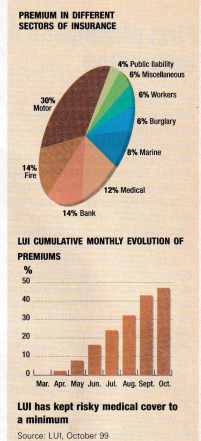
Insurance,” December 1999). LUI’s medical premiums at the end of October 1999 did not
exceed 12% of its total premiums, whereas
its premiums from motor insurance were
30%, while bank insurance and fire insurance
each contributed 14%.
But do strict and short payment plans, as
well as severe scrutiny, scare off potential
clients? Absolutely not, reckons Harb. The
argument is that an insurance company that
collects premiums quickly pays claims
quickly, and that attracts clients who are
looking for peace of mind.
LUI’s short collection period has another
advantage too: with funds on hand, LUI settles
medical bills within two weeks, a rarity
in the Lebanese insurance industry.
Additionally, clients have the option of having
their medical bills settled by the firm
directly to the provider, sparing the client the
inconvenience of having to be reimbursed
later. Motor accident claims, whether made
by LUI’s clients or third parties, are paid
within days of the accident. A claim coming
in from Monday through Thursday is settled
on Friday. Compare this to what Lebanese
with motor accident claims are used to,
which is basically at least a month of running
back and forth until the insurance company
“discovers” that the paperwork has come
through. This is likely to be one factor that
encourages a client to opt for LUI in spite of
the initial financial inconvenience. “This
kind of service suggests a professional
approach to underwriting,” says Aline
Kamakian, general manager of Insurance
and Investment Consultants.
Another advantage, at least for customers,
is that as a new company, the
recent insurance law was applied to LUI
before it was issued, meaning the firm was
required to have a start-up capital of $1.5
million in place. In addition, guarantees in
the form of deposits amounting to $3.5
million were required from day one for it to
be licensed as a general insurer. Though
inconvenient initially, this simply removes
the burden of having to come up with these
sums later on, as many other firms are trying
to do presently, some unsuccessfully at
that. This allows LUI to focus fully on
business, on staying liquid, and to be able to
turn down doubtful business.
A large part of LUI’s premiums, Harb
says, comes from captive business. The United Bank of Lebanon, which has merged
with Banque du Liban pour le Commerce and
is now known as UBL (BLC), makes up a
sizeable part of LUI’s clientele base. Harb
asserts that LUI is financially and administratively
independent, but the insurance firm
has strong links to Ark Financial Group, the
aggressive investment firm behind the creation
of UBL and the acquisition of BLC. Ark
is headed by Harb’s brother, Safi Harb, and
LUI’s other shareholder, Chafic Nehme, is
Ark’s and UBL’s legal advisor. Harb has also
previously said that the intention is for either
UBL or Ark to buy into LUI in the future.
For a company just starting out, LUI has got
the right attitude. It will have to maintain this
for the long run, however. Paying claims
quickly is commendable, but speed can result
in errors on the part of the insurer, and
improper scrutiny and assessment of a claim
is not in their best interests. On the whole,
however, LUI is a breath of fresh air in an otherwise
harsh and troublesome industry.