Economic focus
United States
• The economy’s performance is shifting from truly spectacular to
merely good. Mounting evidence points to a slowdown in growth.
The latest sign was declining retail sales figures for a second consecutive
month; another was the drop in housing starts for May.
Looking further ahead, we are becoming increasingly convinced
that the current tightening cycle is at an end.
• As we have pointed out in the past, the equity market tends to do
well once the Fed finishes tightening. After the last three Fed tightening
cycles, the S&P 500 was up by an average of 14% after a year.
The healthcare, consumer-staples, and financial sectors outperformed
the overall market on those occasions. The tech sector had
a mixed performance.
• Whether the tech sector outperforms the overall equity market
seems to depend on whether it is growing faster than the overall
economy. During the second half of the 1980s, tech spending as
a share of GDP held steady, and the tech sector underperformed the
overall equity market.
• Things changed dramatically after that. Since 1991, the tech share
of GDP has risen steadily. During that period, including the year
that immediately followed the end of the mid-1990s Fed tightening
cycle, the tech sector outperformed the overall equity market
by a wide margin.
Global view
• Is the US current account deficit, which could be as much as 4.2%
of GDP this year, a good or a bad thing? What about Japan’s projected
current account surplus of 2.5% of GDP? We recently examined
those questions and reached the following conclusions:
• The US current account deficit reflects robust investment spending,
not excessive consumption and a declining savings rate. The
composition of US investment spending shows that most of the new
capital associated with the current account deficit has been used
to fund business fixed investments; the bulk of that has been directed
toward producers’ durable equipment, a category that includes
high-tech goods such as computer systems and software.
• Because the US current account deficit is financing productivity-
improving investment activity, it should, in essence, “pay for itself.”
With that in mind, it ought to be clear that the deficit is hardly the
Achilles heel of the current US expansion, as some market participants
maintain. As we see it, it would take decades for US deficits,
at their current share of GDP, to push foreign liabilities to a dangerous
level. There is little risk of a “dollar crisis,” in our judgment.
• It is possible that foreign sentiment about America’s growth
prospects could turn negative, making overseas investors less willing
to provide capital to the US economy. That would raise the risk
premium on US assets, effectively tightening credit conditions and
slowing the pace of investment spending. Even so, it is more likely
that a more moderate rate of economic growth in the US will gradually
reduce the economy’s reliance on inflows of foreign capital.
• We believe that the tech share of the US economy will continue
to expand during the next couple of years. Companies everywhere
are in the midst of what is probably the most rapid change in corporate
business models in history: they must successfully harness
the Internet or wither away.
• The advance of technology is primarily responsible for the
remarkable acceleration in productivity growth that is evident in the
economy. In a speech that some market participants dismissed as
being devoid of policy significance, Fed Chairman Alan
Greenspan ascribed more than half of the acceleration of productivity
during the past seven years to the spread of technology. He
asserted that most of the productivity pickup is structural, not cyclical,
and therefore won’t fade away, and he explained why the broadest
measure of US productivity, as good as it looks, almost certainly
understates actual productivity growth. We heartily concur.
• Ultimately, it’s the improvement in productivity that enables the
economy to expand rapidly without inflation, accompanied by
strong corporate earnings growth and rising real wages. Because
tech spending remains so strong, we believe that productivity will
continue to grow rapidly. If it does, inflation will probably
remain a no-show while corporate earnings continue to rise,
albeit more slowly.
Bruce Steinberg, chief economist
• The experience of Australia and Canada, two countries that have traditionally
relied on foreign capital to support investment spending, provides
some perspective on the US situation. Even if the US were to run
large current account deficits through 2010, the resulting net foreign-liability/
GDP ratio would be only somewhat above the level in Canada
today and well below the level in Australia. Both countries have
attracted the capital inflows needed to finance their current account
deficits without major currency-market disruptions.
• The Canadian and Australian examples also make clear that there
are long-term risks associated with large current account deficits:
the currencies of both countries have been weakening on a secular
basis. If the US current account deficit remains near current levels,
the dollar may eventually weaken too.
• The situation is much different in Japan. That country’s current-account
surplus is a product of unattractive domestic-investment
opportunities. Japan’s savings surplus is rising, and much of it
is being mopped up by public-works spending. When government
Top of Form
Strategy focus
United States
• Is the stock market vulnerable to good news? Although we
believe that it is too soon to determine if the Federal Reserve has
successfully engineered a soft landing for the US economy, the
macroeconomic news so far in June has been encouraging. As a
result, we think that the relief rally in equities, marked by the NASDAQ’s
recent one-week advance of 19%, could persist if
investors increasingly believe that the Fed has completed its tightening
campaign. That stance is in sharp contrast to investors’
extremely risk-averse position at the end of May.
• We suspect that the Fed may need more data to become convinced
that growth is slowing. From an investment-strategy perspective,
we think that a significant downturn in consumer confidence is needed
to confirm that the labor market has indeed softened. That said,
the probability of a soft landing appears to have increased, and that
has improved the prospects for US financial assets. Accordingly,
we have shifted 5% of our Institutional Tactical Assets Allocation
(ITAA) portfolio out of international equities and into US equities.
Another consideration was the deterioration in international markets:
there has been growing uncertainty about the Japanese recovery
and speculation about a Bank of Japan tightening before the end
of the year; in addition, the recent rally in the euro and a stronger-than-
expected rate increase by the European Central Bank point to
a tighter monetary policy in Europe.
• Furthermore, we have become less cautious about US financial
assets than when we launched the ITAA (and the ML Investment
Clock) early in March. At that time, estimates of growth and inflation
were being upgraded, short rates were set to rise further, and the
strongest worldwide synchronized industrial upswing since 1994
was taking place. Those conditions, which were negative for
financial markets, are not what they were.
• The other significant change that we have made to our ITAA model
is that we have closed out our 5% exposure to commodities and shifted
that allocation to bonds. A number of factors suggest that the environment
for bonds will be better than for commodities during the second
half of 2000, provided that inflation remains subdued as cyclical
productivity gains unwind. For example, evidence is growing that
Technical focus
United States
• The stock market’s recent hesitation may be a consolidation of its
previous gains that will lead to a further recovery in the next months.
• The stock market has had a shallow pullback after a fairly strong
rebound. The rebound pushed most short-term momentum indicators
into moderate overbought territory, but left most intermediate-
term measures in neutral-to-oversold positions, leaving room for an
extension of the recovery. Looking further ahead, the market’s recovery
from its spring lows has not yet shown any evidence of the strong
investment spending declines, the upward pressures on Japan’s current
account balance and the yen may intensify.
Michael Hartnett, senior international economist
Matthew Higgins, international Economist
the global business cycle will peak during the third quarter; key cyclical
indicators have started to turn down; the OECD leading indicator
for April shows a further slowdown in the year-to-year rate of
growth; the pricing component of the NAPM survey showed a sharp
decline for May; the inventory-to-shipment ratio in Japan has
stopped improving; and consensus forecasts for industrial production
for 2000 and 2001 have stopped being upgraded.
• Our assets-allocation shift has implications for our US sector rotation.
First, the prospective peak in global growth in the third quarter
means that the window for outperformance by the basic-industries
sector is closing fast; we have thus reduced the sector’s
overweight. However, we remain positive on energy.
• Second, we have increased our exposure to bond-sensitive and defensive-
growth sectors. The economy may be facing a soft landing, but
a decline in GDP growth from 5.4% for the first quarter of 2000 to
3-to-3.5%, which we think the Fed would prefer, is likely to have some
braking effect on prospective earnings. Historically, downturns in the
NAPM survey have coincided with declines in I/B/E/S prospective
earnings growth.
• Finally, we remain selective toward the technology sector. As
Steven Milunovich, global coordinator of our technology
research, observes, “An economic slowdown is not good for technology,
given a positive correlation between capital spending and
technology outlays.” However, he sees two mitigating factors:
when corporate profit margins narrow, tech spending tends to do
well; and he also thinks that spending on Internet infrastructure
is unlikely to slow in a soft landing. In addition to the defensive
computer-services group, we think that some areas should
escape the worst of any slowdown. As we see it, for example, the
optical fiber build-out should continue, growth in ecommerce
applications ought to remain strong; Internet infrastructure
should continue to develop, and storage demand seems to be insatiable.
We think that semiconductor stocks could perform fairly
well in a modest slowdown because of the current undercapacity
in that sector. •
David Bowers, chief investment strategist
Cheryl Rowan and Lisa Cullen, investment strategists
breadth momentum that would be an indication that a long-lasting
advance has started. Even so, some long-term measures are gradually
improving; for example, 54% of NYSE common stocks are
above their 200-day moving averages, suggesting that the majority
of stocks, most of which are mid-to-small-cap issues, are slowly
reversing their post-April 1998 down-trends. That, in turn, suggests
that this year’s expected transition phase from narrow
strength in the technology sector to a broader advance during the next
year or two is still on track.
• Our main concerns about the durability of a recovery, and about subsequent
downside risks, are primarily associated with the state of sentiment
and speculative indicators as well as the recent faltering of
many “value stocks” in the basic-industrial, retailing and consumer-cyclical
areas. The latter condition seems to imply that a significant
economic slowdown may develop, one that could further delay the
next major upturn in this potential long-term leadership area.
• On balance, however, we think that the market still has the potential
to fashion a near-term recovery in which the DJIA and S&P 500 might
approach, or marginally exceed, the peaks they reached earlier this year.
The NASDAQ Composite could regain about half of its March-May
decline, moving it back to the low-4000 area. Beyond those levels, we
still expect the overall market to have bouts of testing or weakness during
the summer-to-fall period. Such tests may be more severe for the
NASDAQ/tech complex than for the NYSE/value area of the market;
they could produce at least further probes of the NASDAQ 3000 level.
If the indicators were to improve substantially during such a setback,
a durable and major advance could emerge late in 2000 or early in 2001.
• Candidates for accumulation on weakness include, in our view, a
number of energy-sector stocks as well as selected stocks in such
improving groups as airlines, brewers, specialty chemicals, computer
services, health care services, primarily hospital management
and managed care, fertilizers, agricultural machinery, gaming,
and some restaurant chain and lodging issues.
Richard McCabe, chief market analyst
Currencies/commodities
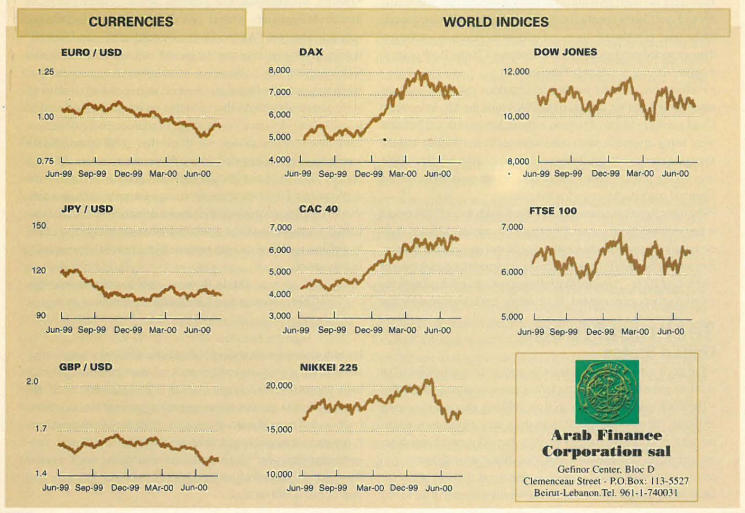
• The dollar’s short-term momentum versus the euro is constructive.
However, the greenback’s medium and long-term oscillators have
peaked or are close to peaking, its sentiment measures are overbought,
and the currency has had a breakdown through its post-October
uptrend line. On balance, it is more likely than not that the dollar has
recorded an important top against the euro as well as against other European
currencies. The dollar has already moved into major chart support
at $/euro 0.952-to-0.977.
• The dollar is in much better shape against the yen. Its technical condition
versus the Japanese currency has improved across the board lately,
pointing to better prospects in the weeks ahead. Even so, the greenback
is currently stuck in a multi-month trading range. That range displays
strong first resistance at ¥/$ 109.10-to-110.80; second resistance
begins at 111.70. The dollar will probably have to break out through those
levels to lay the foundation for a sustainable rally.
• Is there a threat of commodity inflation in the air? “No, but …”. A
look at the Dow Jones-AIG Index and its components tells the story.
The index is up by about 14% so far in 2000, but it would be down
if it did not include the 55% jump in its energy component. The
industrial metals area is off by 7% since the beginning of the year,
precious metals have lost 5%, livestock is up by 1%, and soft
coffee, cocoa, sugar and cotton, are more or less unchanged.
Walter G. Murphy, senior international market analyst
William O’Neill, senior commodity strategist