Trading places with Adonis Insurance and Reinsurance
(ADIR) would be an irresistible proposition to many of
Lebanon’s insurance companies. The company knows
how to tum a profit and, let’s face it, at the end of the day that’s what
business is all about. In the eye of the hurricane that is Lebanon’s
turbulent insurance sector, ADIR operates as if completely
immune to the surrounding mayhem.
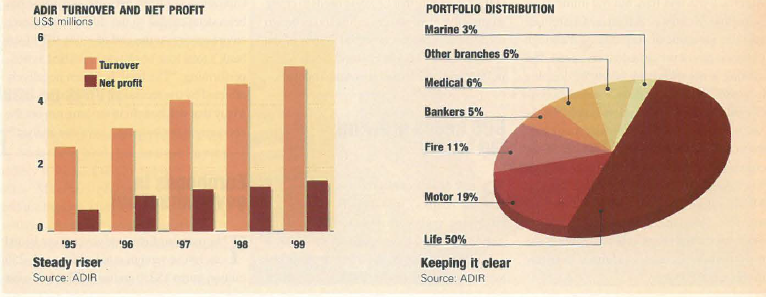
Accounting for less than 2% of the $400 million in life and nonlife
premiums sold last year, ADIR ranks 16th overall with a portfolio
of just $5.2 million. That’s up almost 100% from $2.7 million
in 1995. The increase in premiums has been more than matched by
profits, which rose by 135% from under $700,000 to $1.6 million
in the same period. So how does ADIR do it when the industry has
been caught in a nasty storm?
The insurance firm’s strength is derived largely from its parent company
Bank Byblos, which provides more than 80% of business.
Lebanon’s second largest bank in terms of profits and third largest in
deposits and assets, Byblos has demonstrated its prowess on more than
one occasion, especially with the unprecedented leap to become the
first to offer retail products such as personal loans, mortgages and certificates
of deposit in the early 1990s. The bank’s retail products include
insurance policies guaranteeing that whatever happens the bank
will get its money back. That resulted in net advances to customers
totaling nearly $1.44 billion last year. But being approved for that housing
or car loan is an unlikely prospect without the purchase of
accompanying insurance policy from none other than ADIR.
But ADIR isn’t unique in this respect (see “Come together,”
September 2000). More than ten of the banks have established
their own insurance companies, including Banque du Liban et d’Outre
Mer (BLOM) with Arope. Others, like Banque Audi with Libano
Arabe, have either completely acquired an existing insurer, or, Like
Bank of Beirut with Arab Lebanese Insurance Group (ALIG), have
taken a partial stake in an insurer.
ADIR’s strategy is simple. It takes advantage of the captive business
through Byblos by keeping costs low. ADIR need not worry about investing
in real estate since Byblos has over 50 branches that double as a source
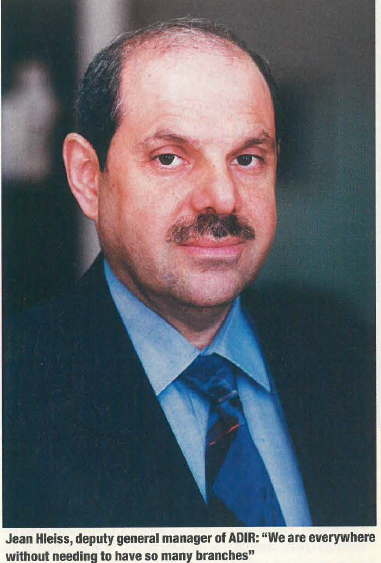
of business for the insurer. “We are everywhere without needing to have
so many branches,” says Jean Hleiss, deputy general manager of ADIR.
“And our staff is very small compared to the market, so that cost is also
reduced.” ADIR has no need for sales agents or office personnel.
Profits remain in-house, instead of large chunks being handed out as commissions.
The savings are substantial since brokers take as much as a 60%
cut on premiums in some cases. “If you Look at insurance companies that
are owned partly or completely by banks, you’ll see they have either
small- or medium-sized portfolios,” says Fateh Bekdache,
general manager of Arope insurance. ‘They’ re all comfortable if you look at
their balance sheets. All captive business, zero receivables, they get paid upfront
and at the same time it generates business on a daily basis.”
ADIR also focuses on its bottom Line by doing a balancing act with
its portfolio, which is heavily weighed in the more profitable lines.
Life insurance – the most profitable – constitutes about 50% of premiums
at more than $2.6 million. That puts ADIR fourth in the
Lebanese market after American Life (ALICO) with $51.7 million,
Societe Nationalc d’ Assurance at$ I 0. L million and Libano Suisse with
$2.9 million. But, with the exception of ALICO, none are so heavily
weighted in life as ADIR. “It’s not a secret, life insurance is a very
profitable business,” admits Bekdache. “Nowadays it’s probably the
only profitable business.” Credit Libanais d’ Assurance (CLA),
owned by Credit Libanais, similarly handles the bank’s insurance
needs with over 55% of its $2.3 million portfolio in Life, and made a
tidy net profit of $912,000 in 1999.
At the other end of the spectrum, ADIR keeps unprofitable and
volatile medical at a minimum. Just 6%, or about $300,000 of its
business, is generated from medical insurance. That makes ADIR
31st in a market that averages 50% for the medical line. “It’s a losing
product,” says Hleiss. “Our hospitalization is limited and we
only cover people who are completely insured with us. We are not
interested in having hospitalization plans, and that’s one of the main
reasons behind our profits. “AI-Fajr, for example, has a portfolio
about the same size as ADIR’s at $5.6 million. But 39%, or $2.2 million,
of Al-Fajr’s portfolio is in medical resulting in profits of less
than $160,000 in 1999 (see “Profits not insured,” July 2000).
That’s a profit margin of3%, and only LO% of ADIR’s profits. Even
tiny Middle East Assurance and Reinsurance company
(MEARCO) with a portfolio of $1. l 3 million managed $159,000
in profits – a result of staying out of medical insurance. CLA doesn’t
even provide medical insurance unless it’s a client of the bank
or someone who has purchased other policies from the insurer.
But perhaps the best part of ADIR’s arrangement is what it means
to collection. Most insurers have to resort to drastic measures in order
to sell, including allowing extended credit facilities. While the
average collection period of the market fluctuates between four and
five months, there are many that allow as long as a whole year. ADIR
doesn’t have to deal with all this nonsense. ALI its accounts are closed
at the end of each month, meaning no receivables, which translates
into liquidity. Collection for insurance is included in loan payments.
That means premiums are secured with collateral along
with the loans themselves. Regardless, they hardly have to worry
about defaults on payments. Since captive business results from loan
applications, the second the client fails to pay the insurance premium
their credibility with the bank is jeopardized. “The bank will
assume the client will not make good on its payments on the loan
either,” says? Elie Torbey, manager of the life and bancassurance
departments at CLA. “They will take corrective measures.”
Other companies have to chase down their money. Some even have
receivables that exceed half their sales. “We don’t allow that,” says
Hleiss. “It reduces our expansion but we have made a choice. We
sacrificed expansion but we collect our money.”
Even with these advantages ADIR seems to operate in a naturally
protective mode. “In all our business we do very selective underwriting,”
says Hleiss. “For life insurance we ask for exams. Every
file is studied by us, our doctors and our reinsurers.” This reduces
the loss ratio. “I know some companies don’t do this for small
amounts, and these cases have a tendency not to disclose all the
facts,” he says. When a claim comes in the insurer might deny payment.
ADIR wants all the cards on the table upfront. “If you don’t
do that you’ll lose,” warns Hleiss. “We insist on having everything
clear at the beginning and we pay without questions. We have to
be cautious because we have the bank’s name to protect.”
ADIR’s success can’t simply be put down to its relationship with
Byblos. Not all insurers that are associated with banks are doing as
well. Over 50% of Arope Insurance’s $5.5 million portfolio is either
captive business from BLOM, or the bank’s products, yet their
profits for 1999 were just $474,000. A third of this insurer’s total portfolio,
or $1.65 million, is in medical. And direct sales-meaning neither
the bank nor brokers are involved-account for 30% of its portfolio,
while broker business comes in at 15%. That translates into
commissions, salaries and real estate expenses.
There are those who argue that catering solely to a bank’s needs
has its downsides. Allowing for other sources of business can be
important to increase a portfolio. “It’s not healthy to depend on the
bank all the time,” says Bekdache. “Direct business will generate
more income for you.” Salam Hanna, general manager of Libano
Arabe, which caters to Banque Audi, concurs: “Of course you have
a much faster collection, but it’s harder to grow your portfolio.”
CLA is a good example of a company that has found a balance
between bank business and outsourcing. While handling captive
business from its parent bank, it also provides services to over a
dozen other financial institutions, specifically in the area of credit
card covers, one of the factors that has led to the firm’s growth
beyond solely catering to Credit Libanais.
All in all, ADIR ‘s strategy is elegant. It avoids the hassle of collections,
cuts costs and has a constant flow of business. Sure that
has its limitations, but considering ADIR’s returns, who cares
about limitations.