
No stop sign
Banque du Liban et d’Outre-Mer (BLOM) keeps plowing ahead on profit growth. The leading Lebanese bank in terms of assets, deposits and profit volume earned $39.3 million in the first half of this year, a 14.6% increase compared to the same period in 1999. Deposits climbed 19.4% to $4.7 billion and assets grew to $5.4 billion, up 20%. BLOM’s near-stellar performance contrasts sharply with the rest of the banking sector. Last year the average profits for most banks in the Alpha group fell 3.7%, according to Bankdata Financial Services.
“BLOM’s profits so far this year are not surprising,” says Nicolas Sawan, head of trading at Lebanon Invest. “It has proven over the years that it can thrive on adverse conditions.”
But despite its profit power, there is little interest in the bank’s GDRs. Its shares have dropped 17% this year, from $27.1 to around $22.
Up in the world, down in the ranks
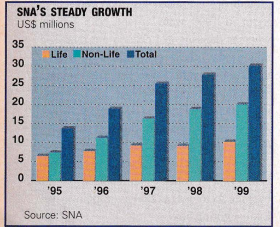
Société Nationale d’Assurance (SNA) dropped to third place in the insurance market in 1999. Its premiums, in terms of both life and non-life, totaled $30.1 million, just shy of second-place Medgulf’s $30.4 million and way behind Alica’s $59.7 million.
SNA Holding (Bermuda), the parent company, declared a net income of $3.2 million for the year, up 17.25% from $2.7 million in 1998. Last July, Assurance Générale de France (AGF) raised its stake in SNA to 51% in a deal worth $11.8 million. Banque Audi owns another 10%, while Lebanon Holdings has a 5% stake.
“The alliance with AGF has allowed SNA to further modernize its accounts, bringing them up to international standards,” says Rosette Gharzouzi, head of corporate communications at SNA.
In February 1999, SNA was planning to go public on the Beirut Stock Exchange, but the move was postponed.
“The market conditions just weren’t favorable. It wasn’t the right time to make such a move,” says Gharzouzi.
Hit me baby one more time
The threats just keep on coming. One month after Standard & Poor’s (S&P) told the government to either get its fiscal house in order or risk being downgraded, Saudi prince Al-Waleed bin Talal raised a yellow flag of his own.
If the economic atmosphere in Lebanon doesn’t improve and the government doesn’t speed up the issuance of building permits in Solidere, he’s threatening to cancel a $250 million project to build a Four Seasons hotel in the Beirut Central District.
“If Al-Waleed pulls out, it will be a heavy blow to Solidere,” says economist Marwan Iskandar. “He hasn’t decided to withdraw, but it is a warning to authorities that they must facilitate permits.”
Last year, Solidere’s profits tanked from $54.2 million to $3.7 million. A decree to allow the souqs to be developed—an area that could give a boost to Solidere’s business—has been sitting with the Council of Ministers for more than four months.
“There are many interpretations of the permit problem, but one thing that is definitely true is that Michele Murr, the minister of interior who supervises municipalities that grant permits, has a standing dispute with Solidere over the Murr Tower,” says Iskandar. “It’s not necessarily true that he’s wrong on this issue, but certainly he’s wrong to use it to stop the entire project. It’s hurting the country.”
Repeated attempts to reach Murr for a comment have failed.
SGLEB increases stake in Fidus
Société Générale Libano-Européenne de Banque (SGLEB) has acquired a further 16% of local brokerage firm Fidus for an undisclosed price. That brings SGLEB’s share up to 67%.
“We decided to increase our participation because we are satisfied with the results of the company,” says Nadim Moujaes, head of development at SGLEB.
The bank initially bought 51% in the brokerage house in March 1999, which gave Fidus access to the global trading network of the French bank. At the time SGLEB was given the option to eventually increase its share an additional 16%.
SGLEB ranked ninth in profits last year with close to $18 million. But that’s down from 1998’s $19.7 million and seventh-place ranking. Established in 1994, Fidus carries out more than $6 million worth of transactions a day. Last year it handled 30% of trading on the Beirut Stock Exchange but has increasingly emphasized international markets because of the stagnation on the local bourse.
Banque Audi voted Lebanon’s best bank … again
For the fourth time in five years, Euromoney magazine has voted Banque Audi the best Lebanese bank. Euromoney, a monthly business magazine published in London and distributed in around 120 countries, used as its criteria the bank’s level of excellence, reputation, client base, financial indicators, level of innovation and ability to attain objectives.
The magazine also voted Audi as the best securities house and best domestic investment bank.
“It’s almost becoming a tradition,” says Gaby Kassis, deputy general manager of Audi.
This comes despite the continued fall in Audi’s profits. Earnings for the second quarter of 2000 dropped by 10.9% and for the first half by 11% over the same period of last year. In other news, Audi recently signed a multimillion-dollar enterprise agreement with Microsoft to provide fast and standardized deployment of software at the bank.
Just slightly better
Bank of Beirut has reported that its earnings for the first half of this year grew by a mere 0.37% to $9.52 million, compared to a nearly 27% earnings boost during the same period of 1999. Sami Saliba, BOB’s financial controller, blames the recession for the poor performance.
In addition, he says that there were a number of added expenses carried over from BOB’s merger with Transorient Bank last year.
“Everything goes as a function of the environment,” says Saliba. “If we compare ourselves to the rest of the banks, many of whom have had negative growth, 0.37% is not a bad achievement.”
A number of Lebanon’s biggest banks, including Fransabank, Banque Audi and Banque Saradar, suffered a significant decline in profits between 1998 and 1999, according to an unaudited report by Bankdata Financial Services.
Making sense of a big mess
The International Finance Corporation has been asked by the Central Bank to conduct an assessment of Middle East Airlines in preparation for the possible eventual privatization of the country’s faltering national carrier.
“The study will offer several recommendations including partial or full privatization, or a strategic sale to another national carrier through a private placement,” says Rania Fathallah, senior associate of Middle East Capital Group.
The Central Bank controls a 99.37% share of MEA, which has lost $360 million since 1996. The airline, which has just nine planes, employs 4,500 people, many of whom are expected to lose their jobs if the carrier is privatized.
The IFC is charging $1.3 million for the assessment, which is expected to take 17 months. Additionally, the IFC will extend a 20-year loan of $40 million to $60 million to help cover end-of-service indemnities for the staff of MEA and other state-owned enterprises who are made redundant by privatization.
The government hopes to raise about $5 billion from privatizing state-owned assets.
Bond, eurobond
Lebanon raised $500 million from its recent five-year eurobond issue. Originally set at $400 million, the issue was oversubscribed by 25% with the local banks as the main participants.
“Considering the prevailing conditions in the Lebanese economy, it was quite successful,” says one analyst. “It was easily subscribed and there was even demand for it in the aftermarket.”
Just 30% of the eurobonds were snatched up on foreign shores—the majority by Gulf investors, 5% by US pension funds and 10% by Europe.
“The government probably would have preferred to have more international investors, but that would have required an increased spread,” says the analyst.
This most recent issue, which carries interest of 9.37%, will be used to finance the repayment of a previous issuance, which matures next July.
Take my house, please
Insurance firms are finally starting to feel the squeeze of Nasser Saidi’s vice. Under a new insurance reform law, passed by parliament last year, companies are required to carry $1.5 million in capital. Those which did not have this amount were given until June 2000 to deposit half the amount they owed with the ministry of economy and trade. (If a company had $1 million in capital, for example, it was required to deposit $250,000.)
Of the 30 firms that tried to fulfill the requirement by the due date, 20 attempted to use real estate as collateral. Saidi’s response? Take a hike.
“The whole reason for requiring raised capital is to ensure liquidity should the insurers face unforeseen claims beyond their ability to settle,” says Joseph Issa, one of Middle East Assurance and Reinsurance’s major shareholders.
The ministry has been trying to encourage companies lacking the minimum requirements of the new law to merge. Fidelity, which has a portfolio of $12 million, and Iskan, with $3.5 million, are the latest two companies to follow the ministry’s advice and join forces.
Go south, young contractor
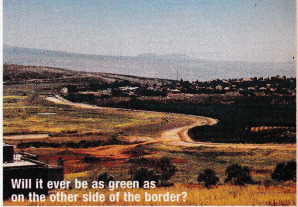
Development funds have started trickling into the newly liberated South, whetting the appetites of struggling contractors. A recently approved $1.2 billion government plan to develop the region includes spending $896 million on infrastructure projects over the next five years.
About $40 million to $50 million has reportedly been released so far. A further $300 million worth of financing is being arranged and will be put into projects a year from now. Projects worth between $500 million and $550 million will be carried out at a later stage.
The World Bank has extended an $80 million soft loan to finance infrastructure projects, $15 million of that is for southern municipalities. And the Kuwaiti government has granted $20 million for reconstruction and development in the region.
But not all of those in the construction business are confident that the money will be spent properly. The syndicate of contractors recently met with the prime minister to request that all construction projects be handled by the Ministry of Public Works and be delegated to companies through open tenders.
“We were requesting that contracts be done in the normal way, through proper tenders and proper qualifications,” said Fouad Khazen, president of the contractors’ syndicate.
He says that a number of projects have been designated to companies without tenders.
