W orld commodity prices
have strengthened signifi-
– candy since mid-1999, as
evidenced by the 25% rise in the IMF
index of primary commodity prices in
the past 12 months. While much of the
credit for this recovery goes to the
upturn in oil prices, non-fuel commodities
have also shown strength this
year with the index of non-fuel commodity
prices rising by 5% over the
nine months to June this year.
However, non-energy prices have yet
to recover fully from their late 1990s
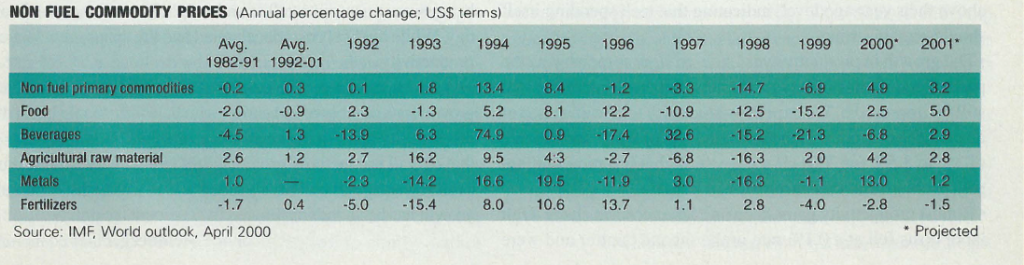
slump when they fell by as much as
25% over the period between the beginning
of 1997 to the middle of 1999. The
IMF non-fuel commodity price index fell
by 14.7% in 1998 alone. Prices are
expected to continue the recovery that
started in 1999, due to stronger economic
growth and reductions in excess
supply of certain commodities.
Cycles are the dominant feature of
movements in world non-oil commodity
prices, challenging policy makers in
many developing countries that depend on
primary commodity exports. This last
cyclical decline has been more severe
than the previous two declines in the
early and late 1980s due to the more pronounced
than usual concurrence of
strong supply and demand shocks. The
slowdown growth in global demand during
19’97 /98 coincided with continued
production increases. Most of the decline
in non-energy prices was due to the Asian
crisis and the recession in Japan, especially
as several of the Asian countries were a
major source of demand for primary
commodities prior to the crisis. At the
same time, production of many commodities
had continued to increase at a
rapid pace, owing to technological
advances that cut production costs. In the
case of metals and fertilizers, oversupply
by producers to make up for the reduction
in revenues maintained the downward
pressure on prices. For certain agricultural
commodities, prolonged periods of
favorable weather in the US and Europe
have resulted in particularly good harvests,
preventing major rises in price.
The recent pickup in non-fuel commodity
prices is due to a reversal of the
supply/demand factors that triggered
the decline. World economic growth is
expected to be around 4% in 2000,
higher than initially expected, and supporting
a recovery of commodity
prices. However, while non-fuel commodity
price indices appear to have bottomed
out last summer and raw material
prices are increasing as the world
economy revives, the recovery is likely
to be slow. Stocks for most commodities
are still relatively high, and new capacity
is coming on stream. This means
that it will probably take longer than
usual for the upturn in demand to translate
into a significant increase in prices.
According to the IMF, non-oil commodity
prices are projected to increase by
5% in 2000 and between 3% to 4% in
2001. One important distinction
between the recovery in oil prices and
non-oil commodities as a group is that the
upturn in oil prices, while supported by
the recovery in world demand for oil, was
mostly driven by significant supply cuts
by OPEC and other oil producing countries.
On the other hand, producer cartels
in other commodity markets have largely
failed and producers in these markets
are unable to follow OPEC’s example in
reducing excess supply. Ample capacity
exists in countries producing non-oil
commodities, be it metal, phosphate,
petrochemicals and potash. Production
volumes should continue to ·rise in the
remaining part of 2000 as a result of the
ambitious expansion programs introduced
prior to the Asian crisis and a general
upturn in demand.
For exporters of non-fuel commodities,
the net effects of this year’s projected
increase in price hinge on the specific
commodities they export. The prospects
for Arab countries that depend on
exports offertilizers, such as Jordan and
the Gulf states, remain subdued.
According to the IMF, fertilizer prices fell
by 4% last year and are expected to
decline further, albeit at a slower rate, this
year (2.8%) and in 2001 (1.5%).
However, the surge in oil prices and
stronger economic growth worldwide
may initiate an earlier recovery.