Al-Mashrek has its sights set on
becoming the top insurer in
Lebanon – and not just in terms of
premiums. Already ranked sixth in the country
last year with non-life premiums of
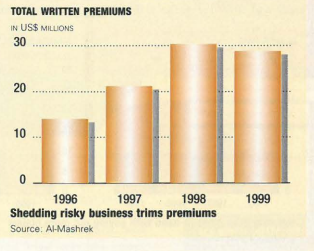
$14.5 million, Al-Mashrek’s global business
was about $29 million in 1999. That’s an
increase of more than 100% from $14 million
in 1996 (see graph). Al-Mashrek is now getting
ready to tackle the 21st century. The company
is aiming to expand both locally and
abroad, where already 50% of its business is
generated. But that won’t be so simple.
The insurance market is no longer the
carefree, anything-goes sector it once was
(see “Premium Pressure,” March 2000).
The players are faced with many new
obstacles, such as consolidation and new
government solvency requirements. Then
there are the foreign big hitters who have
moved in: Assurance Generale de France
(AGF) now owns 51% of Societe Nationale d’ Assurance (SNA), the third
largest insurer with non-life premiums of
about $20 million, while Axa bought 51%
of Societe Libano Française (SLF), the
fifth largest at $18.5 million. There are also
local subsidiaries of international firms,
such as Arab Lebanese Insurance Group
(ALIG), which is majority owned by its
parent company, Arab Insurance and
Reinsurance Group (ARIG). These firms
have the financial strength to compete
aggressively in the Lebanese market, solid
international experience in insurance and the
advantage of having names that carry a lot
of weight. Banks are also joining in the
insurance game, posing a new threat.
That aside, insurers have to find a way of
satisfying market demand, despite the relatively
low purchasing power of the population.
This has forced some to quote rates
lower than they would like, despite liquidity
considerations, and offer extended
credit facilities. If companies don’t walk a
fine line, they could easily follow Mesir,
Income and Phoenix.
All this and Al-Mashrek
doesn’t appear
overly concerned. Why
so smug? Al-Mashrek
thinks it has what it
takes. Part of its strength
comes from its reinsurers.
These help determine
to a large degree an
insurance firm’s credibility.
The reinsurers
behind Al-Mashrek are … and Swiss Re of Switzerland. All are rated
triple A. Al-Mashrek’s pricing strategies
are just as sound. The firm sets tariffs for
each branch of insurance based on statistics
gathered from the markets in which it operates.
Based on volume of expected claims
and rates offered by competitors, Al-Mashrek
works to maintain a balance
between safe underwriting and a competitive
spirit. Some, like American
Underwriters Group (AUG), sell just
below the market norm, while ALIG seriously
undercuts prices (see “New kid on the
block,” July/August 1999).
But with their financial strength (ALIG
has $7 million in capital and AUG has $4
million) and strong reinsurers (ARIG has
$1.7 billion in total assets and $460 million
in shareholders’ funds), both should be
able to cover losses in the event of unexpected
claims. Bankers, Societe Nationale
d’ Assurance and Libano Suisse are much more conservative when it comes to pricing,
with some of the more expensive rates in the
market. Al-Mashrek’s prices fall between
the two extremes.
On the collection front, Al-Mashrek also
tries to maintain a balance between liquidity
and convenient terms for its clients. For medical
insurance, the riskiest branch, it will not
deliver a policy before receiving a deposit
equal to 25% of the premium. The firm
allows no longer than 45 days for full payment. Sixty days is allowed for other types of insurance,
except in cases where large amounts are
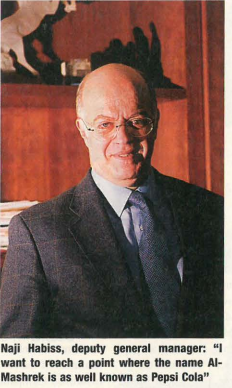
owed. “We have to be realistic,” says Naji
Habiss, Al-Mashrek’s new deputy general
manager. “Someone who buys $4,000 to
$5,000 worth of coverage
may not be
able to pay all at
once.” In such
cases, the limit is
set at three months.
“But we have to
make sure that the first thing we collect
is what we have
to put as reserves
with the government,”
he continues.
Lebanese United Insurance,
for example, demands 35% up front and a
maximum of two months to close the
account, well within the market average
of four months (see “Getting tough,”
January 2000). Middle East Assurance and
Reinsurance Co (MEARCO) leaves no
room for maneuvering, requiring all payments
up front (see “A sure thing,”
February 2000). Some, like Libano Suisse,
play it too dangerously, allowing clients
as long as five months to complete their payments
(see “The $8 million millstone,”
November 1999).
Although initially Al-Mashrek’s activities
were geared towards marine insurance, it
gradually realigned its business by extending
operations to all branches. Now, 35% of its portfolio is in medical and 5% in life. The rest is in general insurance. Of that 40%, or about
25% of Al-Mashrek’s
portfolio, is in motor
insurance. Dealing in
all branches of insurance
assures that the
firm won’t have to turn
away potential clients.
“Often we lose clients
for the branches we do
have,” says Rached
Rached, chairman of
MEARCO, “because we
don’t deal in other branches that the
client needs.”
With 35% of its business in medical, Al-Mashrek
will start working with an international
third party administrator (TPA)
which is in the process of registering to
operate in Lebanon. Though Al-Mashrek
doesn’t work with one, TPAs like Medical
Express and Mednet already handle the
medical portfolios of many Lebanese
insurers. A TPA manages its clients’ healthcare
portfolios and is responsible for ensuring
that the branch is efficiently run, that the
guarantees are in place and a sound level of
liquidity is maintained (see “Doctoring
insurance,” December 1999). With physicians
working full-time on their payroll, the
TPA will screen clients for pre-existing
medical conditions and make sure that hospitals
don’t overcharge the insurer or prescribe
unnecessary expensive treatments.
This way Al-Mashrek can avoid worrying
about the high-risk branch and focus on
the others.
A major advantage for Al-Mashrek is
chairman Abraham Matossian’s wealth of
know-how. With decades of experience in
the insurance field, Matossian is the current
chairman of the Association of Lebanese
Insurance Companies (ACAL) and was
heavily involved in the implementation of
the new law. He was also instrumental in
getting diplomas from Centre d’Etude
d’ Assurance accredited. This qualification
is essential for those who wish to work in the
insurance industry according to the new
government requirements (see “Corporate
medicine,” September 1999).
Al-Mashrek is also in the process of
restructuring its management, reshuffling
personnel to positions where they’re most
qualified. The firm is bringing in new blood
from other insurance companies, including
SNA, !’Union
Nationale and
Libano Suisse. One
example is Habiss,
who ran Libano
Suisse for more than
22 years, which
ranked fourth in
1999 with non-life
premiums of about
$19 million.
As far as the bank
threat is concerned,
Al-Mashrek is loading
its guns. It is
ready to do business
with all financial
institutions, unlike
insurance firms that
are owned by banks.
One example is
ADIR, which does 90% of its business through Byblos Bank. Banks look for securities against loans. Clients are generally required to buy insurance, ranging from car and cargo insurance to house and life insurance, depending on the type of credit. “Banks won’t give credit to someone if he doesn’t get insured,” says Habiss. “We’re creating all kinds of products for the banks’ needs.” This way Al-Mashrek can sell motor policies to those buying cars on credit and cover the dealer if the client defaults on payments.
Another advantage Al-Mashrek has over
local rivals is its business abroad. Through
affiliates and subsidiaries in Cyprus, Saudi
Arabia, Egypt, and France, the firm generated
$14.5 million
or 50% of its business
in 1999. Not
only does Al-Mashrek
bring
home the experience
derived from
those markets, giving
itself the tools
to face the new foreign
threat, but it
takes the battle to
the foreign firms’
home turf. Others
that have offices
abroad include
SNA and Libano
Suisse.
Al-Mashrek is
also seriously looking
at consolidation.
It is currently in negotiations for an acquisition with two insurance companies, though Matossian declined to disclose which ones. The move would increase the firm’s client base and assets as well as provide greater coverage of the market with an increased branch network.
“But nothing has been finalized,” says Matossian. “We aren’t even ready to apply for ministerial approval.” If it is finalized, the firm will have taken a solid step towards achieving its ambitions for growth.
But growth will also come from within. In
this sense, Habiss plans to put a greater
emphasis on life insurance, which now
accounts for about 5% of Al-Mashrek’s total
premiums. “It’s the most profitable of all the
branches,” says Habiss, “unlike medical,
which is like a running faucet with funds
flowing out continuously.” Many others
agree. “It’s the safest and most profitable
branch of insurance,” says Aline Kamakian,
general manager of Insurance Investment
Consultant (IIC). For this reason, MEARCO
hopes to acquire a company for its life
license within a few years.
Is it worth it? AUG seems to think so. It
acquired ELKA insurance, solely for its
life license. Al-Mashrek is also in the midst
of creating services that are so far unavailable
in the market. For example, those who
buy all-risk car insurance will receive a
loaner car for a few days should they have an
accident. For those with house insurance
that get snowed in, Al-Mashrek will have
the snow cleared, saving you the trouble
and saving money for them by avoiding
water damage claims. The firm also plans on
introducing a 24-hour hotline service for
emergency assistance. “I want to reach the
point where the name Al-Mashrek is as
well known as Pepsi-Cola,” says Habiss.
But in order to grow, Al-Mashrek believes
it has to go back a step first. It’s sacrificing
premiums by brushing off some bad and
high-risk clients in favor of a clean portfolio.
Though premiums generated locally have
increased from about $13.9 million in 1998
to $14.5 million in 1999, the non-renewal of
bad business contributed to a drop of $1.5
million in total revenues from $30.4 million
in 1998. With that, Al-Mashrek is seriously
screening all new business.
Talks are now ongoing with potential
new investors. “Al-Mashrek doesn’t need
big names to attract business,” says Habiss,
“but more liquidity can facilitate growth in
new ventures.”
Al-Mashrek is aggressive, but it does
not take the unwise risks that have brought
the downfall of others. It has also found a
balance to counter most of the sector’s pitfalls.
Al-Mashrek is confident that it is
taking the right steps. The question is
whether this will be enough to take the
business further.