Shape up or ship out. Those were the
words of warning given to insurance
companies when the new insurance
law was finally passed last May, though
the original draft legislation was prepared in
1993. It was about time that something was
done to restrain the chaotic sector. The ministry
of economy and trade had finally
taken the first real step since the 1968 law to
get Lebanese insurance companies back in
line (see ‘Corporate medicine’, September
1999). The new law is expected to shake up
the market, bringing consolidation and
pushing out the slackers, if the authorities
actually come through on enforcement.
Insurers will now have to juggle tougher
government requirements and the pressures
of a competitive insurance market.
The law requires insurance companies to raise their capital to a minimum of $1.5 million,
as opposed to the previous $200,000.
The first installment, 50% of the increase on
their existing capital, is due on June 28,
2000, while the payment of the remaining
50% is to be paid by June 28, 2001.
A company must also secure deposits for
each type of insurance it writes; the minimum
is about $500,000. A deposit of
$800,000 is required for each life and credit
insurance, $500,000 for agricultural and
$233,000 for each fire and transport. A
firm wishing to write all classes of insurance
would be required to secure deposits of
about $3.4 million, on top of the minimum
$1.5 million in capital. These deposits are
due in the same two installments.
But how serious is the ministry really?
Lebanese United Insurance (LUI), which was licensed at the end of 1998 and began
operations in March 1999, months before
the law was passed, wasn’t granted a grace
period. It had to come up with the minimum
capital and required deposits from the get-go
(see ‘Getting tough’, January, 2000).
Companies are also required to have a
realistic solvency ratio. Now the maximum
volume of premiums a company can write is
set at ten times its capital and reserves, with
$15 million being the limit for a company
with no more than the minimum capital.
These requirements are meant to give insurers
the financial credibility to honor claims.
With the weak economy, purchasing
power has been reduced dramatically so
consumers are likely to hunt for the lowest
prices available and the most lenient credit
terms. The insurer expects to face claims from just a small portion of his portfolio and
calculates rates accordingly. But if that
means cash flowing in isn’t sufficient to
honor claims, the company will have to tap
into any available assets. Mesir was forced
to close down in 1999 when its gamble of
undercutting prices failed. It was faced with
millions of dollars in claims and only a few
hundred thousand in the cash box.
Mesir also had its fair share of collection
problems. Insurers can’t afford to be too
lenient in collecting premiums, otherwise
they’ll face serious liquidity problems. In
medical insurance, for example, the probability
of receiving claims is much higher and
less predictable than for car insurance. When
premiums are collected slowly, claims are also
paid slowly, giving the company a bad reputation.
And if premiums are collected too
slowly, the insurer runs the risk of bankruptcy.
LUI doesn’t tolerate long collection periods;
it gives two months at the most with 35%
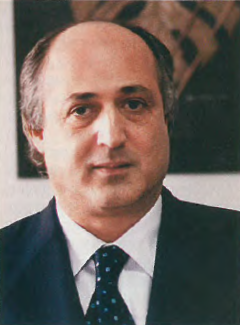
up front. “I collect premiums up front so
when it’s time to pay claims, the funds are
there,” says Hassan Harb, managing director
of LUI. Middle East Assurance and
Reinsurance Co (MEARCO) is strictly cash and carry with no credit allowed except in rare
cases. Al-Mashrek bases its collection period
on the risk involved, with 45 days for hospitalization
and a maximum of 90 days on the
whole portfolio.
Insurers are faced with a dilemma.
Lowering rates to meet market demand
jeopardizes the firm’s solvency. But opting
for solvency by raising prices, discourages
potential clients. “Often we have to turn
clients away because we don’t allow credit
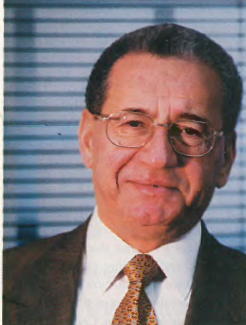
facilities,” says Rached Rached,
MEARCO’s chairman. “But we have no
outstanding claims as a result of our policy
to remain liquid.” Companies aren’t finding
it easy to strike a balance between competitive
business moves and caution.
Unless, like Arab Lebanese Insurance
Group (ALIG), you have the financial
backing of Arab Reinsurance and
Insurance Group (ARIO), one of the Arab
world’s largest reinsurers with assets of
over $1.7 billion, cutting prices to get market
share is a sure ticket to disaster (see
‘New kid on the block,’ July/August,
1999). Had Mesir’s portfolios been adequately
reinsured, the company probably
wouldn’t have gone bankrupt.
The credibility or risk rating of a reinsurer
makes a big difference when it’s time to pay,
as does the amount of retained risk. The
greater the risk retained by the insurance
company, the more profits-or losses – it can
make. The reinsurer may be less expensive
and allow the insurance company to offer
lower rates, but when it’s time to pay claims,
will it? Ask Mesir. Such decisions should be
based on the risk involved, the firm’s solvency
ratio and its collection period. The law now
requires that a reinsurer be rated B or better.
The maximum risk the local insurance firm
is allowed to shoulder is 5% of its shareholders’
equity, but even at that its assets are
highly involved and may need to be liquidated
quickly if the company’s retention is hit too
many times. Insurers need to calculate the
amount of risk it retains so that it doesn’t need
to liquidate assets to pay liabilities. The higher
a reinsurer’s rating, the better its support to
insurance firms. But it will also require that
the insurer charge higher premiums.
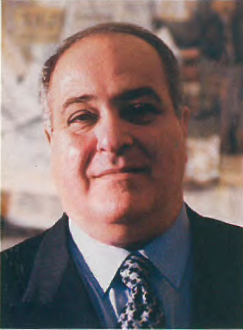
Again, back to the fine line. “Although it’s
a competitive industry with each company trying
to get more business, it’s also a dangerous game,” says Abraham Matossian, chairman of
Al-Mashrek and president of the Association
of Lebanese Insurance Companies (ACAL).
Finding the right combination of prices and
credit terms isn’t so easy. Simply writing a lot
of business and competing to be number one
or two means nothing. “Tomorrow you can
decide to undercut your premiums and be
very free in your collections, absorbing half of
the market, but how long you can continue
being number one is another story,” says
Matossian. “You cannot tell clients when it’s
time to pay that they’ll have to wait until you
collect your dues.” Income, Phoenix and
Mesir tried to get market share by undercutting
prices and allowing extended credit
terms. All were forced to close their doors.
There’s also the matter of what classes of
insurance one operates in. Can a company
decide not to go into medical because of the
risk and headache involved? Some do.
MEARCO has a ‘you want medical insurance,
go somewhere else’ policy. But that
might mean the insurer loses out on the
chance to insure the same person’s car,
house, business or life. Medical makes up
about 12% of LUI’s business – low by
industry standards. Despite offering medical
insurance, LUI is careful about whom they
accept. Mesir went heavily into medical
and lost just as heavily, while its other portfolios
weren’t enough to compensate for
that. For some, it’s just not worth the risk.
Insurers are finding their livelihood
threatened elsewhere as well. Banks, which
contributed 15% to the GDP in 1999, are also
playing the insurance game. Try applying for a loan at a bank. The credit officer will
probably direct you to a particular insurance
company. For a personal loan you will need
life or disability insurance covering about
110% of the loan. Housing loan? Add property
insurance to that life policy. Car loan?
Take out all-risk insurance. It might be difficult
to disregard the suggestion if you
really want the loan.
Though far behind the world trend that
has seen a convergence of banking and
insurance, a grow-ing number of Lebanese banks are either setting up
their own subsidiaries
or buying
shares in already
established insurance
firms. Banque du Liban et d’Outre Mer
(BLOM) has Arope Insurance, Banque Audi
now owns Libano Arabe and part of Societe
Nationale d’ Assurance (SNA), Bank of
Beirut owns 10% of ALIG, UBL has ties with
LUI, Byblos Bank owns ADIR, Fransabank
owns a chunk of Sofrace.
For the banks it’s all pretty profitable,
though it doesn’t leave too many choices for
the consumer. The question for insurance
firms is what it leaves for them. Can they
come up with the funds needed to increase
their capital or will they stop writing business? Can they meet the market
demands? Can they
remain standing in
the face of greater competition? Insurance
firms say they can. MEARCO, which currently
has a capital of $400,000 (see ‘A sure
thing?’ February, 2000), intends to come up
with the funds itself. “We will not bring in
new investors,” says Rached. “The present
shareholders will provide the amounts
required as each due date comes around.”
That’s $550,000 this June, and another
$550,000 a year after that. But there’s still the
matter of coming up with the required deposits. For those
lacking the financial
strength, one
alternative is to
bring in new
investors to increase their capital. Another is to merge.
But that’s not an easy prospect in
Lebanon. While some companies see new
investors as less control and a smaller
share of profits, others see mergers as a sure
way of losing their identity. “They keep
meeting with each other in order to reach
some form of agreement, but the meetings
always break up when it’s time to decide
who will run the company,” says Aline
Kamakian, general manager of Insurance &
Investment Consultant (IIC). “Those who
already have the funds have nothing to
worry about. American Underwriters
Group (AUG), is capitalized at $4 million
and has assets of about $12 million. ALIG
has $7 million in capital.
These might just face less competition, as
it is generally believed that many undercapitalized
companies will not be able to
come up with the funds and will have to close
down. But the question is whether the ministry
will have the guts to be as tough as it is
on start-ups when it comes to pulling the plug
on existing firms that don’t make the grade.
“Only about two thirds of the companies in
the market will probably remain,” says Naji
Habiss, deputy general manager of Al**-**Mashrek,
“with about eight or ten major
players holding the majority of the market.”
Lebanon is a small market. There are
more than 70 insurance companies fighting
over a few hundred million dollars in premiums.
Consolidation would reduce that
number, while solving the capital and solvency
dilemma. Does it really matter who’s
running the show, if the other alternative is
being forced to close down. Remember
Strikers insurance. It was in trouble due to
price competition and was acquired by
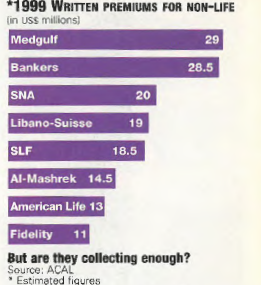
Medgulf, which now holds the number one
position in the non-life market with total premiums
of $29 million from the Lebanese
market in I999 (see graph). Large foreign
insurance companies are entering the
Lebanese market. Societe Libano
Francaise (SLF) sold 51 % of the company
to AXA while 51 % of Societe Nationale
d’ Assurance(SNA) is now owned by
Assurance Generale du France. Vulnerable
companies have no chance of surviving in
such an aggressive industry, especially in the
face of international giants. The only way
they can survive is to merge.