Morocco
The bourse in Casablanca shrugged off a series of
healthy corporate results and continued to linger in negative
territories. It is estimated that overall corporate
profits for listed companies surged 12% in 1999; however,
this failed to pull the Casablanca Stock Exchange
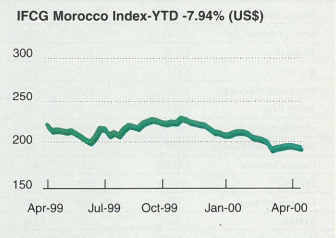
(CSE) out of its doldrums. Since the beginning of the
year, the market has shed almost 8% as institutional investors
remained on the sidelines, waiting for firm plans on the
partial sale of state-run firms such as Maroc Telecom and
Royal Air Maroc. Although the rise in average net profits
indicates future signs of recovery, only a resumption
of institutional buying can lift the market’s spirit.
EGYPT
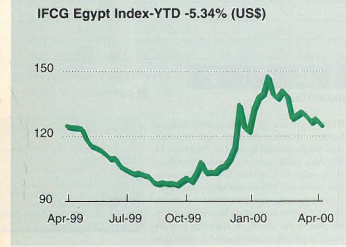
Egyptian equities continued to lack momentum, remaining
on a downward trend accentuated in the last few weeks by
worries about the stability of the Egyptian pound. Trading
was mostly concentrated in a handful of traditional blue
chips capturing the bulk of activity. Egyptian Media Production
continued to maintain a negative correlation with
MobiNil as investors kept on shifting their positions between
the two stocks. However, investors reacted positively
to news that Egypt will be included in the Morgan Stanley
Capital International (MSCI) emerging market index in
November 2000. The inclusion is expected to reinforce the
bourse’s liquidity by attracting larger foreign inflows, especially
from US investors.
JORDAN
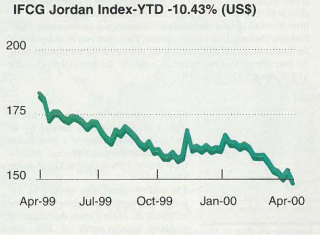
Fresh selling pressure and a dearth of positive market
news combined to drive the market index below the
150 psychological support level to reach its lowest
level since the end of 1996. Following the foreign
selling spree that has taken place over the past few
months, net non-Jordanian investment on the bourse
stood at a mere $3.7 million at the end of March,
compared to $18 million over the same period last
year. Market capitalization fell from $5.8 billion at the
beginning of the year to $5.4 billion at the end of
March, driven lower by losses in the industrial and
banking sectors.