
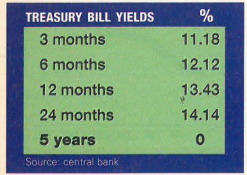
The government demonstrated its creative
inclinations, or that its feet are
not entirely on the ground, when it
launched five-year interest-free T-bills
geared towards the Lebanese expatriate
community. What an altruistic lot those
emigrants must be. They’re apparently
willing to forego possible return-generating
investments in order to lend a helping hand
to the debt-ridden government of their distant
homeland. Sounds more like charity
than a sound investment instrument. “I
don’t think anyone is that generous, especially
the Lebanese,” says one analyst. “It’s
pie in the sky.” And we’re not talking about
chump change, either. Each T-bill will be
sold for $100,000. In real terms, ‘investors’
are guaranteed that upon maturity the T-bills
will be worth less than the purchase price.
The T-bill special was announced at a recent
conference for the Lebanese expatriate business
community held in Beirut. The finance
ministry has set its sights high, hoping to
raise some $10 billion, in other words, find
100,000 Lebanese willing to part with
$100,000, to retire a large chunk of the $22
billion debt. “But expats won’t put money into
the country until they see clear signs of the
government getting its act together,” predicts
the analyst. Even then, they might prefer a
chance, however slim, of making a gain.
Shout it out
The government has given the go-ahead
to continuous trading on the Beirut
Stock Exchange (BSE), a move that might
pump some new life into the stagnant
bourse. Trading will start with fixing, followed
by two hours of an “open outcry” session. There will be a 5% limit to price fluctuations
in both fixed and continuous trading.
The BSE will have the freedom to increase
price limits and trading times in the future.
“We prefer to start with two hours of trading,”
says Fadi Khalaf, the market’s chairman.
“We don’t have enough volume for, let’s
say, four hours of trading. When volume
increases, we can increase trading time to
three, four, five hours, whatever the market
needs.” Computerized continuous trading is
scheduled to start next spring, with technical
assistance from the Paris bourse. But most
analysts are skeptical that continuous trading
is the key to increasing trading volume.
“Continuous trading will have minimal
impact in the near future,” says one analyst.
“What is needed is an economic recovery and
more listings, hopefully done through privatization
first. However, this government is
notorious for being slow. So an increase in
trading on the BSE will probably take time.”
Here I am to save
the day
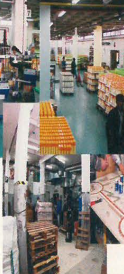
Lebanon’s industries are
about to get a much-
needed shot of
adrenaline. The
European Union
has signed an
agreement to
extend an 11 million-
Euro grant
of $10 million, to
finance an industrial
modernization
program.
The grant will be
used to modernize
some 200 small and
medium-size businesses
in order to
improve the competitiveness
of the
Lebanese industrial sector.
In addition, the ministry of industry and the
United Nations Industrial Development
Organization have devised a three-year $4.5
million program for the development of local industry. “Every bit of aid is a step forward,”
says Fady Abboud, chairman of the North
Metn Industrialists’ Association. But, he
adds, grants are not enough to make local
industry competitive. Steps must be taken to
reduce the high costs incurred by local industries,
he says.
Borrow some more
The Lebanese government will cover
eurobonds that mature in July with a
$400 million rollover issue. It will be a five-
year dollar bond. Holders of the bonds will
be able to exchange their existing paper for
the new bonds, while it will also be for sale
on a cash basis. The spread is likely to be at
least 300 basis points higher than US
Treasuries. The widening of the spread is
believed by many to be the result of shrinking
investor confidence in Lebanon.
Recently, Standard & Poor’s (S&P) put the
country on CreditWatch and might downgrade
Lebanon in the fourth quarter.
Georges Corm, minister of finance, argues
that S&P’s position had little impact on the
spread. “Because of changes in the US T-bill
rate, spreads are getting thinner. You
have to increase the spread to keep a
similar yield for investors,” says Corm.
He expects the bulk of purchases to
come from local and Gulf banks.
The rollover eurobond is
expected to have a coupon
between 9.25% to 9.5%.
Just in time
Two out of three Lebanese
banks planning to issue
eurobonds have proceeded
with their debt issues. Credit
Libanais issued a three-year
bond worth $55 million. The
paper carries a floating rate
with a yield of 230 basis points above the
three-month Libor rate. Bank of Beirut
issued a three-year eurobond worth $60 million.
It carries a floating rate and offers yields
of 225 basis points above the three-month
Libor rate.
“The purpose is to have a diversification of
resources and stability. The CDs are for three
years while deposits for customers are for 50
days [on average],” says Elie Abimrad, Credit
Libanais’ financial controller. The debt issues
could not have come at a better time. Standard
& Poor’s is threatening to downgrade
Lebanon in the fourth quarter if the government
does not take serious action to reduce its
deficit. If the banks had waited, they might have
paid higher rates on their bonds.
Another bank
bites the dust
The central bank intervened to prop up
the struggling Inaash Bank. The bank
had accumulated $40 million worth of bad debt
that had not been provisioned. A new general
manager for Inaash was appointed by the central
bank, which also asked the family-owned
bank to close at least $20 million in loans that
might violate article 152 of the code of money
and credit concerning lending to members of
the board or related parties.
“It’s typical central bank behavior. They’re
very keen to maintain a decent and clean banking
sector,” says Nicholas Photiades, analyst
with Thomson Financial BankWatch. “But at
the end of the day maybe you need to have a
bank fail to send a signal to the others.”
According to Photiades, Inaash was a small but
aggressive bank that wanted to modernize.
“But I think it bit off more than it could chew,”
he says.
Two of Lebanon’s top ten banks appear to be
interested in acquiring Inaash, which last published
financial results in 1998. At that time, the
bank had about $300 million in assets, loans
worth $115 million and just $31 million in
provisions.
Investor friendly
The Investment Development Authority of
Lebanon (IDAL) has announced that
its recently established one-stop-shop service
has been a resounding success. The
agency claims that it has received applications
for projects worth $300 million.
Furthermore, the agency helped the Hilton get
a license to build a $100 million hotel in the
Beirut Central District, as well as a $11 million
hotel called the Oasis in Soufar and a $6
million residential complex in Aley. “These
projects appear to be genuine,” says Nassib
Ghobril of Lebanon Invest. “Even the sponsors
of the projects concur that IDAL helped
them get licenses.”
Fund having little fun
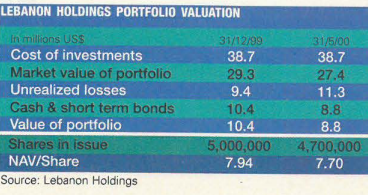
The value of Lebanon Holdings, the only
closed-end fund listed on the Beirut Stock
Exchange (BSE), dropped from $39.7 million
to $36.2 million during the first five months of
this year while the market value of its portfolio
(excluding cash and short-term bonds) fell
from $29.3 million to $27.4 million. The 6.5%
market value drop was not as bad as the BSE’s
13.5% decrease in the same period. To help stabilize
its net asset value per share (NAV),
which slipped from $7.94 to $7.70, the fund
bought back 6% of its shares this year.
Lebanon Holdings’ shares, which rarely
change hands, are priced at $5.75, 25% below
its NAV. According to Khalil El-Khoury, associate
at Lebanon Invest Asset Management
and the investment advisor for Lebanon
Holdings, Lebanese stocks’ valuations have
become ridiculously low. “We believe that the
market bottomed out,” says El-Khoury, “and we
think that now is the time to buy.” Banque du
Liban et d’Outre-Mer’s P/E ratio, for example,
is six times below last year’s earnings.
Lebanon Holdings’ position in Societe des
Grands Hotels du Liban, which owns
Vendome Hotel and recently opened
Phoenicia, has already gained 10% this year and
the company is expecting to increase its earnings
from $3 million in 1999 to $15 million in
2000. The problem is that the trading volume
for Lebanese stocks has not picked up.
According to analysts, if the BSE is ever going
to pick up, the country will need an economic
boost. Privatization would encourage more
companies to list on the BSE and a comprehensive
peace agreement would increase
interest in Lebanese stocks.
Banking on the South
Good news for banks interested in opening
branches in the newly liberated
South. The central bank has decided to grant
three branch licenses for every commercial
bank planning to open branches in the area.
The standard central bank policy has been to
allow commercial banks to open just two
branches per year, one every six months.
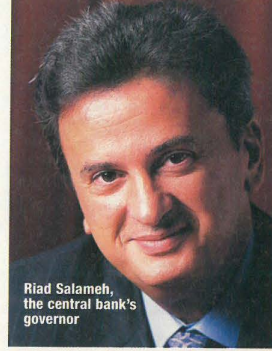
Now, says Marwan Nsouli, vice governor of
the central bank, “as soon as they [banks]
submit requests with proper feasibility studies,
they will immediately receive the licenses.”
He adds that several requests to open
new branches have already been given to the central bank. “You have to
go to your customers, not
wait for them to come to
you,” says Mounir Freiha,
operations manager of the
First National Bank’s
Hamra branch. “The better services you give your
clients, the better deposits you receive.”
