
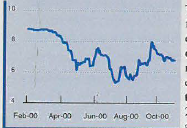
The political stagnation resulting
from the long break between the
end of the parliamentary elections
on September 3, and the appointment
of a new government by the
end of October, is taking its toll on
the market. Solidere’s GDR fell
2.41 % to $7 .075 (22/9), then fell
another 1.06% to $7 with the
materialization of S&P’s downgrades. International investors continued
trading cautiously as uncertainty surrounding the identity of the new
prime minister was still in question, though sentiment is leaning toward
Rafic Hariri. Solidere’s GDR lost 1.07% to finish the first week of
October at $6.925 (6/10). The escalating tensions in the Middle East
alarmed international investors who registered their concern by exiting
Lebanese GDRs. Solidere lost 2.17% to $6.775 (13/10).
AUDI
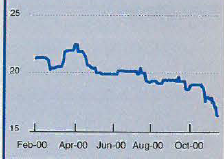
Two downgrades from international 25
agencies negatively affected Audi ‘s
GDR, first S&P credit downgrade of ~
Lebanon’s sovereign rating, as well as 20
Bank Audi and two other banks, citing
concerns on the deteriorating public
finances. Audi’s GDR fell 1.06% to
18.65 (22/9). Rating agency Fitch
IBCA then downgraded Bank Audi’s individual
rating, voicing concerns that asset quality will be affected by the
ongoing economic recession. Audi tumbled 4.83% to $17.75 (29/9). It then
fell another 2.37% to $17.33 (6/10) as international investors saw the political
stagnation, resulting from the transition of power, as negative and persistent
to Audi’s outlook. The increasing political instability in the occupied territories
crossed the border into Lebanon, driving Lebanese GDRs south, with
Audi’s GDR losing the most and dropping from 6.64% to $16.18 (13/10).
BLOM
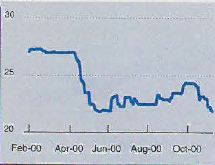
S&P lowered its rating for BLOM
in line with the sovereign downgrade
as concerns mounted about
asset quality during the economic
recession. BLOM lost 0.72% to
$24. 125 (22/9), then plummeted
4.04% lo $23.15 after a volatile
week that saw its, price fall to
$22.85, but rebounded by the end
of the week on rumored foreign
buying. The economic and political freeze did not impress investors, but
BLOM attracted some buying leaving its price at $23 (6/10), a 0.65%
weekly decrease. The rising troubles across the border were immediately
seen by wary investors as the first signs of political instability in the
region. They sent BLOM’s GDR down 4.78% to $21.9 (13/10).
BLC
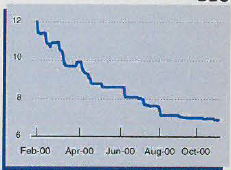
Going along with the market
sentiment, BLC’s GDR edged back
slightly, 0.36%, to $6.95 (22/9), as
the vacuum in the political arena
started 10 weigh on the economy.
BLC was not specifically affected
By the downgrade by S&P. The rating agency cited the overall
economic recession as the main reason for
the downgrade, while investors
believed that the old news was already reflected in the price. BLC held
its ground two weeks in a row (29/9) lo remain at $6.95 (6/10).
However, investors did not ignore the escalating tensions in the Middle
East that resulted in the halt of the peace process. BLC lost 1.08% to
$6.875 ( 13/10).
MOROCCO
The Casablanca Stock Exchange ended lower driven
by losses in leading shares as investors failed to
react to the announcements of first-half corporate results
that were somewhat in line with expectations. A
wait-and-see mood dominated the market as investors
kept to the sidelines awaiting the announcement
of promised reforms, including new incentives
for companies to list their shares on the stock market
and a series of tax breaks. Year-to-date losses now
stand at almost 17%.
EGYPT
The rising political tension in the region and the continued
liquidity crisis combined to deal a heavy blow to
Egyptian equities, which shed almost 20% since early
October and are down more than 50% since the beginning
of the year. This was heightened by news that foreign reserves
retreated to $14.64 billion in July 2000, down from
$15.13 billion a month earlier, while the Egyptian pound
has been traded at almost EGP4 to the dollar. In an effort
to contain the foreign currency crisis, the Central Bank issued
directives limiting daily cash withdrawals of foreign
currency to $20,000.
JORDAN
A cautious mood continued to dominate the Amman
Stock Exchange following weeks of Israeli atrocities
in the Palestinian Territories, bringing year-to-date
losses to 21 %. The banking sector led the decline as a
result of a drop in Arab Bank, which is one of the market’s
largest blue chips in terms of capitalization. Nevertheless,
statistics show that around 150 foreign mutual
funds have been operating in the Amman Bourse
over the past three years. Net non-Jordanian investment
at the bourse between August 1996 and the end
of August this year amounted to $281 million, or
around 6% of total market capitalization.
