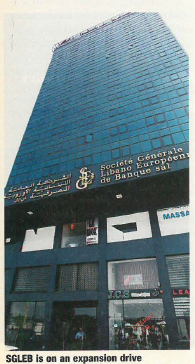
S ociete Generate Libano-Europeenne
de Banque (SGLEB) has reportedly
acquired the financially troubled lnaash
Bank in a deal worth $50 million. The
Central Bank had recently taken control of
lnaash after the J affal family relinquished its
84% stake. The bank had allegedly been in
violation of certain lending regulations.
SGLEB, which is half-owned by France’s
Societe Generale, will add 17 branches to its
30-branch network, vastly expanding the
reach of the financial institution and giving
it a presence in the South and Beirut’s
southern suburbs. “They were restricted in
opening new branches so they bought
lnaash,” says one banking analyst. SGLEB
is in an expansion mode. The bank has
moved into the Jordanian market and, a
couple of months ago, it purchased a
majority share of the local brokerage firm
Fidus. SGLEB registered profits of $18
million last year. lnaash had a capital of $10
million, assets worth $356 million and
$290 million in customer deposits in 1999
Safe bet
A rab Bank is planning a regular issue of
Investment Linked Deposits (ILD),
which will be offered with a choice of
indices. The US dollar-based deposits
guarantee that investors will not lose their
capital. The ILDs also, to some extent,
guarantee a certain return on an investor’s
money. The issue of the ILDs follows the
success of an earlier issue by Arab Bank. It
is linked to one or a basket of major
indices. These include the Nikkei 225,
Standard & Poor’s 500, Hang Seng or the
DJ Eurostoxx 50. “Instead of a fixed interest
rate, you get a return based on the
increase in the indices,” says Rim Zanabili,
senior relationship manager at Arab Bank.
“Once a new ILD is opened, clients have
four to six weeks to invest.” The minimum
deposit is $20,000.
Fast mover
A 1-Mawarid has become the first
Lebanese bank since the Israeli
withdrawal to open a branch in the former
occupied zone. The new branch is located
in Hasbaya. It has six employees and
serves a population of around 50,000 people,
including those living in outlying
.1 areas and villages. Only Fransabank –
which has been operating branches in
Marjayoun, Bint Jbeil and Jezzine since the
early ’90s – has had a presence in the
zone. “The next closest bank is at least a
half-hour’s drive away,” says Marwan
Kheireddine, AI-Mawarid’s chairman.
“Most of the local residents are middleclass
employees, so they are the ideal target
market for our retail products.”
Kheireddine is originally from Hasbaya
and his familiarity with the area and many
of the locals who live there helps assure that
he will have a loyal clienl base. The medium-
sized bank had profits of $1.1 million
in 1999, up a full 26.9% from the previous
year. Its assets increased by 32% to $30.19
million. Al-Mawarid has over 40,000
accounts and has extended 17,000 loans, averaging around $2,000 each.
Current accounts
Allied Business Bank (ABB) and
Societe Nationale d’ Assurance (SNA)
have launched a new set of bancassurance
products called H.imaya. The policies were
developed by SNA and will be marketed
exclusively by ABB to its clients. These
include savings-with-insurance plans for
education and retirement benefits as well
some traditional policies. ”We have to keep up
with the worldwide trend that makes it possible
for clients to handle all of their financial
transactions – namely banking, investment
and insurance – at one location, a sort of
financial supermarket,” says Nada Assaf,
ABB’s manager of research and development.
A number of banks in Lebanon have
either started theirown insurance company or
have bought majority shares in established
firms. Banque du Li ban et d’ Outre Mer is one
of Arope’s major shareholders and Byblos
Bank owns ADIR (see pp. 32).
The casino cashes in
Casino du Liban (CCL) saw profits
jump to $5.2 million in the first half of
2000, a 60% increase over the same period
last year. Profits were just $3.6 million in the
first half of 1999. Revenues for the first half
of 2000 totaled $42 million. The casino
saved some $5.4 million by renegotiating
contracts. It is also trying to change the contract
with Abela Development and Tourism
Company and the London Clubs responsible
for running the gaming facilities. But the
casino is not as lucky as it may seem. The
company owes the London Clubs some $5
million and the ministry of finance is
demanding that the casino pay $23 million
in back taxes from slot machine revenues, a
case that is now before the Shura council.
The new Audi
convertible
B anque Audi has launched a new threeyear
convertible bond linked to the
bank’s global depository receipts (GDRs)
and carrying a fixed rate of return. The bonds
are being marketed towards Audi’s retail
depositors. The minimum investment is
$1,000. The paper will offer investors a return
of6%, 7% or8% and are priced at$23.81, $25
and $27.03. Interest is paid semi-annually.
The GDRs’ issue price in 1997 was $27!. This
·marks the second issuance of convertible
bonds in post-war Lebanon. The first ones
were issued by Ciments de Sibline in 1996.
Retail depositors at Audi’s 61 branches will
have the right to exchange the bonds any time
during the paper’s lifetime. Over $75 million
in bonds will be issued. The first tranche, to be
sold in August, is not expected to exceed $30
million. ‘The timing is right because analysts
consider the bank’s GDRs undervalued,” says
Nabil Chaya, head of capital markets at Audi.
Rolling downhill
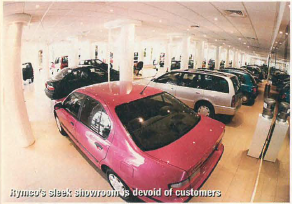
1999 suffered a drop of 17%. Until the end of
June this year, sales fell 28% compared to the
same period last year. Rymco’s shares,
which are traded on the Beirut Stock
Exchange, have been stagnant, just like the
rest of the stock market. They have
remained at or below $2.50 since the beginning
of the year.
Babv steps
S yria has taken the first steps toward
opening up its state controlled banking
system by granting three Lebanese
banks permission to open branches in the
country’s free trade zones. Societe
Generale Libano-Europeenne de Bank,
Fransabank and Banque Europeenne pour le
Moyen-Orient are allowed to provide banking
services to Syrian companies operating
within the free zones,
provided that each
bank maintains a
minimum currency
capital of $11 million.
But the move is
not likely to result in
any major financial
windfall for the
banks that open in
the zones, says
Maurice Iskander, an
analyst for Thomson
Financial BankWatch.
“There are only
about 700 companies
in the free zones,
most of which already do business with
Lebanese banks,” he says. “Yes, it’s interesting
to set up a bank there. How profitable
it will be, I don ‘t know.” But the
move could be a precursor to much bigger
reforms. The Syrian government is reportedly
studying legislation that will allow foreign
banks to open branches throughout the
country. Last month, Mustapha Miro, the
Syrian prime minister, announced that foreign
banks were welcome in Syria, as long
as they had a local partner. Reforming
Syria’s state controlled economy is
believed to be one of the top priorities of new
president Bashar Al-Assad.
Trade aid
The Arab Trade Finance Program (ATFP)
has extended to Byblos Bank and Credit
Libanais lines of credit worth $20 million
and $10 million respectively, to facilitate
trade transactions with Arab countries. ATFP
had previously granted the Lebanese government
a $40 mill ion loan for the same purpose.
The ATFP has so far granted several
Lebanese financial institutions a total of 37
lines of credit, worth some $251 million. The
Credit Libanais program includes deals to
import crude oi l, which could prove fruitful
should work resume on the refineries. “Loans
wilJ be given at Libor for six months and at
Libor plus 1/8 for one year. But the bank will
add a risk factor of 1 % to 2%, depending on
the project and the client,” says Georges
Khoury, assistant general manager of Credit
Libanais Investment Bank.
Bucking the trend
At a time when most banks are struggling
to maintain profit, Banque
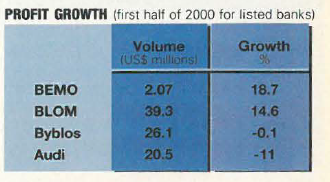
Europeenne pour le Moyen-Orient (BEMO)
has been seeing some healthy earnings.
Profits for the sector dropped 13% in 1999,
but BEMO’s earnings shot up to $2.07 for the
first half of 2000, a full 18.7% increase
compared to the same period last year.
Customer deposits climbed 35% and total
assets increased 28.8%. While most
Lebanese banks are reducing the amount of
money they lend to private sector companies,
BEMO increased its lending 31 .4%.
“BEMO’s performance is obviously working
against the tide in the banking sector,” says
Nicolas Sawan, head of trading at Lebanon
Invest. The bank is also bucking the trend at
the Beirut Stock Exchange. While there is little
activity on the market, BEMO’s shares
climbed 8% last month, to $3.25.