Banque du Liban et d’Outre-Mer
(BLOM), Lebanon’s largest bank in
terms of assets and deposits, has become the
fourth local bank to be granted a license to
open a branch in the Damascus free zone.
Fransabank, Societe Generale· Libano Europeenne
de Banque and Banque
Europeenne pour le Moyen Orient (BEMO)
have already been given permission to operate
in the free zone. The banks are required
to have no Jess than $10 million in capital at
their main branch in the Damascus free
zone. Each additional branch in other free
zones must have $1 million in capital.
“Most Syrian clients already deal with
BLOM in Lebanon and lots of other banks on
the border. This is just a foot in the door,” says
Bassam Yammine, corporate finance manager
at Lebanon Invest.
Another low blow
In its semi-annual survey on creditworthiness,
the American magazine
Institutional Investor ranked Lebanon 77th
out of 145 countries, down from the 74th position
it was ranked in the last survey. Out of 17
countries in the Middle East and North
Africa (MENA), Lebanon placed 12th. On a
scale of 0-100, with 100 representing the
least chance of debt default, Lebanon scored
36.8 points, below the regional and global
averages of 45.7 and 43.4 respectively.
Lebanon was ranked ahead of Libya, Iran,
Algeria, Syria and Iraq, but fell immediately
behind Namibia, Bulgaria, Guatemala
and the Dominican Republic. “Although
Lebanon has never defaulted on a loan, this
ranking is not surprising given the ongoing
increase in public debt,” says Nassib
Ghobril, analyst at Lebanon invest. In the
MENA region, UAE had the best credit worthiness.
Switzerland held its ground as the
country with the lowest chance of default
worldwide. The survey indicated that the
MENA region showed significant improvement
and noted that emerging markets have
made substantial progress in their willingness
to undertake financial reforms, boosting
investor confidence.
Good news … for a change
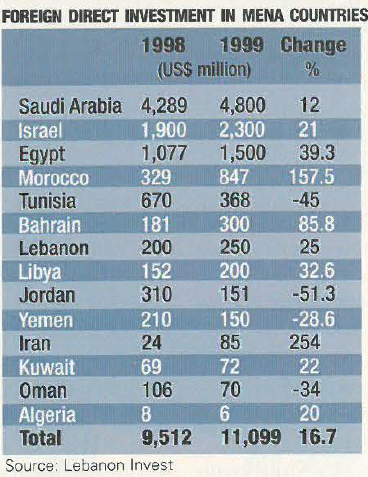
Foreign direct investment (FDI) in Lebanon
totaled $250 million in 1999, a 25%
increase from 1998, according to the World
Investment Report 2000, published by the
United Nations Conference on Trade and
Development (UNCTAD). The increase parallels
a 27% increase in investments worldwide
during the same period. The report added that
Lebanon will likely continue to enjoy an
increase in FDI due to it5 free economic policies
and the recent Israeli withdrawal. The privatization
plans were a prime factor contributing to
the increase. “In nominal terms, the flow of FD I
is modest compared to East Asia or other
emerging markets,” says Ziad Maalouf, vice
president at Middle East Capital Group
(MECG), adding that Lebanon needs to create
an attractive environment to lure more foreign
investment. Lebanon absorbed 2.26% of the
total FDI in the Middle East and North Africa
in 1999 and 2.87% of FDI in Arab countries.
BOB keeps growing,
but barely
Bank of Beirut (BOB), one of five listed
banks on the Beirut Stock
Exchange, registered profits of $14 million
during the first three quarters of 2000, a
1.5% increase over the same period last
year, according to the bank’s unaudited
results. BOB pulled in net profits of $4.3
million in the first quarter, $5.2 million in
the second quarter and $4.5 million in the
third. Assets increased 15.3% to $1.9 billion,
loans were up 10.25% to $50 I million and
deposits jumped 16.84% to $1.46 billion.
BOB was ranked ninth in terms of deposits
At the end of 1999 with $1.33 billion.
BOB has also launched its Beirut income
Fund. “The fund’s objective is to provide
existing and potential customers with a new
investment vehicle for their asset relocation
and secure for them a steady and superior
return,” says Michel Chikhani, manager of
BOB’s asset management department. The
fund will invest in Lebanese fixed income
securities, such as eurobonds and certificates
of deposit. BOB will be managing this
open-ended fund and has put a minimum
subscription requirement of $10,000.
Recession sensitive
Rating agency Fitch JBCA downgraded
Banque Audi’s individual rating from
B/C to C, citing the recession as the main culprit_
for the deterioration in the bank’s asset
quality. The agency also assigned a negative
outlook to the bank’s long-term rating of BB in
correlation to the outlook of Lebanon’s
long-term sovereign rating. The agency said
that higher levels of doubtful debt negatively
affected Audi’s profitability in 1999, with
reserve coverage lower than that of its peers.
In recent years, the bank’s high cost base has
depressed earnings, while the increase in revenue
expected from network expansion has
been delayed due to the difficult economic
environment. At the end of 1999, 9% of the
bank’s total loan book was classified as nonperforming.
“The bank has been negatively
affected by the recession. It has expanded in
a way that will benefit in the long run but the
economy is not helping,” says one analyst.
Eurobonds in,
government out
The outgoing Lebanese government issued
its last sovereign eurobonds worth 250
million euros ($230 million).
The four-year issue, which is lead-managed by
Germany’s Commerzbank, included a further sale of
bonds that were originally issued in 1999. Over
70% of the issue went to local banks. The rest
went to Arab and European investors. The
euro-denominated bonds carry a coupon rate of
8.25% and a spread of 320 basis points over
German government bonds. The government
has sold about $1 billion in net foreign debt so
far th.is year and has been mandated to issue up
to$ l.5 billion by year-end. In 1998 and 1999,
the government issued $2.7 billion worth of
eurobonds in a bid to replace short-term local
debt – two-year Lebanese treasury bills with a
14.14% interest rate-with foreign debt. “The
new issue is in line with parliament’s mandate.
It’s also a precautionary step for maintaining a
good reserve of foreign currency in the central
bank,” says Nabil Chaya, head of capital markets
at Banque Audi.
Still in the wash
Lebanon is one of seven countries that has
taken concrete steps to combat the flow
of dirty money through its banking system,
according to the 29-nation Financial Action
Task Force (FATF). But the country remains
on the organization’s list of 15 nations considered
to be non-cooperative in the fight
against money laundering. ”There is no
exchange regulation in Lebanon,” says one
banker. “But banks are watchful for questionable
transactions.” In the corning months,
the FATF will evaluate the progress of countries
to determine whether they should be
removed from the list. “We have less than a
year to show we’ve taken positive action
against such activities,” says another banker.
Dead on arrival
The outgoing cabinet has passed a draft
budget for 2001, but analysts say it is
unlikely to be adopted by the new government.
“Members of Hariri’s block criticized
the budget. They are unlikely to adopt
it without changes,” says one analyst.
The budget is considered to be unrealistic,
with revenues forecast at $3.73 billion,
expenses at $6 billion and a 38.15% deficit
The revenue figures are rather optimistic,”
says the analyst. “I don’t know where they are
going to get that money from. And debt servicing
is on the low side. Obviously, they fiddled
with the books.” By the end of August
the cumulative deficit had reached 51 %.
Despite a deficit of just 38% for the month of
September, finance minister Georges
Corm’s initial forecast of 37% for the year is
expected to be overshot by a wide margin.
Landslide
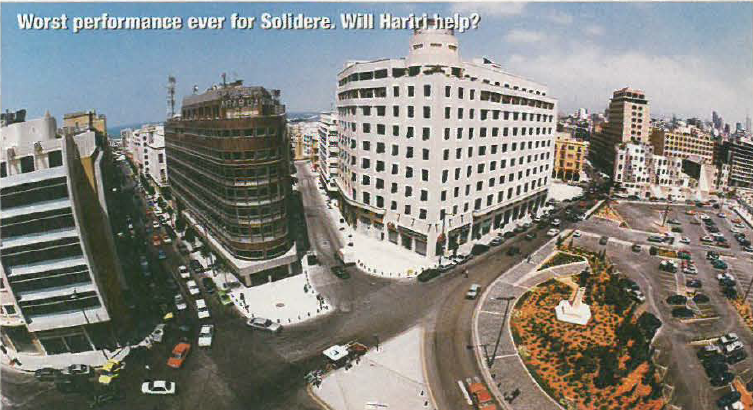
Solidere has reported its worst performance
ever. Due to the economic slowdown
and a freeze on permits under the
Hoss regime, the real estate giant came out
with $2.7 million in losses in the first half of
2000. Net revenues from land and real
estate sales were only $1.8 million, while
rental income produced $2.5 million.
Interest income, $9.1 million, was the company’s
biggest earner. There is some sort of
good news, however. Just before the previous
government left, it passed a decree
allowing Solidere to develop the souks.
Unfortunately, a Solidere official predicts that
it will take three to six months for the plans
to be approved by the Beirut municipality.
Merrill Lynch recently released a report
with a neutral recommendation for Solidere’s
GDRs. The investment firm claims that
despite the positive implications of Rafic
Hariri ‘s ascension to the premiership – which
will likely smooth the real estate company’s
relations with the government –
Lebanon’s recession will continue to hinder Solidere’s
growth. Merrill Lynch calculates net asset
value at $9.2, while the GDRs are hovering
just under $7. A number of local analysts are
also neutral about Solidere’s shares. “lf Rafic
Hariri becomes prime minister, I think we’ll
see limited appreciation of Solidere shares,”
says Ali Ayache, head of trading at Lebanon
Invest. “We’ll have to wait for the economic
plan of the new government. Foreign
investors will buy shares only if they’re convinced
that the economy is doing well.”
Getting a hold on things
The net asset value (NAY) of Lebanon
Holdings, the only closed- ended fund on
the Beirut Stock Exchange, has risen 0.5%
since June to $7.76. That’s below what was
registered at the end of 1999, when it reached
$7.94. But it is above the fund’s share price on
the Beirut Stock Exchange of$5.75.
The fund’s holdings of Banque du Li ban et
d’Outre-Mer (BLOM) increased from
265,000 to 273,000 shares, putting BLOM’s
weight in the fund at the maximum allowable
20%, up from 16.62%. “We still believe that
BLOM is a solid bank. It has proven its stability,
especially during the recession,” says
Khalil el-Khoury, asset management associate
at Lebanon Invest. A I 0% share buyback
was completed in September, bringing the total
outstanding shares down to 4.5 million.
Another buyback of 500,000 shares is
planned, says el-Khoury. That would represent
an unrealized profit of $2 per share.