Arab countries have relatively
large pension and social security
funds by the standards of developing
countries. However, they lag behind
in terms of the efficiency with which they
utilize the long-term financial resources
they mobilize. In several cases, the investment
performance of social security corporations
in Arab countries suffers from
their utilization as captive sources for
financing government expenditure. Given
the right conditions, these corporations can
serve as a countervailing force to banks in
the country, helping to promote financial
innovation, modernize capital markets,
improve transparency and disclosure conditions,
and deepen domestic stock markets.
The long-term feasibility of the social
security institutions’ current investment
policies in the Arab world needs to be reexamined
especially in light of the aging
of the population. In general, Arab
countries have very young populations,
raising little concern over the long-term
sustainability of the systems in place.
However, with the projected rise in the
demographic dependency ratio of the
various Arab countries, pension funds
and social security corporations must be
allowed to pursue the most optimal
investment patterns of the resources they
have, independent of government influence.
This can be achieved by allowing
the pension and social security institutions
to contract out the management of their
funds to professional asset managers.
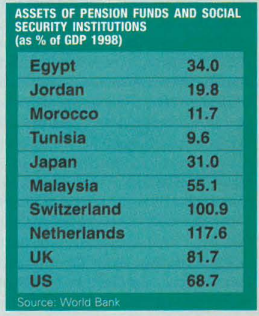
The importance of pension and social
security funds varies considerably from
one country to another. For the majority
of developing economies, the assets of
these funds amount to less than 20% of
GDP, and often less than 10%. In contrast,
for most European and North American
countries they fall within the 30% to
100% range, while in a limited number of
countries, such as the Netherlands and
Switzerland, they come up to over 100%
of GDP. A number of Arab countries,
particularly Egypt, and to a lesser extent
Jordan and Morocco, have managed to
mobilize a large volume of pension savings.
In Egypt, the assets of social security
and pension funds amount to nearly 34%
of GDP. The percentage is less for Jordan
and Morocco, around 20% and 12% of
GDP respectively, while Tunisia lags further
behind at less than 10% of GDP.
In Jordan, the assets held by the Social
Security Corporation are financed by a
15% contribution rate. The system has so far
benefited from a low dependency ratio
(the number of beneficiaries against the
number of contributors), and from a positive,
albeit modest, rate of return. The
higher volume of mobilization of pension
funds in Egypt is partly explained by a
higher contribution rate, 26%, and therefore
substantial annual flows. Similar to
Jordan, the system benefits from a predominantly
young population, but has suffered
from highly negative real returns in the
late ’80s and early ’90s. Social pension
systems in Morocco and Tunisia have
lower contribution rates and are already
under pressure because of limited accumulated
resources.
The role of social security institutions and
pension funds in the development of a
country’s capital market depends on the
allocation of their assets, which varies widely
between countries. In the UK, pension
fund portfolios are heavily biased towards
equities, while in the rest of Europe they are
concentrated in government, corporate
and mortgage bonds and long-term loans.
In many developing countries, social security
funds have failed to provide a direct
stimulus to the development of domestic
securities because of requirements to
invest in non-marketable government
securities, quantitative investment limits or
conservative investment policies.
In Arab countries, social security and
pension funds are subject to direct government
influence, with exceptions. In
Jordan, the influence of the government is
indirect; investments are constricted by
the conservative policies of the Social
Security Corporation. In Egypt, social
security resources are transferred to the
National Investment Bank to be invested in
public projects. Social security institutions
in Tunisia and Morocco must invest in
low-return government notes, low-interest
housing loans, in addition to building low-
rent housing units. Such practices have
kept investment income low.
Social security institutions are also often
restricted from investing in foreign assets by
regulations in the form of either foreign
exchange controls and/or tight prudential
controls. The relaxation of these controls in
some countries has allowed them to build
up large holdings of foreign equities and
bonds, exceeding 20% in Saudi Arabia,
the UAE and other Gulf countries, and contributed
to higher rates of return. The
inclusion of foreign assets in investment
portfolios of social security corporations in
the other Arab countries would increase
returns and reduce the risks of portfolio
funds under management.