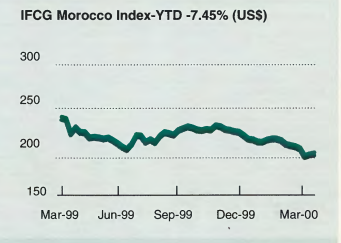
MOROCCO Equities on the Casablanca Stock
Exchange remained under pressure,
with most investors opting for the
sidelines in anticipation of 1999
corporate results. Share prices headed
mostly downward in thin liquidity as
institutional selling outweighed buying.
Total assets under management by local
institutional investors in Morocco
reached $4.3 billion at the end of
February, down 2% since the beginning
of the year. Of the total, around 13% are
invested in local equities. On the
privatization side, the flotation of
state telecom company Itissalat
al-Maghrib looks unlikely to be effected
before 2001. This will be the real driver
for an improvement in the market’s
fortunes.
EGYPT
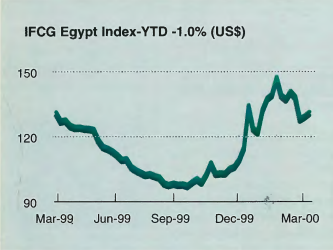
A profit-taking spree swept through
the Cairo Stock Exchange (CSE) ahead
of the holiday season in mid-March.
However, the market weathered the
storm, narrowing year-to-date losses
to just 1%. Trading was mostly
concentrated in a handful of blue chips,
with Commercial International Bank,
MobiNil and Media Production City
capturing most of the market activity.
Investors also reacted favorably to the
news that the Egyptian bourse has
preliminary approval from the New York
Stock Exchange to list some Egyptian
companies in the form of American
Depository Receipts (ADRs).
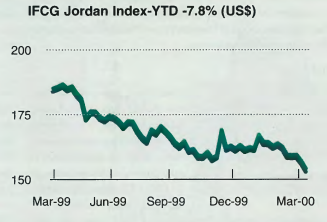
Prices slid across the board in Jordan
under the sway of increased dumping
by foreign investors. During the first
two months of 2000, non-Jordanian
investors purchased an equivalent of
JD12.2 million worth of local securities,
while they divested a total of JD48.5
million. The market is now down almost
8% from its level at the beginning of
the year. Selling pressure was mostly
concentrated in major banking and
industrial blue chips. The poor
performance was recorded despite the
release of healthy 1999 corporate
earnings results by a score of blue chip
stocks, among which is Jordan Cement
Factories (up 73%).