
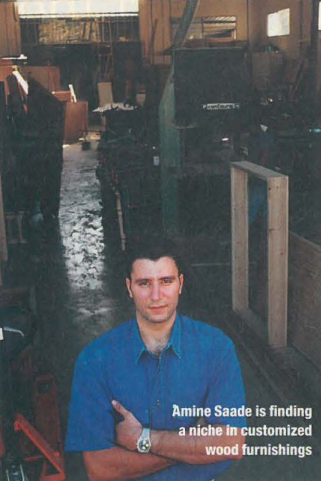
A fter a two-year stint with Byblos
Bank, Amine Saade wanted to satisfy
his entrepreneurial inclinations.
In 1998 he established a contracting
firm that subcontracted woodwork to small
workshops. While the contracting sector
looked bleak, Saade saw potential in setting
up a modern factory that produced custom-made
wood furnishings for contractors and
interior designers. He solicited three friends
to invest in the enterprise: Art Wood Line.
While preparations for the factory were
underway last year, Art Wood Line continued
subcontracting work, mostly for small projects.
That gave the company exposure and,
since the factory opened in January, business
has grown quickly. Sales are increasing by
25% a month, up from 10% when subcontracting.
Saade wouldn’t reveal turnover,
divulging only that since in-house production
began, profit margins increased to 20-25%
from 10-15%. The increased workload
required a bigger workforce. “In January
we had 15 people; now we have 55,” says
Saade. During this period the monthly overhead
ballooned from $8,000 to $25,000.
To date $500,000 has been invested in the
factory. With $300,000 in the latest woodworking
machinery from Germany and 50%
of its staff holding technical degrees, Saade
says that Art Wood Line can bid for any project
in town. Items produced
include door and cabinet frames,
door panels, cabinets and floorings.
Construction contracts worth over
$25,000 account for 50% of business.
Small projects continue to
generate 25% of sales, and custom-made
furniture for interior designers
the remaining 25%.
At a time when most local industries
are up against competitive
imports, why is Art Wood Line faring
so well? Gilles Sayagh of Raymond
Knaider, a timber distributor, says
that imported furniture is cheaper
than local production despite customs
duties of about 45%. But custom-
made production is feasible for
two reasons. Standard measurements don’t
always fit domestic project designs.
Additionally most imported furnishings are
made of commercial materials, such as chipboard,
while a segment of the local market
demands higher quality and costlier materials.
It is more feasible to import quality
wood in its unfinished form because the customs
duty is 5% to 6%.
Saade isn’t able to cite Art Wood Line’s
prices, which are determined by specifications,
wood type and ironmongery. “We specialize
in high-quality woodwork for luxury build-
ings,” says Saade. Art Wood Line faces collection
difficulties like most firms. As a result
the company raised down-payment dues.
“We’re not willing to start a project unless we
get 30% to 40% up front,” says Saade.
Current undertakings include expanding
the factory and bringing in additional
machinery. To keep up with expansion, Art
Wood Line recently recruited two supervisors,
upping the administrative team to seven.
“Delegating management responsibility is
imperative when you reach a certain size,”
says Saade.
Taking care of business
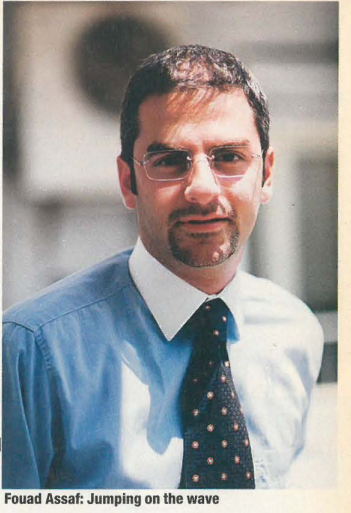
A t 31-years-old, Fouad Assaf oversees
operations and strategies for
the company he established two
years ago, Proactive Business Developers,
which offers marketing and management services.
Proactive audits clients’ problems,
brainstorms with clients and executes the recommended
reforms. “It’s like having marketing
and management departments, but
instead of paying fixed costs for employees,
clients hire us on a project basis,” says Assaf.
He learned fast that local companies
expect a quick fix. “When you’re talking
business development, you’re talking about strategies lasting a minimum of six months,” he
says. Proactive started out handling projects
for a couple of international companies
based in Lebanon, but is now working with
a few local companies, including event
organizer RK&A. But this type of work
hasn’t been sufficient for healthy expansion.
Aware that having a website is an important
part of marketing a business, Assaf set
up Proactive Web Site Developers. The
autonomous unit has its own graphic
designers, programmers, sales and management
departments. The subsidiary
obliged upping investments to about $50,000, mainly on IT equipment. But it’s
been worth it. “Since starting it one year ago,
we’ve had ten times the growth we had in the
first six months. We are tripling in terms of
employees and quadrupling in terms of
turnover,” says Assaf, though he declined to
reveal turnover figures. “This is the time
for it; the market is huge,” says Antoine
Feghali of TimezerO, a web site developer.
Proactive Web Site Developers offers two
packages: The Silver Package is a six-page
website costing $600.
The Gold Package,
with ten pages, costs $1,000. Customized
websites are also available. For added features, such as search engines and e-commerce
capabilities, prices can go up to $50,000.
Proactive has developed websites for companies
such as Morrico TV Shopping, Air
Liquide and Nalbandian Tapis d’Orient. Many
of Proactive’s 60 clients were accessed
through strategic alliances with
Terranet, ODA Liban and 5 Index. Through
partnerships with Kuwaiti-based
Telecommunications Consultants India
Limited, and a British IT consulting firm
Aston Kean, Proactive has created websites for
companies in those countries. These represent
about 40% of turnover, according to Assaf.
“A lot of companies are looking to produce
in Lebanon, because the price is cheaper by
30% to 40%, and the quality is good,” says
Assaf. For these reasons, a US company
recently contracted Proactive to develop its
sports-betting website. He wouldn’t
divulge the company’s name, but explains
that one of its Lebanese shareholders sug-
gested a developer in Lebanon.
Through partnerships, Proactive
is hoping to gain a foothold in the
Middle East. According to
Feghali, penetrating the local
market is easy, “but to have
something lucrative, you have to
concentrate on the regional market.”
TimezerO recently opened
an office in Dubai.
Proactive is also setting up an
ISO department, which is slated
to begin operations this summer.
“We will be developing
and preparing business outlines
for companies to get ISO labeling,”
says Assaf. Like Proactive
Web Site Developers, it will be
an autonomous department that
the “mother” company can
employ for its business development
plans.
Catering to corporate tastes
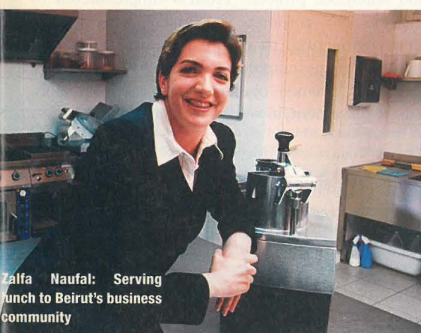
From the time she got her degree in
hotel management, Zalfa Naufal
plunged into the food service business,
working at a number of hotels and
restaurants in Geneva, Paris and Beirut.
But since entering the labor market in 1991,
Naufal had one goal in mind: “To open my
own company in the food sector.” That was
achieved in March with the establishment of
The Food Box, a food delivery company.
“We are targeting the business crowd for
lunch,” says Naufal. Annette Maalouf, managing
owner of Casper & Gambini’s, a
strong contender in the field, says there is
big demand for lunch deliveries at offices.
And many restaurants are jumping on the
bandwagon. “But they don’t realize that
it’s a costly service,” says Maalouf.
For this reason Naufal chose to use
Khadamat for deliveries, while a bakery
supplies specialty breads. Outsourcing these
services meant her initial investment was
just $60,000, the bulk of which financed the
kitchen and computerized system for orders
and accounting.
Maalouf says that a
lot of delivery companies
open up hoping to
capitalize on the
demand. But few withstand
the competition.
Naufal is all too aware
of this. She spent
months researching
and testing recipes for
sandwiches. “We elevated
the sandwich to a
gourmet status,” says
Naufal. Exotic creations
include ‘Prosciutto di Parma’ with
blue cheese and fig preserve. This costs
LL8,000, but prices range from LL3,500 to
LL9,500. Salads are priced from LL3,000
up to LL7,000. The Food Box also sells a
number of publications including An
Nahar and The Wall Street Journal.
Creating an identity is vital to penetrate
this market: restaurants have visibility on
their side, but delivery companies are hidden
kitchens. “That’s why the packaging is
as important as the quality of the food,” says
Naufal. The colors she uses, white, black
and silver, suggest cleanliness, professionalism and urbanism.
After three months, business is not bad.
“People think the food business is like a slot
machine, but you don’t have a return on your
investment immediately,” says Naufal, who
expects to see returns in two years. The fixed
cost for rent, salaries and delivery service is
$2,500 a month, while food is roughly
$30,000. To raise the profile of her company,
Naufal is planning to extend marketing, so far
limited to Ras Beirut, to Ashrafieh. If things
go well, she plans to open a cafe. “With a
restaurant I can be more creative.”
