
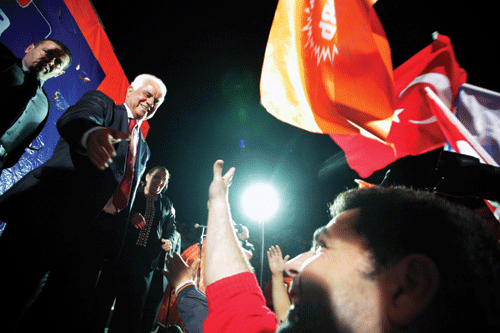
The brilliant classical scholar and poet A. E. Housman had a profound mistrust of opinions that are shared by a large number of people. Even, perhaps especially, when the vast majority of manuscripts contained the same version of a line of Latin poetry, the former Cambridge University professor was dogged in pursuit of what he saw as a more likely — and correct — alternative. His views on last month’s presidential elections in Northern Cyprus would doubtless have been entertaining and scathing in equal measure.
The anonymous commentators and analysts so oft quoted (or invented) by political writers have mostly been trotting out the same, simplistic line of the likely effects of the outcome, no matter who won.
The incumbent president, Mehmet Ali Talat, was credited with holding 71 meetings with his long-time fellow trade unionist, Greek Cypriot leader Demetris Christofias, which led to a series of unofficial and unenforceable agreements between the two sides of the divided Island, which was split in 1974 when Turkey invaded after a Greece-backed coup attempt. All these would be jeopardized, ran conventional wisdom, if the so-called nationalist hardliner, Turkish Cypriot Premier Dervis Eroglu, were to win the April 18 vote. The entire process of unification for an island now in its 36th year of division would be put on hold at best and vanish forever at worst.
Eroglu won an absolute majority in the first vote, eliminating the need for a run-off the following Sunday. And with that victory, the pundits continued, Turkey’s chances of joining the European Union suffered another devastating reverse. All of this somewhat misses the point.
Turkey’s ruling Justice and Development Party (AKP) calls the shots in the Turkish Republic of Northern Cyprus (TRNC) and it made very little difference who actually won last month. Turkish-Cypriots are financially dependent on Turkey. Without the $500 million annual contribution from Ankara, the TRNC would sink into bankruptcy faster than Greece. The rhetoric from both candidates during the election was mainly for domestic consumption.
Christofias said he was ready to negotiate with whomever was elected but insisted he would not resume talks from scratch. Eroglu told supporters: “Talks will continue because I want peace more than those who say that I don’t.”
Much more significant is what Recep Tayyip Erdogan, the Turkish prime minister, had to say. His clear disdain for what he sees as disruptive tactics from the European Union was illustrated by his public description of the union as a Christian club. It may well be true that a solution to the Cyprus issue is a prerequisite for Turkish EU membership. However, rapid accession is unlikely with or without a solution, and Erdogan’s desire for an answer to the divided island’s problems has other motives. Opening the northern side to direct trade would improve its economy and eventually lessen its dependence on Ankara’s money, and a reduction in the 30,000 troops stationed there would cut Turkey’s contribution to maintaining their presence.
Even additional benefits accorded to Turkish Cypriots if they become “official” members of the European Union alongside their fellow Cypriots in the south are less than they might appear. Around 40 percent — or 80,000 — Turkish Cypriots already hold EU passports. Roughly the same number cross into Greek-Cyprus daily to work jobs that pay far more than the equivalent employment in the north.
For all the publicity surrounding the Talat-Christofias talks, nothing of worth was achieved in two crucial areas — a system of governance or a solution to the property problem. In the north, 30,000 villas and apartments have been built since the split, mainly on land owned by Greek Cypriots. Properties subject to claims by their former owners are being sold at discount prices to foreigners, perhaps unaware of the difficulties of ever securing full title to them. The land problem is not one-sided. The land that houses the old Larnaca Airport and part of the terra firma on which the new one stands belongs to Turkish Cypriots. Optimism stemming from the 18 months of meetings between politicians on both sides of the island is based on little, save an excess of shallow public relations, cheerfully and regularly trotted out by the foreign media.
Housman-style followers of useful information would do better to watch for results from Erdogan’s visit to Athens this month.
PETER GRIMSDITCH is Executive’s Istanbul correspondent
