
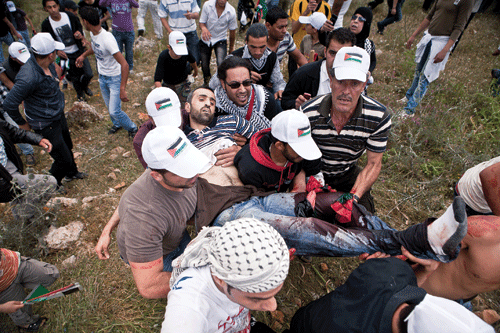
There has been a suggestion that a “third intifada” is imminent following the deadly border incidents on May 15, when Israeli troops fired live rounds into demonstrators commemorating the Nakba (or “catastrophe”) anniversary in south Lebanon and in the Golan Heights, with eight confirmed deaths and well more than 100 wounded.
There has been talk for several months of launching a fresh drive for Palestinian emancipation, with a focus this time on the rights of the Palestinian refugees expelled from their homeland in 1948 and 1967. The first intifada between 1988 and 1993 was associated with stone-throwing children and the second between 2000 and 2005 with suicide bombers. The third could adopt the tactic of mobilizing mass marches of unarmed Palestinians to the borders of Israel, including from the West Bank.
This would present a serious dilemma for the Israeli army, which knows how to deal with armed aggressors and unarmed individuals but, as history shows, is unprepared to deal with large crowds of unarmed civilians.
The May 15 marches in Maroun Al Ras on Lebanon’s southern border and opposite Majdal Shams in the Golan Heights, and Israel’s deadly —and characteristically disproportionate — use of live ammunition against unarmed protestors, diverted attention, albeit briefly, from the crisis in Syria. The increasingly beleaguered Syrian president, Bashar al-Assad, would be wise to recognize the value of mounting future marches against the Golan Heights in the coming weeks.
There is no shortage of willing volunteers. The Palestinians would enthusiastically volunteer for such marches; so would the descendants of the roughly 120,000 Syrians driven from their villages on the Golan in the 1967Arab-Israeli war. As for the Lebanon front, there is little to prevent further mass Palestinian marches to the southern border.
The threat of breeches along the Lebanon-Israel border by a crowd of Palestinians is a nightmare scenario for the Israelis. Even with the relatively small breech in the Golan on May 15, one enterprising Palestinian made it all the way to his ancestral home of Jaffa before turning himself in to the police.
There have been previous gatherings of Palestinians at the Lebanon-Israel border fence. In October 2000, a crowd of Palestinians gathered at Marwahine in the western sector of the border to protest Israel’s crackdown on the nascent Al Aqsa intifada. Four of them were shot dead by Israeli soldiers when they tried to scramble over the fence. Shortly afterwards, Hezbollah launched its operation to kidnap three Israeli soldiers from the Shebaa Farms in the eastern sector, confirming that the Palestinian protest was intended to divert the attention of Israeli military commanders. Perhaps the most effective target for a civilian march along Lebanon’s southern border is not the original boundary with Palestine, but the Shebaa Farms.
The Shebaa Farms is not sovereign Israeli territory; it is internationally recognized as occupied Arab land. It is unpopulated except for Israeli troops deployed in seven hilltop outposts, most of them beside the Blue Line. There are three potential points of access for large crowds looking to infiltrate the farms — the Shebaa Pond gate at the northern end, the Hassan Gate in the middle and via the road from the Arslan family estate at Majidiyah in the south. Israeli frontline outposts, including Rowsat Allam and Jabal Summaqa, overlooking Kfar Shuba and Ramta above the Bastara farmstead, could beblockaded by crowds deployed on the military roads connecting the outposts.
The Israelis would face three unpalatable choices. They could attempt to physically prevent the crowds from crossing the Blue Line by shooting at them, evacuate troops in the frontline posts before the access roads are cut by the civilian marchers, or leave the troops in the outposts and resort to a diplomatic means of ending the crisis.
Such a march would require a high degree of prior planning and coordination and it would risk a confrontation with the United Nations Interim Force in Lebanon (UNIFIL), which is mandated to preserve the integrity of the Blue Line. But if the Lebanese state approves the march — or at least fails to prevent it from occurring — then UNIFIL will be in a bind. It too will not want to stand in the way of thousands of determined and angry marchers and would probably step aside. The tactic of civilians marching into occupied territory hastened the withdrawal of Israeli troops from south Lebanon in 2000. One wonders whether a similar tactic would work with the Shebaa Farms.
Nicholas Blanford is the Beirut-based correspondent for The Christian Science Monitor and The Times of London
