
Occupy Wall Street and the Egyptian uprising have more in common than it may seem, and surely much more than Washington wished for. Egypt seems a la mode in New York. For example, the protests were partly inspired by Adbusters magazine, which in July encouraged its readers to flood Manhattan with the battle cry: “Are you ready for a Tahrir moment?”
When American protesters, blocked by police from reaching Wall Street, decided to settle at nearby Zuccotti Park, little did they know it had only been renamed after a local property developer in 2006. Until then it had been known as Liberty (Tahrir) Plaza. These were not the first American signs of emulation of revolutionary Egypt. When the state of Wisconsin last February attempted to cut the salaries and benefits of government staff, tens of thousands of workers took to the streets under the slogan: “Fight like an Egyptian”.
Most Western observers, however, prefer to stress the differences between Occupy Wall Street and the Egyptian and other Arab uprisings. The former, they argue, aims for economic reform, while the latter called for political change. Hence, they speak of an ‘Arab Spring,’ a reference to the 1968 Prague Spring when Czech citizens attempted to shake off the Soviet dictatorship. Implicitly, the term assumes that both Czechs and Arabs aspire for a Western notion of democratic freedom.
That is only partly true. Sure, most people prefer voting over dictatorships, yet the Arab uprisings, especially those in Egypt and Tunisia, were as much about economic justice as fair representation. Let us not forget that the so-called ‘Arab Spring’ started over economic injustices: Following the confiscation of his vegetable cart, Tunisian street seller Mohamed Bouazizi set himself on fire at the main square shouting: “How do you expect me to make a living?”
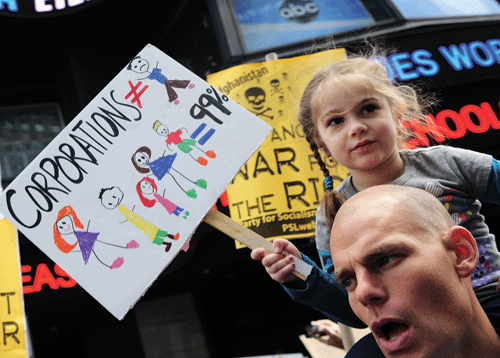
At Tahrir Square, demonstrators not only called for the downfall of Mubarak, but also of people like Ahmed Ezz. Politically, Ezz was not particularly powerful, yet he controlled two-thirds of the steel market and was seen as one of the faces of Egypt’s corrupt and elitist economy. Interestingly, the ‘Arab Spring’ started in Tunisia and Egypt, both formerly state-led economies that — more than most countries in the region — bought into the West’s free market mantra over the last decade. State-owned assets and companies were privatized —generally ending up in the hands of the well-connected few — and then streamlined, resulting in massive layoffs. And while economists routinely pointed at gross domestic product growth as a token of success, the disparity between rich and poor accelerated year after year. Just as the Arab uprisings were not solely about political change, so the current manifestations in New York and elsewhere are not exclusively about economic reform. Yes, the Occupy Wall Street slogan, “We are the 99 percent”, refers to the pyramid-like structure of the American economy, as 1 percent of Americans earn 24 percent of national income and own 40 percent of national wealth.
Yet by referring to the majority, protesters also evoke the founding principle of democratic rule. “We are the 99 percent, and that is why we need a voice,” is the full slogan. The reality is fewer and fewer Americans feel represented by the two traditional parties, which both seem caught in a web of corporate interests and lobbying dollars; the situation is only slightly better in Europe.
This sense of a political sell-out culminated in the 2008 financial crisis and the subsequent bailout. While several banks were soon awarding major bonuses again, unemployment rose and people everywhere were confronted with austerity programs. In the minds of many it is all rather blunt and simple; politicians bail out the banks, and the people end up paying.
It would be a severe miscalculation if President Barack Obama were to define Occupy Wall Street as merely a call to rein in the malpractices of the financial system. As one protester in New York put it, “we tried voting for change, today we shout for change.” And tomorrow, if need be, they may well fight for it.
PETER SPEETJENS is a Beirut-based journalist
