• Donate
  • Our Purpose
  • Contact Us
Executive Magazine
  • ISSUES
    • Current Issue
    • Past issues
  • BUSINESS
  • ECONOMICS & POLICY
  • OPINION
  • SPECIAL REPORTS
  • EXECUTIVE TALKS
  • MOVEMENTS
    • Change the image
    • Cannes lions
    • Transparency & accountability
    • ECONOMIC ROADMAP
    • Say No to Corruption
    • The Lebanon media development initiative
    • LPSN Policy Asks
    • Advocating the preservation of deposits
  • JOIN US
    • Join our movement
    • Attend our events
    • Receive updates
    • Connect with us
  • DONATE
AnalysisEnergy

Energy security at a crossroads

by Rouba Bou Khzam March 26, 2024
written by Rouba Bou Khzam

Across the globe, access to reliable and affordable energy underpins the very fabric of society. The International Energy Agency (IEA), a leading intergovernmental organization on energy, defines energy security as the “uninterrupted availability of energy sources at an affordable price.” For Lebanon, however, with its long-plagued energy sector, continuous and financially accessible energy remains a distant dream. For years, the nation has grappled with rolling blackouts, crippling infrastructure, and a dependence on volatile import markets, leaving its citizens and businesses in the perpetual twilight of energy insecurity.

IEA frequently emphasizes three pillars of energy security in its publications and reports – availability, affordability, and accessibility. All three are far from sturdy in the Lebanese context marked by political dysfunction, economic volatility, and a glaring lack of long-term planning. Considering Lebanon’s energy morass, which is further complicated by a new and bloody regional conflict, it remains a critical question if Lebanon can truly achieve a secure and sustainable energy future.

The triad of availability, affordability, and accessibility

As of March 2023, Lebanese households endured an average of 12 hours of daily blackouts, with some areas experiencing total blackouts for up to 24 hours. This unstable power supply significantly disrupts daily life, hampering businesses, hindering work-from-home options, and jeopardizing access to vital services like healthcare and education. While not as disastrously bad as during the first months after forced total withdrawal of energy subsidies in 2021, public electricity supply has not matched political promises for more extensive electricity provision by state utility Electricité du Liban (EDL) in exchange for higher usage fees. The broken promises of the government to solidify “consistent energy availability” became glaringly apparent as inadequate infrastructure, financial mismanagement, and overdependence on volatile fuel imports left citizens grappling in the dark.

The introduction of the new EDL tariff in November 2022, involves the second and third pillars of energy security, namely affordability and accessibility. Testimonies collected by Executive from electricity consumers, however, suggest that with regard to either the second or third pillar, the situation of Lebanese private households has not improved and often is perceived as worse when comparing 2023 to 2021/2. 

Lebanon’s economic struggles, marked by dwindling foreign reserves and an overwhelming annual fuel expense of $1.5 billion, according to the World Bank 2022 report, have thwarted efforts to ensure a steady supply of fuel. According to the latest Energy Security report from Executive, one analysis entitled False promises of improvement takes a behind-the-scenes look at several stalled regional agreements that would have offered Lebanon an energy lifeline via fuel transports from Jordan and Egypt via Syria. The failure of these agreements has contributed to the deterioration of domestic energy infrastructure, difficulties in securing more economical fuel alternatives, and consequently a notable escalation in electricity expenses for households and businesses alike.

Designed with the intention of achieving greater fairness, the new tariff structure introduced a tiered system based on electricity consumption. However, the overarching impact was an overall increase in rates, ranging from 20 to 50 percent or even higher, depending on consumption levels and geographical location. This significant rise in electricity costs exacerbated the financial burden on already struggling households and businesses, amplifying the challenges posed by Lebanon’s ongoing economic crisis.

EDL’s new billing system, linked to the volatile parallel market dollar, has caused monthly electricity bills to soar above 1,000,000 LL, a significant increase from the previous range of 50,000 LL to 300,000 LL.

This surge was due to hiking of taxes and assorted fees, and directives from the central bank compelling the EDL to convert its revenues from pounds to dollars. As a result, subscribers bore the brunt. The disparity between electricity supply hours and costs pushed bills higher than those from private generators. Faced with this fiscal dilemma, consumers responded by removing meters or suspending operations for two years, reflecting widespread dissatisfaction.

In a statement issued on January 11, 2024, EDL announced a cautious step towards brightening Lebanon’s electricity landscape. The state-owned provider revealed a “gradual increase” in power supply, bringing one gas unit back online and pushing production capacity to 400 megawatts. While this news offers a welcome respite from chronic blackouts, it’s essential to recognize the fragile nature of this progress.

EDL emphasizes the need to maintain this “up to 400 megawatts” limit to avoid regulatory hurdles in mid-February. This cautious approach reflects the uncertainties surrounding future fuel shipments. While a recent tender promises additional fuel by February 27th, delays can quickly plunge the country back into darkness. Furthermore, the expected “additional quantities” from the Iraqi swap agreement were stalled by bureaucratic roadblocks, highlighting the precariousness of relying on external agreements.

Despite these mixed signals, the increased power supply provides a much-needed reprieve for basic facilities like airports, ports, and hospitals, and translates to fewer blackouts for households. However, it’s crucial to remember this is a temporary win, not a permanent solution. Lebanon’s electricity saga requires more than a quick fuel fix.

Lebanon’s solar revolution in focus

Lebanon’s energy landscape in 2023-2024 is a tale of rooftop solar panels blazing with promise and the ever-present shadow of the dysfunctional national grid. Crippling blackouts and skyrocketing bills have fomented a rushed, citizen-led pursuit of alternative solutions, mainly solar photovoltaic (PV). 

In addition to the increased energy self-sufficiency that accompanies the switch to solar, financial relief is an equally compelling motivation as public electricity costs soar. Estimates by the Lebanese Center for Energy Conservation (LCEC) in their 2023 report suggest homeowners can expect average returns on investment (ROI) of 15 percent to 20 percent per year over the system’s life. While not directly comparable to cost savings, this impressive ROI translates to significant long-term financial benefits, with some calculations even pointing to potential savings of up to 25 percent annually. This financial allure, coupled with the promise of escaping unreliable grids and soaring bills, is making solar a compelling and increasingly viable option for many Lebanese households and businesses.

While a growing environmental consciousness may be an earnest secondary or tertiary motivation fueling Lebanon’s solar surge with its promise of reduced carbon emissions, the picture isn’t entirely rosy. One concern lies in the e-waste disposal. While solar panels typically have long lifespans of 25 to 30 years, their ultimate disposal raises questions. Lebanon, currently lacking a robust e-waste (or general waste) infrastructure, faces the risk of these discarded panels and their accompanying components – including inverters and batteries with significantly shorter lifespans – contaminating the environment. Lead, arsenic, and other harmful elements could leach from improperly disposed-of equipment, negating the environmental benefits solar energy was meant to deliver.

Furthermore, the integration of solar energy into our grids demands meticulous planning and strategic upgrades. The surge in solar adoption necessitates a forward-thinking approach to grid management, involving not only infrastructure enhancements but also the implementation of smart systems to ensure stability and efficient energy distribution. Overlooking these critical aspects could indeed undermine the overall effectiveness of the solar surge. It’s also crucial to underscore the significance of safe installations in this context, as ensuring the safety of solar setups is an integral part of fostering a sustainable and reliable energy landscape. 

Ultimately, embracing solar energy in Lebanon demands a holistic approach that balances its undeniable environmental benefits with potential downsides. Investing in e-waste recycling infrastructure, promoting responsible manufacturing practices, and prioritizing grid integration will be crucial to ensuring a truly sustainable and successful solar revolution in the country.

DRE law to save the day?

Enter the Distributed Renewable Energy (DRE) Law, passed in December 2023. It purportedly has the potential to revolutionize the country’s energy sector by legalizing net metering and peer-to-peer trading of renewable energy. This could significantly increase Lebanon’s reliance on clean energy sources and decrease its dependence on expensive and polluting fossil fuels. The DRE law would allow renewable energy producers from the private sector to connect their systems to the central EDL grid and sell electricity. Increased renewable energy installations would create jobs across the spectrum, from panel manufacturing and installation to maintenance, injecting much-needed dynamism into the Lebanese economy and attracting green investments. 

However, as the history of several nationally beneficial laws and imposition of supposedly independent regulatory authorities has demonstrated in the past twenty years, political changes to the original draft of the DRE law have become grounds for deep skepticism about the new law’s timely implementation. Some argue that hurdles preventing the application of the DRE law are nearly insurmountable. In what critics see as the biggest hurdle, the ratified DRE law is linked to the establishment of an Electricity Regulatory Authority (ERA), which is still pending in Lebanon despite Law 262 of 2002 which meant to create an independent ERA. Setting tariffs, issuing licenses, and enforcing regulations are all crucial functions the ERA should perform, but as of now it has yet to be created despite a December 2022 paper produced by the Ministry of Energy and Water detailing the roles and functions of the pending ERA.

Another challenge is that Lebanon’s unreliable electricity grid, prone to frequent blackouts and disruptions, poses a threat to renewable energy infrastructure such as solar panels. Although the government has expressed commitment to enhancing the grid, as outlined in the EDL statement issued on January 11, 2024, substantial time and investment are required to fortify it sufficiently for large-scale renewable energy expansion.

Despite these barriers, the DRE Law heralds a positive trajectory for Lebanon’s energy sector. It has the potential to foster job creation, stimulate economic development, and diminish reliance on fossil fuels. If it reaches execution, the DRE Law could propel Lebanon toward achieving its ambitious target of generating 30 percent of its electricity from renewable sources by 2030, as indicated in a report by the International Renewable Energy Agency (IRENA).

Governance: the missing measure

Ultimately, the obstacles barring the way to implementation of the DRE law—and most of the country’s energy issues—come down to a lack of governance, the Lebanon’s oft-repeated stumbling block. Despite having considerable hydrocarbon reserves, the corruption and lack of transparency that the energy sector has become notorious for in addition to general political deadlock serves as a hindrance, impeding the country from developing these resources, exploring offshore gas reserves, and achieving energy self-sufficiency. Lack of accountability within the energy sector and public sector corrodes public trust and investor confidence. 

Renewable energy advocate and policy expert Christina Abi Haidar emphasizes – see “Oil Wealth: One Last Chance for Lebanon” comment in the October/November 2023 issue of Executive Magazine – the urgency of exploiting these gas reserves as a vital economic lifeline. While acknowledging the environmental risks involved, there is the importance of pursuing responsible development strategies centered on sustainability and equitable distribution of benefits. Echoing a recurring theme, she advocates strongly for robust governance, highlighting the necessity of transparent institutions, anti-corruption measures, and streamlined processes to effectively manage this potential wealth.

Lebanon’s energy security remains precariously balanced. While challenges seem daunting, glimmers of hope emerge through citizen and private sector-led initiatives and the newly ratified DRE law, which, if implemented—a big if—would have significant positive implications for Lebanon’s energy future. Ultimately, addressing the crucial missing element – robust governance – and implementing responsible development strategies are keys to unlocking the potential for a secure, affordable, and sustainable energy future. It’s a challenging tightrope walk, but one Lebanon cannot afford to ignore.
March 26, 2024 0 comments
0 FacebookTwitterPinterestEmail
Overview

To be a state and economy for the 21st century

by Thomas Schellen March 26, 2024
written by Thomas Schellen

There is no denying that Lebanon’s territorial sovereignty has especially in recent months been heavily violated. Not a dozen or a hundred times, mind you; it has been transgressed against to the point where numbers have become so routine as to be meaningless. Lebanese finds itself again as the playing field of international powers at the expense of its own sovereignty. 

Yet, not only have the daily violations of this country’s territory, carried out with no regard for human lives and material damages, climbed to their highest peaks in decades. In facing the transgressions against its sovereignty, Lebanon seems to be left to fend for itself, without international diplomatic or moral support of its territorial integrity while aerial attacks against the country continue being perpetrated with scandalous impunity. 

Moreover, recent threats of foreign intrusions and escalation against Lebanon went from a ground invasion to as far as burning down Beirut. The physical and mental assaults against this polity have insidiously entered a dimension of harm and disrespect that is a magnitude or two above the self-inflicted weakening of the Lebanese state that has arisen in the past four years from damages to the country’s monetary sovereignty, economic stability, and social equity. 

The outcome for Lebanon, in terms of the country’s standing vis-à-vis the community of nations and the managing partners in the global order, appears to be singular: a tortuous weakness of the Lebanese state’s supreme authority in its territory (the currently dominant definition of sovereignty) that is almost beyond repair. How can a state position itself for commanding new international respect and negotiating strong development potentials when its acute impotence of shielding its borders further exacerbates a staggering economic and social meltdown that has been causally entwined with failures in the institutional backbone of its democracy? 

However, far and above the territorial and national security challenges of Lebanon, there are serious global implications of the Palestine crisis of which the Lebanese people are but one, and not the most suffering, group of victims. Along with war crimes and genocide wherever it occurs around the world today, the blatant disregard for a country’s sovereignty as shown against Lebanon has to be counted as facet to an ongoing wider mockery of the global order. 

When judged in combination with failures revealed in information wars, meaningless elections, and hapless genocide debates in the global realpolitik of 2023/24, an event such as the disregard for a small state’s sovereignty counts toward an involuntary declaration of moral and legal bankruptcy by the system of ordered relations between states. This acute weakness of the global system is unmistakable when examined against the United Nations’ founding ideals. The system’s weakness actually appears to be on the verge of becoming critical when contextualized with the many moves that the UN and related institutions have made toward a more interventionist role in the universal enforcement of human and social rights, determination of digital sovereignty and monetary sovereignty in context of a borderless virtual world, and trans-national management of global climate, health, and environmental risks.  

From this general observation and the experience of Lebanon as a state enmeshed in the region’s most concentrated and destructive conflict in at least 50 years, three or more lines of questions arise with regard to a global system based on sovereign nations as the constituent elements. Questions such as: what is the validity of sovereignty from a conceptual perspective and historical examination? What are reasonable and rational remedies for the Lebanese weakness in sovereignty? What are the best aims for this country, other small states, and the community of nations in seeking to face the challenges that are outlined in the introductions to practically every global meeting on future policy needs? And what role can sovereignty play in producing solutions?

The origin of state and sovereignty 

The fact that the baseline of international political relations today is the sovereign state, is the fruit of the 17th century European invention of indivisible state authority. Under this paradigmatic combination of state and sovereignty, much crime and damage has been dealt to groups and individuals within states and, between states, to neighboring populations over more than four centuries. 

But the state-sovereignty combo stands also as a paradigm that from its very inception during the years of negotiating the Westphalian treaty to end the pan-European 30-year war has facilitated the ending of indiscriminate violence and in the long run contributed to outlawing what since the 20th century is known as genocide. In views held over years and years by many political theorists, the “power to command and control everything inside a physical space”, as American scholar Joan Cocks describes the supreme authority defined as sovereignty, was even a method of liberating polities from patterns of universal warfare of all against all that made their ordered existence and coexistence impossible. Sovereign states created order and shaped the world. 

This position of political orthodoxy, however, is juxtaposed with the notion, expressed as introductory argument to numerous current treatises on the topic, that sovereignty is a “highly ambiguous and contested concept” and, as, for example, Cocks argues in a 2014 book, “has emerged in our time as a highly complex and often incongruous knot of problems.” According to her, sovereignty has engendered problems stretching from foundational violence of settlers (with the US the prime example of the phenomenon) and groups seeking to ascertain their delusional sovereign freedom at the cost of others to problems of global interconnections that have rendered sovereignty into the category of concepts in need of rethinking for the global age.

Moreover, the linkage of state and sovereignty is being tested also by a fact check of assumptions over the origin of the state and expressions of sovereignty by noted author team of anthropologist David Graeber and archaeologist David Wengrow. This particular background check spans a few millennia, long before myth had one young lady migrate on the back of a steer from Tyrian shores to become a queen on the peculiar continent named after her. 

Graeber and Wengrow’s examination of not old myths but new archaeological and anthropological evidence finds that throughout human prehistory and history the sovereign was perceived as an individual of divine ancestry who at the same time stood above the law and was law giver but whose supreme, extralegal authority was in many cases circumscribed to his personal, physical reach. Graeber and Wenggrow thus surmise that modern states are “an amalgam of elements that have come together at a certain point in human history” and that even recent arguments about the origin of the state by historians, philosophers or political scientists have been “projecting that rather unusual constellation of elements backwards”. 

In summary, contrary to long held positions of Western political and social theorists, glimpses into processes of societal organization from before the dawning of recorded history have lately suggested that there is no clear origin of the state or single type of sovereignty which would justify taking a 17th century European construct and its conceptual descendants as universal blueprint for contemporary state organization or sovereignty.     

The Lebanese and their state – lasting romance or bad crush?

As important for the redesign of normative ideas on state and sovereignty as such findings are, the sorry state of Lebanese sovereignty needs a practical solution. Assessing the case of Lebanon begs the question if the population’s sense of popular belonging has recently weakened. How has the identification of people with their country reached such a low point that the term “sovereignty” appears quite regularly in 2024 speeches of government officials and political elites but rings mostly as empty tokens of insincere political phraseology that is deployed exclusively by elites pursuing their partisan agendas?

This particular question is warranted by the observation of how sharply the polity’s immense current deficit of national self-assuredness contrasts with the groundswell of popular will that in the past 20 years expressed itself in growing demands for Lebanon’s self-determination. It is, moreover, a question that needs answering because of its implications for the sovereign of this country, the Lebanese people (preamble of the constitution: “The people are the source of authority and sovereignty”). 

The groundswell of popular will for change and national authority is not a widely discussed story in debates over methods to rescue the Lebanese economy. But it is pertinent for discussions on the economy under a needed new social contract. This rich narrative arc spans from the “liberation of the south” ending the partial Israeli occupation in May 2000 over the popular uprising against overbearing Syrian presence in 2005, but also the 2011 civil society demands linked to the Arab Spring and the “garbage protests” of 2014 and 2015, to the call “all means all” demanding fundamental systemic change in 2019. 

As a memorable highlight of this historic arc of confident popular events, the two dichotomous demonstrations that took place 19 years ago at time of this writing on March 8 and March 14, which were triggered by the nationally traumatic blow of the assassination of Rafiq Hariri but at the same time revealed the strong factional disagreements over the country’s identity and allegiances, peaked in thundering calls for freedom, sovereignty, and independence (Hurriyyeh, Siyedeh, Istiqlel). 

Equally historic as in the March 14, 2005 largest-ever demonstration on Martyrs’ Square, the same central public space in downtown Beirut was flooded in October 2019 with the expression of massive popular demand for change and removal of the political establishment (kellon ya`ani kellon). 

The civil thawra, lasting throughout the fourth quarter of 2019 and into the first months of 2020, in itself included many admirable highlights, such as the day when an online mobilization succeeded, on October 17, 2019, to have people of all ages and identities link up for a human chain stretching from north to south. Thus, in an important departure from the status quo of the preceding three post-conflict decades, the thawra was united in rejecting corruption and the political establishment. The young-at-heart demonstrators of all physical ages and backgrounds in late 2019 transcended, if only for a brief but cosmic moment, the resident population’s partisan fears and the country’s notorious divisions of allegiance to a few fiefdom lords. 

Additional factors of note in the 2000s and 2010s, factors that earned Lebanon a few international accolades, were the Lebanese economic and financial system’s resilience to the Great Recession of 2007 – 2009 and many citizens’ exemplary readiness for dealing open-mindedly with a deluge of social emergencies and refugee inflows when a neighboring country was thrown into systemic convulsions in 2011 – 12.   

A devastating local devaluation of sovereignty? 

So why, against all these signs of positive change in the 2000s and 2010s, did the centennial of the Lebanese state’s creation in 2020 not carry over into a continued increase in the achievement of civil rights and civic duties, or even spark, after the fashion of demagoguery seen elsewhere in those years, a rousing nationalist narrative of pretend greatness – a “Lebanon First” populist tale? 

Looking beyond the obvious factors – immense distrust in state institutions, explosive loss of trust in the banks, the Covid 19 pandemic, and the collapse of the economy in 2020 – there are powerful hidden drivers of this sovereign devaluation in the national narrative. 

It has to be considered as one such factor how the polity has over the past 30 years been deluded into fake assumptions about key attributes to its own sovereign existence – meaning assumptions that territorial, monetary and popular sovereignty were cherished and upheld by the state and ruling secto-political elites. 

Moreover, as the past four years have proven, the country was living too long under assumptions of stability in the real and services economy and deceiving itself with success stories in important but narrow economic sectors such as real estate, finance, entrepreneurship and ICT. 

In hindsight reflection from today’s perspective, the calls for sovereignty – or self-determination in an alternative reading of the Arabic term – that were so forceful in 2005, serve mainly to highlight that even the best slogans are hollow when used as a mass rallying call without having the strength of an idea that appears as self-evident to a qualified majority (or very determined minority with overwhelming popular appeal). 

This insight rings even truer when political slogans originate from old concepts whose power is fading. According to the above cited scholarly discourses and a growing number of policy makers around the world, even popular sovereignty falls far short from being a gold standard in political relations and the validity of any particular slogan of sovereignty or demand for sovereign freedom needs to be carefully assessed today as the underlying political concept has to be rewritten for the global age. 

The pertinence or impertinence of a political theorem  

In the Lebanese specificity, the validity of the term sovereignty can be questioned from several angles, one being that the realization of a sovereign state has over centuries not been pursued as the kind of desperate – and violent – search for territorial and ethnic boundaries that marked – and marred – the history of other modern states. 

Obsessing over delineation of “natural borders” against their neighbors in form of mountain ranges, rivers, oceans, etcetera, was a hallmark of European history in the formative epoch of modern nation states. In the following centuries of the worldwide nation state narrative, nationalist movements and ideological fighters answered with great amounts of violence to colonizing European powers who had been imposing sovereignties within state borders drawn up by them throughout the “New World” of the Americas, and also throughout Africa and Asia. 

In the Middle East, the arbitrary drawing of borders with rulers at a (by colonial timescales late point and waning moment in the history of European imperialism) was no less of an act of foreign interference and void of a moral justification than in other parts of the world. However, at least in the case of Lebanon, the intrusive act of sovereign delineation after the erasure of the Ottoman empire provoked less of a bloody response in the short term even as this state construct for the following 100 years had limited normative power as far as creating a sense of national belonging. 

Defining a state in terms of ethnicity, dominant language, uniform culture, or religious belonging, another fateful Enlightenment era predilection of Western civilization that persisted deep into the 20th century, was in the genesis of the Lebanese state replaced with the idea of a polity of minorities. This perhaps more sensible but certainly more ambiguous foundation of constitutional existence was promulgated in the debates and struggles over this state’s formation and independence in the early 20th century. It was followed by submersion into the global confrontation of East and West.

In what posed another, supremely powerful practical barrier to ascertaining its own sovereign state, Lebanon was during the middle years of the 20th century confronted by the emergence of an ethno-national state as its direct neighbor. In scholarly analysis, the formation of settler states on a quest for their sovereign freedom is today often viewed as a process that is inescapably tied with the occurrence of “foundational violence”: sovereign states dispel a double dose of this violence as they firstly form through erasure of old authority systems that existed in the same physical space they have claimed (American indigenous nations in the case of the US), and secondly assert themselves by searching domination and win-lose competition against, not win-win coexistence with, other states. 

When Lebanon emerged from its period of being a battlefield of competing superpower interests in the 1990s, it came back onto a global stage of sovereign nation states in widely varying alignment with or contradictions to the Westphalian system’s concept of sovereignty. The international system was since the end of the Cold War undergoing geopolitical shifts where ardent debates over sovereignty were raging and circumscription of state sovereignty were enacted through widening of rights and dignity-based compacts and obligations. All the while Lebanon vainly tried to emulate popular sovereignty with mostly illusory notions of supreme and indivisible authority over its own affairs. 

A real Lebanese solution versus a new ivory tower myth

Political theory debates in ivory towers happen in great academic distance from popular will and collective emotions of the groups – the states and the immense groups of political stakeholders – that are being talked about. The debate on the concepts of state and sovereignty is such a debate with little immediate impact on practical statecraft and political behaviors. However, instead of merely affirming the nuisance value of intellectuals, long-term normative effects of the ongoing sovereignty debates are already taking shape in international governance institutions. This implies on one hand that sovereignty debates are effective shakers of old certainties yet on the other hand that supreme scrutiny of the shift in sovereignty paradigms is in order. 

Signs of this shift’s potential for controversy can be found in intellectual push backs and also in form of assurances that are not actually self-evident. In a virtual demonstration of the latter, the UN Office for Prevention of Genocide and the Responsibility to Protect claims on its website very counter-intuitively that the implementation of supra-national Responsibility to Protect (R2P) principle – which dictates to states what they must do – is “ultimately” reinforcing “sovereignty by helping states to meet their existing responsibilities.” 

Before having been adopted by the UN in 2005 and dressed up as fashionable abbreviation, the R2P principle, known since antiquity as jus gentium, was in 16th century Iberian scholastics and by 17th century English philosopher Thomas Hobbes assumed to be reason and justification for the formation of the state. In modern UN phrasing, R2P actually won praises early on by leaders such as Pope Benedikt for its ambition of requiring all international leaders to act jointly in “questions of security, development goals, reduction of local and global inequalities, protection of the environment, of resources and of the climate”. 

Yet today, given that both the first and second paragraphs in the nearly 20 years old R2P declaration explicitly demand for states and the international community “to protect populations from genocide”, it seems harder than ever to have much enthusiasm over a moral and political imperative such as R2P. 

From the opposite angle of pushback against circumscription of national prerogatives in yet another multilateral UN declaration, the influential Heritage Foundation in the United States warned already last year against pillage of the country’s sovereignty if UN plans for a Pact for the Future are adopted at its Summit for the Future that is scheduled for September of 2024. 

The zero draft of this pact, which has been released in February, advocates in lofty phrases for “meaningful changes to global governance to address new and emerging challenges” and for a “new beginning in international cooperation with a new approach” by developing “a multilateral system that is fit for the future, ready to address the political, economic, environmental and technological changes in the world, and with the agility to adapt to an uncertain future”. 

An innocent sounding proposal elaborated on near the end of the draft suggests for “the Secretary-General to develop a set of protocols and convene and operationalize an Emergency Platform” to deal with shocks impacting multiple regions of the world and requiring “a coherent, coordinated and multidimensional response.” The Heritage Foundation took umbrage with the idea that such an Emergency Platform operation could be decided upon without prior consent in order to bypass eventual reluctance of governments “to heed the dictates of the UN”.

Analyzed together, the exuberant language advocating for the Pact for the Future – which in its content by UN admission can be found in declarations issued between 1948 and 2015 – as well as the pushback against it validates the proverbial insight that massive risks and unintended outcomes more often than not loom behind the best-laid human plans. Concretely, there is no denying the immense discrepancy between the realpolitik that ruled the global system from day one of the Palestine crisis and the precepts and promises of UN declarations on principles such the responsibility to protect. When reviewing those principles or the first official drafts for the Pact for the Future people, peoples, and nation states may have to consider this contradiction of institutional word and deed to still be a gigantic warning beacon also in the 2020s: a reminder to reread Huxley’s dystopian narrative of a brave new world where happiness is the supreme good administered (with the massive help of biological and chemical manipulations) by World Controller Mustapha Mond. 

It is easy to wonder if a small country with weak sovereignty needs to bother itself with defining its own view on a contentious global issue which the strongest political wales, bulls, tigers, or perhaps Velociraptors must be expected to seek domination of. In the context of being a sovereign state and member of the extant global order that governs international relations and which changing will take an indeterminate amount of time, it is nonetheless important for Lebanon to discover if sovereignty of the state is a future-proof political theorem in answering the fundamental human want for security and responsibility or if the better answer might be sovereignty that is not tied to the idea of the state. 

Under the second perspective, it seems reasonable that sovereignty without a state, that is to say supreme but decentralized normative authority that is not entrusted to a single, elected or appointed, supranational organization that faces constant temptation of turning into a Hobbesian Leviathan of a quasi-world government, can best, meaning with more convincing equity than in the recent past, be advanced by small states’ determined assumption of the universal responsibility to protect natural rights, including human rights, in a global framework defined by not independence but circumscribed interdependence. 

Even without such far-reaching aspiration, however, it stands to reason that Lebanon will want to carve out its proprietary mental sphere of sovereignty in a realm of international relations where the maneuvering space of national interests is likely to be increasingly circumscribed. In anticipating such scenarios it could be opportune to prepare national positions in fields such as food and energy security under a concept of interdependent sovereignty that have good prospects to become categorical under imperatives of individual sustenance, group sustainability, and planetary stewardship, all indicating countries’ need for networked assumption of responsibility for the living space that the human species is privileged to call home together with all other fauna and flora and non-animated, natural treasures. 

In connection with developing networked and interdependent sovereignty, it even might work to the advantage of Lebanon that sovereignty in this country has never been fully realized under the concept of an indivisible state with clear and inviolable borders. And on a side note, neither could any state, friend or adversary, present any evidence that Lebanon is in actual command of a highly developed apparatus of bureaucracy and administration, which is commonly seen as a precondition of states in search of domination over other states. 

Thus, without displaying these two historical hallmarks of aggressive states, a new path to networked, non-threatening sovereignty could be paved by adopting a bottom-up approach for development of priorities such as food security and energy security. That Lebanon’s private sector and civil society stakeholders would be posed to champion the implementation of such a path is documented in the economic roadmap for the salvation of Lebanon (link to RM 7) and its new digital edition (link to ERMI) which private and civil stakeholders have developed under Executive Magazine’s consultative methodology. 

Building a networked and interdependent sovereignty under utilization of the Executive Economic Roadmap will require popular will and governmental determination in the selection and implementation of measures and policy priorities. Achieving this, for which reforming the public sector and institutions has to be the starting point, will make Lebanon positively stand out. It will shine twice as bright against the backdrop of its past fake state, through achieving financial and social security by activation of its fiscal and investment capacities, contributing more than its minimum share to climate and environmental security, and ascertaining its genuine national security and cybersecurity interests. These social and economic building blocks of security that no member state in the community of nations could reasonably perceive as threats or attempts of domination over them can in turn become aspects of sovereignty that are not vying to overpower sovereign rights of any other polity but rather to facilitate more effective coexistence.

Seen through this lens, implementing the sovereignty, or self-determination, of the Lebanese polity and state is not something that should be waited with. Actually, if she does not want to risk vanishing as a sovereign state or becoming a mere vassal entity of foreign interests that is a state in name only but instead wants to command the dignity and international respect due a sovereign state under any definition, Lebanon has no choice but to implement, out of its own societal strength and determined private and public sector efforts, the economic and social and national security aspects of a sovereignty that transcends historical barriers of state interests. 

Additionally, presuming boldly that the UN will one day transform away from the path of a quasi-state being dominated by a small bureaucratic elite with pretenses of inclusiveness to become an organization genuinely representative of prevalent interests and identities in the world community according to their actual numbers,  Lebanon’s bottom-up achievements of societal security and networked and interdependent sovereignty could serve the world community as example of a transcendent sovereignty with a state as not the owner but the competent agent of circumscribed supreme authority.    

March 26, 2024 0 comments
0 FacebookTwitterPinterestEmail
Editorial

The purpose of the game

by Yasser Akkaoui March 26, 2024
written by Yasser Akkaoui

There’s nothing quite like sitting down with friends on a sunny winter afternoon for rounds of backgammon. Anyone passing by tables of competitors would likely hear good-humored curses and raucous shouting. During one such Sunday afternoon, after watching a streak of wins and observing different playing strategies, I began to notice exactly what differentiated a winning tactic from a losing one.

In the game of backgammon, players maneuver their pieces across the board, each move carefully calculated to advance their position while simultaneously thwarting their opponents’ progress. The winner is able to advance their own pieces quickly while dodging their opponent’s attempts to slow their progress. Yet, there exists a subtle balance between strategic disruption and focused advancement.  A player fixated solely on disrupting their opponent’s strategy often loses sight of their own objectives, squandering valuable time and resources in a futile pursuit. While some of my friends tried to gain ground by impeding each other, the winners were too busy trying to win their game to waste time needlessly obstructing others’. This strategy works. 

I can’t help but apply the metaphor to our country. It’s clear: leaders embroiled in petty disputes and power struggles are derailing the collective agenda for the sake of short-term gains. Lebanon has no time for this. Just as in backgammon, where victory lies not in the destruction of the opponent’s pieces but in skillful navigation towards one’s goal, so too must our leaders prioritize the advancement of a secure and sovereign Lebanon. 

The essence of backgammon is strategic focus and adaptability, not brute force or coercion. In the playing field of Lebanon, which happens to be a country full of backgammon experts, anyone with vested interest in the country’s sovereign future should realize that success hinges not on the capacity to dominate or hinder others, but to navigate complex situations with integrity and a spirit of cooperation.

There are lessons to be learned –whether in backgammon or on the national playing field—about strategic balance and focused purpose. Both require transcending immediate and exclusive self-interest for the overarching purpose of achieving a more lasting and meaningful “win.”

March 26, 2024 0 comments
0 FacebookTwitterPinterestEmail
Infographics

Forging an economic path to new sovereignty

by Executive Editors March 26, 2024
written by Executive Editors

Crisis situations are nothing if not an opportunity for change. In this sense acting as a supreme motivating force for change, the economic crisis was expanded by a national security crisis and threat to sovereignty of Lebanon. In the 2023/24 issue of Executive, we explore the magazine’s consultative Economic Roadmap under a perspective of building security and ultimately a new expression of sovereignty that is both networked and interdependent, instead of being defined as indivisible and territorial. 

Economy is the aspect of a polity that is always in flux. By definition, economy is never at the same time static and growing. The investigations and inquiries of Executive Magazine over the three years since March 2021 have shown that some sectors of the economy meet the criteria of both serving greater societal need and opening larger economic development potential. 

Specializations of economic activity that have these two characteristics of great need and reward included renewable energy and production of food stuffs. Improvements of productivity and output in these sectors will therefore translate into the increase of security for the whole of society. In an additional advantage, meeting societal priority needs for food and energy is acknowledged globally under targets of food security and energy security (see stories contained in this pdf issue that summarize our 2023 findings on these sectors). 

The economic crisis of Lebanon has in this sense spurred on the identification of economic activities with high potential for job creation and market growth. Such potentials for boosting the economy were discovered through stakeholder consultations curated by Executive in manufacturing, hospitality, knowledge and creative industries, tech entrepreneurship, and niches in the real economy such as healthy cosmetics and organic products in food and beauty. 

Further priority efforts of private and public sectors are needed for creation and improvement of financial markets and social safety networks, which are curiously interdependent to one another in the respective assurances of social security and financial security (see special report in issue 270 and dollarization comment in this pdf). 

A new aspect of security needs is cybersecurity, which is the meeting defense needs of an increasingly digital society and in many ways is the equivalent of national security in the physical territory of a country. The importance of addressing those two security needs has been heightened immensely and the value of national security has been put in sharp relief by events in the last quarter of 2023.

It must be noted, however, that the economic sectors of above stated potential were not at all times the first focuses of private investment. Neither were they the recipients of incentives by legislators or public sector support. This has to change as much as private and public capacities can facilitate. 

A further factor of detriment was made evident through Executive’s research, namely that the sectors with the highest job creation potential in the real and the services economy, and the priority issue of security, are interconnected with national public sector and governmental capacities that have been long and deeply deficient are still not being developed. The implementation of the economic roadmap through private and civic efforts and achievements of its purpose and vision layers cannot be completed without building and reforming the state and its institutions.  

March 26, 2024 0 comments
0 FacebookTwitterPinterestEmail
Uncategorized

The secret of the seventh Roadmap: meet ERMI

by Executive Editors March 26, 2024
written by Executive Editors

The Executive Roadmap is a dynamic, consultative and collaborative undertaking that documents solutions and bundles of measures which are seen as answers to Lebanon’s economic and structural woes by committed residents from many walks of life. To the best of the editors’ knowledge, the Roadmap is the longest-running, often relayed on or copied, and most crowd-sourced economic plan under publication in Lebanon. It also is distinct in its origins and character from rescue plans that were conceived in public sector, business community and civil society contexts of the country’s acute economic crisis in the past four years. As such, the Roadmap is a testimony to the will of the people beyond any political affiliations. It is a permanent draft that is in its seventh annual iteration, thus in its pdf iteration marked as Draft 7.0.

At the same time, Draft 7 marks the entry into Executive Roadmap’s third phase of iteration and development. This new phase is externally determined on one hand by the national circumstances that entail more severe external threats and internal dangers – but also new economic and social impulses that highlight the potential for restructuring and rebooting what Executive codifies as economic democracy. On the other hand, the new phase of RM iteration represents a significant editorial effort of making the Roadmap Drafts more accessible, visual, and indeed inviting to new stakeholders aspiring to share in the shaping of Lebanon’s fortunes.

To this end, the Executive Roadmap is now garbed in fancy digital attire. The visual representation and navigation have been redesigned from scratch. Its 390 recommendations have been condensed and aligned in style to be sharper, under the intent of serving as content platform in workshops, roundtables, and new interaction formats where Executive will in this year and henceforth be inviting contributions and debate. When compared side by side with the 7.0 pdf version, the Executive Economic RoadMap Interactive, or ERMI, are one in spirit and fully aligned in content but distinct in appearance and nuance.  

Three phases of Roadmap evolution

Induced by years of observing and analyzing administrative and political deficiencies that have been widening instead of being resolved, and of social and economic pathways that were directed at walls and cliffs instead of sustainable solutions and stairways to greater prosperity, the Executive Roadmap to save Lebanon was first prepared in the second half of 2018 and published in December of that year as a substantive plea for implementation of reforms and creation of efficiencies. 

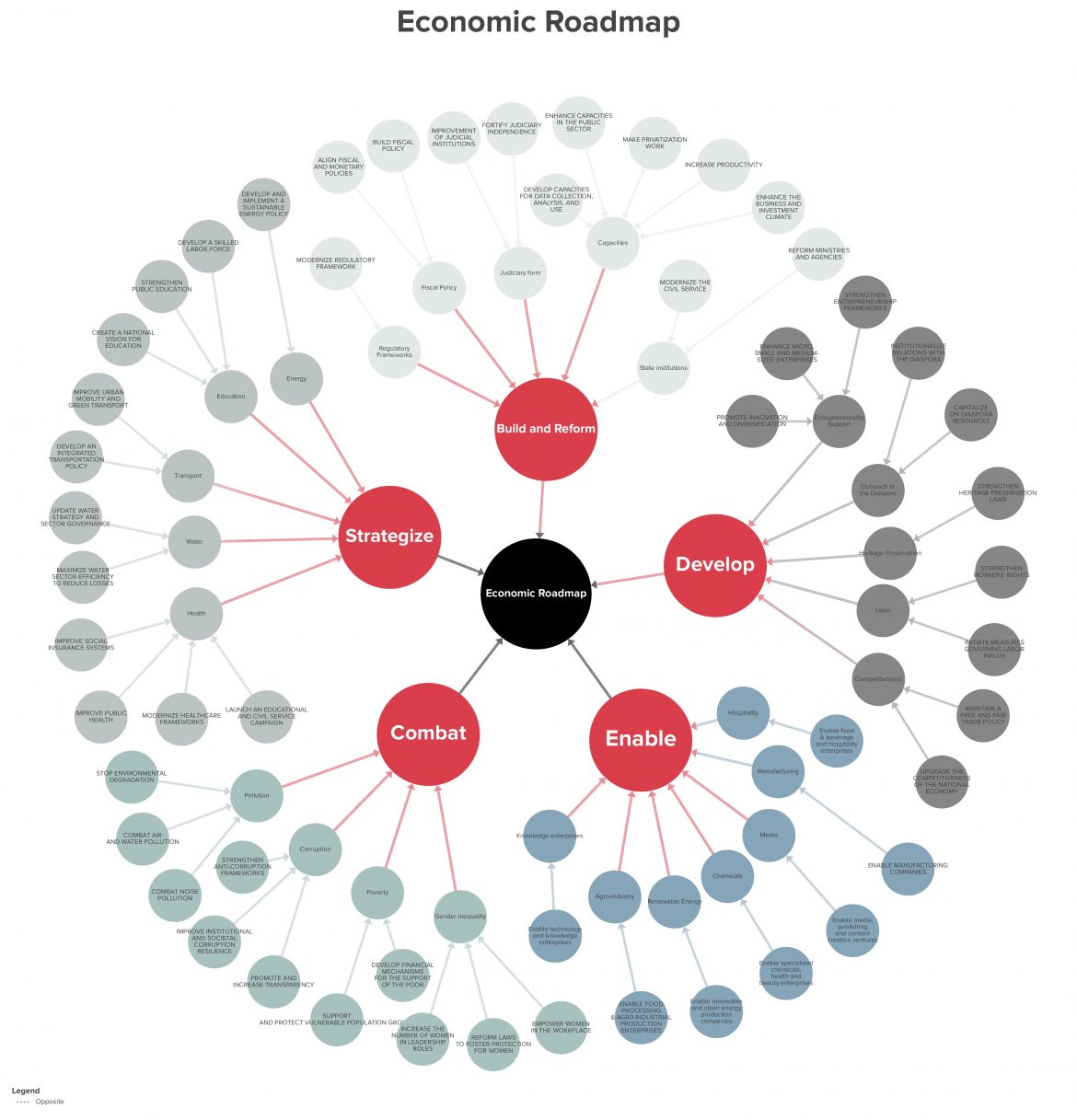
In the earliest iteration, direct consultations with stakeholders as well as the archive of Executive informed Draft 1.0’s formation with analysis pieces, industry reports, business features, interviews, expert comments, by-invitation op-eds, and editorials. Extracted from a loose list and organized into four pillars (Build & Reform; Strategize; Combat; and Develop), the aggregate of the magazine’s stakeholder contributions and insights was translated into an actionable document of 16 Policy Priorities laid out on 48 pages. Three internal and twelve external stakeholders were listed on the masthead of Draft 1.0. 

The mindset of Executive editors at this moment in time, expressed in the Facts & Figures 2017-18 end-of-year issue, was deeply concerned, but still hopeful. The issue’s Economy & Policy overview piece warned “The Lebanese state has no plan for where to take the country economically in 2018 and beyond.”

It can thus in hindsight be said that the first steps of the structured Roadmap process, while yielding Draft 1.0, were embedded in an increasingly uneasy calm, the relative peace of the status quo ante that lulled Lebanon in the entire post-conflict reconstruction and development period of the 1990s, 2000s, and 2010s. In the months following publication of Draft 1.0, the country was still engulfed in deceptive calm (while the July 2019 issue of Executive was titled “Breaking Point” and argued that, if Lebanon were a corporation “its management would need to be fired and fired fast”, editors continued to emphasize the great value of the financial system and called upon banks “to make every effort they can to be absolutely trustworthy”).

But in editors’ anticipation of likely deepening social and economic chasms and breakages in the country’s integrity, Executive’s Roadmap was, in a parallel effort to the regular coverage, materially reviewed and substantially expanded through consultative meetings held with diverse civil society organizations and stakeholder groups (that in some cases did not even consider themselves being prima facie economic stakeholders). Because of these interactive, on-the-ground consultations, the number of credited Roadmap contributors multiplied more than sixfold; Draft 2.0, published as a standalone document in spring 2019, introduced 268 newly proposed measures.

A first for Executive in the preparation of Roadmap 3 was an intense cluster of five economic and financial roundtables organized in a downtown Beirut hotel just ahead of national day 2019. Stepping out of the conference venue and walking less than 50 steps after the successful conclusion of the last roundtable session meant that participants and conveners of the gathering were immersed in one of the most vibrant and enthusiastic Martyrs’ Square convocations of civil demands for change. Draft 3.0 was thus informed by the civil thawra at the end of 2019, but was still in many ways an effort of finding ways to avert the tsunami of despair that had been looming higher and higher in the preceding months. The number of credited contributors and stakeholders in the project again rose, almost doubling from Draft 2.0.

Aspirations of rescue in dire straits 

As the liquidity and banking crisis merged into the structural economic meltdown, the Roadmap process entered its second phase of iteration and became a crisis response and rescue tool. Draft 4.0 sought to help chart the way through the crisis by highlighting proposed emergency measures while attempting to “complement the emerging political will, doctrine, and resolve, which centers Lebanon’s well-being.” Draft 4.0 was presented in print in the “Fight for Hope” December 2020 – January 2021 issue of Executive. 

As the immensity of the Lebanese political, economic, and social crisis was building up in 2020, the crisis turned into a mega- and meta-crisis of the Lebanese convivial model. Executive’s Roadmap Drafts went in search of new perspectives and ways forward. 

In this overwhelming crisis context it is important to acknowledge that the work on RM Drafts 5.0 and 6.0 was marked by many financial and personnel impediments because of the—in national memory unprecedented, and, also by Executive in its magnitude wholly unexpected—mega-crisis with its exacerbation of the Covid-19 pandemic and the restrictions on residents’ lives that were initiated by a surprisingly proactive state to curb the spread of “corona.” The other exacerbating factor of the national pain in the first and biggest crisis year was of course the Beirut Port explosion of August 4, 2020 unleashed by human failure and criminal political negligence.

Under the impact of the mega-crisis of 2020 to 2022, RM Drafts 5.0 and 6.0 saw addition of measures urging fast action on issues such as negotiations for an agreement with the International Monetary Fund and provision of vaccines. A most noteworthy effort of opening new perspectives for economic recovery on basis of private sector productivity and focus was the addition of the Enable pillar, documented in Draft 5.0. This pillar emerged out of consultative roundtable work with international agencies and private sector industry leaders in March 2021.

The Enable pillar consequently covers seven sectors of promise in manufacturing and services. These seven sectors – manufacturing; agro-industry; media and content development; hospitality; knowledge enterprises; specialized chemicals (with utility for health and beauty); and renewable energy – were judged by consulting experts as best positioned for new growth. The recommendations in this pillar present strategic recommendations and proposed practical measures, directly and primarily addressing private sector decision makers. The number of credited contributors in Draft 5.0 reached more than 180 and the number of proposed measures culminated at over 360. Draft 6.0 at the start of 2023 reiterated the content of Draft 5.0, adding new accents and shifting emphases. 

Due to financial restraints, Drafts 5.0 and 6.0 were disseminated solely in electronic format. Ideation of ERMI started in mid-2023. In the iteration’s design and collation phase, Executive agreed on parallel production of a mindfully shortened, more visually appealing and intuitively interactive ERMI and the reference Draft 7.0 that combines revised introductions for each Policy Priority with annotations that record edits and streamlining of proposed measures versus Draft 6.0.  

Through the looking glass(es) of many innovative minds 

As the crisis landscape has ceased economic and social escalation and shifted in 2023 to a wider need for integrated regional development and stabilization, Executive deems that the third phase of our Economic Roadmap iterations is upon us in form of ERMI, whose abridged proposed measures content-wise mirror pdf Draft 7.0 as the comprehensive summation of the Roadmap process’s phase one and two. 

In preparation for the day after regional instability – or more precisely the day after the day after – the start of phase three in the Executive Roadmap denotes the time of joint striving for a new sovereignty that is realistic, modular and interdependent rather than indivisible and implemented in antagonism to and isolation from Lebanon’s direct neighbors. Executive has worked on the first iteration of the third phase by empowering ERMI while in parallel providing Draft 7.0 as final pdf iteration and reference document containing the longer-form Policy Priority descriptions and proposed measures.  

Digitized but not yet fully digital, ERMI offers the experience of an abridged Roadmap version that encourages more debates by condensing lengthy proposed measures into shorter versions and omits some proposed measures, mostly such measures which overlap and have been included in earlier drafts in more than one pillar and Policy Priority. We also condensed the introductions for each theme and designations of Policy Priorities for easier interaction in ERMI.  

The editorial condensing of measures notwithstanding, ERMI is even more committed than Drafts 1.0 to 7.0 to the stakeholder diversity and consultative approach that is the governing mindset of the Executive Roadmap process since day 1. The editorial commitment to continuity of this process is evident in the structure of five verticals (pillars) and 26 topics or Policy Priorities with a total of 52 sub-categories that are denoted in both RM7 versions by the numerated entries 1.1 to 26.1. 

The affiliated measures are denoted in the second decimal layer, from 1.1.1 to 26.1.24. The integrity of the Roadmap numbering system has been retained, even where individual measures have been retired from ERMI for reasons of redundancy or inappropriateness in the 2024 timeframe. In short, numerical identifiers of Policy Priorities and proposed measures in reference Draft 7.0 and EMRI are 100 percent the same.   

For complete elucidation of the roadmap numbering scheme, it is additionally to note that the subdivisions of Policy Priorities in Roadmap pillars 1 to 4 number between 10 and 12 per pillar. This grouping is numerically set off against the Policy Priorities in the industry-addressing fifth “Enable” pillar that covers seven industrial sectors (policy priorities 19 – 26) with no further subdivisions. 

In terms of intended priority audiences, pillars one and two have been compiled with the primary target of serving and inspiring public stakeholders, pillars two and three are designed to appeal civil stakeholders, pillar four and even more so pillar five aim to reverberate with private sector stakeholders. All five pillars, however – and this is the raison d’etre of moving the Executive Economic Roadmap into expanding interactivity with more and more digital functionalities envisioned for future EMRI iterations – seek to unleash innovative thinking and garner input and debate from all types of mindful stakeholders.

March 26, 2024 0 comments
0 FacebookTwitterPinterestEmail
Leaders

Reading beyond the ominous signs

by Executive Editors March 22, 2024
written by Executive Editors

Lamentations over the state of the world, the ongoing extinction of a Mediterranean conurbation, and the mass murder of a populace in our corner of the Middle East are currently ubiquitous on the world’s streets and in virtual public squares. In the global market place of opinions, minds are bombarded with both constant protests against war and genocide and constant hue and cry lambasting the parties bearing the blame of the ongoing armed conflicts. 

From the vantage point of our small geopolitical neighborhood, this has the perverse effect that apparently vote-seeking philippics about concrete wars, genocide, and everything and everyone that is – verily or presumably – not adequately functioning in the global system, currently are detracting from giving what it takes to meet this troubled region’s urgent need for radically new, sustainable and long-term solutions. 

Such detraction is all the more tragic under the Lebanese socioeconomic perspective. Any valiant effort for a full national reboot, the need of which has been stated openly and unmistakably for seven consecutive years by the economically literate in this country who trusted this magazine as their forum, is today forced to confront the bickering, self-centered of the country’s political class and their external beneficiaries. Additionally, all calls and efforts for producing solutions to the Lebanese economic dilemmas are now drowned out by the political maneuvering, fake news and propaganda assaults in the massive info-war that has been raging since last October on multiple fronts around Lebanon. This is nauseatingly counterproductive because the crisis of the Lebanese economy is not solved in the least. 

A horizon hanging full of mourn 

However, before it is conscionable to discuss if and how the worsened Lebanese situation, heightened national security, and persistent economic threat level can be rationally addressed, it is a human obligation to acknowledge that Lebanon, while suffering, is far from being as bad off as the Palestinian territories, long the nexus of universal suffering in this part of the world. With the Palestinian pain at a tortuous and wrongly justified historic peak level, it must be expected that nothing other than dirges will become the emblems of living in Gaza and all of Palestine and that those Arab dirges will for years be sending their worthy message to the world. 

This outlook on future perception of the Palestinian cause is diametrically opposed to the way how, in the global battlegrounds of opinion manipulation and mind twisting, it is today impugned as barbaric and disgracious to open one’s mouth, asking for example what delineates genocide when the stage is Gaza, or “coldheartedly” compare what percentage of Gazans have been killed in five months with the percentage of civilian casualties during two years of warfare over Ukraine. But most depressingly, and regardless of the inevitable rectification of the current vile rage against calling out the mass extinction of Gazans and deliberate “inflicting conditions of life calculated to bring about a group’s physical destruction in whole or in part” for the genocide it is, the stories of monstrous suffering and unbearable pain in Gaza will only lead to the eternally unanswerable question of “why?”. 

“Why” is the essence of lamentation, whether one searches today, 7 decades, or 27 centuries ago. And even if one dirge were to ask, “where are signs of hope and peace?”, such a question’s indisputable answer can only be the negative affirmation: not with terrorists, not with the tyrants of power, and – with 99 percent certainty – not in geopolitics. 

And yet

However, an equally indisputable fact about the future of what is today the world’s most concentrated war zone, is that the there will be a “day after.” Even as no one can predict how many more needless deaths it will take for the power of atrocity raging in Gaza to finally wane, it is a fact of history that wars do cease. 

And this means there will be the day when all partisan non-starter solutions and peace-of-the-cemetery plans for Palestine, and by extension Lebanon, will be substituted with an endeavor of somehow realizing non-violent coexistence and a multi-faceted and fair regional framework that fortifies these peoples’ yet to be built sovereign path of self-determination, prosperity and virtuous interdependence.   

Notably, even if there will also be a “day” marked by the need to heal the souls of victims and unmask the lies that have been and still are ruling the war, the “day after” on country level will require return to economic life and implementation of political coexistence with neighbor countries.  

Being cognizant of all this, it would be wholly unconscionable to approach the economic “day after” for Lebanon without a cogent plan. 

The Executive Economic Roadmap, throughout seven iterations, has adhered to the concept that balanced cognitive processes are crucial for a diversified and sustainable economy.  This has motivated the roadmap’s structuring into pillars in adherence to the thought that what is crucial in an economy’s intensification and expansion, are applied methods of information processing for balanced growth and conservation while also considering juxtaposed innate tendencies such as aggression and cooperation. This mindset, used since the first draft of the Executive Roadmap, is the mindset that we relied on when revising our current roadmap draft 7.0 and its more appealingly digitized version, the Executive Economic Roadmap Interactive, or ERMI, which we intend to be maintaining and updating under this designation in continuity. 

Beating the Red Queen from a new baseline

The 2024 departure line for the next attempt of igniting Lebanon’s economic democracy is marked firstly by new dangers, namely the specter of foreign aggression against Lebanon and the equally threatening specter of violation of liberty from inside. But the course of our roadmap is also newly distinguished by the opportunity to analyze where Lebanese sovereignty has in the past 30 years been faked and how thoroughly the people were deceived by a false sense of economic security. 

The race to a sustainable country is secondly entering a new phase this year on strictly national grounds. With the old Lebanese fiefdom system of fake freedoms and pretend economic security gone, the target of economic salvation is no longer delineated by a polity that either masters structural reforms and gains approval from international development finance institutions (DFIs), or has no other chance but to run for the foreseeable future in what is sometimes called a Red Queen’s race (in allusion to Lewis Carroll). Being trapped in the latter would running and striving at the highest speed that Lebanon’s business community can muster – yet without a chance to escape dependence on handouts by DFIs and others from abroad. 

The vision driving ERMI is that of an interdependent and networked real sovereignty with meaning in the digital age. This concept of sovereignty as supreme but not indivisible or absolute can only succeed if based on social and economic security, and constructed by way of consultative collaboration from an economic democracy that practices non-confrontational conflict management. 

Executive invites all to access ERMI. Join our journey to security and realistic sovereignty by delving deep into propositions for betterment of Lebanese social and economic compacts. 

Testing far-out methods 

Many methods have been used throughout human history when seeking conflict resolution and post-conflict scenarios. Some involved looking for celestial signals. By some trait encoded in the human being, turning our eyes to the skies is ingrained in our kind. Turning their eyes to the skies was what the augurs– one might describe an augur as a political consultant and futurist – of antiquity’s Mediterranean super power Rome did routinely and professionally over 2,000 years ago. 

Another no less astounding but very different story of reading the skies is the tale of the Mediterranean seafarers who, close to three millennia ago, navigated to distant African and Northern European shores. 

They did so not by auguring from mystical sights but by using a combination of celestial and terrestrial observations, imprecise mathematical calculations, and experience. Thus ensued the narrative of long-distance trade and the fame of requisite Phoenician skills eons before sailors started to use the compass, not to mention GPS.

Thus, despite the boost in appreciation for metaphysical decision-finding that the performances of leading players in today’s empires may have unwittingly caused in the past few months, it is the method of combining intuitive, experiential, and evidentiary elements that Executive continues to trust as far as the salvation of the Lebanese polity and economy is concerned. 

Yet, outside of our economic roadmap, how can a contemporary human being react to the recent revelation of seemingly irreversible moral bankruptcy and operational catastrophe of the overextended geopolitical system? 

It is in this context that the anachronistic proposition of auguring sneakily arises in this writer’s notoriously simple mind. When contemplating and agonizing about the political maneuvering and grandstanding that falsely claims to be a search for peace in the Middle East, it suddenly sounds sane, almost compellingly so, to resort (like a Roman augur) to reading aerial movements as arguments for a Pax Deorum. 

However, to return to a more realistic mental ground, about the short-term potential of ERMI one must make no mistake: what in a best-case scenario is on the cards for Lebanon will not be, for a great and indeterminate while, a day of peace or prosperity. It will be a day of newly endeavoring for economic sanity. This effort can be informed by two prior stages of mapping of the Lebanese economy’s needs, but it will also in the coming post-crisis years remain an absurd aspiration to succeed on terrain that has up to this day been hostile to sane and sustainable economic life in so many different ways. In this spirit let’s just recall one apt motto of Lebanon’s 2006 mental rebellion against being bombed into the “stone age” by a most belligerent neighbor: Keep walking.

March 22, 2024 0 comments
0 FacebookTwitterPinterestEmail
Banking & FinanceEconomics & Policy

Saving the economy or saving face?

by Mounir Rached March 22, 2024
written by Mounir Rached

An alternative to ineffective banking reforms and recovery plans

The latest version of the bank resolution law has the same pitfalls as the previous ones.

Mainly, the law proposed the creation of a committee entitled to determine which banks to be resolved and which to be restructured. The committee is composed of the central bank’s governor and vice governors as the main decision makers, which implies that Banque du Liban (BDL), the debtor, is determining the destiny of banks, the creditors. It is an absurd situation.  The decision-making process should be in the hands of an independent committee.

 It has other pitfalls such as the discretionary classification of deposits into qualified and nonqualified deposits. The proposed reforms would also require depositors to provide evidence of how they earned all deposits exceeding $500 thousand dollars and confirmation from the ministry of finance of the respective country where the deposits originated. This is impossible, especially in cases where earnings originate from Arab oil countries that don’t impose a tax regime. 

An alternative reform plan 

It is, therefore, imperative to devise an alternative plan that resolves the insolvency issue without depriving depositors of their legitimate financial savings. Furthermore, deleting deposits can’t be undertaken without the consent of the majority of depositors under a “collective action clause-CAC” requiring a single aggregated vote of consent of 75 percent. A massive bail in is an aberration and departs from good practices as noted by some member of the IMF Executive Board. Deposits of banks at BDL are liabilities and should not be classified as losses under any circumstances. The solution is neither to delete nor to refund deposits, but to safeguard them in banks’ balance sheets and create liquidity and trust in the financial system. 

Creating trust and liquidity are the indispensable elements of resolving any banking crisis. To achieve these goals, it is essential to implement the following:

1. Protect all deposits: First, assure that deposits are protected and maintained as banks’ liabilities. Any emerging losses incurred from liquidated banks should be dealt with through the proper legal liquidation channels (liquidation law 110) and not through ad-hoc discretionary measures. The government should declare adherence to the constitution safeguarding all financial and real assets.  Safeguarding personal (national and foreign) and institutional savings is necessary to regain trust.

2. Adopt a free market-determined exchange rate: Unify and free the exchange rate for all public and private transactions and remove all restrictions on bank transactions in foreign exchange.  The central bank may intervene in the foreign exchange market as part of its stabilization monetary policy and to avert unexpected market pressure. A free foreign exchange market will diminish the role of the BDL in hoarding significant amounts of reserves.  Required reserves ratios can be significantly reduced, thus generating foreign exchange liquidity in the banking sector.

A free foreign exchange market creates trust as it allows depositors and banks to freely make transactions from their foreign exchange accounts in either Lebanese pounds (LBP) or dollars at the market rate. With a unified market determined rate, the depositors will be unconcerned about whether they are reimbursed in Lebanese pounds or in dollars from their accounts. The virtual and digital role of money can be resumed with the use of checks and credit cards and other digital schemes such as PayPal and e-wallets. With all banks accessing the foreign exchange market, the market will become larger and more competitive, limiting opportunities for manipulation by single foreign exchange traders.

A free rate can equilibrate financial markets and the balance of payments by promoting production of import substitutes and exports of goods and services. It restores the real value of financial assets and liabilities, promotes savings and investments, attracts foreign investments, and promotes growth. 

3. Reschedule financial assets and liabilities: Reschedule all public and private financial assets and liabilities in foreign exchange and LBP accounts including deposits and public debt for short, medium, and longer-term periods not to exceed 5 years.  This measure can be designed to ease the initial strain the banking system may face when a free/ floating exchange rate is adopted. The BDL can initially allocate a portion of its reserves to reduce a possible initial turbulence in the foreign exchange market. Rescheduling of financial assets and liabilities may be guided by the term-structure that prevailed in 2017-2018 before the crisis. The BDL could supervise the process to ensure its adequacy according to the prevailing conditions in banks.  The rescheduling should include all client deposits at banks and the liabilities of the BDL toward the banking sector. Any write-off proposals to reduce liabilities of banks has to be acceptable to depositors individually or in the context of a Collaborative Action Clause (CAC). The government cannot devise a plan that reduces deposits without acceptable and appropriate compensation, which requires the participation of creditors and legal transparency.

Foreign currency debt consisting of $33 billion (composed mostly Eurobonds) is being held by foreign financial institutions and private holders (approximately 50 percent), Lebanese commercial banks (7 percent), the BDL (15 percent), and by bilateral and multilateral obligation (3 percent), with the remainder being held by Lebanese banks and private holders. A large part of the portion held by international financial institutions (IFIs) was acquired at a discounted price during the crisis.  Netting out BDL-held Eurobond debt and the discounted value of IFI-held Eurobond debt could entail a reduction in foreign currency debt of nearly 20 to 25 percent. The government may be able to reschedule dollar debt on terms consistent with debt sustainability with the consent of creditor.

Public debt in LBP mostly held by BDL and banks has been diminished in dollar value by 98 percent, or the exchange rate depreciation rate.

4. Balance the budget: Pursuing fiscal reform with the objective of achieving a balanced budget with a primary surplus is a key ingredient in generating stability in the foreign exchange market and improving external transactions outlook. A free rate enhances government revenues from trade taxes, VAT and income taxes. It can allow the government to adjust its expenditure including wages, investment spending and, at the same time, contribute to a balanced budget target. 

In addition to the impact of adopting a free market-determined rate, several additional fiscal measures should be considered that can improve budget performance and debt sustainability by enhancing revenue collection, such as adopting an appropriate tax structure combined with an efficient- spending programs. 

5. Efficiently reform the banks: Banks’ troubles stem from the default of both the BDL and the government in servicing their obligations.  Their non-performing assets can be resolved as part of rescheduling their liabilities.  Bank reform can be supervised by the relevant financial agency at the BDL in collaboration with the Association of Banks of Lebanon. Exchange rate reform should precede any resolution or liquidation of banks. Commercial bank losses could be limited as most bank assets are collateralized except for sovereign public debt.

The BDL recapitalization could be replenished gradually from government sources as Article 113 of the code of money and banking stipulates that BDL losses have to be borne by the government. The rescheduling of BDL assets and liabilities combined with freeing the currency market could be sufficient to allow the BDL to resume its normal operations. However, the BDL is indeed in need of implementing an administrative restructuring plan in order to reduce the centralization of its current structure. 

6. Corporatize public enterprises: The public enterprise sector has been a major burden on state finances with most of the dollar debt burden emerging from financing their financial gap, prominently within the power sector. The power sector alone received transfers of $50 billion over the past two decades including interest cost estimated at $26 billion.

Corporatization of state-owned enterprises will create an opportunity for depositors to invest in the private sector, and reduce the liabilities of banks. The emergence of a new corporate class will be a fertile ground for allowing banks to play their proper intermediation role and grow again instead of relying on the state for their livelihood.

A salvage plan for whom?

All recovery plans that have been presented since mid-2020 by the governments of Prime Ministers Diab and Mikati, respectively, continued to focus on writing off presumed losses and diluting them rather than on reviving the economy. They presumed the crisis as a bankruptcy rather than an insolvency or liquidity case.

These plans, endorsed by the International Monetary Fund (IMF), assumed losses equivalent to over 90 percent of deposits and concluded that the burden of losses should be borne by the depositors, as they falsely claimed that both banks and the government are bankrupt. Residents and non-residents alike have already assumed large losses from restricted and undervalued dollar withdrawals. As noted at the onset of this comment, no version of the bank resolution law has resolved this fundamental flaw. Any new recovery plans must not further penalize the people.

This article reiterates and expands on a similar argument from this same author published by Executive in February 2023. 

March 22, 2024 0 comments
0 FacebookTwitterPinterestEmail
Editorial

Those who raid other people’s pockets

by Yasser Akkaoui February 5, 2024
written by Yasser Akkaoui

Fulfilling your work orders in a timely manner is the absolute minimum requirement if you want to keep your job. Parliament, whose job description is the protection of the people’s interests, has started this year by – for the first time in almost forever – nominally satisfying one of its standard yearly obligations by voting on the budget before the end of January. 

But this theoretically commendable fulfillment of parliamentary responsibility indicates nothing about its real job: legislating a budget that will sustain and improve the livelihoods of the people. This is not, as many vested experts know and state loudly, what the 2024 budget is about: at best, it is weak temporary fix and a dead-end solution. 

It’s no surprise that the establishment continues protecting a system that has been serving them for decades. One that took so much effort and corruption to perfect. To understand the workings and delusions of the powers that really are in charge among Lebanon’s political class, my mind leaps back to a film that was made in the heyday of venture capitalism and hostile takeovers about the thrills and the perverse “romanticism” of being a corporate raider. 

Other People’s Money with Danny DeVito, Penelope Ann Miller, and Gregory Peck was a 1991 flick whose slick and obnoxious winner was “Larry the liquidator”. He got both the company (with the declared goal of tearing it apart), and (in the movie’s concluding scene) a hint at further romance with the smart lady that had opposed him and lost. Just like in this movie, to me it seems that there those in our political class who believe they can steal the people’s money, liquidate our national assets with impunity, and still have lady Lebanon fall for their oily charm. 

Should the people adore their elected representatives for approving the budget for once within the legal deadline? Applaud the government for presenting a budget without a strategy describing how the country’s resources will be managed and without clear economic performance indicators to hold its managers accountable for? 

Despite the budget’s passing, it stinks again and the odor is so foul this time because there is so little left to steal. Continuous improvement can only be achieved when everyone is empowered to achieve its responsibility to protect the people in an inclusive, transparent and accountable manner. Our government and its budgetary perpetrators cannot be permitted to continue raiding our remaining, minimal financial safety by dipping, without creating any prospect for real growth and structural reform, into what are other people’s pockets.

February 5, 2024 0 comments
0 FacebookTwitterPinterestEmail
Last Word

Taking the local path towards enhanced economic security and urban stability

by Taina Christiansen February 5, 2024
written by Taina Christiansen

In Lebanon, nearly 90 percent of the population live in urban areas, making it a country of cities. Therefore, applying an urban lens onto the future economic – and social – stability of Lebanon, where localized urban investments are seriously considered and encouraged, must be at the heart of Lebanon’s sustainable and inclusive tomorrow. Local economic development and investment, where local dynamics and the involvement of respective authorities and stakeholders are at the centre, should be a key consideration within the overall ongoing deliberations of macro-economic reforms in Lebanon. 

Urban social stability and safety is intricately linked to people’s inclusive access and rights to key basic services, such as housing, water, electricity, infrastructure, public spaces, education, health and more. In Lebanon, this is no exception. Haphazard urbanization and expansion of informality across Lebanese cities, coupled with historical mass internal and external displacement – amongst other factors – has made it challenging for government institutions at national and local levels, to resolve or at least mitigate conflicts over land, resources, property rights and equitable services for urban inhabitants. Appropriate economic management in Lebanon can tap into strategies that improve efficiency of revenue collection (as part of a broader financial strategy) and contribute to the beginings of a renewed social contract – which in turn can improve urban affordability for the poor, and contribute to enhanced social stability and safety. 

Financing sustainable urbanization is an investment in Lebanon’s present and future. Lebanese local government capacity must be expanded to harness private sector participation, leverage local assets through value capture, and partner with the central government to invest in urbanization. At the global level, United Nations member states have clearly committed to this through the New Urban Agenda, where the need for a strong municipal finance system is clearly highlighted as a requirement for advancement towards the Agenda 2030 for Sustainable Development. Lebanon’s 1977 Municipal Law outlines the range of sources of finance available to municipalities. This includes fees collected by the central government on behalf of municipalities in an Independent Municipal Fund (IMF) – managed by the Ministry of Interior and Municipalities and Ministry of Finance – which in theory sees funds redistributed back to municipalities and unions of municipalities. In practice municipalities rely largely on funds from the IMF, some more than 30 percent, others up to 70 percent and smaller municipalities almost entirely. However, these allocations have been beset by delays – for multiple reasons – even prior to the ongoing economic crisis, and current distributed allocations are on hold. Local authorities have thus sought international assistance to finance part of this gap, even more so since 2019 (with a previous increase since the onset of the Syrian displacement crisis in 2011), through innovative ways to support municipal finance and capacity building in order to enable service delivery and contribute to social stability through investments in Lebanese cities and localize development and humanitarian assistance. 

The system for financing local governance and development in Lebanon stands to benefit from a comprehensive overhaul to move closer towards self-sufficiency of municipal services. Doing so, will afford local authorities a real chance in addressing local social instability in a bottom-up approach. As summarised in the UN-Habitat Lebanon and ESCWA State of the Lebanese Cities Report 2021, a key aspect of national and sub-national public finance reform, must re-consider the fairness of the intergovernmental grant system to better take into account actual differences in local needs: “A particular and well-known source of bias in the budget allocation is its blindness to the pressure on municipal services exerted by people who are not registered in a given municipal jurisdiction. This mismatch, which disproportionately affects urban communities, is symptomatic of complex issues spanning voting rights reforms, lack of national population data, and the long-term policy approach to rights afforded to non-Lebanese nationals. This suite of recognized issues may find traction as part of the overall governance reforms.”

February 5, 2024 0 comments
0 FacebookTwitterPinterestEmail
FinanceOverviewSpecial Report

A laboratory to study financial challenges

by Thomas Schellen February 5, 2024
written by Thomas Schellen

By the strange virtue of its unresolved economic and financial crisis of now four year duration, Lebanon has become an examination room and nation-scale laboratory for analyzing an economic and financial catastrophe. The reasons are plain: this crisis of a small, highly and deeply dollarized country was composed of interconnected financial, economic, social, political, and external shocks and has been playing out at the cusp of a hyper-connected, hyper-(mis)informed, heavily globalized, extremely financialized and increasingly digitized world that cannot but expect to see novel and very hard-to-manage long economic waves and superfast financial cycles.  

The people who were involuntarily subjected to this experiment seem to have shown a rebalancing of newly precarious and informal financial safety with equally precarious and massively externally secured social stability. They have done so through their behavior and coping adjustments over the past four years, which, a cynic might note, were not significantly distorted by government interference or by any notion of trust between people and their government. 

It could further be hypothesized that firstly financial safety and price stability, the domains of central bank policy making that are also the mission of Banque du Liban (BDL), the Lebanese central bank, are not only requirements of stability and/or growth in economic outputs but also quintessential for social security and stability. 

Secondly, it could be said that the slowly improving levels of financial safety, economic performance, and social stability in the country show no indication of sustainability. The evidence of informed altruism and healthy self-interest are focused on the here and now of rational coping, not on national or institutional rebuilding. 

Attributes that characterize the Lebanese economy after four years of disruption and administrative chaos are economic informality, the dollarized cash economy and the inflow of remittances. Many economists and stakeholders in the industrial sector have told Executive that they consider economic informality to have doubled in the past three years, from an already high level that in the mid-2010s was estimated to be in the 30 to 40 percent range. As to the cash economy and remittances, the World Bank estimated earlier in 2023 that last year’s cash economy was worth $9.86 billion, or 45.7 percent of GDP by World Bank computation, and that remittances equaled 31.7 percent of GDP. 

These estimated numbers present a blurry snapshot of the current level of “normalization” in people’s daily affairs, snapshots taken with substantial x factors of further growth of the cash economy and increasing pressures of informality in the first nine months of 2023 as well as fluctuations in inflows from remittances and external financing through diverse channels. It is clear, however, that external financial lifelines have been sustaining anything from peer-to-peer emergency aid to rebuilding of schools and hospitals to salaries of teachers, from civil society research pursuits to non-governmental aid efforts and private household sustenance. 

Hands-on normalization 

This journalist’s daily experience of normalization of living conditions at the end of summer 2023 begins with the personal comfort of mornings that are once again filled with the excited sounds of hundreds of children before the school bell chimes and the national anthem rings out from the school yard next door. For more than two years after the Beirut Port blast, there had been only the sounds of demolition and restoration. 

Further anecdotal observations of everyday life around the wider neighborhood and on trips around Lebanon in the second and third quarters of 2023 have made this observer sense a superficial “normalization” trend in traffic and transportation patterns from the availability of service taxis to the experiences of urban congestion on streets in the Beirut conurbation. At night, the city’s streets are – although sporadically – lit better and there has been “normalization” in the supply of electricity to those who can afford it. There is a new normal also in the supply chain flows and retail market availability of increasingly hard-to-afford consumer goods and especially imported foodstuffs, as in the difficulty to find a table at a mid-range but overpriced eatery in shopping malls during the expat visitation season.

The socioeconomic “normalization” delivers a picture full of contradiction. On one side it shows a social landscape of unbearable inequities that have sunk back into hiding but on the other side it also shows a panorama of how a society’s economic and social coping efforts have proceeded under a new survival formula. It is to be interjected here, however, that the perceived relative normalization of the economic crisis and living circumstances, where insufficient household incomes were the main source of societal pain, has in October 2023 been overthrown by exponentially rising fears over acute shortages of everything from shelter, food, and water to medical care and communication services because of the threat of war and foreign aggression that again came to loom over Lebanon. 

Nothing normal in finance

The new normal in the financial services sector, by contrast to the societal picture in the first nine months of 2023, has stayed and is quite anti-normal and disturbing: commercial banks, which a little over one year ago overwhelmingly turned themselves into barricaded obstacle courses attracting only the most desperate or daring of customers, have retained their dysfunctionality. On the other hand, visible activity in the financial retail market has been swamped with flashy storefronts and marketing messages of purveyors of money exchange and cash transfer services. All in all, the new normal in finance is a market in alternation dominated by new and recurring stories of corruption and by the reality of zombie banks that have lost many decades’ worth of trust and human capital.

But is the ill health of financial markets really a recent problem? In the analysis of Fouad Zmokhol, dean of the school of business and management at the University of St Joseph in Beirut, financial safety in Lebanon has been a problem long before the onset of banks’ liquidity problems. “Financial safety and financial stability are headline issues in all economies, specifically the large developed countries. Taken into the Lebanese scenario, we have to be realistic in saying that financial safety and stability was never in existence in the country,” he tells Executive, emphasizing that financial safety and social stability were absent even during the 30 years until 2019, and that safety which was thought to exist during that period, was in truth fictitious.

For Zmokhol, the 1989 Taef agreement to end the civil war involved a pact among warlords to usurp economic power in Lebanon and embark on a debt financing strategy for the country, thereby accepting a huge pileup of public debt and a government that was running on deficits and debt machinations that precluded achieving real financial safety and social stability.  

Other indications for the situation of financial safety were elucidated throughout the first nine months of 2023 by the developments, or absence thereof, of banking and financial market reforms, by audits of the financial entities, by the changing of the guard at the central bank, and by fragile but fresh shoots of innovation. 

The issue of first magnitude is the absence of financial sector reforms and correlated deterioration in the capacity of banks and financial market participants to channel stored monetary value into productive investments. 

For investment expert Khaled Zeidan, chairman and general manager of financial consultancy Capital EE, pillars of the financial system are yet to be constructed – probably beginning with capital markets – but there is no going back to the previous system which was so deeply flawed that it practically failed by design. At the exit from the meltdown of the financial system, “the funding of the economy is the issue, because there is no medium to long term deposit base in the country now,” he tells Executive. 

On a best-estimate assumed current GDP in the range of $25 to 27 billion today, the economy would require about 30 percent, or approximately $7 billion, in funding to securely resume growth but such large access to finance could not be supplied by commercial banks in the foreseeable future. “How do you fund the economy? Let’s say banks come back under a restructuring plan and you will have something like five or six banks instead of over 50 banks as before. Assuming that these banks will be able to address the market needs, I don’t expect them to be capable of addressing more than 30 percent [of it],” Zeidan elaborates. 

A second facet in the recent financial developments is the effort of unmasking and cleaning up the sector’s governance breakdowns and illicit practices of the past 10 or 20 years. In a case of crucial institution-building failure for example, a thorough mess was made of seriously delayed regulatory innovation and underwhelming supervisory empowerment of the Capital Markets Authority (CMA). 

What many say were political and clientilistic delays in reaching CMA operability, and therefore capital markets functionality, run into years of failures as far as establishing, staffing, and properly operating the CMA institution needed to invigorate the historically anemic but principally vital Lebanese capital markets. The extent of this failure has become clearer this summer, in the revelation of a long-suppressed CMA report of malpractice findings at financial brokerage Optimum Invest (OI) from before 2016. 

The report actually surfaced in public debates in conjunction with the forensic audit of the Lebanese central bank, whose governor was at the same time the chairman of the CMA. However, public discourses of the OI case were not so focused on the OI report’s systemic implications – which among other things suggest that conflicts of interest and cronyism were deeply permeating and damaging the sphere of financial intermediaries. Instead, the primary focus of public attention throughout the summer of ‘23 was once again on the person of then-central bank governor Riad Salameh and his alleged culpability in every problem at Banque du Liban as investigated by a forensic audit – whose language was loaded with innuendo and whose preliminary findings appeared less than spectacular and revelatory to informed observers (for more on the culprits and victims, see story page zxxx). 

The views of the professionals 

Being not just an informed observer but an active professional stakeholder in the arduous task of unraveling the web of legal violations in the financial sphere of Lebanon is lawyer Iman Tabbara, who serves as board member in the Lebanese Private Sector Network (LPSN). She tells Executive that a group of lawyers, including herself, had been tracking the issue of not only the forensic audit conducted by financial services firm Alvarez and Marsal (A&M) but also two slightly earlier central bank audits by consultancies KPMG and Oliver Wyman. The lawyers actually obtained a court decision that forced the Ministry of Finance to make their results accessible. “As to the outcomes of the three audits, we were very well aware that the practices [of the central bank] were not in accordance with the applicable laws or the accounting standards that we knew of. Even the figures highlighted in the forensic audit we knew in an approximation,” Tabbara says. 

Having gained the audit results, law firms were able to prove that their allegations of rule violations at the central bank were backed by relevant numbers and not just politically motivated witch hunts. But for Tabbara, the audits were still falling short from many of their objectives such as bringing financial sector and banking transparency and facilitating better accountability in commercial banking through individual audits of the top 14 commercial banks. 

Moreover, in some ways audit debates in media and society, in their singular concentration on personal corruption findings at the top of BDL,  even contributed to the Lebanese people being sidetracked “from the bigger issues that the regulatory authority was unregulated and that the central bank was the gate keeper or accountant of the deeply rooted, deep state”, Tabbara says.

 Despite these shortcomings, the audits confirmed that legal professionals’ criticism of the central bank’s adherence to laws and standards is warranted. The audits flagged specific failures in BDL practices and behaviors, such as the A&M audit’s testifying to non-implementation of “Chinese Walls” of separation of responsibilities and authority between the governor, central bank departments and BDL-associated entities. “It was very alarming to us because it showed how one man, to whom all authority had been given, could design something of a monetary policy irrespective of any checks and balances in the central bank,” Tabbara elaborates. 

Her conclusions confirm to private sector stakeholders how important the completion of the audit and resolution process for central bank and the banking sector is. “There is no doubt that the private sector needs a proper and healthy banking system. Today we are unfortunately in a cash economy, which means that the banking sector is no longer playing its part. When the banking sector is no longer playing its part, this will affect the private sector negatively, in many ways,” she says.  

A new guard 

While it cannot be said today that any closure has been achieved in either the audit process or the process to repair the banking sector’s brokenness in terms of trust, capacities, manpower, and capital, an important intermediate step has been taken this summer in the changing of the guard at BDL’s leadership level. The experts and stakeholders in finance who talked with Executive during the research for this financial safety report commented very positively on the ascendance of First Vice-governor Wissam Mansouri, and specifically acknowledged his decisions on monetary issues such as retiring the relatively nontransparent Sayrafa platform in favor of the external Bloomberg platform for lira exchange rates. 

Commenting on the early declarations and decisions of the acting BDL governor, USJ’s business school dean Zmokhol notes four positive signals, including Mansouri’s commitment to the central bank’s regulatory responsibility and approach to exchange market operations that aims to maintain balance at times when having to buy dollars for fuel or similar purchases. “[Mansouri] says he will not lend to the government while not being sure if the money would come back and has stopped the Sayrafa platform because he saw it as neither transparent nor ethical, and went into Bloomberg platform, which, however, has other pitfalls,” says Zmokhol – who otherwise sees no signs of progress towards financial sector rebirth on the level of Parliament or in the presidential issue. 

Asked about his view on the adoption of the Bloomberg platform, Zmokhol approves the move in principle firstly because international platforms will not enter any local political games. “The second positive aspect is the psychological effect of being linked again to the global economy and appearing back on the radar of actors in global markets through presence of [the Lebanese lira] at a sort of floating rate,” he adds. 

On the side of risks and potential pitfalls, the economist names the possibility of high and sudden fluctuations and currency speculations on a platform that is managed internationally, as well as such platforms’ computation of exchange rates relying on official money supply data and other official economic data that do not reflect the totality of monetary flows and economic activities, due to the massive role of the informal economy. “Providing a free float in a small economy may mean that you can have some major players, from locals to foreign banks to exchange offices and speculators, who can play around with the exchange rate by simply making big transactions,” Zmokhol warns. 

Other negative effects would in his view be inevitable if locally controlled exchange rate information tools and data streams, such as opaque apps with unknown sources and concealed agendas, were continuing to contravene the concept of a unified exchange rate. Zmokhol finally sees arbitrage opportunities and risks of significant deposit withdrawal pressures in situations where either the Bloomberg market rate and a still existing low rate at the banking deposit level were scissoring, or when BDL were to adopt the platform’s rate for depositors’ withdrawals from hitherto inaccessible “old” dollar accounts – albeit this would in the short term be a boon to deposit holders. 

Innovate and live 

According to all who were queried by Executive, the start of the fourth quarter in 2023 is too early for new banks entering the Lebanese market from the region or new local banks acquiring operating licenses. Expectations are that this will change at some point because of currently unmet market opportunities. Capital EE’s Zeidan, who reasons that Lebanon’s resilience during the crisis years proved stronger than many had expected, says for example that there is a great opportunity for large regional banks to enter the financial market in Lebanon and do “huge business”. 

As the country’s innate power of survival in the past three years has defied most conventional financial and economic logic, Zeidan and others among Lebanon’s entrepreneurial minds and economists  still have faith in Lebanon’s capacity to rise quickly into a new financial culture. Tender shoots of innovation are present on the digital edge of the financial market (see story page 20) and in online banking (see interview page 26) – despite the still underdeveloped aspects of digital finance.  

Thus it is undeniable today that on many fronts of finance, many more efforts are required. For a financial feat of the magnitude needed for new and more sustainable economic growth, – and based on the assumption that the political system becomes adequately functional – Zeidan in this sense calls for functioning capital markets and “multiple different verticals”. 

To his mind, it is imperative for the Lebanese to develop market verticals for short-term commercial paper and longer-term debt, or bonds, and specialties such such as leasing or microfinance, plus the necessary support system of credit assessment. At the same time he has at least one eye firmly locked on the digital finance and tech realm, including e-wallet operators. 

By his reading of the financial system, Lebanon can in no way “be restructured to be the way it was before the crisis” and may not have a future as a regional commercial banking hub – principally because of what he says is a global shift away from commercial banking. At the same time, he regards the long-term lesson of the financial crisis as a positive one. Since the county’s financial elites have quasi fallen on their own sword of corruption-prone and narrowly self-interested practices, Lebanon’s banking and finance model cannot be rebuilt with same mindset, he tells Executive: “This resulted in a new paradigm, where the Lebanese are forced by circumstances to reinvent the finance model that we [have used until] now. This, in my opinion, is going to give us an advantage five, six, or ten years down the road.”

Editor’s note: Interviews for this article were recorded in October 2023 and do not reflect updates  or changes that may have occured since.

February 5, 2024 0 comments
0 FacebookTwitterPinterestEmail
  • 1
  • …
  • 11
  • 12
  • 13
  • 14
  • 15
  • …
  • 689

Latest Cover

About us

Since its first edition emerged on the newsstands in 1999, Executive Magazine has been dedicated to providing its readers with the most up-to-date local and regional business news. Executive is a monthly business magazine that offers readers in-depth analyses on the Lebanese world of commerce, covering all the major sectors – from banking, finance, and insurance to technology, tourism, hospitality, media, and retail.

  • Donate
  • Our Purpose
  • Contact Us

Sign up for our newsletter

    • Facebook
    • Twitter
    • Instagram
    • Linkedin
    • Youtube
    Executive Magazine
    • ISSUES
      • Current Issue
      • Past issues
    • BUSINESS
    • ECONOMICS & POLICY
    • OPINION
    • SPECIAL REPORTS
    • EXECUTIVE TALKS
    • MOVEMENTS
      • Change the image
      • Cannes lions
      • Transparency & accountability
      • ECONOMIC ROADMAP
      • Say No to Corruption
      • The Lebanon media development initiative
      • LPSN Policy Asks
      • Advocating the preservation of deposits
    • JOIN US
      • Join our movement
      • Attend our events
      • Receive updates
      • Connect with us
    • DONATE