Economics and Policy
Egypt is not interested in importing gas via pipeline from Israel and instead is focusing on a plan to import liquefied natural gas, a top state executive said Wednesday.


Economics and Policy
Egypt is not interested in importing gas via pipeline from Israel and instead is focusing on a plan to import liquefied natural gas, a top state executive said Wednesday.

Jacques Sarraf is something of a godfather in Lebanese industry. The former head of the Lebanese Association of Industrialists runs Malia Group, which has 1,608 staff across the region — around a third of them in Lebanon. Executive sat down with him to discuss how the sector is developing.
How would you assess the mood of Lebanese industrialists right now?
The problem is what is happening in our environment. Today we are suffering a lot from what is happening in Syria because Lebanon is connected to Syria and all our exports, whether to Iraq or the Gulf [go through Syria]. When Syria has a high risk with the transport this is the first big problem we are encountering.
But if we look at different sectors within the environment of Lebanon, industry is still on the safe side. I would say that despite all that is happening in our environment, still we are surviving.
What advice would you give to companies looking to stay afloat?
There are no tips on that, no magic formula. Frankly speaking each [company] knows how to survive in a critical situation. We are in pharmaceuticals, which can survive. We are in the water industry; the water industry isn’t suffering at all. But on the cosmetics we have to find more export markets, diversify our markets.
Do you have an estimate for the amount you lost in Syria?
All our investment in Syria was completely destroyed. It is in Qaboon — an area that is no man’s land between the two factions there. This year is better than last year because [when] the Syria problem began in 2011 it was very surprising for us. 2012 we got the big losses, in 2013 we are acquainted to it, we know how to survive. And at the same time Syrian industry is 80 percent destroyed and now you have 20 million to feed — they have to eat, they need everything.
Have you been able to increase exports to Syria?
[Last month] the [Syrian] minister of economy again put import licenses, [meaning] any product officially entering the Syrian market has to have a license. The licenses are only for the first priority [goods] — for pharmaceutical products it is easy to get an import license, food it is easier than others, but cosmetics are not a priority for them. [In the future] if we are doing something I would say we may do it illegally and non-transparent. Because it has to go there illegally, any product that doesn’t have an import license cannot enter Syria.
Right now your products are going in legally?
It used to be legally but now we have to find ways and means with our partner or distributor in Syria to get licensing to let the goods go inside.
The general perception is that the government has failed to support industrialists in recent years. Is that a fair representation?
In my mind, I tell my industrialist friends ‘forget about the government…’ It is not the case of whether [there is a government] or not, [industry] is not their priority. In 2005 we succeeded with Omar Karami’s government to get a 50 percent reduction on tax for exports. We are now in 2013 but still [it hasn’t been implemented]. Today we have three ministers [who have come] from the private sector, supporting us, helping us — they didn’t succeed. Why? Because the government doesn’t have the priority to support the industry and the economy as a whole. They are always happy to let the private sector do it themselves. When they need the money they go to the private sector to finance their budget. Now if we said “we are not going. We will not finance you until you solve our problem” — they would do it.
An increasing number of Lebanese industrialists are changing strategy to have their logistics hub in Lebanon but to start outsourcing industrial production and targeting other markets. What is your strategy?
This is what is happening for us. We use Lebanon as a hub, all the service company is in Lebanon — banking, financing, human talent, whatever it is — but investments are in the region. Iraq today is still the area where we feel we have big possibilities.
How would you assess the impact of the initial stimulus package organized by Central Bank governor Riad Salameh?
It was very positive. Salameh knows what he is doing and we assess it very positively.

Walking through the buoyant Beirut Art Fair on its opening night last month, one could understand why the city has been featured as one of 12 worldwide to watch for contemporary art according to a new book published by Phaidon Press, titled “Art Cities of the future: 21st-century Avant Gardes”. Lebanese artistic talent has even caught the attention of renowned British art collector Charles Saatchi, the backer of Britain’s richest living artist Damien Hirst. Saatchi has amassed work from Lebanese arists including Hussein Madi and Zena Assi in his Middle Eastern art collection. Many were put up for online auction last month. Facing mighty neighbors such as Dubai and Doha, which have significant financial muscle and a keen interest in promoting their image as ‘art savvy’ destinations, Lebanon’s artistic talent is still taking a back row seat on the international art scene. But the country’s gallerists are not sitting idle.
Keeping up appearances
The fourth edition of the Beirut Art Fair, held at the Beirut International Exhibition and Leisure center (BIEL), was a busy affair. Gallerists and collectors mingled with curators, artists and passers by. The backdrop was trendy, with Momo at the Souks’ Blow Up installation, a lounge in the center of the fair, playing hip music. The opening night drew in 7,500 visitors with total attendance standing at 18,000 — up from 11,000 last year — a surprisingly strong figure given current circumstances. Similarly, sales from the 46 galleries present at the fair totaled $2.6 million —up from $2.15 million last year — according to the organizers.
Most gallerists Executive spoke to had not been expecting such a large turnout. Aida Cherfan, a newcomer to the fair this year and one of Lebanon’s best-established gallerists, opened her first art space near Antelias in 2000. Cherfan refused to participate in the previous fairs, partly because they took place in July “when most people are busy or away” and partly because of restriction on art from outside the Middle East, North Africa and South Asia regions, meaning she could not bring along the international artists she represents. “This year they changed it, they said 60 percent Middle Eastern artists,” she says.
With 13 years of experience in the art market and notable artists on her roster including Madi, sometimes referred to as the ‘Oriental Picasso’, Cherfan says that her gallery is performing in line with previous years. When asked if she is worried about the country’s economic crisis, she says “It can’t be worse than [during the war in] 2006 when we couldn’t see the light at the end of the tunnel”.
The performance of Lebanon’s galleries is difficult to know as most galleries, which take between 25 to 50 percent of total art sales, refuse to share their figures. Gallerists need their clients to be economically confident in order for them to reach into their pockets to purchase a piece of art — whether it is a coup de coeur, a short term investment or a strong belief in the potential of the artist. The most established names, however, still manage to flourish even in distressed times.
Established galleries holding up
Mark Hachem, a Lebanese gallerist based in Paris, established his downtown Beirut gallery three years ago. Since then, its sales have grown at a faster rate than in his New York or Paris galleries, with revenues in the past year north of 200 percent. “It is the fastest growing project I have ever entertained,” says Hachem, who opened his Paris gallery in 1996 before branching out to the Big Apple in 2006.
Initially focusing on kinetic art that depends on motion for its effect, Hachem’s interest for art from the region was triggered after the opening of his New York gallery. “The contemporary expression became more interesting and genuine,” he says. “There is an economic renaissance in the region pushing private Middle Eastern collectors to start developing their own collections. Historically, most collectors are patriotic and that’s what you see here too,” he adds.
Hachem has been participating in the Beirut Art Fair for the last three years. “I would never consider not participating, as it’s a way to resist and show that with culture we can do more than anything else,” he says. Hachem’s optimism comes off the back of an exhibition held in September in Beirut exhibiting the work of French sculptor Polles. Forty percent of the work on display sold in the first two days. “It was an amazing success and I was really surprised as we are living in a tough moment now” says Hachem. Two days after the fair, the gallery opened an exhibition for seven Syrian artists to a packed audience.
Another gallery performing well despite the economic crisis is the well-rooted Agial Art gallery, which has been operating from Beirut’s Hamra district for the past 23 years. The ongoing “Belt” exhibition of Lebanese artist Mohammad Said Baalbaki was 70 percent sold on opening night. “That’s because I’ve been around for 20 years, people trust me; in my first five years it was hard,” says Saleh Barakat, owner of the gallery. Upon opening in 1990 the Agial gallery presented art from throughout the Middle East but shifted its focus in 2005 to exhibit exclusively the work of Lebanese artists.

A painting by Lebanese artist Hussein Madi
The Janine Rubeiz gallery in Raouche follws a similar business model. Nadine Begdache, daughter of the late Janine Rubeiz, says that it’s becoming harder and harder for the gallery to sustain itself. “There are years and months when we have to make sacrifices. Gallerists are a bit crazy like the artists. They have messages and we have messages too,” she says.
Begdache is an established name in the Lebanese art scene. In her office, surrounded by numerous books and art pieces, she shares her frustration with the current crop of Lebanese collectors, without whose investment homegrown art will be unable to flourish. “The Lebanese collector, the old one, collected by pleasure, taste and education. When we bought [prominent Lebanese artist] Chafic Abboud in the 50s, we didn’t think he’d have extraordinary prices in 2013, we bought to help because we appreciated his pieces. Today the collector, the young one, invests in known names at high prices because it’s safe. It blocks a lot of artists, the emerging and the already emerged [from getting financial support],” she says. But not all young collectors are looking to acquire renowned names.
Facing big players like Agial and Janine Rubeiz, Lea Sednaoui’s Running Horse contemporary art gallery, located in the industrial Qarantina zone, has fought hard to establish a name for itself since its 2009 opening. To stand out, Sednaoui chose to represent emerging artists — both from Lebanon and abroad — targeting a younger clientele, with more affordable prices reaching up to a maximum of $10,000. One of her artists, 33 year-old Alfred Tarazi, has featured in an exhibition at the Austrian Krinzinger gallery that represents controversial performance and installation artist Chris Burden. Last year was a record year for the gallery, however in 2013 sales are down 30 percent. “People don’t want to spend as much anymore” she says.
Going international to stay afloat
Many gallerists in Lebanon have had to represent more than just local talent to remain in business. Throughout her career dealing contemporary art, Cherfan has featured international as well as Lebanese artists. “I felt the gallery couldn’t function with only Lebanese art,” she says. Naila Kettaneh-Kunigk’s Tanit gallery, which has exhibit spaces in both Mar Mkhayel and Munich, represents 55 artists of whom 15 are Lebanese. Tanit represents several world renowned artists such as the late American artists Sol LeWitt and Donald Judd. LeWitt also features among gallery Sfeir Semler’s roster of 34 artists, seven of whom are Lebanese. The gallery also owns exhibition spaces in both Beirut and Munich.
But some galleries such as Agial and Janine Rubeiz continue to focus exclusively on local talent, representing some of the most established names in the Lebanese art pantheon: from the late Shafik Abboud to Huguette Caland — daughter of Lebanon’s first president Bechara al-Khoury — to pieces by Lebanon’s first abstract artist Saloua Rouada Choucair. Barakat is proud of his Lebanese heritage and disagrees that Lebanese art is not up to international standards. “Look at Saloua Rouada Choucair: she is sharing headlines with Roy Liechtenstein at the Tate Modern. She was a blockbuster this year,” he says.

A sculpture by Kamel Hawa in downtown Beirut
Lebanon at the Venice Bienniale
Gondolas on the Venetian canals have been packed with more than just sightseers this year as curators, artists and collectors have flocked to the city for its 55th Bienniale, a celebration of arts held in Venice every two years. This year, for the second time in the Bienniale’s history, the Lebanese flag has been planted on one of Venice’s tiny islands. Barakat, along with Sandra Dagher — currently co-director of Beirut Art Center — curated Lebanon’s first pavilion at the Venice Bienniale in 2007, bringing along five artists with the support of Lebanese foundations and corporate donors. This year, artist Akram Zaatari is representing Lebanon. His piece, a video entitled “Letter to a Refusing Pilot”, concerns an Israeli pilot who objected to bombing a school in Zaatari’s hometown of Saida in 1982.
Unlike in Britain, where the British Council manages the country’s national pavilion, or in the United States where the Department of State selects a public gallery to manage its pavilion, in the case of Lebanon a private non-governmental organization called the Association for the Promotion and Exhibition of the Arts in Lebanon (APEAL) was behind this year’s initiative. This year’s Bienniale was the third time APEAL has brought Lebanese artists to an international audience, having organized collective exhibitions in Washington DC in 2011 and London in 2012.
The apathy of the public sector
When it comes to supporting the arts in Lebanon through the purchase of Lebanese artists’ works, again, public sector efforts are negligible. Long gone are the days when the Ministry of Culture selected top quality pieces for its collection, which features some of Lebanon’s most prominent names such as Khalil Saleeby, Bibi Zogbe and Said Akl. “The Ministry of Education and of Tourism had a buying committee that went around galleries and bought paintings; that’s how the collection of the government was built,” says Begdache, who regards Michel Edde as the only former minister of culture that had a strong interest in supporting the arts.
Stepping into the public sector’s shoes when it comes to funding and acquiring art pieces are private donors and foundations such as the Mikati Foundation, the Philippe Jabre Assocation, Foundation Saradar and Marwan Assaf. The banking sector is also not averse to the occasional dalliance in the market: Bank Audi has a wide collection of Lebanese and international works, while BankMed and Banque Libano Francaise support the Beirut Art Fair and the Beirut Art Center respectively. “Art is also social visibility and it indicates where the person or organization stands with regards to their evolution,” says Pascal Odille, art critic and artistic director at the Beirut Art Fair.
With no national museum displaying Lebanon’s contemporary art, the private sector has had to fill the cultural gap to increase public access to both national and international art. The Beirut Art Center (BAC), which opened in 2009, and the Beirut Exhibition Center (BEC), which opened last year, are examples of spaces exposing contemporary art. While BEC’s mission is to promote art from Lebanon and the region through regular exhibitions, BAC is increasing the country’s artistic exposure by bringing international art to its space. Another example of a private initiative taking the lead is the Modern and Contemporary Art Museum (MACAM) opened by Lebanese art critic Cesar Nammour in a large compound factory in Jbeil.
The lure of the Gulf
With auction house Christie’s choosing Dubai as its Middle East base and competitor Sotheby’s opting for Doha, collectors and their deep pocket capital have been flowing into neighboring cities in search of the latest names capturing the zeitgeist. “We are now on a wave, it’s unbelievable what’s happening in the region,” says Hachem as he describes how his clients in the United States have been increasingly interested in art from the region, particularly Syrian art. Dubai’s artsy reputation has suffered in recent years due to the financial crisis the city has experienced — Christie’s latest auction for modern and contemporary Arab, Turkish and Iranian art held in April brought in just over $6 million, down $8 million from 2011.
Doha, on the other hand is faring better — Sotheby’s successfully raked in $15 million this year in its second auction in the city, during which international as well as Middle Eastern artists’ work was exhibited. While Beirut currently has no auction houses Odille strikes an optimistic note: “It will come,” he says.
But will it? Lebanon’s well-established gallerists aren’t so sure. “The platform is gone and for a long time to Dubai: they have the stability and the money” says Barakat. Even the younger generation is not optimistic. “We don’t see the end of the tunnel, it’s been years and years, from the days of our fathers and grandfathers” says Sednaoui.
Lebanon’s fatigued financial muscle has not allowed its homegrown creative talent to reach its full potential, curtailing the arts and culture from developing and contributing to the growth of the country’s tired economy. While the private sector — from gallerists to private individual sponsors and donors to associations — fights hard to establish international and local recognition for the country’s artists, the country still has a lot of artistic potential to explore. To support the development of the country’s art and culture and help it gain deserved recognition, it’s up to the Lebanese private sector to discover, enjoy and continue making efforts to promote the abundant local artistic talent.
Economics and Policy
Saudi Arabia’s unprecedented rejection of a U.N. Security Council place has pushed the world body into uncharted territory, but fellow Gulf nation Kuwait is emerging as an early front-runner to fill the seat.
Saudi Arabia's intelligence chief has said the kingdom will make a "major shift" in dealings with the United States in protest at its perceived inaction over the Syria war and its overtures to Iran.
Egypt hopes that political tensions with natural gas giant Qatar will not undermine efforts to secure supplies from the Gulf state, but sees Algeria and Yemen as other options.
Companies and Business
Iraqi Kurdistan’s largest oil and gas investor has filed the first major legal case against its regional government over $1 billion in owed payments and production rights, just as the autonomous region looks to become a major energy exporter.

Neemat Frem is the president of the Association of Lebanese Industrialists and chief executive officer at INDEVCO Group. He spoke to Executive about a forthcoming industrial park, optimism for 2014 and why he has given up on the government.
What advice would you have for Lebanese industrialists that are struggling at the moment?
To help themselves first of all — not to expect anything from anybody. We have learned the hard way with the situation today — when we see the public sector in complete paralysis, when we see one organization after another collapsing and going into a coma. I can describe the phenomena we are living in as a multiple organ failure in the public administration. Being in such an environment the industrialists have decided to count on themselves, and start special initiatives between each other to see how they can help each other.
What kind of initiatives?
First of all we have started to put direct business-to-business contacts between industrialists in Lebanon and importers in England and Greece. We are taking from the portfolio in Lebanon [the goods and services] which we think are exportable and [which have] reached a level of manufacturing excellence that will allow them to be exported easily. We are opening these routes to markets.
Also, two years ago we started working very hard to build an industrial park with the highest international standards. [Initially it was] with the public sector and the government but again we found out that we can’t count on anybody — this is why now we have resorted to our own initiatives to form a private company. Instead of having developments for real estate or touristic resorts, we are going to build an industrial resort. We are moving quickly in that direction and hopefully in the coming three to four months we are going to launch an industrial park.
Could you give me more details on the size and location?
At this stage I prefer not to talk about it before it is completed. We can just say that it will be about 500,000 [square] meters, we will leave the land to industrialists, prices will be very affordable and we will build the right infrastructure for industry.
Are you expecting any tax breaks?
Again, I go back to my former answer [about not expecting anything from the government].
How much more expensive is exporting goods than it was three years ago?
Land exports are getting really exorbitant because of insurance. This is why today sea exports are what is supporting our exports. We didn’t experience major growth in expenses first of all because the sea lines have worked very hard to be competitive and because we have a slight increase [in exports] to our primary destinations in Saudi and the UAE. Iraq as a destination and Jordan as a destination are two countries that are landlocked — we have witnessed a major [negative] surge, but they do not constitute the bulk of our exports. The only countries where we are suffering a net loss in competitiveness are Jordan and Iraq.
The Central Bank’s Evolution of opinions shows industrialists are less pessimistic this year than last. Are you sensing a new optimism?
[Industrialists] discounted last year. There is a window of opportunity today in a sense that we didn’t have a major collapse. Last year everybody said it was a matter of weeks or months before we had a major political collapse in Lebanon or major civil unrest or conflict. Because this did not happen it has given a lot of hope that we might be able to pass the situation with less damage than expected. On the economic front the private sector was able to somehow mitigate a lot of the problems and has tried to take advantage of what is happening in Syria somehow.
So industry has been able to survive the crisis?
Not only survive; develop and thrive. We have proven this time that the industrial sector in Lebanon is the shock-absorbing sector of the economy. When you have a major crisis this sector is more resilient than others. Can you believe that we are growing? Our industrial export is growing, our output is growing, our investment is growing. This is all coming from the fact that the Syrian industrial expansion was really competing heavily with the industrial sector in Lebanon due to competitiveness and their ability to operate illegally in Lebanon and having a lot of tax breaks because of that.
In effect you have lost some competition?
Yes
Economics and Policy
Cairo will begin repaying the more than $6 billion it owes to foreign oil firms within two months, the chairman of state-run Egyptian General Petroleum Company has said.
Lebanon's Caretaker Prime Minister Najib Mikati cannot call for a Cabinet session to discuss oil and gas licensing without political consensus and such a meeting remains unconstitutional, the caretaker Economy and Trade Minister Nicholas Nahas has said.
Companies and Business
Etihad Airways is close to placing an order that could kick off a $50 billion jet-buying spree from the Gulf as the region’s carriers flex their muscles in an industry hit by weak margins and high fuel prices.
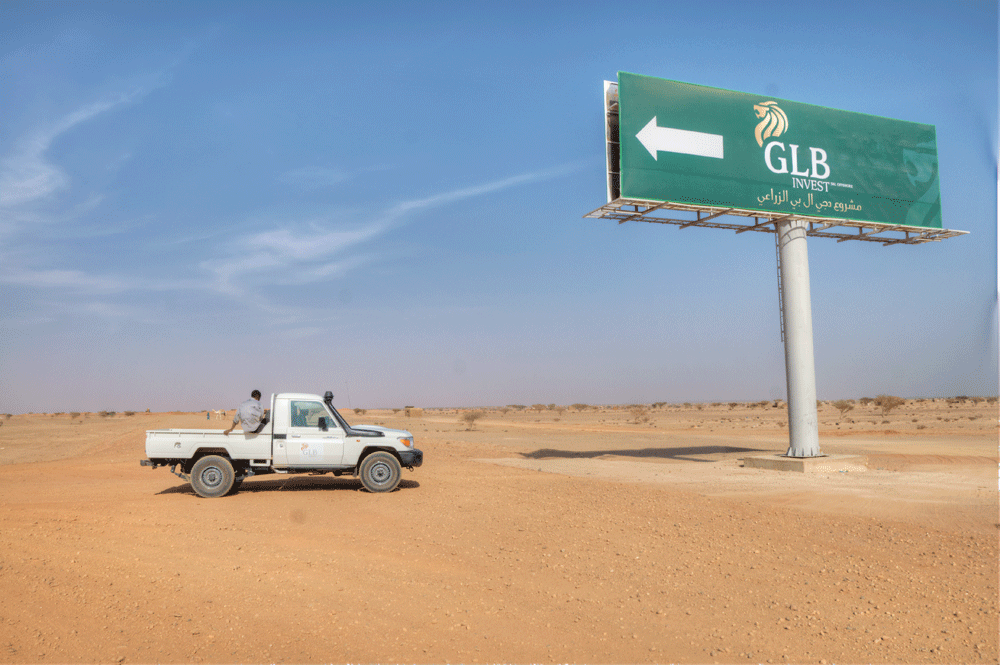
GLB Invest (GLB), a Lebanese offshore company based in Sudan, is developing an $800 million alfalfa production project in Sudan with plans to primarily export the crop to Saudi Arabia. $200 million has been invested by Firas Badra, president of FB Holding, which owns GLB.
This alfalfa plant is GLB’s first venture into agricultural production. Their business so far has focused primarily on agricultural trading through Golden Grain, their grain trading company, and FB Negoce, which trades in sugar, rice and fast moving consumer goods in Lebanon and the wider Middle East region. Badra admits that he lacks experience in agricultural production but says he has hired experts from France and Spain to run the project’s operations and ensure quality.
“The queen of forage”
Alfalfa is known as the “queen of forage” and is either dried as hay or mixed with other crops for feeding dairy cattle. Its main advantages include a high yield per hectare and a high nutritional value, which maximizes cattle’s milk production. Financially, alfalfa is considered a cash crop since it can be harvested every 35 days. GLB’s Sudan Project plans to start making profit within the second year of the project initiation. One drawback of alfalfa farming is the sheer volume of water required to cultivate the plant. Irrigated alfalfa is the single largest agricultural water user in California with as much as 40 inches of seasonal water neccesary to maintain healthy growth. Hence Saudi Arabia is encouraging its agricultural and dairy companies to import their forage needs.
While America currently dominates the market in alfalfa production, a 2012 report by the United States Department of Agriculture indicates that alfalfa production in the US, in terms of area and production, is the lowest it has been since 1957. Debates have ensued on whether to discontinue its production.
Dwindling American production has has created an opportunity for others to fill the supply void. Badra has an eye on the Saudi market but says GLB is open to exporting to China, Japan and the United Arab Emirates as well, all markets with a considerable dairy industry.
In 2011, GLB acquired 87,200 hectares of land in Sudan under a 99-year renewable lease and secured the water rights for 900 million cubic meters per annum in deals signed with the Sudanese government. Aside from its favorable climate and its proximity to the major areas of export, Badra says Sudan was chosen for the project because of a lack of local competition. To date multinationals have avoided operating in Sudan as it is classified a “high risk” country and subject to US sanctions. In spite of this Badra remains confident, “We know the market and how to deal with it; we know the people there and have good relations with the government so we have all the support we need from it.”
Recouping the investment
GLB’s Sudan Project is spread over five phases of land development, seeding and harvesting with the final goal of producing 750,000 tons of alfalfa annually by 2019. According to Badra work on the project is progressing as planned, with the first harvest scheduled for January 2014 currently on target.
Badra says that more than half the $800 million to be invested in the project will be generated from the project itself. Once the project completes its second phase, scheduled for October 2014, it will yield a minimum additional capacity of 210,000 tons of alfalfa per annum and will begin to finance itself with the majority of profits generated being reinvested in the project. FB Holding’s $200 million share has already been invested in the first phase of the project. “Financing was a difficulty as European banks, US banks and some Arab banks don’t finance in Sudan because of the sanctions so that’s why the project started as 100 percent equity,” says Badra.
The second phase requires an investment of $140 million and GLB is in the process of convincing banks and would-be investors to back the project. Badra says they already got approval from Islamic banks as well as development and African banks. As most of the profits will be reinvested in to the next phase of the project, Badra says investors can expect an initial return on investment between 40 to 45 percent within two years of their investment. Though the central bank places restrictions on repatriating dollars from Sudan, Badra says “we have our ways to manage that”.
Alfalfa won’t be the only crop planted by GLB in Sudan, as they also plan to plant sunflower seeds when it is time to rotate the crop in three years. The sunflower seeds will be used to make oil to be sold locally in Sudan and exported further afield.
Though Badra is aware of several new alfalfa production projects coming up in Sudan over the next few years, he says the demand generated by Saudi Arabia alone will create more than “enough room for everyone.”

In September the Ministry of Finance, Credit Libanais, Fransabank and online payment gateway NetCommerce launched Lebanon’s first online taxation gateway, allowing credit card holders to pay their taxes online. Executive sat down with Credit Libanais’ assistant general manager, Alain Hakim, to discuss the achievements and limitations of the new platform, and what type of road it paves for electronic government.
Can this platform be considered as a step towards electronic government?
This is the opening of a new era in Lebanon of electronic government through the payment of everything — tickets, taxes, whatever. For us to speak about electronic banking, electronic government, in 2013 with all that’s happening, is an achievement. It’s an achievement for the government, and for the banking sector. It’s a breakthrough because of the relationship between the public sector and the private sector, represented by the Ministry of Finance, and by two of the major banks in Lebanon. The Lebanese government is on track to grow into electronic government, which is a premiere in Lebanon. Due to our surrounding problems and internal problems, it’s a pioneering thing to think about electronic government in such a surrounding mess.
Could you explain how the e-taxation platform works?
The e-taxation is coming in two parts. The first part is the online process. This is a first in Lebanon, which will be available through a direct transfer from their bank accounts to the account of the Ministry of Finance. The second part is to pay the same taxes but through credit cards online through a gateway called NetCommerce. It is implemented and available, and the advantage of that is that even non-customers of this bank or another bank, or any credit card holder, can pay his taxes through this gateway. The taxes can be settled via the Ministry of Finance portal www.finance.gov.lb using Visa or MasterCard credit or debit card in the most easy and secure way.
What are the benefits of the platform?
First of all, it will decrease bribery, since clients will not be dealing or transacting directly with any employee. Second, it will help to reduce waiting lines, and cut penalties that the client will incur when he is late for his tax payment due to his busy schedule, or outside the country. The benefits are huge especially that he can pay for his taxes anytime, anywhere even during holidays and outside working hours. Plus, on the government side it will open the door for the public sector to move toward e-government.
Can users pay any kind of tax online?
To begin with, it is the built property tax and the income tax, which are the major taxes in Lebanon. But, eventually it will be gradually implemented on all taxes.
Do people have concerns about online safety?
The taxes e-payment is very safe knowing that NetCommerce supports the Verified by Visa and the MasterCard Secure Code, in addition to customer authentication programs, ensuring a secure internet acceptance e-payment experience. Besides, NetCommerce offers extensive and vigilant monitoring services, keeping the fraud risk at a minimal low rate.
There’s still no law on the electronic signatures. How is that affecting the e-taxation platform?
Negatively, but we cannot do anything. This is the duty of the government to do something about it — not even the government, the parliament, but they have other things to think about.
What is the percentage of people in Lebanon that have bank accounts?
1.5 million people in Lebanon have bank accounts in Lebanon: between 40 and 45 percent [of the adult population]. And from those, almost 50 percent have deposit accounts. And deposit accounts you cannot do transfers with. So roughly 20 percent have accounts that can be used on the online system.
How will the adoption of e-taxation be affected by the fact that not everyone in Lebanon has a credit card or a bank account?
We are pushing a lot — us banks — to push people to have a bank account or debit or credit cards. Of course, it is an issue. But we are working on it. We have a steady increase of online users on a banking level. You have an increased number of online users and transactions per day, per month, per year, and this increase is continuous and stable.

The climate for Lebanese industrialists is perhaps the toughest it has been since the Civil War. A combination of geopolitical turmoil, challenging economic conditions and a lack of political support are working against them. In these circumstances companies need to have smart survival strategies. Executive talked to three companies taking very different routes through these challenging days.
Coping strategy 1 – Go Niche
It is a brave man that establishes a factory in Lebanon in the current economic and political climate, but Marwan Malek — founder of Pharma M — isn’t one to shy away from a challenge. His small seven-man factory in Brumana opened in January and is the Middle East’s first, specifically designed to manufacture dietary supplements.

Malek’s Pharma M is a relatively new company
The supplements market in Lebanon is worth $120 million annually, with annual growth rates of over 20 percent for the last four years. Malek believes that a Lebanese firm has a huge advantage in the domestic market, which is currently dominated by Western brands.
“We should become number one in the market. As the only Lebanese manufacturer, we have so many advantages: we know the market, we are very flexible, we follow what the market needs,” he says. As an example of how local market knowledge can help the company thrive, Malek, a trained pharmacist, cites the Omega-3 group of fatty acids. The standard Omega-3 supplement has the unfortunate side effect of sometimes opening in the stomach, giving the taker a fishy reflux.
“Outside Lebanon this is not a big problem but in Lebanon we have one of the highest reflux percentages in the world, that is why we have an abuse of acid medication,” he explains. As such he has developed a tablet that does not open in the stomach but instead is protected by a gel that ensures it only dissolves once in the intestines.
Malek’s belief is that by focusing on a specific niche for the local market and having better intelligence on his customers, he can buck the trend for industrial companies in Lebanon. The company is currently on course to manufacture about 200,000 tablets in its first year, with the capacity to reach 600,000 in the future. They also have long-term expansion plans, with northern Iraq the primary target, but Malek says that in the short term he wants to focus on conquering as much of the Lebanese market as possible.
Related article: Industry’s surprising success
It helps that, unlike most industrialists, Malek has been supported by the government, specifically the Investment Development Authority of Lebanon (IDAL). The agency supported the firm and has helped them get a ten-year tax exemption on all its manufacturing products.
Malek says he was pleasantly surprised by the support offered. “IDAL is a very, very important support for companies in Lebanon. When you go to something governmental you are going with, as they say in Arabic, one foot forward and one back — you are hesitant [about whether] they will help you,” he says. “I was surprised they were very helpful, very professional, very nice people. They consult you on stuff that doesn’t have to do with IDAL, if you want advice on the market they help.”
But despite IDAL’s backing, Malek doesn’t feel there is enough support for industry in the country in general. “Actually for us as pharmaceuticals we are very scientific, we have very expensive raw materials and we don’t need a lot of electricity, we don’t need a lot of fuels. But for companies that produce plastics, that produce cement, bricks, stuff — they are in huge trouble. They cannot compete with the Chinese, Turkish — [in those countries] they have a lot of support on energy, a lot of support of fuel, even the land is for free almost.”
Coping strategy 2 – Go Outside
Until the 2006 war with Israel, Carlos Sfeir and his company Sfeir Industries had focused all their efforts on Lebanon. The firm, a specialist producer and manufacturer of high-end steel products mostly for kitchens, had become a major player in Lebanon’s small market.
But the 33-day war left them unable to pay the salaries of their employees, and Sfeir said he and his father decided that enough was enough. “It was a wake up call. We decided to go out [of Lebanon]. It was the best thing that ever happened to us. Thank you to the people that made war,” he says.

Sfeir is looking outside of Lebanon for future profits
Since then the company has branched out into new markets, particularly West Africa, Saudi Arabia and Qatar. Sfeir senior died two years ago, but Carlos has overseen continued growth — with the company’s $10 million turnover three times what it was in 2006. Of this, three quarters is now coming from abroad. “Before 2006 we were focusing 100 percent on Lebanon, now we are 75 percent outside Lebanon — targeting 95 percent,” Sfeir said.
This has been achieved largely through the outsourcing of the company’s industrial production to companies outside Lebanon. In the last two years, particularly in the wake of what Sfeir called the “catastrophic” government decision to increase minimum wages for private sector workers, he has effectively given up on Lebanon as a base for manufacturing. He has reduced his factory staff from 35 to 15, and admits that there may be further lay-offs.
But he has kept the company’s logistical base in the country, taking advantage of lower salaries and the highly talented local workforce. “If I want to take an engineer to Saudi, his package is very heavy. I need to pay perhaps $25,000 [a month] but here I can pay him $6 or 7,000,” he says. Sfeir travels between his more profitable projects in other countries and the less valuable ones in Lebanon, but says he is able to control everything from Beirut.

The company still has a small factory in Lebanon
The cumulative result is a Lebanese-based company at least somewhat inoculated from the economic crisis and the effects of the civil war in neighboring Syria. “I found the right formula with my team here to be able to grow. That is why we are [still] paying good salaries. Everyone [in Lebanon] is paying half salaries now because there is a crisis — we don’t have any crisis,” Sfeir says.
For Lebanon’s policy-makers, however, Sfeir Industries’ change in policy must represent a personal failure. For an established firm to move away from manufacturing is a bad indictment of the country’s lack of support for industrialists. While Sfeir highlights the wage hike and corruption as factors driving him away, the most basic one is the increasing tension in the country. “We need stability … we need security,” he says. And, at least in Sfeir’s case, it appears once he gives up on the country there is little that can be done to lure him back. “We definitely will not invest any more in Lebanon, definitely,” he says.
While he has no current plans to set up a factory outside of Lebanon, he admits that he has discussed the idea of doing so in Saudi Arabia, partly due to the kind of government support lacking in Lebanon. “In Saudi there are a lot of facilities, they give you the land for free for 25 years — it is crazy,” he said. “They give subsidized loans very easily, especially for industry … so maybe.”
Coping strategy 3 – Adapt fast
Al-Wadi Al-Akhdar is in perhaps a fortunate position in the Lebanese industrial sector. The food giant, which has over 200 products including Lebanese specialties, frozen vegetables and tinned goods, benefits from the fact that it operates in a market less prone to cyclical trends than others. “You are in the food business; you cannot have people not eat,” Gay Mandour, marketing manager for the firm, says bluntly. “You just have to be more proactive than the competition and you will be ok.”
This proactivity manifests itself in an in-depth knowledge of the local market, and a constant struggle to readjust. In the past 18 months, Mandour says, the deteriorating security situation has caused a shift in shopping trends. Previously, Lebanese people had been moving toward large supermarkets for their weekly or monthly shops, but there has been a shift back toward local stores. Adjusting to this has been a major part of the company’s strategy.
“When people are insecure and there are bomb threats, people don’t go out of their neighborhood as much — so they shop in their local mini markets,” Mandour says. “So you have to try to make sure at this level of distribution that you have all your products [in smaller stores] as well and the best offers available. If you don’t know that this is happening you are losing part of your sale.”

The company has set itself the perhaps ambitious target of 9 percent growth for 2013, a goal Mandour says they are on schedule to meet. While sales of staple goods such as canned products — a field in which the company is the market leader — continue to grow at a solid rate of between 2 to 3 percent, the real expansion comes from introducing the right new products to the market — decisions that are carefully made based on their knowledge of local demand.
Mandour gives the example of balsamic vinegar, which they have started packaging and importing from Italy in the past 18 months. “For the Lebanese, balsamic vinegar is very Italian so people thought it might not work. But today we are number one in the country, because people trust our brand,” she says.
With over 700,000 Syrian refugees in Lebanon, it would be fair to assume a large knock-on effect on staples that the company sells — particularly tinned foods. While they have seen a small lift, Mandour says that the company has not seen a major boost, partly because many refugees are reliant on aid.
There are, however, exceptions. The company has four recipes of foul — one Lebanese, one Egyptian, one spicy and Aleppan. Until the Syrian crisis began sales of the latter were, as Mandour says, “peanuts,” produced mostly for range expansion and because some customers preferred the larger bean. Since the crisis, refugees looking for a taste of home have boosted sales exponentially. “We used to sell 100 cases a month, today we sell 300.”

Online medical consultation platforms Sohati and eTobb are bent on digitalizing the process of diagnosis. In the past year both companies have launched interfaces that allow users to ask medical questions and get a doctor’s response within 24 to 48 hours, anonymously, and for free.
The digitalization of health has clear benefits. It is making reliable health information more accessible in Lebanon and the wider Middle East — where not everyone has adequate access to healthcare or the means to procure a doctor’s services. It is also raising awareness of taboo topics that are sometimes considered too personal for the doctor’s offices while enabling tech-savvy doctors to attract new clientele.
Zena Sfeir and Elsa Aoun, two of the co-founders of Sohati, recently quit their jobs at pharmaceutical and consulting companies to work full-time on the project. Together with Naji Gehchan and Wassim Kari, they launched Sohati in April, an online platform bringing doctor-verified information to the internet. This is Aoun and Kari’s second venture into digital marketing after founding Ounousa.com, a popular online women’s portal. For the four of them, the need for reliable health information online was apparent. “You can go on the internet and find tons of medical forums, where you have lots of information, but you’re not sure that this information is really credible,” explains Sfeir. “What we decided is to have something really credible, that’s validated by doctors, [to ensure] we have the right information.” Sohati points to various medical articles written by doctors, in addition to Q and A’s and monthly forums — available through the website — in which the general public can pose health-related questions to Sohati’s contributing experts.
Trusted medical knowledge
Co-founders of eTobb Paul Saber and Sara Helou also cited inaccurate health information online as a reason for starting their company in January with third co-founder Jad Joubran. “What we want to do is digitalize health in the region, and the problem is that doctors are not very digital when it comes to their profession,” says Saber, “We’re trying to capture the patient life cycle…helping them every step of the way,” he continues. “We launched eTobb to give specific answers to personal cases, and who better to answer you than a doctor?” Helou echoes the sentiment, “This is one of the main objectives: to empower people with medical knowledge. Not any medical knowledge — trusted medical knowledge.” ETobb, like Sohati, allows users to ask medical questions in Q and A forums which are then answered by doctors. The platform also lets users browse through doctors’ full professional profiles.
The two initiatives have sparked the interest of users, doctors, and investors alike. Sohati’s Arabic-language platform generated 150,000 unique visitors in the month of August alone, and they currently have over 10,000 users active on the site. ETobb did not wish to disclose their visitor numbers, but claim 20,000 registered users on their English-language platform. Sohati’s user base mostly comes from the region, with 30 percent coming from Saudi Arabia and 18 percent from the UAE. Only 6-7 percent came from Lebanon. ETobb’s user base by contrast is primarily Lebanese.
Contributing doctors offer their expertise for free. Of the around 13,000 registered doctors in Lebanon Sohati draws from a pool of 30. ETobb boasts over 500, explaining that although doctors essentially work for the site pro bono they benefit from the online exposure. “Doctors are not paid, but what they get is a free profile and a chance to engage with the community, to answer questions, so people know them better,” explains Saber. “Doctors can’t advertise themselves in Lebanon — it’s illegal. So this is one way to spread their reputation to get people to know them better,” adds Helou.
The projects have attracted the eyes of investors. Sohati received angel funding from a Lebanese investor who did not wish to disclose the size of her investment in print. ETobb received $76,500 in cash and in-kind investment from startup accelerator Seeqnce. The interest of investors for these budding companies is perhaps a good indication that there is a market for electronic health, as both companies are working on ways to monetarize their ideas.
Business Models
Sohati is leaning towards advertisement and sponsorship to monetize their platform. On the ad side, selling banner space on the website on a cost per click or cost per impression basis would generate some revenue. As for sponsorship, Sohati are looking for partnerships with pharmaceutical companies, universities, insurance companies, and hospitals. Currently the group is in negotiations with a major Lebanese hospital to feature a new machine on the site.
Sohati is also eyeing the e-commerce market with plans afoot to carry out a pilot test in a particular country before launching regionally. “It’s going to be more over-the-counter products: pharmaceutical supplements, vitamins, stuff where you don’t need a prescription from a doctor and can buy it online. Especially for products that we don’t have in the region,” says Sfeir. Although without revenue to date, Sohati are hoping that come December the revenue stream will start to flow.
ETobb has already made $30,000 from sponsorships by charging a flat rate for people to place logos on their site. They are also looking for ways to charge users for certain services on their website. For example, by setting up an online booking option in the next couple of months that would enable doctors to manage their appointments through eTobb while charging them a monthly fee — equivalent to the price of a consultation. “Sometimes you do still need to go see a doctor for a physical consultation, so we have the online bookings for that,” says Saber.
ETobb is also geared to launch a premium version of their Q and A platform, which would be private and would give users the option to add features in order to customize their interactions with the doctors. “In the premium private sessions you can share your medical information with the doctor,” says Helou. “We’ll be allowing patients to upload their medical files on eTobb.” Users can also opt for a video chat with doctors although prior to launch the company is finalizing security measures so that patients’ privacy is not compromised.
Taking on the taboos
Anonymous online consultations have helped to create a platform for people to seek professional advice on often touchy personal health issues without the potential embarassment of a face-to-face meeting with a general practitioner. “The most popular are the taboo subjects, the ones where people are intimidated when they want to ask a doctor face-to-face, especially in the Arab world,” says eTobb’s Saber. “There is not a lot of awareness in our society because of taboos so now when people go on eTobb and read the questions and answers they are like ‘oh, I didn’t know this could happen, I didn’t know this was true,’” says Helou.
Sohati’s most popular live chat sessions with doctors have been hosted by gynecologists. “You cannot imagine the number of questions we got, even after we closed the session we had it on the inbox of Facebook with lots of questions,” says Sfeir. Much of the interest is coming from Saudi Arabia. “If it’s not the woman, it’s the husband,” she says.
As far as online health goes, it is only the beginning. ETobb will be launching a cellphone app with the same features as their website, as well as an Arabic language version of the site. Sohati plans to launch a related platform in January and re-vamp the group’s website to increase its user-friendliness. “We’re working on it so hopefully we will have it soon,” says Sfeir.
The market for online health in Lebanon is still uncharted territory. “The health industry, especially in this region, has so much potential,” says Helou. “In the [United] States, there are so many health apps and so many health websites and everything is still growing and growing and multiplying and there are always new ideas. I think the same can be applied to the region … We still have a long way to go and a lot of things to do. What we’ve listed here are the main features — this is just the beginning. There is so much to do.”