Economics and Policy
Lebanon may not get sufficient funds from the donor states to cope with the huge influx of Syrian refugees to the country, caretaker Finance Minister Mohammad Safadi has said.


Economics and Policy
Lebanon may not get sufficient funds from the donor states to cope with the huge influx of Syrian refugees to the country, caretaker Finance Minister Mohammad Safadi has said.

Economics and Policy
Hamas is struggling to meet its payroll in the Gaza Strip, where income from taxes has been badly hit since neighboring Egypt started destroying a network of tunnels used to smuggle food, fuel and weapons into the Islamist-run enclave.
War and sanctions are taking an increasing toll on Syria’s vital seaborne trade, with fewer vessels calling at its cargo ports as ship owners shy away from the risks.
The Arab Spring uprisings will end up costing Middle Eastern economies about $800 billion in lost output by the end of next year as countries struggle to restore stability, banking giant HSBC has estimated.
Lebanon recorded the highest balance of trade surplus with Syria thanks to exports of fuel oil to its war-ravaged neighbor, according to figures released this week by the Beirut Chamber of Commerce.
Companies and Business
Abu Dhabi’s Aldar Properties is talking to banks about raising a bridge loan of up to $1.5 billion with an option to convert it later into a bond.
Citigroup Inc and International Bank of Qatar are holding up negotiations to restructure $4.5 billion in debt of Abu Dhabi conglomerate Al Jaber Group, further complicating drawn-out talks.
Dubai’s hotels are recording strong growth, with year to date occupancy rates rising to 79 per cent, according to a Q3 report by Jones Lang LaSalle.

Online shopping in Lebanon bears the burden of slow internet, slow delivery speeds, and a lack of overall coordination on the online front. Repeated delays have plagued the passing of a law on e-signatures, which would make online transactions more secure. Shoppers in Lebanon have little faith in making purchases online. Only 1.44 percent of Lebanon’s internet users — who constitute around 60 percent of the population — shop online, according to a 2012 Ipsos poll. Compared to twice that in the United Arab Emirates and 6.65 percent in Kuwait, the market for online shopping in Lebanon is still immature.
Despite these barriers, a small but growing segment of the Lebanese population is beginning to enter the world of online shopping. In 2012 online purchases in Lebanon reached $200 million, according to MasterCard and Visa data compiled by Bank Audi. This was a 40 percent increase from the year before. “Even though e-commerce is still considered in its infancy compared to other countries, we are pleased to notice that there is a drive and readiness from Lebanese consumers in general and young crowds in particular, encouraging businesses to tap more and more into this electronic market,” says Randa Bdeir, group head of electronic banking and card services at Bank Audi. As consumer interest in online shopping blooms, investment in e-commerce is also on the rise. Roughly half of the major banks in Lebanon are making significant investments in e-commerce, according to Visa Lebanon country manager Ramzi Sabboury. Bank Audi launched eMall at the end of June, a platform which enables Lebanese merchants and artisans to set up an online store. They already have 125 registered merchants and hundreds more applications, according to Bdeir. Banks’ investment in e-commerce platforms would create a push to encourage stores to enter the online market and help diversify the range of products available.
But boosting the number of online shoppers is not just a matter of investment. Online stores need to adapt to the burgeoning market to recognize what sells and what doesn’t. According to Carla al-Rayes, chairman general manager at online payment gateway NetCommerce, many Lebanese stores that have gone online have had a limited life span. “We have experienced a lot of Lebanese merchants that have experienced Lebanese e-commerce and then dropped out,” she says. “They opened a shop online, invested in technologies, and they don’t sell. They don’t sell for many reasons. One, they don’t have the right products at the right price. Two, they’re not innovative. They put their catalogue up online but they don’t have sales every day.”

Trust remains an issue for Lebanese online shoppers
What online shoppers want
The Lebanese pioneers of online shopping are receptive to unique items and unique deals. According to Karim Saikali, founder of BuyLebanese.com, as well as e-consultancy and online marketing company E-comLebanon.com: “in order to be able to sell something online, you have to offer something which is really unique in terms of pricing, in terms of product. You need to offer an added value service to your consumers.” Saikali says that group-buying sites have done very well in Lebanon for this reason. Group-buying sites give buyers access to deals provided they are purchased in large groups — of 20 or 30 — which makes it possible for the seller to give a significant discount. The group-buying model offers deals for high-quality goods and services that wouldn’t normally be found offline.
A concept similarly tailored to online spending is flash sales, wherein shoppers have access to items and services at large discounts for a limited window of time, pushing them into speedy purchases. One such platform is Jordanian-based MarkaVIP. Established in 2010, it is now among the top online sellers in four regional countries surveryed by Ipsos in 2012, and well-known in Lebanon. According to Eddy Farhat, the company’s chief strategy officer, Lebanon is MarkaVIP’s most important revenue stream after Saudi Arabia and the UAE. So much so that they have their own warehouse and drivers in the country to deliver their products — a service they have not yet made available in every country in the region. “Lebanese consumers are highly fashion-aware, and brand-aware,” says Farhat. “And the growth is healthy. The repeat purchasing behavior in Lebanon is interesting. Customers who like MarkaVIP are really loyal and they keep coming back.”
Flash sales offer unique prices to customers that are not readily available offline. Flash sales with a high-end flair have also been adopted by Lebanon-based Mistile. According to its chairman and CEO Fadi Dabbagh, having an online-only platform enables the company to keep overhead costs minimal, which creates better deals for the consumer. Dabbagh explains that Lebanese people “are quite knowledgeable when it comes to fashion and they always like to have the latest models. They really jump on it once they see an item they know that is the latest trend and discounted online — it’s a good catch for them.”
The bulk of online purchases in Lebanon are made in retail, booking travel arrangements, and services. According to Bank Audi 24 percent of spending is made in retail, 36 percent in travel and entertainment, and 40 percent in services. This distribution is likely to change as the market matures and new shoppers start buying online.
Trust issues
It has not always been easy to convince shoppers in Lebanon to make purchases online, and this is cited as a massive barrier to online shopping. According to the MasterCard Online Shopping Behaviour Study 2012, 49.5 percent of Lebanese respondents felt that payments made online were not secure. “The key element today preventing people from buying is the trust element,” according to MarkaVIP’s Farhat. Louise Doumet, co-founder of Lebanon’s online platform for designers Lebelik, has also cited trust as an issue. “They don’t trust the system because they’re not used to buying online. They have this thing that if they use a credit card online their heart will stop and their bank account will go dry. And then they’ll have to sell their house because they’ll be over-indebted.” While she notes that this trend is gradually starting to diminish, it is still the dominant sentiment in the shy Lebanese market.
John Abou Jaoude, co-founder of ShopinLeb, an online platform for merchants, explains that while some customers are buying with credit cards without a problem, others are very reluctant and even at times confused with the process of buying online. He claims that 30 to 40 percent of the customers from ShopinLeb merchants are calling the stores to help them through the procedure of buying online. “The customer in Lebanon doesn’t know the procedure of online shopping. Many of the customers are calling us saying ‘I want this item,’” Abou Jaoude explains. “This is a good thing. They are trying to buy online.”
Bank Audi’s Bdeir sees trust as an issue that will dissipate with time. “Just like what happened in America and Europe, it becomes so practical to buy online where the practicality of buying things online overrules the trust. It takes time,” she says.
The learning curve
Shoppers in Lebanon are slowly becoming more used to buying online, as they gain their first e-commerce experiences. “The tough part is to get them to buy once,” says Lebelik’s Doumet, “Because once they buy once, our rate of recurring customers is very high.” MarkaVIP’s Farhat says that there is still a big job to be done in educating customers about the security of online shopping websites. “It’s not a system where you have 20, 30 MarkaVIPs. We are still pioneers in the region,” he says. “You always have this first experience. Any customer that has a negative experience on any of our competitors may opt not to buy again. We have a responsibility. Whenever a customer has a negative experience, they will be more reluctant to trust in other companies.”
One method stores have used to ease customers into the system is the payment-on-delivery model. ShopinLeb’s Abou Jaoude says that 35 to 40 percent of their merchants’ customers pay for their online purchases on delivery, and these are generally the people who have the least trust and struggle the most with the system. Lebelik has also incorporated a payment-on-delivery option. “This has helped us a lot,” says Doumet, referring to the increase in online purchases that this brought the company. While MarkaVIP has the payment-on-delivery option, they are trying to orient customers toward paying with a credit card online. “Some customers used to pay cash-on-delivery, after a few experiences they started to pay online,” says Farhat. “Sometimes people need just a bit more incentive,” he adds. “We tried to reinforce the online payment by hosting events only on credit card.”
Farhat found that a key element to building consumer trust in Lebanon had to do with operating their own fleet in Lebanon — with MarkaVIP trucks that came to buyers’ doors. “It enhanced the trust with the customers a lot to deal with MarkaVIP the whole way through. Even our drivers know the customers. Getting closer, and maintaining the contact all the way through was very beneficial for us in Lebanon,” he says. With their fleet of trucks and warehouse in the country, MarkaVIP customers were more likely to trust online payment and shop again from the platform.
With trust an important barrier to online shopping, the consumer market in Lebanon still has a long way to go before it reaches maturity. But the Lebanese pioneers of online shopping have shown that they are willing to relinquish their credit card information if they see an added value to buying online.
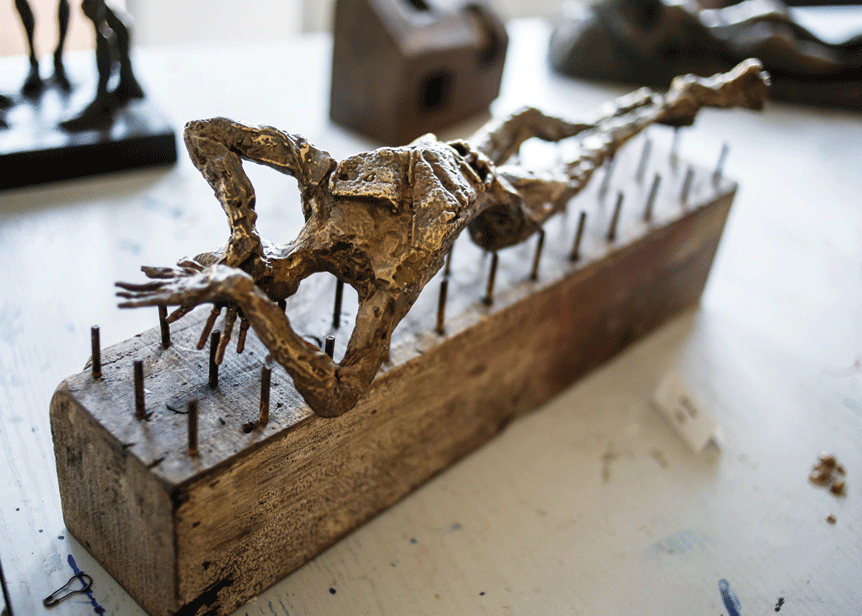
The presence of Syrian artists in Beirut is far from new, due to the city’s international connections, and the higher prices artworks fetch. “Syrian artists have always been part of the Lebanese art scene for as long as I can remember,” gallery owner Joanna Seikaly says.
However, currently more work by Syrian artists is being showcased in Beirut than ever before, as Damascene gallerists and artists have shut up shop and relocated to avoid war in their homeland. Seikaly has featured five Syrian artists over the past year.
Of all the Syrian creatives now in Beirut, it is visual artists who have found their place in the city’s art galleries and on the stage of international culture, as well as its open and internationally recognized cultural scene, which affords creative minds more opportunities and liberties than elsewhere in the Arab world.
Syrian art has long been held in high regard by collectors and galleries in the region and further afield. Prompted by his connections to the Syrian art world, coupled with a shortage of space for the art he had acquired over the last 20 years, collector Antoine Haddad opened Artlab in late 2012. For the first nine months, the gallery only featured Syrian artists. “Syrian artists have given the local art scene a boost,” he says.
According to the sculptor Mustafa Ali, Syrian art has become more open. The volume and focus of the artistic output since the uprising, itself marked and driven by a widespread use of creative media, has indeed fundamentally changed. Before the uprising, art that consistently challenged the regime, such as the cartoons of now-exiled Ali Ferzat, were the exception rather than the rule. But the mold is changing.
In late 2012 Houmam al-Sayed expressed his rejection of violence against children in his “From Damascus to Beirut” exhibition at the Mark Hachem Gallery in Minet el-Hosn. Tackling injustice, confronting the status quo and condemning violence on a wider scale are adding new dimensions to Syrian art in an unequivocal manner.
Focusing on work with the war raging close by can be painful and challenging. “You’re thinking about people, how they live, how they take this. You feel guilty,” says Fadi al-Hamwi, who painted a large portrait of a friend who had been arrested. “It’s not a quiet situation in which we find ourselves.”
“Before things got messy, before they started to use guns and threaten us, my only way to express my opinion freely was through my art,” Heba al-Akkad says. “[Now] it is my duty to talk about it [the war] in my art.”

Akkad's work is infused with the artists memories of the war in her homeland
Akkad’s show of mixed media work, “Things are still the same,” shown at Galerie Tanit this summer, is a powerful message of hopes dashed. Her colorful yet macabre, naïve yet highly symbolic and evocative body of work turns out to be an obituary to a still-born infant: the revolution. Some of Akkad’s recent work was produced during a month’s stay at Raghad Martini’s Artist Residence in Aley (ARA), a creative hub established to help Syrian artists connect with local galleries and collectors.
On the terrace of his home studio, painter, videographer and installation artist Hamwi points to works similarly influenced by current events in Syria. For a 2012 installation in Damascus titled “4am”, Hamwi painted the walls of the 5x5m gallery room black, put grass on the ground and placed his bed in it, with bricks aligned to look like a mattress. “People would enter my dream. I was not telling a story but putting you in a situation,” he says.
Symbols of hardship
This year, Hamwi painted dinosaurs, each wearing a gas mask while holding a single flower, and human skulls and machine guns in X-ray vision. “A Bone In The Head”, the first in the ‘transparent’ series, features a pistol inside a brain, as the artist tries to get inside the heads of killers and tormentors.

Hamwi's installations and paintings invoke the mindsets of both tormentors and the tormented
“This is the change that came to my work when I was in Syria. How do they think when they shoot a human being? When they cut a body part? Many people are prepared to do these kinds of things,” he says.
Akkad gave birth to her first child in Lebanon last year. Already pregnant, and with her husband facing the draft, leaving Damascus became inevitable. Her 10-month-old son has no birth certificate, a consequence of her husband’s refusal to join the Syrian army.
Without papers to prove her son’s identity, Akkad used her art to provide him with one: “Black & Yellow and vice versa” is dominated by a large male head at the center symbolizing her son. It also bears witness to friends and family she has lost, featuring in one corner a beautiful sketch of a woman sitting cross-legged, drawn by her teenage brother. Akkad recently found out that he’d been killed in tragic circumstances.
With her husband studying, Akkad became the sole breadwinner. Syrian artists can make up to three times what they would in Damascus for their work, in line with prices for other goods, but they have to contend with much higher living expenses and renew their visas every six months. Though she has sold art in both Lebanon and Jordan, Akkad has also been forced to take on low paid casual work.
While some Syrian artists struggle to get by in Lebanon, others are making the city work for them.
Artist and musician Samer Saem el-Dahr lives and works with Waraq, an artists’ collective located in a traditional house painted bright yellow and turquoise in Ras el-Nabaa.
Last year, he contributed to a collective exhibition and managed to sell two paintings. He subsequently approached Seikaly who encouraged him to put together his first solo exhibition: “This is not politics!” — which included 26 new expressionist paintings — was held in early 2013.
The 23-year old artist left Aleppo in September 2012. “The plan was to stay here for one month but then things got worse,” he says. “I’m comfortable here now, because I’m producing a lot. For now Lebanon is good for me, for another couple of months. There is the stress though of what’s coming up next, what if Lebanon doesn’t want us? Where will we go? All over the world, we’re not wanted.”
“For sure I feel homesick,” says Hamwi, who left much of his art behind. “I left the old memories as well. All the small details, my whole life — it’s there.”
Nostalgia infuses some of the personal projects the artists undertake, notably Hamwi’s painting of the logo of Derby — a Syrian chips brand — which created a buzz on his Facebook page, or Dahr’s Hello Psychaleppo, an electronic-classical Arabic music collaboration with Lebanese music producer Nabil Saliba.
Visions of home
Dahr’s career took off in Beirut but he sees his future in Syria. “I will be going back to the country, [but now] it’s a war zone. There will be nothing. Then there will be a lot. We’re the youth. If it’s not us, nobody will do it.” For Mustafa Ali, who was born in 1956 in Latakia, relocating to Beirut was fairly easy. Dividing his time between Paris, Damascus, and Beirut where he took an apartment in early 2013, he is among those who still regularly enter Syria, but has sent his small children to school in Paris. Working primarily as a wood and metal sculptor, based in Damascus since 1974, he has exhibited widely and received prestigious commissions, notably from the Institut du Monde Arabe in Paris.
While he has moved work to Dubai, Paris and Beirut, Ali still has his main studio and most of his art in Damascus; his large sculptures are simply too heavy to be moved. His cellphone is filled with images of his work, of openings or events at his Damascus gallery that used to attract a thousand people. Besides his gallery in the old city, he has three workshops; the largest in Al Ghouta, which he has been told has been partially destroyed.
Though better connected in Beirut than younger Syrian artists, Ali heads to Damascus to work. Dahr on the other hand, consciously refrains from drawing inspiration from his surroundings. “That way I’m not dependent on it or on being in Syria.”
“I don’t like to take advantage of what’s happening,” Dahr says. He refers to a sketch he did of the artist Youssef Abdelke who was held captive for a month between July and August 2013. “For this one I did it…He came twice to my studio; I’ve known him since I was very young. When I heard he was arrested, to spread the word, in favor to someone I know personally, I did this sketch.” Syrian artists are aware that their work has now become fashionable and generates considerable media interest, a fact that is not without its complications. “People want to buy the story,” Hamwi commented. “We have the story. We’re now the ‘world victims’. This is very clear to us. Some artists play into that, but it shows. To do archiving of this era you need to be super sane and stay objective.”

Unlawful. Such was the UK Supreme Court’s verdict on sanctions against Iran’s Bank Mellat this June. And by ruling the UK Treasury’s actions illegal, the court hinted at a deep vulnerability within the international sanctions regime against Iran — such restrictions may not be compatible with Western respect for justice.
“The Supreme Court has really broken the back of the sanctions for the UK and EU,” claimed Sarosh Zaiwalla, senior partner at Zaiwalla & Co Solicitors, the litigators in Bank Mellat’s case. The EU General Court — the Union’s second highest court — struck down similar European-level restrictions on the bank earlier this year.
The reasons the UK court gave were particularly problematic for those hoping to impose further sanctions on Iranian interests — or even keep existing ones in place. Not only did the court say that singling Bank Mellat out was arbitrary and unjustified, it crucially ruled that the way the UK Treasury had gone about it was an affront to the rule of law.
The court particularly condemned the fact that the bank was given no notice of the Treasury’s decision and had no recourse to challenge it. In other words, the Treasury’s procedure for designating the bank was unlawful.
The Treasury had barred individuals and companies from doing business with the bank under the Counter-Terrorism Act 2008. Handing down the ruling, Lord Jonathan Sumption said, “unless the Act expressly or impliedly excluded any relevant duty of consultation, it is obvious that fairness in this case required that Bank Mellat should have had an opportunity to make representation before the [Treasury’s] direction was made.”
Speaking to Executive, Zaiwalla was adamant on this point. “Justice requires that evidence be produced, and the defendant must have an opportunity to look at the evidence and comment on it if it’s right or wrong,” he said.
Zaiwalla wasn’t given this opportunity, even at trial. Following lower courts’ procedures and pleas from the government, the Supreme Court held an extraordinary closed session without Bank Mellat’s lawyers to consider secretive ‘sensitive’ evidence. Despite this challenge, Zaiwalla and the bank still won — underscoring the strength of potential legal challenges to sanctions. But Zaiwalla was nevertheless unhappy that the court had established a new precedent of sitting in closed session. A defendant must have the right to review evidence, he said, but “in a secret court, he does not have that opportunity.”
Bank Mellat’s favorable rulings at both the UK level in June and the EU level in January paved the way for similar victories by other Iranian-linked firms operating in Europe, many of whom had been blacklisted by the same 2010 Council decision naming the bank — the EU General Court handed down eleven decisions relating to Iranian sanctions just last month, most of them in favor of protesting companies. While sanctions are still in place pending appeal, the rulings bode well for the winners — and poorly for those who favor further tightening sanctions.
Despite the recent victories, sanctioned companies still face a series of hurdles, especially outside of Europe. Both the United States and the United Nations still consider Bank Mellat or its subsidiaries complicit in illegal activities. Zaiwalla appealed both listings, and was “cautiously optimistic” about clearing his client’s name at the UN.
But he was less enthusiastic that the Office of Foreign Asset Control (OFAC), the bureau that manages sanctioned entities for the US Treasury Department, will delist Bank Mellat anytime soon. “There is no rule of law [with OFAC listings] at all,” he said, adding that while a company can apply for delisting, the backlog of such applications means any decision will be very slow. “For the last year, we haven’t had a reply.”
Warmer relations
Bank Mellat’s victories in the UK and EU came after years of sanctions and litigation against Iran. The bank was originally blacklisted by the UK government in 2009, and then by the EU Council the following year. These sanctions were part of a concerted push by the West to isolate the Islamic Republic amid concerns the country was developing nuclear weapons.
While Iran vehemently denied any such activities, questions about disclosures to the International Atomic Energy Agency, the global nuclear watchdog, as well as defiant rhetoric by the country’s former president, Mahmoud Ahmadinejad, weakened European faith in negotiations, pushing the EU towards adopting more comprehensive and coordinated sanctions.
With the election of a new president this year, these circumstances may have changed. In what’s being called Iran’s “charm offensive”, President Hassan Rouhani gave a flurry of conciliatory interviews to US media outlets and a carefully crafted speech to the United Nations General Assembly last month. Remarkably, he also spoke to US President Barack Obama directly by telephone — the first such contact since the nation’s 1979 revolution. The message: let’s resolve the dispute over sanctions and nuclear programs.
This new public engagement and softer style has prompted hopes that the nuclear and sanctions crisis surrounding Iran may finally be headed for resolution, fueled by speculation that the economic strictures have finally brought Iran to the table.
Whether this is the case or not, the recent European court rulings regarding Bank Mellat and other Iranian entities may provide an incentive for the West to resolve the Iran file now, while sanctions are still in effect and its hand is perceived to be strongest. As EU foreign policy chief and lead Western negotiator Catherine Ashton’s spokesperson said last month, “We are fully aware, as are the [EU] member states, of the consequences deriving from these judgments…[and] the need to come to a swift conclusion on the approach regarding these cases.”
Economics and Policy
A leading company has said that international oil firms were not willing to explore for gas in the disputed territorial waters with Israel until the demarcation of this area was completed and voiced support for auctioning off all of Lebanon’s 10 blocks to the bidding companies.

The film “Conflict 1949 – 1979” tells the story of director Josef Kalüf’s bid to discover his father’s role in the Lebanese civil war and was screened this weekend at the Beirut International Film Festival. Executive caught up with the film’s producer Bahaa Khaddaj to discuss the film and the Lebanese movie industry.
Your film screened at the Beirut International Film Festival this weekend. How did it evolve?
I met [director Josef Kalüf] once at Screen Institute Beirut and we became friends right away. He wanted to make a documentary about his father and link it to the Lebanese civil war. In Josef’s opinion, the fact that his dad was a fighter ruined his childhood and the regrets Josef has in his life, or his decisions, his personality or his character – he links that all to his dad. The moment I saw this film is [very] personal I wanted to be part of it and we’re lucky to have a festival in Lebanon to motivate young filmmakers. It’s a good film community.
What is your background in filmmaking?
I studied at University of Southern California’s School of Cinematic Arts and there I met Malek Akkad, who is also a USC graduate. I interned at his production company in the story department reading around three scripts per day and writing coverage. Reading scripts was a good way to learn about different narrative styles and to recognize the technicalities of storytelling.
After that I worked for a post-production house in Los Angeles, I started as an assistant editor and became an editor after 6 months. Around 2007 I started freelancing for National Geography and Lifetime TV. I also wrote and directed a couple of short films. At that time, Malek was getting ready to start his production on Halloween, he contacted me and I joined him in making the movie.

Khaddaj thinks a new generation of filmmakers are changing the Lebanese industry
What was your experience with funding for “Conflict 1949 – 1979”?
For “Conflict”, we didn’t have a lot of money. We applied to Screen Institute Beirut at that time and they accepted. We pitched the story, we got the checks, and we started working. It was a two-year process of shooting and editing.
Is there a certain genre of film, or style of director, that is more likely to get funding?
The market in Lebanon is split into two things: either cheap Lebanese movies and TV shows or sophisticated documentaries. There is not much in between. Nadine Labaki is in between and I think partly it’s why she gets her scripts funded. She is a famous director/actress, she made a good name for herself, and people like her so if she makes a movie it will make money. I’m not saying she’s a genius, I think she should work more on creating a new style.
What does that say about Lebanon’s artistic style?
I think we don’t have a Lebanese style. You have Lebanese filmmakers who are so obsessed with European cinema or with the Hollywood style and they just copy. But you don’t have a clean Lebanese mind that tells you a Lebanese story in a Lebanese way. Not even one. The moment I have an interesting script I know how to make it in a Lebanese way.
How do the business aspects of filmmaking in Lebanon affect content?
In Lebanon [filmmaking] is a cheap business. The market is not big, so if you want to make a Lebanese movie and make a profit it needs to be made cheaply. For soap operas the problem is psychological. Screenwriters who write most Lebanese soap operas have this weird phobia of showing things the way they are; their stories are uncommon to our society, which makes them untruthful. Syrian and Turkish shows are more truthful which makes them more popular. We have a lot of important things to talk about. Once your main concept is based on something solid and truthful it’s interesting. But it will change, now there is a new platform.
You’re referring to Internet viewership and on-demand content?
Yes, now you can just go online and watch whatever you want. Smart production companies [in Lebanon] are starting to invest in that. They look for young filmmakers and fresh content. Those people created their own market and their market is honest.
What do you mean by honest market?
What is good will stay and what is bad will lose funding. So if what you make is appealing, you’ll have a lot of viewers; meaning you’ll get paid through advertisement. Once on-demand television is introduced, everything will change.
How can young filmmakers adapt to this emerging platform?
The question is how will the old filmmakers adapt? [laughs]. This is a tough, specific market. The old way is easy; if you knew someone you were in. Now, if the masses like you you’re in, you’re successful.

The phone call between Barack Obama and Hassan Rouhani at the United Nations, the first direct contact between presidents of Iran and the United States in three decades, signals the seizing of a chance to advance relations between the two countries and potentially open up debate over Iran’s nuclear program and US sanctions.
The earlier agreement between the US and Russia over Syria’s chemical arsenal had given Obama the opportunity to reach out to Iran while making it clear Washington regards Iran’s nuclear program as a far more serious potential threat.
The arrival of Hassan Rouhani as president has brought a shift in Iran’s policy towards Syria as well as the US. New foreign minister Mohammad Javad Zarif spoke last month of “grave mistakes” made by the Assad regime that had “unfortunately, paved the way for the situation in the country to be abused.” Former president Akbar Hashemi Rafsanjani directly accused Assad’s forces of using chemical weapons.
Dialogue between Washington and Tehran has two related tracks, the search for a settlement ending the war in Syria, and Iran’s nuclear program. Each needs face-to-face bilateral contact as well as respectively the Geneva-2 conference, scheduled for July and postponed by the US, and the P5+1, the permanent members of the Security Council plus Germany, which has been in nuclear talks with Iran for seven years without significant progress.
The hope for Syria is that both sides realize war is less in their interests than calming the regional Shia-Sunni tension it is enflaming. Wiser counsels in Washington know the road to 9-11 began in the US-Saudi intelligence co-operation and support for militants in Afghanistan in the 1980s.
In Iran, pragmatists argued within months of Mahmoud Ahmadinejad’s arrival in office in 2005 that his assertive Shi’ism would alarm the Sunni Arab establishment just as surely as his questioning of the Holocaust would alienate the US and Europe. Neither, they said, served Iran’s national interests.
Shortly after his election, Rouhani said diplomacy with Saudi Arabia was an urgent priority but the sheer speed of his reaching out to Washington is a surprise.
Improving US-Iranian relations faces a challenge in reviewing grievances. Americans still resent the 1979 embassy seizure and the 1983 bombing that killed 241 in the Beirut airport marine barracks, possibly the work of an Iranian national. A BBC poll earlier this year found 87 percent of Americans viewed Iranian influence negatively, the highest percentage in the world.
Iranian state television often shows images of the floating wreckage of Iran Air flight 655, shot down in 1988 over the Straits of Hormuz by USS Vincennes, with the loss of 290 lives. Rallies regularly evoke Ayatollah Ruhollah Khomeini’s denigration of the US as the ‘Great Satan’.
Rouhani is buoyed by his election victory but knows his fundamentalist critics in Tehran are waiting to pounce. His leeway to reach a compromise is real, but limited. In describing talks with the US Ayatollah Ali Khamenei, the rahbar (leader), expressed the balance between backing negotiations while remaining skeptical of Washington’s motives and intentions.
Arguably the outlines of agreements on both Syria and Iran’s nuclear program have long been evident. A former senior western diplomat told me earlier in the year that world and regional powers should agree that while the Shia would lead Iraq, with minority rights, the Sunni would lead Syria, also with minority rights.
Western desire for ‘objective guarantees’ over the peaceful nature of Iran’s nuclear program might be satisfied by a deal under which Iran would accept intrusive UN inspections and limit the program in scale and in the level of uranium enrichment. The quid pro quo would be easing sanctions that have, among other things, halved Iran’s oil exports and prevented development of its vast gas reserves. Iran has a vaguer requirement: that the US accepts its regional influence as natural and legitimate.
The obstacles are political. As Sayegh Kharrazi, Iran’s former ambassador, put it to me seven years ago: “On both sides, neoconservatives are strong. But neoconservatives cannot make decisions for everyone.”
As ever, the devil is in the details, but the details are discussed only if there is a broader will for agreement. That is the responsibility of leaders.
Gareth Smyth is the former chief Tehran correspondent of the Financial Times

"Ghadi”, the soon-to-be-released Lebanese movie, is not about the civil war, nor about sectarian tensions; it is about accepting someone who is different. A story with a fantasy twist, it’s a tale of tolerance and of hope; a timely message for the Lebanese in these challenging times. Local movies of its caliber are unfortunately rare, largely due to a lack of financial backers willing to bet on the country’s fragile movie industry. But Ghadi is a story that the producers were determined to bring to the screen with or without significant financial backing.
An unlikely protagonist
The film revolves around the eponymous Ghadi, a young boy with Down syndrome. The specifics of his disorder, also known as trisomy 21, are not as important to the plot as what they represent: difference. The movie is about “accepting people that are different” says Gabriel Chamoun, the film’s producer and CEO of Lebanon based production company The Talkies.
“He was born like this. If we don’t accept him, how can we accept the other differences in life?” asks lead actor and scriptwriter Georges Khabbaz.
Behind a window in a small town
Set in a timeless Christian village, the movie tells the story of music instructor Leba, played by Khabbaz, who marries his high school sweetheart and becomes the father of two girls and Ghadi. Sitting by a window, Ghadi screams day and night, which bothers the local villagers; unable to bear the noise any longer, they demand that Leba send his son out of the village to an institute for children with special needs. For Leba, this is out of the question. Armed with knowledge of sins committed by his fellow villagers, Leba decides to teach the locals a lesson of tolerance. From here the tale takes on a fairy tale twist, as he convinces the villagers that his son is an angel and only makes noise when one of them — a corrupt butcher, a bad-mouthed barber, a thieving policeman, a prostitute, some gossip hungry women among others — commits a sin. Rumors spread that the angel is also capable of fulfilling dreams. Suddenly, the window through which Ghadi looks down on them brings the village’s sinful behavior into check and becomes a window of hope for villagers praying for the fulfillment of their dreams.
Is Lebanon in need of Ghadi today? “Of course,” Khabbaz says. “Lebanon needs hope.”
Inspired by experience
The idea for the script came to Khabbaz out of his experience in the past five years as a theater professor for the children of Lebanese civil association Acsauvel, which provides care for mentally challenged children and adults. Eleven-year-old Emmanuel Kheirallah was handpicked by the film’s director Amin Dora, from Lebanon’s Sesobel association for disabled children, to play the role of Ghadi. Khabbaz wanted them all to play the role.

The villagers of the town believe Ghadi is an angel
After extensive casting, Dora kept going back to the pictures of Kheirallah. “I felt this boy needs to be the main character, he looks like an angel” says Dora. The cast also features prominent names such as Antoine Moultaka, founder in 1965 of the Lebanese University’s dramatic art department, scriptwriter Mona Tayeh and actor Camille Salameh, whose theater career began in 1972. Choosing the cast was not the hardest bit for Dora. “To treat the script in a fantasy way without losing its essence” was the most challenging aspect. It’s an endeavor in which he succeeded, bringing home the film’s powerful message while maintaining its fairy tale character.
A risky venture
This is the first time Khabbaz, a renowned theater director and actor in Lebanon, has acted in a film he wrote himself. His previous film experience is minimal, but includes the 2006 movie “Under the Bombs”, which was shown at the 2008 Sundance film festival. When The Talkies’ Chamoun reached out to Khabbaz at the end of 2011 with the offer of producing a feature film, he seized the opportunity. Within two months, he had the script — which had been running for years in his head — laid down on paper. Khabbaz and Chamoun quickly agreed on who would direct the movie: Dora, director and winner of the International Digital Emmy Award for the world’s first Arab web drama series “Shankaboot”. Dora is also behind the Beirut Duty Free’s flashmob commercials, which have over 4 million YouTube hits.

Ghadi's appearances become a major event in the town
Production company The Talkies are also new to the movie industry, having never produced a feature film before. Since 1998 they have specialized in television commercials, with clients including Samsung, McDonald’s and Qatar National Bank, while its movie experience has been limited to two short films. After failed attempts at producing feature films due to financing issues, Chamoun was determined to go through with the project, even if that meant — as it ultimately did — bearing the bulk of the not-so-little $1.5 million cost himself.
A costly gamble
With investors squeamish about taking a share of the movie partly because of their reluctance to invest in the Lebanese cinema industry and partly because of the fact that the company was a newbie in the production of movies, The Talkies ended up with a 70 percent stake, compared to an ideal target of 30 percent. The remaining share was taken up by friends of Chamoun: Anthony and Celia Sakkal, and construction company J. Matta Holding represented by Fadi Matta and Samer Dadanian.
“I knew it would be a struggle to fund this movie because it’s our first and there are not many successful [Lebanese] movies other than the ones of [actor and director] Nadine Labaki”, he says. One financial institution that has been venturing into the movie business of late is Lebanon’s FFA private bank, which recently co-financed the Hollywood action movie “Two Guns”, but when Chamoun approached them, they turned down the investment opportunity because of the “high budget for a Lebanese movie,” he says. The Talkies also struggled when it came to sponsors, only managing to get Societe Generale de Banque au Liban on board.
Beyond Lebanon, they secured a grant from Qatari cultural organization the Doha Film Institute, which will be assisting with the marketing of the movie for an international audience. Given that the message of the movie is universal and not specific to Lebanon, Chamoun is convinced the film could do well in countries abroad “especially South America because of its large Christian following”, he says. This is key since to break even Chamoun needs to sell tickets beyond Lebanon. Even if “Ghadi” ticket sales match Labaki’s “Where Do We Go Now?” 325,000 entries record in Lebanon — or just under $1 million in revenues — they will still fall short of covering the movie’s cost. Chamoun is hopeful that 50 percent of the return will come from Lebanon ticket sales, with the remaining from sales of international distribution as well as additional items such as DVDs and Video on Demand, all within 12 to 18 months from its launch date set for October 31.
It remains to be seen whether “Ghadi” will prove profitable for its backers. With a lack of public funding supporting homegrown movies, its financial success could be critical to entice investors and advertisers alike to back the country’s struggling cinema industry. It would be a shame to see the floundering of a Lebanese industry that has been around since 1929, beginning with the silent movie “The Adventures of Elias Mabrouk” followed by the first sound film, “In the Ruins of Baalbeck” in 1936. In the sixties Lebanon’s film industry even competed with Egyptian cinema, the Arab world’s center of filmmaking.
A traditional Lebanese setting with high quality acting and a touching script makes this movie one not to miss. It is all the more essential given its message of tolerance, whether for physical, mental or religious differences. Without crucial support, efforts of this sort — which should be seen not just in Lebanon but throughout the world — will not hit the screens nor be able to give our homegrown talent the audience they deserve.
Economics and Policy
Cairo is hoping to start announcing details of its investment programme for this fiscal year later this month and Gulf Arab countries have agreed to provide additional financial support, a senior minister said.
Lebanon's automotive sector is doing surprisingly well in the current economic environment, up 4.33 percent in the first eight months of the year on 2012, and in comparative terms, above the GDP forecast of 1.6 percent for 2013.
GCC markets are expected to show robust economic growth over the medium term due to economic diversification of their local economies, according to an Ernst and Young (EY) forecast.
Companies and Business
Nakheel World LLC, a subsidiary of Dubai World, today agreed to repay almost AED95m ($25.8m) to a private developer which bought a piece of land from it in Dubai in 2008.