• Donate
  • Our Purpose
  • Contact Us
Executive Magazine
  • ISSUES
    • Current Issue
    • Past issues
  • BUSINESS
  • ECONOMICS & POLICY
  • OPINION
  • SPECIAL REPORTS
  • EXECUTIVE TALKS
  • MOVEMENTS
    • Change the image
    • Cannes lions
    • Transparency & accountability
    • ECONOMIC ROADMAP
    • Say No to Corruption
    • The Lebanon media development initiative
    • LPSN Policy Asks
    • Advocating the preservation of deposits
  • JOIN US
    • Join our movement
    • Attend our events
    • Receive updates
    • Connect with us
  • DONATE
The Buzz

Business briefing: 16 July 2013

by Executive Staff July 16, 2013
written by Executive Staff

Economics and Policy

The Syrian government is providing new subsidies on basic items in a bid to counter rising inflation and a plunging currency.

More from The Daily Star


Egyptian tycoon Naguib Sawiris, whose family controls the sprawling Orascom corporate empire, says he and his brothers will be “investing in Egypt like never before” after the ousting of President Mohammed Morsi.

More from Reuters


Turkey’s central bank has signaled that it is set to raise interest rates to stabilize a plunging lira, after intervening heavily last week to shore up the currency as it sank to record lows.

More from Reuters


The Gulf state of Kuwait has discovered a new oil and gas field in Kabed area close to the well-known Manageesh oilfield, Hashem Sayed Hashem, CEO of state-owned Kuwait Oil Co has said.

More from AFP


Companies and Business

Qatar Gas Transport Company (Nakilat), one of the world's largest shippers of liquefied natural gas (LNG), has posted a drop in second-quarter net profit to just $50 million.

More from Reuters


Bank Muscat, the main victim of a $45 million global cyber heist, made a second-quarter net profit of $98.95 million, slightly higher than estimated.

More from Reuters


July 16, 2013 0 comments
0 FacebookTwitterPinterestEmail
The Buzz

Business briefing: 15 July 2013

by Executive Staff July 15, 2013
written by Executive Staff

Economics and Policy

Growth in Saudi Arabia's GDP, adjusted for inflation, slowed to 2.13 percent in the first quarter of 2013 from 6.5 percent a year ago, data from the Central Department of Statistics shows.

More from Reuters


Kuwait has delivered crude oil and diesel worth $200 million to Egypt as part of a $4-billion aid package to bolster the faltering economy.

More from The Daily Star


Lebanon's Caretaker Tourism Minister has backed proposals to allow Syrian refugees to sleep in some of the country's underused hotels.

More from The Daily Star


Egypt's army chief has explained his decision to remove former President Mohammed Morsi from office, his first public comments since the coup.

More from Reuters


Elsewhere in Egypt, authorities have frozen the financial assets of 14 Muslim Brotherhood and other Islamist leaders accused of inciting violence.

More from The National


Read more: http://www.thenational.ae/news/world/middle-east/muslim-brotherhood-chiefs-assets-frozen#ixzz2Z5jpMT40
Follow us: @TheNationalUAE on Twitter | thenational.ae on Facebook


Companies and Business

DeVere, the independent financial consultancy firm, has confirmed its acquisition of UAE-based wealth management firm, Acuma.

More from Gulf Business


Mashreq, Dubai’s third largest listed bank by assets, expects profit from its retail banking unit to double in 2013 from a year earlier.

More from Reuters


Dubai-based port operator DP World has defended its decision not to negotiate with a workers’ union over a pay dispute at the London Gateway.

More from Arabian Business

July 15, 2013 0 comments
0 FacebookTwitterPinterestEmail
The Buzz

Business briefing:12 July 2013

by Executive Staff July 12, 2013
written by Executive Staff

Economics and Policy

A number of the companies bidding on Lebanon's oil and gas have withdrawn over security concerns.

More from The Daily Star


The International Monetary Fund is not currently discussing a possible loan with Egypt's interim government, and its decision on whether to engage would be guided by the views of the international community.

More from The Daily Star


A US-backed plan to boost the Palestinian economy is taking shape.

More from AFP

 
Companies and Business

Dutch dredging and maritime service provider Boskalis Westminster has sold its 40 percent stake in Middle East maritime contractor Archirodon to its joint venture partner and another investor for $190m.

More from Arabian Business


The Iraqi banking sector is set for significant earnings and asset growth over the next decade driven by a strong macro environment, increasing credit penetration and the improving security situation in the country, says a report.

More from Khaleej Times


Bahrain and Saudi Arabia have assigned five firms to study the construction of a railway bridge parallel to the King Fahd Causeway.

More from Khaleej Times

July 12, 2013 0 comments
0 FacebookTwitterPinterestEmail
Business

Linking the world’s bookstores

by Joe Dyke July 12, 2013
written by Joe Dyke

Company: Cedar Books/BookWitty

Country: Lebanon/Switzerland

Industry: Books

Founder: Cyril Hadji-Thomas and Sany Naufal

Capital raised: $1 million investment from Bader


The Internet, it is widely believed, is killing the local bookstore. Across the world independent retailers are going bust as customers turn to Amazon to save a few dollars per purchase. In the United Kingdom alone the number of bookstores has fallen by over half in the last seven years.

Much of the problem is efficiency. Bookstores, particularly independent ones with their high rental costs and low turnovers, cannot compete with the infinite number of sellers online. So while they may be run by people with real expertise and specialist knowledge, they lack infrastructure to enable them to utilize that knowledge.

Hadji-Thomas (L) and Naufal formed Cedar Books in 2007


Cyril Hadji-Thomas and his co-founder Sany Naufal want to help them with that infrastructure. They have already established Cedar Books — a book distribution company focusing on less common books with annual revenues of over $12 million last year. Now the two men have set about helping make niche services profitable with the launch of their new venture BookWitty.

The idea — whose name was chosen as it suggests both intelligence and ubiquity — is, as Hadji-Thomas says, simply “a network of people that are interested in books.” The aim is to allow people, including bloggers, booksellers and experts, to use the Internet to debate, discuss and sell books.

Say, for example, you run a philosophy blog. If you are discussing good philosophical books online within a community, it would make sense to be able to sell the product directly. BookWitty enables you to install basic features to your site so you can do so, with the product being sourced and delivered by Cedar Books. The blogger then gets 10 to 12 percent of the cost — around triple that of Amazon affiliates.

How does that save small bookstores? Well it doesn’t directly. But it enables independent booksellers to utilize their wealth of knowledge on the topic to reach out to customers globally, without having to worry about the logistics. “Books are the heart of knowledge and wherever we have people that are exploring their hobbies we bring the whole logistic part — which no one knows how to do perfectly — and they can concentrate on what they want,” Hadji-Thomas says.

The company, though run by two French-Lebanese men, is actually registered in numerous companies and BookWitty’s testing phase is largely occurring in the United States. Among the first groups they are working with is Green Street Books (http://greenstreetbooks.org/) — a San Francisco-based charity that sell books online. “They use books from the local communities and sell them online and give back some of the money to local charities — it can be helping people to read or planting new trees,” Hadji-Thomas explains.

They will work with the group to create a network of people willing to donate books, both far away and locally. “E-commerce is very useful for something that is very far away but it is also very useful for something that is close to your home that you have no idea about,” he adds.

The company has already been well backed. After discussions with the Middle Eastern Venture Partners, they invested $500,000 from their own fund and another $500,000 from their sister fund Building Block Fund. The $1million total was exchanged for an undisclosed amount of equity, but the money will be used to launch BookWitty. “Most of [the capital] will be invested in servicing booksellers and bloggers on the BookWitty network with software, and e-book, and audio books and proper marketing,” Hadji-Thomas says. The other major shareholders are Levant Distributors and Cyril-Hadji's own company Keeward.

Another major market that BookWitty — and Cedar Books more generally — serve is diaspora communities around the world. They deal with books in numerous languages, arranging shipment at a cheap cost at the expense of Amazon, he explains.

“We are getting the market share of, say, Amazon France selling in the US. If you go on Amazon France you will probably pay a lot of money to have a book delivered to the US.”

“Usually when you want a book and you don’t live in the country you ring your uncle and say: ‘when you come next month please bring this and that,’” Hadji-Thomas explains. “We bypass that by working with local players – so we ship directly to them through the proper channels, but everything is stored where the product came from.”

July 12, 2013 0 comments
0 FacebookTwitterPinterestEmail
The Buzz

Business briefing:11 July 2013

by Executive Staff July 11, 2013
written by Executive Staff

Economics and Policy

Twelve billion dollars in aid from Egypt’s wealthy Gulf allies have bought Cairo a window of several months to try and stabilize its politics and repair its state finances – or face fresh economic turmoil.

More from Reuters

 
Opec conceded yesterday that the North American shale boom is challenging its position in the market.
 
More from Reuters
 
 
Lebanom's Court of Accounts has accused the Turkish operator of an electricity-producing barge of responsibility for a month-long stoppage in power production and urged the Lebanese state to seek compensation for the breach of the agreement terms.

More from The Daily Star

 
Qatar plans to spend $200 billion in construction projects over nine years, including $140 billion in transportation infrastructure, as it prepares to host the 2022 World Cup, Deloitte said in a report.
 
More from Khaleej Times
 
 
Companies and Business
 
Lebanese shawarma firm Shawarmanji is planning major global expansion, it has announced.
 
More from Executive
 

The Saudi Arabian Labour Ministry has warned abaya and lingerie shops they will be regularly and spontaneously raided to ensure men and women are not working together.

More from Arabian Business

 
July 11, 2013 0 comments
0 FacebookTwitterPinterestEmail
The Buzz

Buying time

by Michael Karam July 11, 2013
written by Michael Karam

A high-end watch is today the unequaled symbol of your status. It really represents who you are and what you stand for. It defines you.” So says Paul Kupelian, chief operations officer of retail operations at Holdal, part of the Abou Adal Group, which represents such luxury watch names as Patek Philippe, A. Lange & Söhne and Vacheron Constantin.

Watches are big business. Just pick up any print media — from the International Herald Tribune to the Financial Times to the glossies — and you will notice just how much ad space is devoted to luxury — and even the not-so-luxury — timepieces. Indeed, three years ago, Rolex, arguably the most famous watch brand on the planet, bought the front page of the Herald Tribune to advertise its new GMT Master II. Go figure.

These ads sell many ideas. There is heritage: the father-son bonding narrative that tells us we never actually own a Patek Philippe. Or endeavor: the sporting achievement ads from Rolex, TAG Heuer and Longines that equate success to privilege. Finally, there is glamour: Omega’s dreamy celebrity shots of George Clooney in Venice and Nicole Kidman wrapped in diamond watches. There are things for all of us to buy into.

Global activity

And we do it with gusto. According to the latest figures, in 2012, the Swiss watch industry exported around 28 million finished timepieces with a value of SF21.4 billion ($23.5 billion) ­­— 10.9 percent growth year-on-year.

While Europe showed the highest growth in demand, China for the first time surpassed the United States as the leading market for luxury watches. “Blancpain almost doubled its turnover in China along with Longines and Omega,” says Mher Atamian of Atamian Freres, a Lebanese agent for all three marques.

In the global battle of the brands, Omega, once a mid-range market player with a huge heritage, is now the world’s best selling luxury watch brand. In response, Rolex has come out fighting, strengthening its position in Europe and launching new models of its timeless classics.

Meanwhile, brands that were not so mainstream but are watch royalty nonetheless, such as Patek Philippe, Vacheron Constantine and Jaeger-LeCoultre (JLC), have all picked up in popularity as customers recognize the high level of craftsmanship and the fact that these watches by and large retain their value and can become genuine heirlooms for future generations. “Patek Philippe is today the most admired and respected watch brand in the world,” says Kupelian. “Consumers understand the high quality, the craftsmanship, the complications and the exclusivity behind every Patek Philippe creation.”

They are also among the most expensive — the most affordable is a ladies’ Twenty-4 that costs around SF11,800 ($12,600). Opinions differ, but the basement entry into luxury watch ownership cannot realistically be lower than $1,000, with the main battle being fought in the $5,000 to $30,000 range.

According to World Watch Report, Omega’s Seamaster, Rolex’s Submariner and Daytona hold the position of the most popular men’s status symbol watches across the globe. Not far behind are TAG Heuer’s Carrera, Jaeger-LeCoultre’s Reverso, Audemars Piguet’s Royal Oak and Cartier’s Tank.

Basle 2013

Basle in Switzerland plays host to the world’s most prestigious annual watch fair, an event where the watch industry’s big hitters unveil their latest creations and set the trend for the next 12 months.

“This year we saw a lot of navy and in some brands denim was used, as well as a lot of other innovations in colors and color mix,” says Simone Tamer from Tamer Freres’ agent for Audemars Piguet, Breitling, Montblanc, Omega and Swatch.

“There has also been a move toward black carbon and black PVD. We are [also] seeing a lot of two-tone on the dial with customizations in pink and yellow gold. This not only adds a nice retro aesthetic but makes the watch more affordable and understated, keeping the gold effect on the watch.” 

Tamer also said that innovation has played a big part in many of the brands’ latest offerings. “When it comes to advances in calibers, movements, power reserves and complications, 2013 is the year in which a lot of the research and development is paying off.”

Kupelian agrees, confirming a move toward slimmer watches as well as complications such as tourbillons, perpetual calendars, chronos and craftsmanship. “The new trends are for more complicated watches for men and women and much thinner cases. Most of the big watch brands are showcasing their inherited craftsmanship such as diamond setting, enameling and guillochage engraving.” 

But what of the new models? Among the highlights of this year’s show was the unveiling by Rolex of a blue face and brown bezel platinum Daytona Cosmograph to commemorate the 50th birthday of the iconic chrono. Rolex fans will also have welcomed the new Yachtmaster II with a blue Cerachrom bezel and the GMT Master II with one-piece, two-tone black and blue bezel, a first using Cerachrom.

Rolex also has a new range of unfussy day-dates in six colors. “I think ever since the recession we have seen consumers more aware     of what they buy and how they flaunt it,” explains Ziad Annan, Rolex’s agent for Lebanon and Cyprus. “In these tough times, it is perhaps   better to wear something a bit understated.”

Tudor, the brand that was once seen as Rolex’s poor cousin, has had another good year with most demand from the Asian markets, especially China, where there is a waiting list for the Pelagos and Black Bay Heritage models. The star of Basle was the dramatic Black Shield, a nod not only at Tudor’s logo but also a pointer in the creative direction in which the brand is heading. 

Overall, the buzzwords appear to be modernization and improvement. “The manufacturers have made a big effort to produce unique pieces,” believes Atamian.

“You only have to look at Breguet’s Hora Mundi and the JLC Gyrotourbillon. IWC has upgraded its Ingenieur, while TAG Heuer has added to the Carrera range on the occasion of the watch’s 50th birthday. Omega is putting the coaxial movement in more watches, while Glashütte and Blancpain have strengthened their ladies’ lines. A lot of manufacturers are using ceramics, IWC especially — a move into an area that was generally reserved for ladies watches. Finally, it is good to see JLC making more noise.”

Meanwhile,on the home front

Back in Lebanon, a country that is never out of the top five Middle East markets for luxury watches, a man’s watch is almost, if not more, important than the cut of his suit and all the major watch importers in Lebanon recognize the discernment of the Lebanese consumer, who they feel is now moving away from traditional comfort zones.

“The knowledge and expertise of some [Lebanese] collectors or [the] watch-passionate is really amazing,” says Kupelian, who has noticed that, while traditionally it is the male consumer who opts for the complications, the limited series or innovations, more and more women are becoming watch collectors, appreciating more complicated watches.

“Consumers are more discerning,” agrees Tamer. “They know what they want. Now, we are seeing greater openness and interest in movements and complications. Take Audemars Piguet. We have clients who are on long waiting lists to receive their limited editions, which are a separate and very distinguished niche. I must say that the Lebanese consumer has good taste.”

Atamian agrees. “We have a lot of collectors who know and appreciate watches. They go on forums and read the blogs. They often know more than I do.”

But with such discernment comes greater demand for an all-encompassing retail experience. This is a factor that is not lost on Lebanon’s watch agents. In a local market that has seen tourism affected by political instability and confidence over security, Rolex’s Annan believes now more than ever the priority is to focus on customer care and improve service both in the showroom and with after sales maintenance. “Integrity has to surround everything we do,” he says.

Every clock face tells a story

So let’s assume you have earned a decent bonus and want to blow part of it on a luxury watch, one that will hold its own in almost all situations. This was a simpler choice 20 to 30 years ago. A man would own one watch — which the vast majority still do — and wear it on all occasions, whether it be formal, smart or casual, and if it weren’t waterproof to 1,000 fathoms, he would take it off before swimming or showering.

Now all bets are off. “Each brand has its own image that is reflected in the lifestyle of the client buying it,” explains Tamer, adding, “Breitling for example has always been the watch for professionals, such as deep sea divers and especially aviators.”

The appropriate size of a watch has also increased. There was a time when a 34mm to 36mm diameter was considered a perfectly manly size. Not any more. “Today, 39mm to 42mm is the ideal size. Forty-four mm is the maximum,” says Atamian.

Size is not the only concern. Does one choose steel or gold in all its various shades? Does one go for a simple plain face or a busy Chronometer or a GMT function? Does your watch need to be waterproof to a weedy 300 meters or a skull-crushing 1,000 meters? Will it have an “exhibition” back in which you can see all the parts whirr pleasingly as one? And then there is the issue of movements. Is it in-house or is it a generic movement made by the Swiss giant ETA? There is a lot to consider.

Which brings us nicely to the subject of those hugely popular watches that are nonetheless sniffed at by watch snobs, because they either don’t have the heritage or are too closely associated with jewelry or fashion. Well, they too are adapting to the demands of the market and greater consumer awareness. Panerai, Cartier and Hermes have all developed in-house movements, one of the benchmarks of being taken seriously. Panerai, the Italian sports watch, knew it had to back up soaring popularity with credibility and now has its own hand-wound and automatic movements, while Cartier with its Calibre de Cartier and Hermes with its Caliber H1837 have also gone down a similar path.

“There is no right and wrong,” advises Kupelian. “The right watch is the one you like; the one that makes you feel good, authentic and tasteful. The rest is left to each person’s personal taste and preferences. The best thing is to take the time to learn about each and every brand and understand their respective values and then choose.”

All that glitters

Meanwhile, gold watches accounted for more than 6 percent of total Swiss watch exports by units. In revenues, gold watches accounted for SF7.3 billion ($7.81 billion), an increase of 20.5 percent compared to 2011. But the question we all might ask is what happens to the price of gold watches if the price of gold drops dramatically as it did earlier  this year from a January high of around $1,700 an ounce to the current price of around $1,300? The answer is not a lot, so anyone who thinks that a Patek Philippe Calatrava or a Vacheron Constantin Patrimony will be that much more affordable is going to be disappointed.

“I can’t see a manufacturer leveraging this situation,” says Annan. “Certainly Rolex, which is the only manufacturer to have its own smelter and lab to develop its own formulas, would never do it. We never want to make the customer feel he is being squeezed by market pressures.”

In fact, according to Kupelian, the real force behind rising prices is the commitment to value and innovation, such as increasingly complicated mechanisms and more artwork. So now you know.

Buying wisely

And what about all this talk of watches holding or in some cases appreciating in value? Like with art one should buy what one likes, not what one assumes will appreciate in value. When it comes to watches, the right brands, especially certain models by Rolex, Patek Philippe, Jaeger-LeCoultre, Vacheron Constantin and in particular Panerai, which produces lots of limited editions, can do well.

“As consumers become more aware of the value of a ‘real watch’, they are willing to spend higher budgets, especially when it comes to brands and models that increase [in] value with time,” says Kupelian. “These are perceived as an investment and a heritage for future generations.”

For example, a well-maintained Rolex GMT from the early 1970s, which probably cost around $600 at the time, could easily fetch $5,000 at a specialist auction.

Look out for updates of iconic models and try to buy an original before a re-release. The most famous price spike in recent years was experienced by the original 1970s version of the Tudor Heritage Chrono, of which relatively few were made, soaring from $3,000 to almost $15,000 overnight after its updated model was released in 2010. 

And for those who are buying with an eye to the future, keep everything — bag, outer box, inner box tags and especially the receipt. To collectors, provenance is everything… and time, these days, really is money, in more ways than one.

July 11, 2013 0 comments
0 FacebookTwitterPinterestEmail
Society

Top 10 men’s watches

by Michael Karam July 11, 2013
written by Michael Karam

A carefully chosen watch can be an investment and a pleasure. Here are Executive's top 10 men's watches for 2013:


10 Girard Perregaux 1966


Oozing “Mad Men” martini style! One of the most elegant dress watches on the market.


Related article: How to pick the perfect watch


9 A. Lange & Söhne Lange 1


Just one of a host of unique designs from one of the world’s most low-profile yet prestigious watchmakers.


8 Blancpain Fifty Fathoms
 

A dive watch for the yacht owner. Dripping in affluence and luxury.


7 Tag Heuer Monaco


The first square chronometer. What’s not to like? A genuine icon in the watch hall of fame.


6 Audemars Piguet Royal Oak


A classic, groundbreaking design that has remained popular due to its versatility.


5 Breitling Super Heritage Ocean


Clean and understated. The mesh bracelet gives this dive watch a 1960s vibe.


4 IWC Portuguese Power Reserve


Everything that IWC is about – elegance and substance – is summed up in this beautiful yet functional watch.


3 Tudor Heritage Chrono


Racy and vibrant and with a nod to a considerable pedigree, this is the watch that finally announced that Tudor has stepped out of Rolex’s shadow.


2 Rolex Explorer


Arguably one of the coolest and most unpretentious watches ever made. It scaled Everest with Hilary and still reeks of Cold War intrigue.


1 Panerai Radiomir

A watch with a ton of attitude, the Radiomir is less celebrated but much more grown up and understated than its Luminor stablemate.

July 11, 2013 0 comments
0 FacebookTwitterPinterestEmail
Society

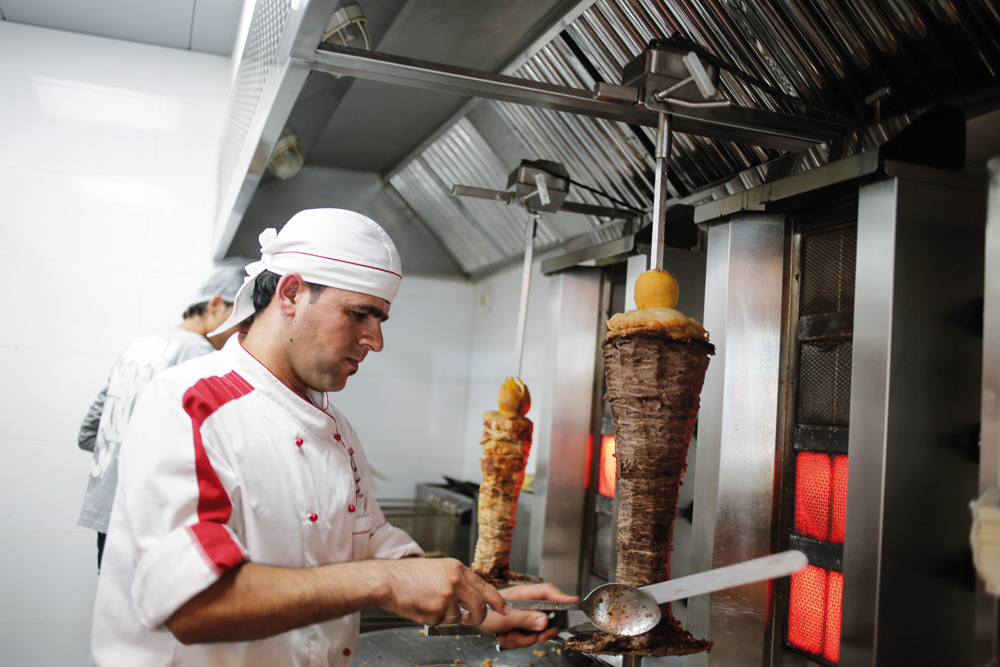
Shawarma goes global

by Joe Dyke July 10, 2013
written by Joe Dyke

Elias Chabtini is a remarkably confident man. The chief executive officer of Shawarmanji, the increasingly ubiquitous shawarma chain which began in Beirut in November 2012, has an incredibly aggressive strategy for the coming years. In a little more than six months, the company has established six branches in Lebanon and one in the United Arab Emirates, while by the end of the year Chabtini says they will have a minimum of 16 across the two countries. And with plans agreed to head into Qatar, other Gulf states and beyond, shawarma could join falafel — with franchiser Just Falafel’s rapid expansion last year — as another taste of the Middle East on the global palate.

“We would like to hit between 50 to 70 shops by the end of 2014. We will be the first concept ever that has opened so many stores in such a short period of time, definitely in our region,” Chabtini says. The company is certainly well-backed — it raised more than $8 million before it launched and the Building Block Equity Fund recently bought a 5 percent stake for $400,000. In Lebanon, Chabtini says, they will open 25-30 shops by the end of 2015, adding that he has few concerns about growing too large. “You can never saturate shawarma. Can you saturate hamburger, can you saturate pizza? Today you have over 80 hamburger brands alone, between the guy who has his own store to McDonald’s, and they are all doing well. Where is the saturation?”

An appetite for growth

This confidence is further reflected in the company’s worldwide strategy. For while Chabtini expects Lebanon and the Middle East to be the basis for the company’s support, he has now set his sights on taking his concept of shawarma global. He says the company has had over 180 entrepreneurs express interest in establishing franchises including in the United States, Germany, France and Canada.

But their first step outside the Middle East will be to the United Kingdom, with a franchise due to open in the coming months. Chabtini was a little hazy on the details, many of which are still being negotiated, but says the initial focus is on central London. “We want to test in London and then from there we will do the expansion of Europe.”

Perhaps the biggest cultural challenge the company may face will be the concept of shawarma. In the UK, the spinning stick of meat is synonymous with Turkish ‘donor kebab’ and — perhaps more worrying for the company that is trying to market itself as the clean alternative to grimy street shawarma — is closely affiliated with drunken nights. But Chabtini, ever the optimist, believes he can change British attitudes.

“People will always relate to shawarma as donor kebab. We have studied the market in London and one of the [points] was ‘Shawarmanji’ might be a name difficult to pronounce. People might not understand shawarma,” he says. “So we said ‘…Why is Häagen-Dazs easier to pronounce than Shawarmanji? Because Häagen-Dazs paid billions of dollars for you to get used to the name’… so it depends how we would market the brand.” Among the other plans to appeal to a European market is a new menu, with lamb being added to the beef and chicken options. As with the launch in Lebanon, which the company preceded by spending more than $180,000 on market research, they are carrying out extensive analysis on London’s incredibly competitive food and drink market. “We are not worried about the concept not working; we just want to make sure that the operation in London is going to be smooth for us to grow.”

But among the positivity is a note of caution as Chabtini says he is not yet willing to give any numbers about revenues. Perhaps this is understandable, since the company is still in its infancy, but it does stir up doubts. “We have very good numbers,” he says. But, he adds, “I prefer to reveal something when I am at least one year old, rather than giving figures that are just six months or eight months old.” He is, however, willing to stand by his previous prediction of $50 million in revenues by the end of 2015. “I think it is going to be doable with our franchises. It is very easy. If we have 50 shops by end of 2015, that’s $50 million,” he says.

Fast food, fast profits?

Franchised or stand-alone, not every fast food outlet turns over $80,000 a month, otherwise Europe and the Middle East would have many more millionaires. With no numbers yet released, it is difficult to assess Chabtini’s claims, but if he even gets close to his optimistic predictions then Shawarmanji will be very big indeed. “We believe Shawarmanji is going to be what sushi was in the early 1990s, which was the fastest growing food [business] ever.”
 

July 10, 2013 0 comments
0 FacebookTwitterPinterestEmail
The Buzz

Business briefing: 10 July

by Executive Staff July 10, 2013
written by Executive Staff

Economics and Policy

Lebanon's March 8 political coalition has collapsed, Parliamentary Speaker Nabih Berri has said.

More from The Daily Star


Saudi Arabia has approved $5 billion in aid to Egypt and the United Arab Emirates has offered $3 billion in desperately needed support for the economy after the army ousted the Islamist president last week.

More from AFP


While private equity firms saw a reduction in the level of new funds raised in 2012, the investment sector has shown strong signs of recovery, with the overall pool of funding available to SMEs, technology and media companies attracted significant interest throughout the region last year.

More from Arabian Business


Companies and Strategies

Royal Dutch Shell announced a surprise choice by naming Ben van Beurden, currently head of refining, as its new chief executive.

More from The National


Qatar National Bank (QNB), the largest Middle East lender by assets, appointed Ali al-Kuwari as acting chief executive officer after a recent government reshuffle that saw its previous head named the Gulf state's finance minister.

More from Reuters


A 75-year-old Palestinian businessman is on a $10 million mission to boost Arabic on the internet, where it accounts for less than one per cent of websites despite being spoken by one in 20 people worldwide.

More from Reuters


July 10, 2013 0 comments
0 FacebookTwitterPinterestEmail
Society

Lebanon’s biggest basketball fan

by Tamara Rasamny July 10, 2013
written by Tamara Rasamny

When Ramzi Traboulsi got his first pack of basketball cards at the age of 10, he knew he was hooked. It started a collection of a lifetime, and soon became an addiction. As a Lebanese living in Canada, he became obsessed with the United States’ National Basketball Association (NBA) and the memorabilia associated with it. The thrill of buying a pack of basketball cards, eagerly hoping for a rare one to appear among the usual stack, was to him far more exciting than playing the game itself. “It is a different hobby,” he said. “I was a kid and I liked the concept of it, and as I grew it became an investment.”

See also: Shawarma goes global

Nowadays his collection is a much more serious matter, including cards, jerseys, shoes and figurines. Among the collection are items linked to Michael Jordan, Traboulsi’s favorite player and widely considered the greatest ever to play, as well as other giants of the game including Scottie Pippen, Kobe Bryant and the NBA’s current Most Valuable Player Lebron James.

And while Traboulsi has been “hiding [his items] for 24 years,” he recently decided to share and sell his possessions in his first exhibition at Geek Express, a new concept store in Beirut’s Bachoura district.

Around 500 items are being exhibited, including trainers, signed basketballs and other goods, but, he says, he has “thousands”.  About 95 percent of the items displayed are signed by NBA stars, and each item has a certificate of authenticity and is registered online with a serial number. Since they are all limited edition or very rare, the prices start at about $500.

Traboulsi’s most expensive items are so rare that they no longer have a set value. A 1997 card signed by Michael Jordan in his collection is believed to be the only one of its kind globally. Its value of which depends on how much a buyer is willing to pay, according to Traboulsi. He also has a jersey signed by Jordan which Traboulsi believes could fetch over $10,000, “depending on the highest bidder”.

Traboulsi says he was interested in exhibiting his collection to discover whether he was really the biggest basketball fan in Lebanon. “[I wanted] to see if people would like it, if there is an interest, if there is a market for it, and to share it, because no one has done anything like this,” he says. Traboulsi explains that in the US, “there is a huge market” for NBA items.

But after many years of expanding his collection, it is becoming difficult for Traboulsi to keep growing because the items he is currently looking for are rare and expensive. Despite this, he is still increasing his collection through companies that sign with individual players.  One of these companies, the Upper Deck Company, asked Traboulsi to be their sub-agent, since he is one of the largest collectors of NBA items outside of the US.

Traboulsi is eager to find out people’s reaction to his collection and is hopeful of displaying his items further abroad. “If I see a response from people, I would definitely be interested in making more exhibitions in the region and outside of Lebanon,” he said. The exhibition is open until August 4 at Geek Express.

July 10, 2013 0 comments
0 FacebookTwitterPinterestEmail
  • 1
  • …
  • 246
  • 247
  • 248
  • 249
  • 250
  • …
  • 695

Latest Cover

About us

Since its first edition emerged on the newsstands in 1999, Executive Magazine has been dedicated to providing its readers with the most up-to-date local and regional business news. Executive is a monthly business magazine that offers readers in-depth analyses on the Lebanese world of commerce, covering all the major sectors – from banking, finance, and insurance to technology, tourism, hospitality, media, and retail.

  • Donate
  • Our Purpose
  • Contact Us

Sign up for our newsletter

    • Facebook
    • Twitter
    • Instagram
    • Linkedin
    • Youtube
    Executive Magazine
    • ISSUES
      • Current Issue
      • Past issues
    • BUSINESS
    • ECONOMICS & POLICY
    • OPINION
    • SPECIAL REPORTS
    • EXECUTIVE TALKS
    • MOVEMENTS
      • Change the image
      • Cannes lions
      • Transparency & accountability
      • ECONOMIC ROADMAP
      • Say No to Corruption
      • The Lebanon media development initiative
      • LPSN Policy Asks
      • Advocating the preservation of deposits
    • JOIN US
      • Join our movement
      • Attend our events
      • Receive updates
      • Connect with us
    • DONATE