• Donate
  • Our Purpose
  • Contact Us
Executive Magazine
  • ISSUES
    • Current Issue
    • Past issues
  • BUSINESS
  • ECONOMICS & POLICY
  • OPINION
  • SPECIAL REPORTS
  • EXECUTIVE TALKS
  • MOVEMENTS
    • Change the image
    • Cannes lions
    • Transparency & accountability
    • ECONOMIC ROADMAP
    • Say No to Corruption
    • The Lebanon media development initiative
    • LPSN Policy Asks
    • Advocating the preservation of deposits
  • JOIN US
    • Join our movement
    • Attend our events
    • Receive updates
    • Connect with us
  • DONATE
The Buzz

Morning briefing: 27 Feb 2013

by Executive Staff February 27, 2013
written by Executive Staff

Economics

Gold traded flat on Wednesday, perching near a 1-1/2-week high hit in the previous session as the US Federal Reserve reassured investors of its commitment to loose monetary policy, burnishing bullion's appeal as a hedge against inflation.

More from Reuters


Lebanese civil servants and teachers will march on Wednesday toward the government’s headquarters in Beirut to increase pressure on the Cabinet to refer a wage hike draft bill to Parliament.

More from The Daily Star


The Institute of International Finance estimated that Lebanon’s GDP growth fell to 0.8 percent in 2012, down from 1.8 percent in 2011, saying the decline highlighted the need for a stable political environment and structural reform.

More from The Daily Star


Companies

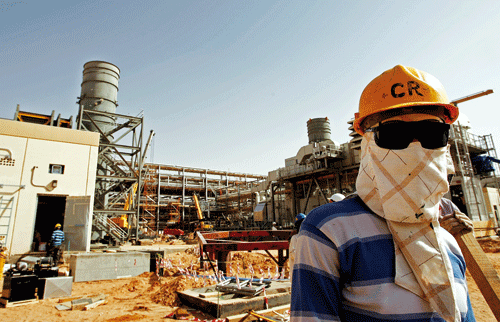
Lebanon's energy ministry has signed a $348 million contract with a Danish-German consortium to build new power plants in Jiyyeh and Zouk.

More from The Daily Star


Qatar’s sovereign wealth fund has hired UBS to advise on a possible $3 billion investment in Russian state-owned bank VTB.

More from Reuters


The Abu Dhabi stock exchange is looking to list some of the emirate’s large private companies to help boost liquidity on the bourse and ensure its benchmark index better reflects the economy, its chief executive has said.

More from Gulf Business


Lebanese property developer Solidere expects to report lower profits for 2012, its general manager said, describing the company’s share price as “severely undervalued” because of political instability and Syria’s civil war.

More from Reuters


Dubai's Emirates Airline, the largest customer for Airbus's A380 superjumbo, is confident in the safety of the aircraft, Sheikh Ahmed bin Saeed Al Maktoum, chairman and CEO of the carrier said.

More from Arabian Business


Marriott plans to open a further 49 hotels across the Middle East and Africa region during the next five years.

More from Gulf Business


Goldman Sachs has raised net profit estimates for Air Arabia, the region’s fast growing low cost carrier, in fiscal 2013-14 on improving earning margins driven by lower costs and increase capacity.

February 27, 2013 0 comments
0 FacebookTwitterPinterestEmail
Real Estate

Signs of a UAE stock surge

by Thomas Schellen February 27, 2013
written by Thomas Schellen

The twin exchanges of the United Arab Emirates — Dubai Financial Market (DFM) and Abu Dhabi Exchange (ADX) — have had a positive start to 2013, particularly when compared to overall emerging markets trends.

From the opening on January 2 until close on February 25, the MSCI Emerging Markets Index (MXEF) — the world’s most prominent emerging markets index — retreated by around 2 percent. In contrast the UAE benchmark indices soared in the same period: the ADX added 14.2 percent and the DFM’s rise was just a decimal short of 20 percent.

Juxtaposed with the troubles in emerging markets, which analysts saw linked to weaker prospects for exports to the United States and European Union, the gains of both ADX and DFM make the UAE equity markets look their strongest in years.

Riding the real estate

The most exciting stocks to watch in the UAE over the period were the big names in real estate. In Abu Dhabi, the slowly progressing merger project of developers Aldar and Sorouh boosted shares of both companies. From the time that their boards recommended the merger in January, up until the companies had to postpone extraordinary general meetings (EGM) of shareholders on February 21 because of insufficient stock representation, Aldar gained 4.1 percent and Sorouch 9.4 percent, according to Reuters.

Favorable votes in the shareholder assemblies are needed for approving the merger but there is high confidence that the second round of voting on March 3 — when only a 50 percent representation of stock is required for a quorum — will yield the shareholder approval. 

In Dubai, the first two months of 2013 marked the resurgence of the King Kong of regional real estate stocks: Emaar Properties. The company, the developer of Burj Khalifa and arguably the region’s best-known real estate company, surged in both value and volume of trade. Between December 26 and February 25, the stock gained an astounding 43 percent and closed at its highest since those days of encroaching darkness in November 2008.

Some investors cashed out on Emaar stock when the company announced on February 26 that it will not increase its dividend payment. From a daily markets performance, this meant a snag of -2.84 percent for the company, just as other property leaders Aldar and Sorouh dropped a few days earlier in wake of their postponed EGMs. However, those kinks in the paths of the three biggest names in UAE real estate pale when gauged against the enthusiasm that these real estate stocks have attracted in the year to date.

Emaar was quite instrumental in sparking new interest in the UAE real estate equities. The company’s glowing sales reports, and stories of newly extreme demand from property buyers in the last quarter of 2012, contributed a major thread to the narrative that Dubai real estate is recouping its state as an economic driver.

Warning signs

While UAE watchers will be happy to see strong growth, the concurrent surge of real estate stocks and UAE indices also carries a warning message. While the past four years have been characterized by growth in tourism, retail and some industrial activities, real estate stocks seem to be the lead ingredient that makes the stock indexes fly.

The fact that the spike in the indexes coincided with property increases shows that the UAE economy is anything but de-coupled from its property market. Whether that linkage is a great thing in what it says about the perception of the UAE economy, remains a matter of perspective.

But the focus on notoriously unpredictable real estate market leaves the UAE’s stock markets prone to surges. Smart investors should be wary of this.

February 27, 2013 0 comments
0 FacebookTwitterPinterestEmail
Business

From the tree to the table

by Sam Tarling February 26, 2013
written by Sam Tarling
IXSIR wine is produced in the fields surrounding Seigniorial House in the hills above the northern Lebanese city of Batroun [Photo: Sam Tarling/Executive]
The house dates back to the 17th century and is located amid beautiful scenery [Photo: Sam Tarling/Executive]
Visitors can discover 20 grape varieties in the company's vineyard [Photo: Sam Tarling/Executive]
As you enter the building, a spiral staircase takes you down to where the wine is fermented [Photo: Sam Tarling/Executive]
The grapes are put in fermentation tanks, gradually transforming into wine over a month [Photo: Sam Tarling/Executive]
After the fermentation is complete, the wine is aged for many months in oak barrels to gain smoothness [Photo: Sam Tarling/Executive]
In the barrels a small amount evaporates, with wine experts dubbing this the "Angels' Share" [Photo: Sam Tarling/Executive]
After a long wait, the wine is finally ready to be bottled [Photo: Sam Tarling/Executive]
The bottling process begins one to two years after the grapes have been harvested [Photo: Sam Tarling/Executive]
But this is not the end of the journey as filled bottles can be stored in metallic cages for years before being sold to customers [Photo: Sam Tarling/Executive]
IXSIR corks of different wine ranges [Photo: Sam Tarling/Executive]


Photoblog explaining how wine is made at one of Lebanon’s top vineyards, IXSIR.
February 26, 2013 0 comments
0 FacebookTwitterPinterestEmail
Comment

The death of national policy making

by Zak Brophy February 26, 2013
written by Zak Brophy

Let’s be honest about it: policy politics in Lebanon was already all but non-existent. Whether politicians had the desire or the wherewithal to deliver policies that addressed fundamental issues — such as the nation’s corroded infrastructure and bloated public debt — was never of much importance. Loyalty to the major confessional leaders, their parties and their interests has always been the factor of consequence come polling day.

But when the joint parliamentary committees last week adopted the proposed Orthodox Law, they may have stolen the last breath from the lungs of national Lebanese policy-making. The law, if passed in parliament, will mean that voters can only vote for candidates from within their sect. To its proponents the Orthodox Law protects the ability of Lebanon’s many smaller communities to choose their own representatives, rather than having the votes of the larger sects determine the outcome of the vote. For its detractors, however, this law further ingrains sectarianism into, even enforces it upon, the social and political fabric of the nation.

But stepping out from beyond the lenses of identity politics we should ask what could the law mean in the day-to-day life for all Lebanese. The reality is that most problems within the country and the solutions that they require are the same regardless of one’s sect. Scant work opportunities, infrequent electricity and spiraling costs of living are afflictions similarly endured whether Muslim, Christian, Druze or Atheist.

A recent study by the Lebanese Center for Policy Studies for the Arab Barometer Project found that the needs, concerns and preferences of most Lebanese citizens do not differ significantly by sect. Indeed, citizens were more likely to have shared views based on their economic or social standing rather than their sect. Perhaps the most telling finding was that 91 percent of interviewees disagreed with the statement that, “political leaders are concerned with the needs of ordinary citizens.”

For more than half a year teachers and public sector workers, regardless of their sectarian affiliation, have been protesting for government to implement the wage scale increase it agreed to last fall but has yet to find a way to finance. The resolution to this bind is admittedly no easy fix, but the manner in which it has been tossed like a hot potato between politicians is reflective of the malaise in addressing society’s many pending issues.

Sit the same politicians down and task them with debating how they will manage the elections and there is no such inertia. There has been a frenetic flurry of sittings and press conferences as they jostle to maintain their respective power bases.

Lebanon’s political establishment is already dominated by zero-sum calculations that stump meaningful and much needed reform. Locking the discourse into identity politics threatens to further distance the debate from issues that are of importance to all of Lebanon.

Many of the critical issues facing the country require not only mature, long-term planning, but also compromise from opposing parties. Constructive bargaining is already in short supply in Lebanese politics but the passing of the Orthodox Law threatens to further entrench leaders in obstructionist stances. With politicians confined to representing the interests of the “street” within their sect, rival players within the same sect will be able to label concessions in the national policy making process as a betrayal against the community, leading to a hardening of isolationist posturing.     

Regional and local representation within parliament could well be another victim if this law is voted into action. While a Shia in the Bekaa and a Shia in Beirut will be voting for the same MPs, the issues facing the two voters can hardly be considered the same because they share the same confessional branding.

A silver lining?

The Orthodox Law could, however, present some unintended openings for prospective political players who wish to challenge the established status quo. While the proposed legislation would lock voters into casting their ballot within their own sect, it would also see Lebanon become a single electoral district under a proportional representation (PR) system.  

The PR element of this system opens the door for smaller parties or fringe personalities to get voted into office. Were an alliance of aspiring political players to form across the sectarian divides united by a clearly defined vision for the country and presenting a basket of actual policies, they may be able to win a block of seats and shake some life into the moribund parliament. This, however, could yet prove an over-optimistic hope.

The inherent feelings of insecurity and mutual-distrust felt amongst Lebanon’s sectarian groupings are derived from the nation’s violent past, unstable present and uncertain future. In this context the drive for the Orthodox Law can be understood.

But the problems of the country cannot be solved from a sectarian perspective. It is only by building a shared body politic harnessing and addressing the whole country’s shared interests that Lebanon can ensure tomorrow’s security. That will involve putting the policy back into politics.

February 26, 2013 0 comments
0 FacebookTwitterPinterestEmail
The Buzz

Morning briefing: 26 Feb 2013

by Executive Staff February 26, 2013
written by Executive Staff

Economics

After months of political wrangling, passage of Iraq's $118 billion budget still hangs on the semi-autonomous Kurdistan region's insistence that the government allocate $3.5 billion to pay oil companies working the Kurdish oil patch.

More from Iraq Oil Report


Egypt’s government has outlined an economic plan to win International Monetary Fund loans, with steps to narrow the budget deficit toned down to avoid inciting further unrest.

More from Bloomberg


An open-ended strike by Lebanese civil servants and teachers is picking up steam as it enters its second week, with the country’s Catholic schools deciding to close Tuesday in solidarity with the protest.

More from The Daily Star


Companies

Solidere, Lebanon’s largest property developer expects to spend as much as $200 million on real estate projects in the country this year even as civil war in neighboring Syria threatens to slow construction work.

More from Bloomberg


Dubai’s flagship investment vehicle is in talks with banks to launch its first Islamic bond, three sources with knowledge of the matter said, tapping improved sentiment towards the emirate in a bid to diversify its funding sources.

More from Gulf Business


Cement deliveries in Lebanon have fallen, an indication that the economy is weakening.

More from The Daily Star


Consumer spending on food in the GCC is expected to reach $106 billion in the next five years, according to a new report by management consultancy AT Kearney.

More from Gulf Business


Shares in Emaar Properties are likely to open lower after the developer announced 2012 dividends that came in below expectations.

More from Reuters


Qatar Telecom (Qtel) will change its brand name to Ooredoo, the company said in a statement, bringing in the change across it operations in the Middle East, Africa and Asia over the next two years.

More from Reuters


Workers across MENA are so unhappy in their jobs that they wish to leave immediately, according to a new poll by online job site, Bayt.com.

More from Arabian Business

February 26, 2013 0 comments
0 FacebookTwitterPinterestEmail
The Buzz

Morning briefing: 25 Feb 2013

by Executive Staff February 25, 2013
written by Executive Staff

Economics

Brent futures slipped below $114 a barrel on Monday, reversing some of the gains made in the previous session.

More from Arabian Business


Lebanese private school teachers have joined their public sector colleagues on strike, causing further disruption to the country.

More from The Daily Star


Iran is to reduce its dependence on oil income and boost non-oil exports in its budget to counter the "heavy" impact of sanctions, President Mahmoud Ahmadinejad said in a television interview late on Saturday.

More from Reuters


The rate of decline in Egypt's foreign reserves could fall next month, Central Bank Governor Hisham Ramez was quoted as saying on Sunday.

More from Reuters


Dubai stocks rallied to the highest level in more than three years as Emaar Properties' new hotel project fuelled calls that the revenue of the developer of the world's tallest skyscraper would grow this year.

More from Bloomberg


Companies

Egypt's tourism minister is heading to Iran in a bid to urge more tourism between the countries.

More from Reuters


Abu Dhabi-based hotel operator Rotana has signed a deal with Dap-Yapi to manage two of its hotels in Turkey as it looks to expand its footprint.

More from Arabian Business


Emirates LNG has leased a plot of land on the east coast of the United Arab Emirates (UAE) and will start building an LNG import terminal there later this year, the company said in a statement on Sunday.

More from Reuters

February 25, 2013 0 comments
0 FacebookTwitterPinterestEmail
Economics & Policy

Mikati’s striking dilemma

by Benjamin Redd February 25, 2013
written by Benjamin Redd

Lebanon’s Prime Minister Najib Mikati appears to be all out of options. Between thousands of public sector workers on strike for better pay and economists that warn of the dangers of a new wage scale, the billionaire Lebanese prime minister once again finds himself walking a fine line.

On the one hand, public servants are fed up with low wages and endless promises of better pay. Exacerbating the situation, last year’s minimum wage increase for the private sector coincided with increased inflation that drove prices higher for everyone. According to the Central Administration of Statistics, the consumer price index increased 10.1 percent in 2012, compared to 3.1 and 4.6 percent in 2011 and 2010, respectively. This means our wallets don’t buy as much as they used to.

But the public sector employees, teachers most prominently, have been asking for better pay since long before the recent bout of inflation. Their complaints have their roots in the spiraling costs of the 1990s and successive governments have only made half-hearted and insufficient attempts to improve their lot. Mikati promises that he still backs the raise but says that until there is a viable economic proposal for how it can be paid for he will not enforce it. “In the end we are responsible for maintaining financial stability and we cannot risk [making] any impromptu or hasty decisions that would hit the economy,” he said in November.

A glance at Lebanon’s balance sheet suggests that making the finances work will be a difficult chore, with the raise estimated to cost Lebanon’s treasury at least $1 billion annually — on top of the fiscal issues the country faces already.

The country has had budget deficits for years and will to continue to do so until at least 2016, according to the International Monetary Fund. Meanwhile the debt remains high – at $54 billion in 2011, representing a debt to gross domestic product ratio of around 140 percent. Simply put, there is little money to pay teachers, soldiers and their fellow public employees without raising new revenue or cutting other expenses. But what are the potential ways for doing so?

The proposals

Mikati has partially proposed a new funding model to pay for the raise. While he has been vague about some of the details — saying they need to be the result of further discussion — he has suggested a number of measures including taxing tall buildings. Under the scheme developers of skyscrapers would be permitted to build higher than they currently can, but would have to pay extra taxes on each additional story. The prime minister has suggested the plan could generate up to half a billion dollars per year — half the amount needed for the minimum wage increase.

Both the labor unions and the Economic Committees — the largest umbrella association of private sector committees — are skeptical whether the policy can work. Charles Arbid, who is involved in the Economic Committees as president of the Lebanese Franchise Association, notes that Mikati’s $500 million figure may significantly overestimate the actual amount of revenue generated.

Meanwhile former Labor Minister Charbel Nahas, who has been working with the union movements to draft an alternative proposal, accuses Mikati of pretending the money can be found “by magic.” “If we can make one billion from one floor, why not make 40 billion from 40 floors? We can pay off the debt in one day,” he remarks dryly.

The unions propose changes to the Lebanese tax system to pay for the bill. Nahas explains that there are two main policies – introducing taxes on capital gains, and increasing interest income tax on bank deposits. With regard to capital gains tax – which in Lebanon is currently non-existent — the unions call for it to be introduced at 25 percent, while on bank deposits they are suggesting increasing interest income tax from 5 percent to 15 percent, putting it in line with corporate tax in Lebanon. Nahas estimates that these increases could pay for the wage hike.

 ‘Very optimistic scenarios’

But it may be that both the unions and Mikati are overestimating the strength of their claims. Elie Yachoui, dean of the School of Business Administration and Economics at Lebanon’s Notre Dame University, thinks neither plan would come near to generating the revenues estimated.

He suggests that even a combination of the ‘Mikati floor’ plan and the unions’ tax increases could only bring in $800 million to $1 billion per year. And that, he added, was “a very optimistic scenario.”

He believes that the plan proposed by the unions could also have significant negative side effects on the economy. “The capital gains tax could be a very good tax” in the long term, but “any tax increase will be harmful to the economy in the short term,” he says.

Instead Yachoui suggests that Lebanon could use some of its gold deposits — the country has the second largest amount of gold per capita in the world — as a short-term way to pay for the raise.

The Economic Committees, for their part, have not proposed any substantive proposals as yet. While they have tentatively agreed that a pay raise should go ahead, their members such as Arbid oppose any new taxes to pay for it. Instead, he says the Committees are in favor of a “national economic dialogue” to examine proposed revenue sources.

Yet the government has allegedly been in dialogue over this issue for over a year, with little progress achieved. With the unions still on strike, there is little time to assess other options — or even fully study the plans that have been presented. With little patience on either side and public sector employees increasingly desperate, the chances of a negotiated settlement are currently few.

February 25, 2013 0 comments
0 FacebookTwitterPinterestEmail
Business

The finishing touches

by Sam Tarling February 24, 2013
written by Sam Tarling
Hotels in Lebanon have been hit hard by a drop in tourists. Some have closed, others have sealed off floors and reduced staff. Despite this, construction at the soon-to-open Smallville Hotel in Badaro continues [Photo: Sam Tarling/Executive]
This cold, sparse room will eventually be transformed into the hotel's bar and lobby [Photo: Sam Tarling/Executive]
From the 21-storey building, guests can see much of Beirut [Photo: Sam Tarling/Executive]
Mosaic tiles are placed in the rooftop pool, which overlooks the Beirut race course [Photo: Sam Tarling/Executive]
The hotel has adopted a policy of using only LED lights due to their longer life and better efficiency [Photo: Sam Tarling/Executive]
A worker puts the finishing touches to a wall outside one of the hotel's 190 rooms [Photo: Sam Tarling/Executive]
Muhammad Chakid, a worker from Aleppo, Syria, tapes a door to protect it [Photo: Sam Tarling/Executive]
The rooms are being decorated with some 8,000 square meters of wallpaper, imported from England [Photo: Sam Tarling/Executive]
The hotel is due to open in summer 2013 [Photo: Sam Tarling/Executive]
Decorators add wallpaper strips to the ceiling in one of the hotel's 190 rooms [Photo: Sam Tarling/Executive]
Each floor features three suites and eight standard rooms [Photo: Sam Tarling/Executive]
Painter Assaf Issa, 18, from Idlib, Syrria takes a break from sanding [Photo: Sam Tarling/Executive]

Inside the making of Lebanon’s Smallville Hotel

February 24, 2013 0 comments
0 FacebookTwitterPinterestEmail
The Buzz

Morning briefing: 22 Feb 2013

by Executive Staff February 22, 2013
written by Executive Staff

Economics

A senior Qatar aviation official has said that the new Hamad International Airport, which is set to open in April, will be one of the world's best.

More from Arabian Business


Lebanon’s energy minister has launched the country’s first onshore seismic survey of potential hydrocarbon reserves, bringing the hunt for oil and gas inland for the first time in nearly 50 years.

More from The Daily Star


Thousands of demonstrators rallied across Lebanon Thursday as a growing number of civil servants joined an open-ended strike to demand the immediate approval of a wage hike.

More from The Daily Star
 

Egypt, the world's biggest importer of wheat, said it has enough stocks of wheat to last 101 days and it expects its supply to increase further as more imports arrived.

More from Reuters


Salaries in Saudi Arabia increased by 5.8 per cent in 2012, according to global recruitment firm Aon Hewitt’s annual survey.

More from Gulf Business


Companies

Lebanon's Association of Bank Employees warned Thursday that it would disclose the names of the Lebanese banks which have failed to implement a 2011 wage hike.

More from The Daily Star


Abu Dhabi's Aldar Properties and Sorouh Real Estate, which have agreed to merge operations and create a business with assets worth $13bn, have failed to meet the necessary quorum for a crucial merger vote.

More from Reuters


Dubai's transport authority has announced new penalties to deter private vehicle owners from offering illegal taxi services in the emirate.

More from Arabian Business

February 22, 2013 0 comments
0 FacebookTwitterPinterestEmail
The Buzz

Still no to the WTO

by Robert Biddle February 22, 2013
written by Robert Biddle

Earlier this week, the US Ambassador to Lebanon gave a speech at Beirut’s Lebanese American University in which she made an explicit appeal to the government to make a move towards accession to the World Trade Organization (WTO). “I understand that Lebanese politicians have a lot on their plate these days,” Maura Connelly said, “but this, the WTO competition law, is a law that has already been prepared and sent to the parliament. All it needs is its day on the floor so that it can be debated and passed.”

But while Connelly may still publicly harbor hopes of Lebanon joining the 158-country club, behind the scenes, American organizations are abandoning theirs. This became most evident when Executive sat earlier this year with representatives from the United States Agency for International Development (USAID). After 12 years of assistance and roughly $12 million of financial support, USAID appears to be calling it quits on Lebanon’s accession to the WTO. The latest assistance program of $3 million ended in October 2012, now they are pulling the plug.


See also: Lebanon and the WTO – the interactive guide


“Basically, we got to the point where we had done everything we could, and it was up to the government of Lebanon to take it to the next level,” says Heath Cosgrove, Director of Economic Growth, Water and Environment of USAID in Lebanon. Cosgrove attributes stalled progress to a political stalemate regarding accession plans, and the inability of the government to implement the necessary legislation the WTO requires.

While the funding is rather insignificant in financial terms, the end of the program could be seen as the final nail in the coffin for Lebanon’s bid.

Flaying in the backseat

Officially, Lebanon has been vying for WTO membership — which would entail eliminating or significantly lowering trade barriers as well as complying with WTO standards of trade — since 1998. At the body’s 2003 conference in Cancun, Lebanon had ‘observer’ status. At the time, many expected the country would accede by 2005. Yet a decade on it remains an observer state because it has failed to pass and enforce all WTO agreements.

There has been some progress toward joining in the last 15 years — 11 out of the 19 laws the WTO and Lebanon agreed upon have been enacted — but since the 2006 war with Israel, Lebanon’s bid has stalled.

Jad Chaaban, an economist at the American University of Beirut, said WTO legislation had been put on hold because there are more immediate matters to deal with. “The  government has put everything on the backseat. The only pressing problem now is how to deal with the security and political crisis from Syria and minimize those repercussions on Lebanon,” he said.

He added that while the WTO may still be somewhere on the agenda, other matters, such as the electricity and housing crises, have bumped it well down the ‘to-do’ list. Minister of Economy and Trade Nicholas Nahas told Executive in November that some of the laws demanded for WTO membership (see chart) were considered unconstitutional on the basis that he considers the government under which they were drafted, that of former Prime Minister Fouad Siniora, to have been illegitimate.

“Anything that came out of that government is in limbo,” Nahas remarked. The competition law, for instance, was sent to Parliament in October 2009 and was intended to eliminate monopolies and curb abusive oligopolies, but its passage seems highly unlikely in the near term.

Opposition to the law is hardly surprising, as the operators of the existing monopolies and oligopolies that pervade the economy normally have strong political ties — or are in the government themselves. “Of course you wouldn’t want to hurt yourself and the money you’re getting to distribute back on your supporters,” Chaaban says.

There is also little hope for the new and improved draft of the intellectual property law, which is required for WTO accession. Lebanon is notorious for its lack of commitment to curbing piracy and flagrant breaches of intellectual property rights (IPR) and copyright laws. Nassib Ghobril, head of research at Byblos Bank, says that Lebanon’s approach to IPR is “embarrassing”, and that he views it as one of the main barriers to Lebanon’s accession. However, AUB’s Chaaban seems to disagree on the importance of IPR, arguing that many countries that are already WTO members are still struggling with the concept, including China and even some US states.

When Executive sat down with Minister of Industry Vrej Sbounjian in October and inquired about Lebanon’s accession, he said, “We have to take into consideration the size of the country and the size of the population. I don’t know all of the details of the WTO but I think that those two issues must be taken into consideration.”

As many of Lebanon’s productive sectors could become more vulnerable under WTO accession, it was perhaps surprising that the Minister of Industry did not provide a more nuanced answer, raising the question of how seriously the government is taking this issue.

USAID’s Cosgrove explained that after seeing no progress on the part of the government in the first two years of their three-year project, they switched their attention (and funding) to working with the private sector, with workshops promoting proper economic analysis skills and creating an ‘Enquiry Point’, a hub to provide information on Lebanon’s trade regulations and policies to both domestic and foreign traders. Cosgrove said it was hoped that by working with members of the private sector that they would in turn be empowered to begin pressuring the government to act.

Lack of public awareness and subsequently a lack of public engagement have also delayed the process, according to Chaaban. “People are not feeling that consumer prices are increasing because of monopolies, they just blame it on inefficient management or the government, there is a kind of ignorance… they just have pressing things to take care of but in the long run they are hurt,” he said. “The fact that the public is not campaigning against these [issues] tells you a lot about how detached the society has become from its problems.”


Is it W.T.O.rth it?

Even if WTO legislation were to come back to the forefront of political discourse, it is not clear that membership would be beneficial to Lebanon.

A December 2011 analysis report commissioned by USAID found that if the competition law that currently sits idle in Parliament was to be passed, Lebanon could expect to see a 10.7 percent growth annually in gross domestic product (GDP) over the next 10 years (the report forecasted figures from 2012 to 2021). The report based this on price decreases and increased access to capital for small and middle-sized enterprises that currently make up about 95 percent of all businesses in Lebanon. Implementing the competition law, the report argued, would be enough of a policy commitment to demonstrate improved political stability, which would attract more foreign direct investment (FDI).

Indeed, with seemingly no end to political instability, both at home and next door in Syria, investors have been shy. According to Ernst & Young’s 2012 Middle East Attractiveness survey, Lebanon accrued $609 million in FDI in 2011, yet in the first half of 2012 received only $96.5 million.

However, the USAID report also compared the difference in several countries’ net FDI from one year prior to accession to 10 years afterwards. While some countries, such as Mongolia, experienced impressive growth of upwards of 2,000 percent, other countries had a net decrease, such as Estonia, which saw FDI drop 42 percent. In other words, the direct correlation between accession to the WTO and FDI is weak.

Some Lebanese economists, like Ghobril, feel that Lebanon is ready to join the WTO, as some of the framework is already in place. “Lebanon has a free-market economy, based on trade; our imports are higher than our exports, so with the WTO membership, that would eventually help Lebanese companies access other markets,” he said, adding that Lebanon’s tariffs are already low (roughly 5 percent on general products), so further eliminating these trade barriers would have a minimal effect.

Trouble on the farm

Yet there are higher tariffs protecting certain sectors, especially agriculture. Agricultural products, particularly fruits and vegetables, enjoy the protection of a 70 percent tariff on imported goods. According to interviews the USAID report writers conducted with non-governmental organizations working with Lebanese farmers, accession would severely hurt the sector. Lebanon’s agricultural production is largely based on small-scale farms, resulting in enormous competition and low-profit margins. This doesn’t leave much room to sustain additional competition, especially from foreign production where subsidies are available to undercut local production costs.

The organizations that were interviewed for the USAID report also suggested that farmers would need to invest in newer and more efficient forms of productions — machinery, irrigation and specializing in growing certain products — in order to stay in business if Lebanon’s agricultural trade barriers were reduced.

Yet farmers are reluctant, and oftentimes unable, to invest in new production methods, due to recurrent political instability and a government that sets aside less than one percent of its budget for the sector.

Agricultural trade has been one of the main issues that the WTO itself has been struggling to deal with. The organization, by its own definition, attempts to level the global playing field in establishing and monitoring free trade. Yet since 2001 it has failed to conclude negotiations on the Doha Development Round (DDR), which focuses on establishing trade agreements on agriculture. Developed countries, such as the US and European Union members, provide enormous subsidies to their agriculture sectors, effectively reducing the production costs of local farmers, which in turn often enables them to undercut their competitors in developing countries. “It’s hard to escape from the argument, ‘How do you want us to open up our borders when yours are not really open?’” said Chaaban.

On free trade, Alexander Bryan, first secretary at the US embassy in Lebanon, remarked: “There are going to be winners and losers, and sometimes in the short term the losers are going to be more than the winners, and that’s something you find everywhere… but in the long term, the productivity gains that are accrued to a country in lowering its trade barriers are stimulative to growth.”

The end of the WTO itself?

The WTO has been waiting for a long time for Lebanon to pass just a few of the laws needed to show the organization that it is serious about its accession, according to USAID’s Cosgrove. “But as of right now,” he says, “[the] WTO doesn’t have much of an interest to restart the talks because there is no action, ownership or a sense of responsibility on behalf of the government of Lebanon.”

But while it has been waiting, the bigger issue that has emerged is whether the WTO itself has become redundant. At the end of December, Peter Sutherland, former Director General of the trade body, penned an op-ed arguing that the WTO has been “marginalized” by its inability to resolve the DDR talks. Member countries, perturbed by the stalemate, seem to be implementing bilateral or regional agreements with their trading partners that are not overseen by the WTO, essentially overlooking their WTO commitments.

Pascal Lamy, the current director general of the WTO, even conceded that the discussions at the DDR were still in a “deadlock” in an interview on BBC’s Hardtalk. “There is nothing much you can do. These two elephants [the US and China] so far haven’t agreed, and the rest of the world hasn’t had the force, or the power, to knock these two heads together.”

One must wonder then, if the world’s leading economies are bypassing this so-called global trading pact to make their own trade rules, why would Lebanon even want to join the WTO? 

February 22, 2013 0 comments
0 FacebookTwitterPinterestEmail
  • 1
  • …
  • 279
  • 280
  • 281
  • 282
  • 283
  • …
  • 686

Latest Cover

About us

Since its first edition emerged on the newsstands in 1999, Executive Magazine has been dedicated to providing its readers with the most up-to-date local and regional business news. Executive is a monthly business magazine that offers readers in-depth analyses on the Lebanese world of commerce, covering all the major sectors – from banking, finance, and insurance to technology, tourism, hospitality, media, and retail.

  • Donate
  • Our Purpose
  • Contact Us

Sign up for our newsletter

[contact-form-7 id=”27812″ title=”FooterSubscription”]

  • Facebook
  • Twitter
  • Instagram
  • Linkedin
  • Youtube
Executive Magazine
  • ISSUES
    • Current Issue
    • Past issues
  • BUSINESS
  • ECONOMICS & POLICY
  • OPINION
  • SPECIAL REPORTS
  • EXECUTIVE TALKS
  • MOVEMENTS
    • Change the image
    • Cannes lions
    • Transparency & accountability
    • ECONOMIC ROADMAP
    • Say No to Corruption
    • The Lebanon media development initiative
    • LPSN Policy Asks
    • Advocating the preservation of deposits
  • JOIN US
    • Join our movement
    • Attend our events
    • Receive updates
    • Connect with us
  • DONATE