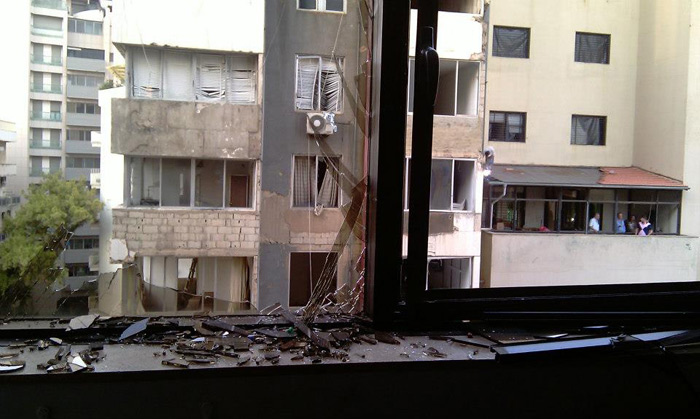
Photographs from the aftermath of the killing of Wissam al-Hassan


Photographs from the aftermath of the killing of Wissam al-Hassan
Economics
US oil giant Exxon Mobil wants to leave its giant oilfield project in southern Iraq, diplomatic sources said, in a move likely to aggravate the country's internal tensions and hamper Baghdad's ambitious energy expansion plans.
Exxon's desire to quit, which the sources said was due to prospects of slim profits from the estimated $50 billion West Qurna-1 project, contrasts with a deal it signed a year ago to explore in Iraq's autonomous northern Kurdish region, where incentives are better.
Baghdad deemed the Kurdish deal illegal and promised to punish Exxon by ripping up its contract for West Qurna-1, which has reserves of 8.7 billion barrels.
A young and increasingly educated population could be the source of prosperity in the Middle East and North Africa if an environment that promotes open competition is created, according to a World Bank report.
The study on Jobs in MENA offers a detailed analysis of the many factors that have contributed to one of the highest rates of youth unemployment in the world, along with one of the lowest rates for female participation in the labour force.
It proposes a set of policy reforms to unlock the region’s large and untapped human potential.
Jordan, which has no natural resources and imports all of its energy, needs to invest as much as US$25bn over the coming ten years to help it become self sufficient, the Jordan Times reported, citing Jordan Economic Social Council President Jawad Anani.
The number of refugees from Syria that have fled to Jordan as a result of a 19-month uprising against President Bashar al-Assad has caused Jordan to incur additional costs estimated at JD600m (US$846m) annually, the newspaper cited Anani as saying.
Jordan imports 96 percent of its fuel needs (the daily equivalent of 100,000 barrels of a oil a day), and until recently was dependent on Egypt for its gas supply, which has caused its public debt to soar. The country relies on foreign grants and aid to finance its fiscal deficit.
Over 50 large European and US companies showed keen interest in Lebanon’s oil and gas prospects during a marathon meeting with Lebanese officials in London this week.
Most, if not all, of these companies expressed eagerness to explore oil and gas off the Lebanese coast as soon as possible after listening to a thorough explanation about progress the Lebanese government has made in surveying part of the Lebanese coast.
Among the questions raised by the companies was the actual size of the gas blocks off the coast; they said the larger blocks would tempt the firms to take part in the bidding.
Lebanese Bank Audi said on Thursday that its net profits rose by 14.1 percent to reach $309.4 million in the first nine months of 2012, despite delicate political and economic conditions in Lebanon and throughout the region.
“Audi Saradar Group registered an adequate performance over the first nine months of 2012, with net earnings growing by 14.1 percent relative to last year’s corresponding period. Net earnings amounted to $309.4 million in the first nine months of 2012, (of which $32.8 million in net earnings after taxes and expenses stemming from discontinued operation),” the bank said in a statement.
Consolidated assets reached $29.2 billion at end-September 2012 and $40.6 billion when accounting for fiduciary deposits, security accounts and assets under management, despite the contraction of assets of Bank Audi Syria at end-September 2012 to a third of their December 2010 levels.
Politics
At least nine soldiers have been killed in an attack by suspected al-Qaeda militants on a military base in southern Yemen, military officials say.
The attackers drove a vehicle into the base in Shuqra, Abyan province, before blowing it up.
One official said they travelled in a military vehicle and passed through several checkpoints to reach the camp.
And finally…
The head of Saudi Arabia's religious police has reportedly said there is a "pressing need" to employ more women in the force.
Speaking to the Saudi Gazette, Abdul Latif Abdul Aziz Al Sheikh said he hoped a recruitment drive would take place soon.
He told the newspaper that the women will work under the supervision of an independent women's department similar to other government agencies
Economics
Kuwait Oil Company set fire to an oil well in the north of the OPEC member state on Wednesday to get rid of gas leaking from the site, state news agency KUNA said.
The state-owned company said levels of the hydrogen sulphide gas from a well at the Rawdatain oil field close to the Iraqi border were "far below danger levels", KUNA said in an SMS alert.
The company said earlier on Wednesday that there had been an oil and gas leak at the well during drilling operations and that no one had been injured.
Brent futures held above $113 on Thursday, buoyed by hopes for steady growth in demand after China, the world's second-biggest oil consumer, posted growth that met expectations, and simmering tension in the Middle East provided additional support.
China's economy expanded 7.4 percent in the quarter to September from a year earlier. That was its slowest pace since the first quarter of 2009, but was in line with a Reuters forecast, with stronger retail sales and industrial output numbers propping up investor sentiment further.
Brent gained 19 cents to $113.41 a barrel by 0233 GMT, after settling 78 cents lower at $113.22. U.S. oil gained 1 cent to $92.13, after ending 3 cents higher.
ExxonMobil has signed contracts to drill in Iraq's semi-autonomous Kurdistan region by the end of this year, despite claims by Baghdad officials that the company has vowed to "freeze" its controversial contracts.
Exxon has spent or allocated a quarter-billion dollars for exploration, drilling and other work and supplies in Iraq's Kurdistan region, according to an official with knowledge of Exxon and the Kurdistan Regional Government (KRG).
Cyprus’s finance minister has said he expects final negotiations to start with lenders on financial aid by next week. Vassos Shiarly told reporters a figure had not been set for Cyprus’ financial needs because of a difference of opinion between the government and lenders on the recapitalization requirements of banks.
Asked by Reuters whether he expected discussions with lenders to start before the end of the month, he said: “Within the month, and certainly in the coming week. Time is restricted and there is not much time left.”
A Lebanese teachers’ union on Wednesday declared a nationwide general strike Thursday to protest the government’s failure to send the salary scale draft to Parliament despite a preliminary Cabinet decision to raise certain taxes to fund the wage increase for civil servants and public school teachers.
The Union Coordination Committee called on all public and private schools and government agencies to abide by the strike and threatened to escalate the situation if Cabinet refrained from sending the higher wages bill to the Parliament immediately.
“We call on all public and private school teachers to observe the strike and not be intimidated by the threats of the private school administrations to fire the insubordinate teachers,” the statement said.
Iran has denied accusations that its revolutionary armed forces (IRGC) are planning an environmental disaster in the Strait of Hormuz and use it to have international sanctions against it lifted, local media reported on Wednesday.
The German newsmagazine Der Spiegel reported on Sunday it had evidence of a plan by IRGC commander Mohammad Ali Jafari to cause an oil spill to block crude exports through the Strait crucial to the global economy.
US computer manufacturer Dell is aiming to boost its footprint in the Middle East as it looks to counter growing competition to the PC from the tablet and notebook sectors, a senior executive said.
“Dell is a US$60bn company so [the Middle East] is a relatively small proportion but it is growing rapidly. We have been experiencing high double digit growth,” Steve Felice, president and chief commercial officer at Dell, said in an interview in Dubai.
“The business is getting quite large and we had added a lot of resources here, it is five times what it was just a few years ago. So it is an important growing market.
Saudi Arabia will allow females to practice law in a courtroom setting for the first time from next month, it was reported.
According to English language daily Arab News, women will be permitted to approach the Ministry of Justice to obtain the necessary license to practice law in the kingdom as part of broader regulatory changes to how legal professionals operate.
The change comes following the submission by the ministry of new statutes governing female involvement in the legal profession to Saudi’s Council of Ministers, which oversees the implementation of new legislation.
Economics
Iraq's cabinet named an interim central bank chief on Tuesday after the bank's well-respected governor, who was on an overseas trip, was suspended amid a currency manipulation probe.
The move followed the announcement of an inquiry into allegations that officials at the Central Bank of Iraq (CBI) had intentionally weakened the value of the Iraqi dinar against the US dollar.
"The cabinet decided to authorise Abdelbassit Turki, the head of the Board of Supreme Audit, to run the central bank indefinitely," Prime Minister Nuri al-Maliki's spokesman Ali Mussawi said, adding that Sinan al-Shabibi had been suspended from his post by the anti-corruption watchdog.
Mussawi said the investigation had been launched because of "what happened with the dinar exchange rate with the dollar" and that a parliamentary report had blamed "the chief of the bank and several other people."
Qatar has launched a $254 million plan to rebuild and modernise Gaza, the biggest injection of reconstruction aid for the Palestinian enclave since it was devastated in an Israeli military offensive nearly four years ago.
Projects announced at a news conference by Qatari ambassador Mohammed Al-Amadi will require the cooperation of Israel and Egypt to admit building materials and heavy machinery to Gaza, which is under a partial blockade.
Amadi said this had been arranged. Work would begin on site within three months, starting with a highway that will run the length of the Mediterranean coastal strip.
Leading international oil firms will get first-hand information about the initial findings of Lebanon’s massive gas wealth under the sea during a meeting in London on Wednesday.
Multinational oil companies such as Exxon, Shell and Mobil will take part in the meeting. It will also be attended by Lebanese officials and senior executives from the British-based company Spectrum, which has been surveying 3,000 kilometers of Lebanon’s territorial waters.
David Rowlands, the CEO of Spectrum and one of the key speakers at the briefing, told The Daily Star over the telephone that 65 representatives of companies will attend the meeting.
Brent futures held steady near $114 on Tuesday as expectations Europe's financial crisis is on the mend renewed hopes of a revival in oil demand growth, while simmering tension in the Middle East provided additional support.
Asian shares, the euro, base metals and gold all rose after Moody's Investors Service affirmed its investment grade rating on Spain, helping ease investor worries of a worsening crisis in the region. Oil was also supported by supply concerns as the European Union slapped fresh sanctions on Iran.
Brent slipped 12 cents to $113.88 a barrel by 0432 GMT. The November contract, which expired on Tuesday, went off the board 73 cents lower at $115.07, while the December one settled 40 cents lower at $114.00. U.S. oil gained 18 cents to $92.27.
Politics
At least five protesters were arrested and several injured in Kuwait as police tried to break up an opposition protest late on Monday, witnesses said.
Authorities had asked opposition lawmakers to call off the demonstration over political reforms, but at least 5,000 people gathered in a square near parliament that has been the site of several anti-government protests since last year.
Although major oil producer Kuwait has not experienced the mass Arab Spring protests seen elsewhere across the region, tensions have escalated between an elected parliament and a cabinet chosen by the prime minister, who is appointed by the emir, Sheikh Sabah al-Ahmad al-Sabah.
US President Barack Obama has hit out at Republican Mitt Romney during a feisty 90-minute encounter in the second of three pre-election debates.
Mr Obama – widely perceived to have lost their first encounter – came out swinging in New York on the economy, tax and foreign policy.
But the former Massachusetts governor accused Mr Obama of broken promises and a record of failure.
And finally…
The number of Arab millionaires investing in Britain in exchange for permanent residency has increased in the wake of the Arab Spring as investors look to flee political turmoil in their home country, financial advisors have told Arabian Business.
Rich Arabs are increasing making use of investor visas that allow wealthy foreigners to live in the UK in return for buying at least £1m (US$1.6m) of gilts or shares and bonds in British companies.
“We have seen a rapid growth of Middle Eastern clients investing in the UK and taking advantage of the UK immigration opportunities available under the Investor and Entrepreneur visa categories,” said Carl Thomas of Visalogic.
Two cars of men carrying AK-47s pull into a tight alleyway, jump out and threaten hijab-cladded women. Another car arrives and out steps a shady Hezbollah leader, the cue for special agents of the Central Intelligence Agency to spring their ambush.
All this takes place on Beirut’s ‘Hamra Street’ in the latest episode of the multiple award-winning American TV series ‘Homeland.’ This episode of the show aired over the weekend in the West and portrayed the Lebanese capital as a hotbed of terrorists and random attacks on foreigners.
Reality anyone?
For those unacquainted with Beirut, the real Hamra Street is a bustling cosmopolitan artery where days spent shopping and chatting in cafes give way to a nightlife of drinking and cavorting in local bars. A hub of modern city life, it is Beirut’s much smaller version of London’s Tottenham Court Road or New York’s Fifth Avenue.
Unsurprisingly, the misrepresentation has sparked more than a little ire in the Lebanese government. Speaking exclusively to EXECUTIVE, Lebanese Tourism Minister Fady Abboud has promised to take legal action over the “lies” in the show.
“This kind of film damages the image of Lebanon — it is not fair to us and it’s not true, it is not portraying reality,” he said. “We want to take action, we want to write to the filmmakers and producers and demand an apology. And we are planning to raise a lawsuit against the director and the producer.”
Abboud stressed that he was studying potential legal routes the government could take, but added that he would be willing to take action personally if necessary.
The first series of Homeland, which aired last year, was both a critical and a ratings success, with high viewing figures followed by recognition at almost every major television awards event. The shows stars Claire Danes and Damien Lewis, who won the best actor and actress Emmys, respectively, while the show also took home the coveted Outstanding Drama Series award.
It focuses around a female CIA agent (Danes) who believes that a United States soldier who was captured in Iraq and returned home a war hero has been turned into an informant by Al Qaeda. During the episode in Beirut, Danes is seeking to kill a senior figure in Hezbollah allied with Al Qaeda (despite the fact that, in reality, there is likely more animosity between these two groups than there is between either of them and America).
Minister Abboud said the reach of the show made the misrepresentation even more problematic. “This series has a lot of viewers and if you are promoting Lebanon as a non-secure zone it will affect tourism. It will mean a lot of foreigners stay away if they are convinced by what they see,” he said. “Beirut is one of the most secure capitals in the world, more secure than London or New York.”
The show was not filmed in Lebanon at all, but was shot instead in the Israeli city of Haifa. For Abboud the fact that it was filmed in a state with which Lebanon is technically at war was an added insult. “We would like to welcome the crews here to film in this city — we were offended by the fact that they filmed the thing in Israel and said it was Beirut,” he said.
Misrepresentation’s long history
Lebanese have long complained about the misrepresentation of their country in the Western media. Jad Melki, director of the Media Studies Program at the American University of Beirut, said the portrayal was disappointing but not surprising.
“We have been dealing with this for over a century, the portrayal of Arabs in the US is that we are all Islamists living in the desert, evil and angry all the time,” he said. “If you look at US media, racist stereotypes of African Americans have all but disappeared but it is still acceptable to stereotype Arabs.”
Melki said that because the civil war made Lebanon, and particularly Beirut, synonymous with violence, trying to convince Westerners that the city is a prosperous, diverse place is much more difficult than playing on people’s preconceptions. Even the title of the episode, “Beirut is Back”, appears to be a reference to the city’s troubled years in the 1980s, when car bombings and kidnappings were rampant.
“The civil war version of Beirut is still portrayed,” said Melki. “There is a frame of mind and a stereotype of a certain group of people or place and it doesn’t make sense if we break away from that as the audience won’t understand. So we look for the version we know.”
British Ambassador Tom Fletcher, who has campaigned for Westerners to reassess their perception of the country, admitted to being a big fan of the show but said it was a misleading portrayal.
“Homeland is one of life's joys, but Lebanon tends to get a rough time from filmmakers — I'd encourage people to see the real Beirut,” he told EXECUTIVE.
Everything sticks
Beyond legal action the Lebanese government’s options for responding to the show are relatively few. Abboud said his office was considering a counter-video in which footage from the show would be inter-spliced with daily images from Hamra Street.
“We also have a campaign to promote Lebanon on CNN which is starting next month,” he said. “It features all the tourism sectors in Lebanon, what Lebanon has and a real picture about Lebanon.”
Melki suggested that if the country were serious about countering Western perceptions then they should spend money on hosting a major American film in the country. In the most recent Mission Impossible film Tom Cruise scales the world’s tallest building — the Burj Khalifa in Dubai — in the kind of advertising deal which costs millions of dollars but can help change perceptions in the West.
“It would be expensive but effective,” said Melki. “Currently the Ministry of Tourism produces videos about Lebanon with lots of shots of the mountains – its not storytelling, its not entertaining. A movie does that, a TV show does that.”
Politics
US Secretary of State Hillary Clinton says she takes responsibility for the failure in security at the US consulate in Benghazi, where the US ambassador to Libya was killed last month.
Mrs Clinton said ensuring the safety of US diplomatic staff overseas was her job, not that of the White House.
It comes ahead of the second campaign debate between President Barack Obama and Republican candidate Mitt Romney.
More than 100 inmates have escaped from the al-Judaida prison in the Libyan capital, Tripoli.
The prisoners are said to be of various nationalities and officials say about 60 have so far been recaptured. It is not clear how the breakout happened.
Al-Judaida is one of Tripoli's largest jails. Human rights groups accuse officials of abusing inmates.
Economy
Saudi Aramco plans to invest $35 billion over the next five years in projects to protect an oil production capacity cushion the world still relies on despite a shale oil boom and weak demand, the head of the world’s biggest oil producer said.
“Preserving our spare oil production capacity is crucial to maintaining oil market stability because it plays a pivotal role in protecting the world’s economic health,” Khalid al-Falih told an Oxford University seminar on Sept. 20 in a speech posted on Aramco’s website on Monday.
“So we are continuing to strengthen our oil business to meet the rising call on our oil production; in fact, we plan to invest $35 billion over the next five years in crude oil exploration and development alone to keep our oil production portfolio robust.”
Lebanon’s taxi drivers union have announced a strike on Wednesday following an unsuccessful meeting with Finance Minister Mohammad Safadi to set a ceiling for the prices of gasoline.
“We call on all drivers to strike next Wednesday to protest the increasing prices of fuel after we exhausted all efforts and reached a deadlock with officials,” the statement said.
The statement reiterated the association’s demand for a LL25,000 ceiling on 20 liters for gasoline and LL20,000 on diesel.
EU member states have announced a new package of sanctions against Iran over its controversial nuclear program.
Foreign ministers meeting in Luxembourg "significantly broadened EU restrictive measures", focusing on Iranian banks, trade and gas exports, officials said.
The ministers reiterated their "serious and deepening concerns" over Iran's nuclear activities and their commitment to "work for a diplomatic solution".
The UAE booked a consolidated state budget surplus of AED36.2bn (US$9.9bn) in 2011, the country's finance ministry said on Monday, publicly releasing such data for the first time.
The ministry said the figure included the federal budget as well as the fiscal balances of all seven desert emirates which form the UAE.
Saeed al-Yateem, executive director of revenue and budget at the ministry, told a news conference that the data would now be released every quarter starting next year.
Global oil prices should stay stable or fall just under their current levels over the next five years as Asian consumption makes up for a potential drop in European and US demand, Kuwait's oil minister said on Monday.
Asia is the Gulf state's biggest oil customer, receiving 65 percent of its exports, Hani Hussein told state news agency KUNA on the sidelines of an Asian summit in Kuwait.
He said oil prices will remain "stable or just under the current level," over the next five years thanks to "active and increasing" consumption in Asia, KUNA reported.
And finally…
Internet users in Saudi Arabia receive more email spam than any other country in the GCC, according to the findings of a new report.
Online security firm Kaspersky Lab found that in the third quarter of 2012, Saudi Arabian inboxes were home to 0.96 percent of all spam globally. The UAE came second in the GCC with 0.19 percent of spam, followed by Kuwait. As a whole the region accounted for 1.29 percent of all worldwide spam.
On a global basis, Kaspersky Lab found that the US was the most spammed country with 26.71 percent of all spam traffic, followed by China with 25.52 percent.
The current Egyptian government led by Prime Minister Hesham Kandil — as well as the other transitional governments in Cairo following the 25th of January revolution — have been heavily criticized for not having a different economic philosophy to the one that prevailed before President Hosni Mubarak’s ousting.
The old regime's economic philosophy that was based on the ‘free, non-restricted market’ has led to economic and social deterioration, and was among the main causes of the revolution. For the average Egyptian, it is unacceptable and undesirable that old policies remain the same.
The current government was expected to reveal its philosophy in simple and clear terms. But as these economic policies (monetary and fiscal) have not diverged from existing economic models, the average man in the street hasn’t seen any significant change. Thus people are quickly making comparisons between the old business elite — such as steel magnate Ahmed Ezz and former minister Rachid Mohamed Rachid — and emerging businessmen such as the Muslim Brotherhood’s Hassan Malek and Khairat al-Shater.
However, and to be fair, the current government is in a dilemma which is shared by many developing countries. When trying to develop an economic strategy there are currently almost no viable alternative philosophies to the free market. Communism would once have been a realistic rival but, after the fall of the Berlin Wall and the transformation of the Russian economy and all the Eastern bloc economies, including China, to various forms of market economies, it is impossible to make the case for it.
And given that the unrestricted free market system has failed advanced economies as much as developing ones — especially after the global financial crisis of 2008-2009 — the choices the Egyptian government faces are tough.
Clearly, the government is attempting to consider the religious dimensions and is tempted to offer ‘Islamic economics’ as an alternative. However, the global and local sensitivity towards emerging Islamic forces are preventing this. More importantly, ‘Islamic economics’ has yet to be fully developed beyond a couple of key policies. While both Islamic banking, as an alternative to commercial banking, and Islamic Sukuk, as an alternative or a complement to conventional bonds, are realistic, there is still a lot of ambiguity concerning the nature of Islamic economics and whether it follows free market or socialist principles.
Therefore to avoid these issues the current government should not pay much attention to the name of its economic philosophy, and should instead work on developing a policy that stems from the reality of the Egyptian economy. In this regard, I propose the following as examples:
1 – The economic policies of export promotion similar to the ones used in the growth models of East Asia have, in Egypt, resulted in the concentration of wealth with a small class of beneficiaries. A good example of the failure of the country’s export policies is the marble industry, where China imports raw materials from Egypt and re-exports it back as a finished product for a much greater price.
We must, therefore, work on import substitution, encouraging the local manufacturing of products that are imported from abroad, especially when the raw materials and basic inputs are available. This may require importing advanced technology and workforce training in economically cooperating countries such as China and Turkey. Entering into a joint-venture or a cooperative partnership with these countries to bring such industries home is vitally important.
2 – Investment policies should adopt the principle of ‘inclusive growth’ or equitable geographical distribution. The establishment of new industries and new facilities should favor areas of higher unemployment and higher poverty rates.
3 – The state should adopt the principle of ‘balanced growth.’ This means giving the same attention and importance to productive economic sectors, such as agriculture, as to the mining and industrial sectors. It is important to note here that the support given to encourage agricultural and rural investment may need to be more extensive than that given to other sectors in order to compensate for the periods of utter neglect.
4 – Economic policies of the country should aim to reduce dependence on the ‘rentier economy’ compared to the ‘productive economy.’ The term 'rentier economy' in this context refers to revenues collected from exporting oil, gas, and other minerals as well as revenues from foreign aid, worker remittances, international tourism, and fees for the use of water, land and air space. Collectively they constitute more than 60 percent of the revenue collected by the government but leave the people dependent on the government rather than vice versa.
These are only examples of some of the policies that, if followed, could help avoid the problems of pure unrestricted capitalism. Thus, we should not worry about how big or small the state’s role in economic activities is or the name of the economic philosophy. What is important now is the rapid and effective treatment before the spread of the country’s economic woes.
HASSAN ALY is a Professor of Economics at Ohio State University and an economic advisor to the Ministry of Planning in Egypt. A version of this article was published in Arabic in the Al Ahram newspaper on October 13, 2012
Economics
Turkey has banned all Syrian aircraft from its air space as it takes an increasingly firm stance against President Bashar al-Assad, while Syrian rebels said on Sunday they had made more gains in a key province near the Turkish border.
Human Rights Watch said Syrian government forces had dropped Russian-made cluster bombs over civilian areas in the past week as they battled to reverse rebel advances, an act which rights groups say can constitute a war crime.
NATO-member Turkey has increasingly taken on a leadership role in the international coalition ranked against Assad.
Saudi Arabia says it is “insulted” by a parliamentary inquiry into how the UK deals with the country and Bahrain.
Saudi officials have told the BBC they are now “re-evaluating their country’s historic relations with Britain” and that “all options will be looked at”.
While they stopped short of cancelling ongoing trade deals, the move reflects growing Saudi resentment at the West’s reaction to the Arab Spring.
Economics
Uncertainty over the euro zone debt crisis is now showing signs of restraining business and household spending in the Middle East, a top IMF official said on Sunday after weekend meetings of the International Monetary Fund and World Bank.
The IMF’s director for the Middle East and North Africa, Masood Ahmed, told Reuters the uncertainty was adding to already existing concerns over political transitions in Arab Spring nations, and a heavy election and legislative calendar in 2013 in the region.
He said the message from the region’s finance leaders during the IMF meetings in Tokyo was that Europe’s debt crisis was seeping into businesses and household spending plans.
Abu Dhabi’s economy grew 6.8 percent in inflation-adjusted terms in 2011, the fastest rate since 2004 and more than double the pace of the previous year, thanks to stronger activity in both oil and non-oil sectors, government data showed on Sunday.
“Growth in GDP at constant prices during 2011 surpassed all the forecasts and estimates made by local and international parties,” the Statistics Centre Abu Dhabi said. The real gross domestic product of Abu Dhabi, one of seven United Arab Emirates, rose 3.0 percent in 2010.
Abu Dhabi, which accounts for most of the UAE’s crude oil output and about 65 percent of the GDP of the second largest Arab economy, released detailed inflation-adjusted GDP data for the first time on Sunday. In the past, the statistics centre only published nominal GDP data.
Saudi Arabia’s biggest listed bank by stock market capitalisation, Al-Rajhi Group, missed analysts’ forecasts with a 3.5 percent fall in third-quarter net profit on Sunday, citing higher operating expenses.
Al-Rajhi reported net earnings of SR1.87bn ($498m) in the three months ended September 30, compared with SR1.94bn in the same period last year. It did not give details on the higher costs.
Ten analysts polled by Reuters had forecast a profit of SR2.11bn on average.
Egypt’s government plans to cut energy subsidies by setting a universal limit on how much cheap fuel and cooking gas every household can buy, Petroleum Minister Osama Kamal told a newspaper Sunday.
The Islamist-led administration that took office in July has vowed to push through reform of the subsidies, which consume as much as a quarter of the state budget, to lower an unmanageable deficit and shift funds to health and education.
Economists say the IMF will not release a $4.8 billion loan until Egypt shows how it will cut a deficit that ballooned after a popular uprising tipped the economy into crisis last year.
The head of Dubai developer Limitless said that the indebted firm’s creditors were “squeezing us for everything” following the restructuring of a US$1.2bn loan announced last week.
Chairman Ali Rashid Lootah said Limitless, which was battered by the emirate’s 2009 property crash, expected to have fully paid up everything it owes by 2016.
“We’re generating [revenue], we’re paying all of our interest on time – you can check with the lenders – they’re squeezing us for everything,” said Lootah, who is also boss of Nakheel, another indebted property developer in Dubai.
The gas flow in a pipeline carrying Iranian natural gas to Turkey resumed on Sunday, almost a week after it was halted by an explosion in eastern Turkey, Turkey’s energy minister said.
“The Turkey to Iran natural gas pipeline just started to pump this morning,” Energy Minister Taner Yildiz told Reuters.
“Turkey is currently getting natural gas from Russia, Iran and Azerbaijan and we did not have any supply problems,” he said.
Sudan expects to double its oil production in the next two years, to 300,000 barrels per day, as it steps up oil exploration, the country’s petroleum minister said on Monday.
The country has awarded nine exploration blocks to consortiums formed by companies from Canada, Brazil and the Middle East, Awad Ahmed El-Jazz told Reuters on the sidelines of the Petrotech energy conference in the Indian capital.
“We offered last month 9 blocks and had around 72 companies competing for them,” he said.
Just before 3 p.m. On Friday, October 19, a bomb exploded near Sassine Square in the heart of Beirut’s Ashrafieh district, tearing apart a residential neighborhood and the lives, homes and businesses of hundreds of people who had simply been going about their normal day. Later it emerged that among the dead was Brigadier General Wissam al-Hassan, and the pall of political assassination fell over this horrific event. On Sunday, after incendiary, partisan speeches at Hassan’s funeral ceremony in Downtown Beirut, security forces fended off a group of angry protesters who attempted to storm the Grand Serail government building.
American politicians have long been unpopular in the Middle East. Even before the release of a trailer for what became a hugely offensive anti-Islamic film and Republican presidential candidate Mitt Romney’s unfortunate promise to kick the Palestinian issue “down the field”, people in North Africa and the Levant were disenchanted with the world’s only superpower.
A new poll released by Gallup – using data taken in the first half of 2012 – shows support for American leadership this year lower than at any point under United States President Barack Obama. Only one in five people in the Middle East approve of US leadership but almost three times that number disapprove, the poll finds.
The drop in average approval ratings was both continuous and quite steep, with the positive image of the first two Obama years (reflected in approval rates of 25 percent in 2009 and 2010) falling to just 20 percent in 2012.
The only country among 12 Middle Eastern nations where a majority voiced a positive view of the US leadership in the spring of 2012 was Libya. There is, therefore, more than a hint of irony that it was in the country’s second city Benghazi where the anti-film protests were most vociferous – with US Ambassador Christopher Stevens being atrociously killed as the embassy was stormed.
The Iranians were least appreciative of America in their stated opinions, with just an 8 percent approval rate. Palestinians were the most outspoken in their opposition – while 18 percent said they approved of the US leadership, roughly three in four Palestinians disapproved. In Egypt, where President Obama tried to open a new chapter on Arab-American relations with his June 2009 “New Beginning” speech, two out of three respondents disapproved of his leadership.
Approval ratings of American leaders in the Middle East are lower than those in Asia, Europe and Africa and in 2011 came out 24 percentage points below global medians in Gallup research. The low intensity of trade between the US and the region (no Gulf countries were shown in the poll) and the friend-of-my-enemy problem in the Palestinian issue go some way toward explaining why the US struggles for support in the region.
But, as we approach the end of Obama’s first term, it is worth comparing Arab views on the US today with previous administrations. The George W. Bush presidency, its fiasco in Iraq and its parallel inability to deal with the Palestinian plight meant Obama had an easy act to follow. It is little surprise that the year 2008 was a low point in Arab approval rates of US leadership, with just 15 percent support.
So Obama’s relative rise in popularity is hardly to be celebrated, and may simply be because opinions could hardly have become worse. They spiked in 2008 because Obama had spelled change and promise to people worldwide.
How much the fluctuations in Arab perceptions of the US between 2010-12 were correlated to the developments that erupted into the ‘Arab Spring’ from January 2011 is a question that is hard to answer, given that the uprisings surprised its many fathers and partisans as much it did the world. No reliable polling research into the exact opinions and attitudes expressed in the ‘Arab Spring’ could have been conducted freely prior to the uprisings.
The current negative outlook for Arab-US relations and a possible worsening of communication is reinforced by the slide in approval rates since that expectation-driven high in 2008. But it appears from the significant fluctuations in views of Arab populations that the disapproval of Arab populations toward American leadership is more related to divergent interests than an expression of a conflict of identities and clash of civilizations.
Unlike in 2008, when Obama came to power amid a storm of international good will, this year’s expectations for a post-election improvement in Arab-American relationships will probably be best kept very modest for the incumbent and even more so for the challenger.
THOMAS SCHELLEN is Executive’s MENA business editor