• Donate
  • Our Purpose
  • Contact Us
Executive Magazine
  • ISSUES
    • Current Issue
    • Past issues
  • BUSINESS
  • ECONOMICS & POLICY
  • OPINION
  • SPECIAL REPORTS
  • EXECUTIVE TALKS
  • MOVEMENTS
    • Change the image
    • Cannes lions
    • Transparency & accountability
    • ECONOMIC ROADMAP
    • Say No to Corruption
    • The Lebanon media development initiative
    • LPSN Policy Asks
    • Advocating the preservation of deposits
  • JOIN US
    • Join our movement
    • Attend our events
    • Receive updates
    • Connect with us
  • DONATE
Finance

MENA stock tips, October 2012

by Maya Sioufi October 2, 2012
written by Maya Sioufi

Bailout news dominated market headlines last month, but this time it was the European Central Bank (ECB) that committed unlimited funds to acquire the short-term debt of European countries in distress. Across the pond, the United States debt topped $16 trillion and the Federal Reserve announced a much anticipated third round of quantitative easing. For investment tips this month, Executive sat with Georges Abboud, head of private banking at Lebanon’s Blom Bank, and Mohammad Ali Yasin, the head of brokerage at National Bank of Abu Dhabi.

Georges Abboud

Bullish or bearish? With a lack of visibility in the markets, Abboud remains cautious and is keeping an eye out for high yielding fixed-income securities. “Investors are afraid of the valuation of equities,” says Abboud. He still recommends exposure to large-cap companies with solid growth in the pharmaceutical, energy and technology sectors but he would buy them on weakness and would sell them once they generate a 7 to 8 percent return.

Can Europe stick together? “It can’t afford not to,” says Abboud. He believes it is not in the interest of Germany to see Europe break up, as the majority of their exports are sold in Europe and they don’t want to see the Deutschmark, their former currency, resurrect with an explosion in value. As for Greece, while Abboud believes it might be better off if it left the Eurozone, its exit will send a very bad signal and cause a domino effect on other European countries. He doesn’t expect the euro to crash but is happy to sell the euro/dollar in the high twenties.

Favorite regions? US markets are now expensive, according to Abboud, and he would stock pick names in the technology sector such as Google, LinkedIn and Apple, which he would buy on dips. As for the European markets, despite their troubles, Abboud would add exposure to solid names such as AstraZeneca, which offers a 7 percent dividend yield. On emerging markets, he favors Russia as it is cheap and Abboud would gain exposure by acquiring energy company Gazprom, despite political risk.

Thoughts on MENA markets? Abboud sticks to his October 2011 recommendation of having some exposure to the stock market in Saudi Arabia and would diversify across sectors. As for Egypt, last October he was very positive about buying Orascom Telecom, he has since exited the stock after generating a significant return and wouldn’t be investing in this country for now due to political issues. In Lebanon, he likes Solidere, which he says is cheap, and could go to $17 within a short time on positive news. He is also bullish on Lebanese government bonds, now generating returns of 5 percent up from 3 to 4 percent in May.

Top investment ideas? While nothing “would make [him] jump on his desk” with joy, he does seem pretty keen on investing in US residential real estate. He is currently working on a partnership with a private equity firm in the US in order to provide his clients with a vehicle allowing them to gain exposure to the US residential market.

Mohammad Ali Yasin

Thoughts on the markets? “Avoid Europe” seems to be one of Yasin’s key recommendations as he sees a lot of value in US markets. As for Asia, with China and India’s economies slowing down, he is not keen on this region. Closer to home, he likes markets in the United Arab Emirates, Saudi Arabia, Egypt and Qatar.

Would an exit of Greece from the Eurozone come as a surprise? Yasin believes the Greek exit is priced in and if the actions of European Central Bank President Mario Draghi, in the upcoming weeks, help keep Greece in the Eurozone, he expects a rally in European markets. He believes some investors are positioning themselves for this by acquiring Spanish and Italian bonds. “If you are a gambler, you can take a position one way or another but if you are not a gambler then you stay out.”

Favorite asset classes to invest in? Yasin would place 60 percent of his portfolio in US, Saudi Arabia and UAE equities. He would place another 20 to 25 percent in corporate bonds and government-related bonds mainly in the Gulf Cooperation Council. The rest he would put in soft commodities or gold.

Top regions to invest in? He favors US equities within the developed markets. For the MENA region, he favors the GCC markets and his top pick is Saudi Arabia, followed by the UAE.

Top ideas? His top two ideas are deploying capital in the US technology sector, which he says “is the sector to be in if [US President] Obama is reelected, as whenever there is a democratic president, the technology and pharmaceutical sectors benefit.” He would also invest in the UAE equity markets with a preference for the banking sector.

October 2, 2012 0 comments
0 FacebookTwitterPinterestEmail
Finance

Q&A: Paul Donovan

by Maya Sioufi October 2, 2012
written by Maya Sioufi

European Central Bank (ECB)’s president Mario Draghi announced last month an unlimited bond-buying program to save the Eurozone and its debt-loaded countries. The United States Federal Reserve is also buying more bonds after it announced a third round of quantitative easing. Investors sighed with relief and markets reacted positively. The United States’ ‘fiscal cliff’ still looms, however, with massive, legally mandated tax increases and spending cuts coming into effect at the beginning of 2013 if no budget-balancing deal is found. For insight on these and other issues, Executive sat for a one-on-one with Paul Donovan, global economist at UBS, while he was in Beirut last month.

Draghi recently announced an unlimited bond-buying program whereby the ECB would acquire short-term government bonds of countries in distress. Is this a band-aid or leap forward for solving the Eurozone sovereign debt crisis?

It’s not a band-aid. I would say it is step forward; leap forward is a bit too far. It demonstrates that the ECB will not allow Europe to fail and that monetary union will hold together. Draghi is going as far as he can legally go at this stage. More will need to be done in the future to make the euro work properly but it possibly needs treaty changes. For now, this is an important step.

What is missing for the Eurozone to work properly?

For the euro to work, a banking union, a single bank supervisor, is needed. We are moving toward that and I think something will be established by the middle of next year. Secondly, we need some degree of fiscal integration. At UBS we prefer the term fiscal confederation, as it sounds more Swiss. Switzerland is a very good model with its highly independent cantons that share limited fiscal policy. We also need competitiveness in Europe and structural reforms.

Doesn’t Germany, which is highly dependent on exports, benefit from a weak euro? It wouldn’t want to see a breakup of the Eurozone as that would mean the Deutschmark would explode.

There is no question that Germany benefits from the existence of the euro. If the Eurozone were to break up, we have done a rough estimate that it would cost Germany 25 percent of its gross domestic product in a year. Germany’s main export market is Europe. Its banks would collapse as they hold French, Italian and Spanish bonds, which would become worthless; it’s chaos for the banking system. So Germany does benefit from a weak euro but the negatives of what is happening now are greater than the positives. Europe, Germany’s main export market, is very weak and German banks are weaker than they would otherwise be because the bond markets are weaker, which is why growth is likely to be below 1 percent this year.

Is a breakup of the Eurozone likely, in your opinion?

Anything is possible. Politicians do silly things from time to time. Our view is that if a country like Germany would lose 25 percent of its GDP in a year by leaving the euro then it would cost Greece maybe 50 percent of its economy in a year. It would be absolutely devastating. If Greece goes, Spain, Portugal and Ireland would leave within six weeks. It is bank runs that cause the collapse of monetary unions. Only four monetary union breakups took place in the last century, aside from when a country got completely destroyed like Germany after the [second world] war: the Austro-Hungarian Empire which broke up between 1919 to 1921, the US monetary union between 1932 and 1933, the former Soviet monetary union in 1991 and the Czechs and Slovaks in 1994. The trigger for the breakups, with the exception of the Soviet Union, was bank runs. The good news is that political leaders in Europe, the ones that matter, understand this, and that’s why we had the Draghi plan. Don’t get me wrong; the euro should never have been created, as it doesn’t work. Now that we’ve got it, it’s the Hotel California. You can check out but you can never leave. You have to keep this thing together because the cost of breakup is too high.

Is the upcoming fiscal cliff of concern to you?

No. It will be dealt with. Politicians in America, like anywhere else in the world, change their minds. There will be some fiscal tightening. We think most [former US President George] Bush tax cuts will be kept, most or all payroll tax cuts will be cut and most planned spending cuts will be reversed.

Who do you think will be friendlier to the markets, Republican presidential candidate Mitt Romney or US President Barack Obama?

Frankly, neither. I’m sure there will be a brief reaction and certain industries will be affected by certain party policies such as defense, healthcare and banking. The issue for us is that its not just the presidency, it’s the Senate which is very closely balanced and the House of Representatives and within that, the influence of the Tea Party among the Republicans and the moderates among the Democrats, etcetera. I don’t think you will get results where you pound the table and say buy or sell equities on these results.

With all the money-printing going on at central banks, do you think inflation is a risk going forward?

No. In developed countries, inflation is about 70 percent domestic labor costs and 10 to 15 percent commodity costs. I don’t see an increase in labor cost inflation in the current climate in the coming years. I do think commodity prices will trend somewhat higher but it will not be a major inflation issue. Printing money has never created inflation; printing too much money creates inflation. We have seen a huge increase in demand for cash globally and central banks have supplied that cash; that’s not inflation so I don’t see it as a major shock.

Are you worried about the slowdown we are seeing in some of the major emerging economies?

It is a mixed picture. We are seeing a refocus on domestic growth from global growth but I don’t think it will be a major crisis. If the emerging economies can manage more domestic demand coming through, they will sustain their growth.

Following the revolutions that the Arab world has witnessed, what are your thoughts on Middle East and North African economies?

There are a number of challenges for the region. As a result of the financial crisis and the European debt crisis, globalization of capital is reversing. For instance, French banks and life insurers invest in France; Italian pension funds invest in Italy.

For the MENA region, it is a problem because international capital will be less easy to secure and it will be harder to obtain the expertise that comes with it in many cases. Of course the region has a lot of capital so it can become more self-dependent, but capital coming from a sovereign wealth fund does not have the same motive as a private investment. My concern is that investments [may] become less efficient.

Also, political risk in the region is present at a time when many investors globally are adverse to risk. The problem here is that international investors first decide if they should invest in a region and then which country in the region. Countries with good stories might be overlooked for the time being. Hopefully when things will calm down, people will consider the region but at this stage, it is probably too early.

October 2, 2012 0 comments
0 FacebookTwitterPinterestEmail
The Buzz

Morning briefing: 2 Oct 2012

by Executive Staff October 2, 2012
written by Executive Staff

Economics

The Lebanese government may issue a dollar-denominated sovereign bond this month, the country’s Central Bank governor has said.

“The government and the Finance Ministry are thinking of going to the market again, maybe in October, with an issue of the Republic of Lebanon in dollars,” Riad Salameh said on the sidelines of a meeting of Arab central bankers in Kuwait.

He would not comment on details of the possible bond issue, saying it was up to the government to announce it.

More from The Daily Star


Egypt's negotiations for a $4.8 billion loan from the IMF have been delayed to give the government more time to draw up its economic reform program, the two sides said on Monday.

Egypt was due to receive a team from the International Monetary Fund at the end of September to discuss the terms of the loan. It urgently needs financial support to prop up state coffers weakened by economic turmoil since the popular uprising last year that ousted President Hosni Mubarak.

"The authorities are working on their economic program and have indicated that they need some additional time to advance their preparations and be ready to receive a mission," IMF spokeswoman Wafa Amr said in a statement.

More from Reuters


Iran has lifted restrictions imposed a week ago on the secure version of the Google email service and search engine.

Google's video-sharing site, YouTube, which has been blocked in Iran since 2009, remains unavailable.

Iran's telecommunications ministry committee said of the ban: "We wanted to block YouTube, and Gmail was also blocked, which was involuntary."

"We do not yet have enough technical know-how to differentiate between these two services," Mohammad Reza Miri said.

More from the BBC


Advertising spending in the Middle East and Africa have grown rapidly in 2012, a new study has shown.

The Nielsen report showed overall global advertising spend up just 2.4 percent to $139bn in the second quarter of 2012 but the Middle East and Africa recorded the highest growth at 19.6 percent.

June saw the most growth of the quarter, at 3.1 percent.

More from AME Info


Iran's currency, the rial, fell as much as 18 percent on Monday to a record low against the US dollar, according to media reports.

It dropped to as much as 35,000 to the dollar, according to agencies citing currency exchange sites in the country.

The currency has reportedly lost 80 percent of its value since the end of 2011.

The fall suggests economic sanctions imposed over its disputed nuclear program are hitting economic activity ever harder.

More from the BBC

October 2, 2012 0 comments
0 FacebookTwitterPinterestEmail
Business

Money for ideas

by Maya Sioufi October 2, 2012
written by Maya Sioufi

An “American Idol” for entrepreneurs; that’s how the first round of selection for Beirut-based business accelerator Seeqnce could be called. The 436 applicants — ranging from designers, developers to business people from 30 countries and places as far apart as California and Romania — had three minutes to pitch their idea to the three-person jury of Seeqnce program directors. Their dream? To become the next DropBox or AirBnb, ideas that found financing from Y Combinator, a renowned Silicon Valley-based accelerator.

All you needed was an Internet business idea, or techie aptitudes as a developer or web designer, and you could have applied to the program to be part of one of the eight startups that were recently selected. There was just one condition. You had to commit to being in Lebanon for six months, the duration of the program, which started on September 25.  The 150 candidates selected after the first screening process had to partake in “shuffles” (where participants worked in teams on assigned projects), and “mixers” (Saturday night rooftop parties to network and share ideas). The aim was for the participants to eventually form their own teams.

They then went on to partake in Seeqnce’s four-day “hackathon” workshops. Some teams fell apart and other opportunities surfaced. Rawad Hajj, cofounder of Rikbit, an online platform for group outings and one of the selected startups, started off with two Romanians who left the program because of the August kidnapping spree that struck Lebanon. He then joined another team that was working on a similar idea. Finally the teams had to participate in the “challenge”, whereby they had 48 hours to pitch their business ideas to the Seeqnce directors. Eight startups were finally selected [see box], of which seven are from Lebanon and one from Egypt.

Funding the startups

Nine investors with links to Lebanon — high net-worth individuals, angel investors and a venture capitalist whose names were not disclosed — are betting on the success of these newly formed startups, each investing $68,000 to deploy a total of $612,000, of which $306,000 will be directly injected into the startups in cash and the remainder will be given in the form of Seeqnce services. Each startup receives $38,250 in cash and an equal amount in form of usage of the Seeqnce space for six months, mentorship from the five program directors, access to the accelerator’s network, and workshops provided by “successful businesspeople and excellent designers,” according to Fadi Bizri, one of the founding members. He did not disclose the names of those providing the workshops, as the roster was not yet confirmed as Executive went to print.  In exchange for this amount, founders of the startups have to give up a hefty 30 percent stake in their newborn company to Seeqnce and the nine investors, which will each receive a three percent stake, valuing the startups at $121,000 each (by taking into account the cash component). Accelerators in the United States and in the region that offer a similar program normally take a lower stake when investing in startups, as two of the most famed US accelerators, Y Combinator and TechStars, both take an average 8 percent stake and value the startups at $300,000; Jordan-based Oasis 500 and Dubai-based SeedStartup both take a 10 percent stake and value their startups at $140,000 and $200,000, respectively.

Cedric Maalouf, founder of et3arraf.com, an online dating site for the Arab world selected by the Seeqnce program, does not believe that the 30 percent stake is too much. “I just had an idea,” he says. “I didn’t have a team or a prototype. I really had nothing.”

The real work begins

According to Michel el-Meouchi, one of the founding members of Seeqnce, “It’s a different environment. We were going for the best balance between investors and startups. It had to be attractive on both sides and had to take into account the risk of the country and the region.” Venture capitalists were not too keen to participate in the program, according to Bizri. “The general attitude was that ‘we love the Seeqnce program and would love to meet the startups when they are out,’” he says. “We told them to get them out, we need to fund the program. Some are getting to a point that they understand that the upstream is necessary, it’s essentially their downstream.”

After the six-month program, the startups are expected to have a product out with at least early users and clear monetization options. At the end of the program, they will have the opportunity to pitch their ideas to investors for a round of financing, though after giving up 30 percent, handing over more equity might seem daunting for some. “It’s a jungle out there so not all the startups might get financing,” says Bizri.

After two rounds of financing, they have the option of buying back 10 percent of their startup. “If they make it big, they can take out some ownership” adds Meouchi.  Holding their first run this year, Seeqnce aims to have it annually. “If we are still alive, we will do it again,” joked Bizri, still recovering from the rooftop party they threw in Hamra to announce the eight startups. Now selected, however, the party is over and the real work begins for these startup founders.

If these startups succeed, the market will likely open to other business accelerators, meaning a more competitive environment; one where the terms are less demanding on the entrepreneurs yet still attractive for investors.

Where Seeqnce invested

elManshar

Similar to Chicago-based Threadless, elManshar is an online community for Arab designers to upload and sell their work. Starting off with T-shirt designs, elManshar will allow its viewers to ‘like’ designs and popular ones will go into production.

Bayt Baytak

An online real estate website for the Middle East, Bayt Baytak will start by listing residential real estate for sale and for rent in Lebanon, with an aim to expand and cover the region. It will be map-based, whereby real estate owners and agents can locate their properties on the site.  

Kactus

To-do lists for “how to certify your baccalaureate diploma” or “how to handle government bureaucracy” are what Kactus aims to provide. It will be an online community-generated collection of to-do lists, or Kacts, that would be easy to manage and to share.

et3arraf

et3arraf is an online dating website for the Arab world in Arabic. It will introduce affinity matchmaking, whereby subscribers need to complete an in-depth questionnaire and matches with blurred pictures will be proposed initially. Following interaction between the matches, a progressive sharing occurs whereby the relationship can be taken to the next level.  

Presella

Presella is a web platform that guarantees a specific number of attendees for an event before it is paid for. Once the desired number of tickets is pre-sold, the event is officially confirmed.

eTobb

eTobb is an e-health platform in Arabic and English.  Similar to WebMD, eTobb allows checking for symptoms online and finding information on medical conditions. It will also list doctors’ and hospitals’ information and allow for ratings and reviews like ZocDoc.

Yoofers

Yoofers is a social gifting platform. It will list a selection of products and users can request from their friends and family to contribute a small amount to a specific gift, and the person with the highest amount pledged wins the gift.

Rikbit

Rikbit is an online platform for group outings. Starting off with outdoor events and gradually branching out, Rikbit aims to allow users to create group events or browse for events that their friends or other Rikbit users can take part in.
 

October 2, 2012 0 comments
0 FacebookTwitterPinterestEmail
Economics & PolicyIndustry

Q&A: Neemat Frem

by Paul Cochrane October 1, 2012
written by Paul Cochrane

Neemat Frem is the president of the Association of Lebanese Industrialists, chief executive officer at INDEVCO Group and founder of technology service provider Phoenix Machinery. He recently sat down with Executive to discuss the state of the industrial sector in the face of regional turmoil, high energy costs and the economic downturn in Lebanon.

Let’s start off with some statistics. Lebanese industry had five years of strong growth, but 2011 and 2012 were slower, reflected in lower exports, a drop in machinery imports and also fewer bank loans to the sector. What do you attribute the drop to?

No doubt the first half of 2011 was tough… basically, Lebanese industry doubled in size in five years. In 2011, it was not a slow down in growth but a complete stop and it was the second half of the year that did all the damage. This year we started to regress, about 6 percent below 2011 — I am using exports as an indicator. Now, what do I attribute this fall to? What happened with the flare-up of oil prices was a major handicap to the Lebanese economy, and I can’t stress enough the fact that our economy is inversely correlated to the price of a barrel of oil, as we have no other form of energy. This is number one. The second factor is the turmoil in the Levant today. Also, a loss of confidence by the Lebanese consumer, and this has affected patterns of consumption, no doubt about it, plus the fact we missed our tourism season, which affected our local market.

Are you optimistic about the rest of the year?

I think 2012 will end as a tough year and I am personally worried, not only for the situation of industrialists but also because of the condition of public finances and the pressure it puts on the private sector. Our indicators are not good, to say the least. I know there is a major struggle within the Cabinet on the level of taxation policy and strategy, but I tell you with such public financing it is hard not to expect that the economic environment will be [negatively affected].

What is your stance on the draft law for a 50% tax cut on exports?

It would help for sure but we asked for 100 percent as that would really change things and attract foreign capital while enticing non-Lebanese industrialists to relocate here. But we ended up with 50 percent. Again, the problem is overall profitability, and it is not easy to be profitable today and to feel the effect as (the tax reduction is based on) profit tax rebates. To tell you the truth, we are not looking today at incentives from the public sector, but are worried about what kind of handicaps we will experience in the coming years due to the level of deterioration in the public sector. What sort of problems are we going to have due to this changing situation? This is my worry today.

What contingencies are in place?

The only contingency Lebanese had for a long time was to relocate, but this time I think the Lebanese are intelligent enough to do it in a flexible way, to stay in Lebanon and have new deployments in emerging countries, like in Africa. I see it more than exports in the coming era. I see Lebanese industrialists having satellite operations to protect their export markets.

One contingency that could be prepared for is if the border with Syria is completely closed.

I doubt it will be completely shut. So far it hasn’t, despite everything. If it is shut, our research shows that the two countries that are the hardest and most expensive to reach are Jordan and Iraq, as [there are] major land freight costs. The others, well, [there will be] a delay in time but costs are almost the same, to Saudi Arabia, Egypt, the United Arab Emirates and Kuwait. Regarding Europe it will be open, and the Balkans, which we… export to by land, as we have a RORO (roll-on-roll-off) vessel to Turkey and from there continue north.

Is the RORO vessel between Mersin (in Turkey) and Tripoli running effectively?

It is already in operation, twice a week. Again, for Iraq that is a way to get there, Kurdistan especially, but it is expensive, double the price.

What prices are we talking about?

It is around $4,000 to $5,000 for a 40-foot container. The problem is the land cost, this is why Iraq and Jordan are the problem. The Jordanian market is up north, not in Aqaba, so you need to drive there.

If we look at the situation in Syria it is obviously affecting us here, and in Syria companies are lacking raw materials and workers. Could Lebanese companies step in to fill the gap?

They already are, first of all in the Lebanese market as competition from Syria is decreasing by the day.

So taking up that slack is primarily for the Lebanese market, not replacing Syrian goods say sold in the Gulf? Could you see that coming?

The Syrians were never big competitors with Lebanese products. I foresee however that once everything settles down there will be a construction boom and a big market for Lebanese cement and other products.

Yes, figures are already being thrown around of $15 billion to $20 billion needed for Syria’s reconstruction, and this could be good for Lebanese business…

No doubt about it. Since the start of the Arab Spring there have been a lot of opportunities the Lebanese could seize, but our history has shown we don’t know how to seize these opportunities. And we haven’t till today. Will we this time? Only time will tell.

Is this due to the divergence between the private and public sector, where the private sector is left to do its own thing? 

Mostly because the political situation needs to [fit] an agenda to seize opportunities for economic growth. But today, the government has other priorities and this is a problem.

…such as industrial zones talked about for years and years?

Forget about it, there is a complete paralysis on the economic zones. Today we are talking about developing private industrial parks and have suggested creating private power plants, as industrialists, and selling to the grid at the same contract and conditions as the government signed with the Turkish power ships that are coming (a three-year, $390 million contract to provide 270 megawatts); this is nothing but fair. What the government gave to a Turkish company should be starting conditions for Lebanese industrialists on the ground to sell electricity to the grid. We have given this proposal to the Industry Minister to put it on the agenda of the Cabinet, but we’ve had no answer.

Where would you set up such zones?

The Zahle area, near Saida or Batroun. You can’t go further than this.

Are there any success stories you’d like to highlight?

We are still surviving in Lebanon, which is a success story and still importing machinery. Okay, machinery imports have decreased by 12 percent this year, which is a leading indicator of growth in the sector, but for me it is quite an achievement. In other terms, in 2012 the sector will import almost $180 million to $200 million of new machines, and this goes straight to the expansion of the sector.

October 1, 2012 0 comments
0 FacebookTwitterPinterestEmail
Economics & PolicyIndustry

Outside the box

by Paul Cochrane October 1, 2012
written by Paul Cochrane

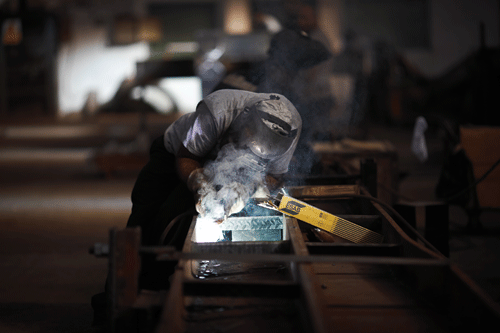
To Lebanon’s older generation, Carosserie Abillama is a household name, with ‘Abillama’ stenciled on the back of nearly every truck, tipper, tanker or ambulance in the country. The company, which has been around since 1933, is still at the forefront of trailer manufacturing and other automotive add-ons, although its name does not stand out as much as it used to amid the surge in vehicles and trucks on Lebanese roads over the past few decades.

Lebanon is also no longer the company’s major sales market, selling to 27 countries and approved for its high international standards by leading European companies Scania, MAN, Renault and Volvo. Abillama has even built trailers for Formula 3 racing cars, “which is at a very high level as it’s so image orientated,” said general manager Daniel Abboud.

Last year, however, Lebanon was a significant market, at 50 percent of sales, then dropping to 15 percent in 2012. “In terms of sales, Lebanon has not dropped that much, but exports have risen,” said  Abboud. “This year our biggest market is West Africa, at 45 percent, followed by the Gulf at 25 percent and institutional buyers 15 percent.”

The surge in exports to West Africa was a deliberate strategy by Abillama to anticipate a potential drop in sales due to the crisis in Syria and its spillover to the Lebanese economy. Abboud put a dedicated sales team on the West African market, and “it worked.”

“I think we’re going to have a good year and next year even better. We have a nice order book,” he said, projecting annual revenues at $16.5 million, up from $14.5 million in 2011.

Part of the company’s success over the past 80 years has stemmed from predicting downturns and keeping sales diversified. “For a while, 90 percent of our market was Iraq before the Americans came [in 2003],” said Abboud. “We saw the dangers so stopped taking orders. It was a good approach, as if we’d  stayed we’d have been in bad shape.”

A further key to success is Abillama’s research and development, and bringing out new products to stay ahead of the competition, such as a new cement mixer developed with an American company for whom Abillama manufactures to order, primarily for the Saudi Arabian market. “There is a lot more research and development in Lebanon than elsewhere in the region. In Saudi Arabia, Syria, the Emirates, they just copy others. The ‘Abillama tipper’ has been a generic term in Saudi Arabia for the past 40 years,” said Abboud.

In terms of competition, in West Africa Abillama vies for business with European firms, while in the Middle East, Iraq in particular, the company is facing stiffer competition from Turkey. “High quality Turkish producers were focusing on the European market, but they have lost it due to the economic downturn there so are turning to other markets where quality is important,” said Abboud.


Universal Metal Products

While Turkey poses a competitive threat to Abillama, aluminum tube manufacturer Universal Metal Products (UMP) sees the closure of Syria as a market and transport route for Turkish products to much of the Middle East as a boon for the company. “We are picking up slack not because of Syria so much, but due to Turkish suppliers being out of the market. They are now being restricted due to logistics and political reasons, and that trade link has been broken,” said general manager Nizar Raad.

UMP has experienced a major up-tick in sales to Saudi Arabia this year for the collapsible aluminum tubes it manufactures for the cosmetic and pharmaceutical industries. The situation in Syria, however, is causing logistical problems and heightened transport costs, deriving from export for which overland transport is the most cost effective method.

“We’ve made contingency plans for sea as there is the possibility of Syria blocking the route to Jordan,” said Raad. “We got the cost by sea freight, to Jeddah, and that is okay but the problem is the delays in offloading. Then the goods have to be driven to Riyadh, the main pharmaceutical hub. These time factors and delays are a problem.”

UMP’s exports are not totally dependent on the Middle East though. “We do export indirectly to Europe and the United States, so the lower euro is helping. We also export to Pakistan for special clients,” said Raad. He expects business to be similar to last year, neither growing nor contracting.

Resource Group Holding

Resource Group Holding – soon to be called just RGH – are an investment group that manages a diversified portfolio of businesses in the Middle East, West Africa and Asia. The company expects to have similar revenues this year as 2011, at over $100 million. But this is not down to less business in the Middle East and Africa, its core markets, or any loss in trade to Syria. Indeed, RGH’s telecommunications infrastructure arm Serta was granted permission by the United States Office of Foreign Assets Control (OFAC), which oversees sanctions, to sell equipment sourced from the US to Syria this year.

Revenues are expected to hover around the $100 million mark because the group is going through a period of consolidation as well as significant investment, with Chief Operating Officer Dany Eid expecting to see returns next year and for RGH’s revenues over the next five years to grow by more than 100 percent to exceed $200 million.

In Lebanon, RGH is expanding its 4,000 square meter Inkript facility, which handles high-security printing, from checkbooks to lottery tickets, electoral voting cards and bonds, to bank cards and electronic-passports, by a further 16,000 square meters, financed through a subsidized loan from the central bank and the Investment Development Authority of Lebanon. The expanded facility is slated to open by end 2013, and will create further employment, adding to the current 500 working at the plant in South Beirut. Elsewhere, RGH has 200 employees in lottery business Intersektion’s brand Afrijeux in Chad, and 300 other employees in Lebanon and abroad.

In further expansion, RGH bought a factory in Saudi Arabia last year to make mobile phone SIM cards and scratch cards. “We bought the facility to cater to the sizable Saudi market and have proximity to our customer base,” said Eid. “The plant is still in the restructuring phase, so we expect this investment to yield results as of next year.” The group is also involved in the smart phone gaming business through investing in a startup called Game Cooks, which co-produced the hit game Birdy Nam Nam. “With the Arab world as the primary target, games like Run for Peace and Déjà Vu have witnessed over 1 million downloads so far in less than a year,” said Eid.

Eid sees Lebanon’s strength as being able to not only manufacture goods at a high quality, but also to combine development with value-added and follow up solutions. “The future is in value-added and solutions. At a group level, our products are already highly technical, such as printing, and through products that provide solutions, like software for SIM cards. What makes our products hard to compete with is that they are relatively unique, as clients for printing, for instance, are mainly governments and banking sectors, and competition at that level is lower.”


Vresso

For Vresso, a manufacturer of customized stainless steel kitchens and exclusive distributor for 50 food service equipment and laundry brands, the dampened economic climate in the Middle East has slowed sales this year, most evident in Syria with hotel and tourism-related projects on hold. But with exports accounting for 60 to 65 percent of business and selling to over 30 countries, Vresso is weathering an economic downturn in one area and focusing on others. “We are optimistic about the future, especially emerging markets opening up, but I won’t say where because our competitors would be on a plane tomorrow,” said Carl Sabounjian, Sales and Marketing manager at Vresso.

Sales have been surprisingly good for the company, even for stainless steel kitchen units that have a price tag anywhere from $10,000 to more than $200,000. To bolster sales of such expensive items, Vresso has been offering more credit facilities. The tactic has worked. “Business has been very good, quite great in fact, especially for restaurants, super markets and coffee shops, as well as with private villas and wine cellars,” said Sabounjian.

Vresso has 120 employees within the group, and 40 employed in manufacturing stainless steel cabinets, tops and refrigeration units. Steel sheets are bought from local importers, then cut, bent and welded at Vresso facilities, with products manufactured from scratch to customer specifications.

“Next year a lot of new models are coming out, and a lot of foreign franchises — especially internationally renowned restaurants — are coming to Lebanon so we see a good market ahead,” said Sabounjian, forecasting that once the conflict in Syria is over there will be significant business opportunities.

October 1, 2012 0 comments
0 FacebookTwitterPinterestEmail
Economics & PolicyIndustry

Exports in mayhem

by Paul Cochrane October 1, 2012
written by Paul Cochrane

Syrian industry has been seriously hit by the ongoing conflict, suffering from a lack of raw materials, workers, energy and capital amid heightened risk. Multinational companies such as Proctor & Gamble that sold fast-moving consumer goods exited the Syrian market last November when European Union sanctions went into effect.

Turkey has not filled any supply gap, with exports from Turkey into Syria dropping from $2.3 billion in 2011 to just $302 million in the first five months of this year. However, exports from Lebanon to Syria have risen by 18 percent to date on 2011, to $126 million, while for the first time in years Syrian products headed the other way have fallen, by 8 percent to $142 million, according to Lebanese Customs data. Are Lebanese industries stepping up to fill an apparent supply and demand gap?

The short answer is: not really. Firstly, demand for non-essential items in Syria has plummeted as prices have risen, people’s finances have been squeezed, and stores are infrequently open, if at all. Take for example the sales of Lebanese cosmetics firm Ch. Sarraf & Co., part of the Malia Group, in Syria. When the group started a distribution company there in 2008, sales quickly reached the same volumes it had taken 10 years to achieve in Lebanon. It was a good market. But since the uprising began in March, 2011, business has dropped.

“We are facing export difficulties so a few months ago we put aside stock as a preemptive measure, but demand [for cosmetics] is about half of what it used to be as purchasing power is down,” said the company’s general manager Joanne Chehab. “People are only buying products of first necessity, although shampoo is still one.”

A second factor is that demand for more life-sustaining essentials has also not risen. According to a report in As Safir newspaper, the Lebanese Farmers Association said that exports to Syria have dropped by two-thirds on last year. Demand has equally not risen for items more suitable for life under a siege than fresh fruit and veggies — tinned and packaged foods. According to the head of a leading Lebanese agro-industry company who asked to remain anonymous, there has been no marked demand by Syrian companies or traders.

One necessary product that is facing production shortages in Syria is pharmaceuticals, yet while there may be demand, potential increased exports from Lebanese pharmaceutical companies are complicated by the borders still being under the regulation of the Syrian state.

“Until now, exports from Lebanese pharmaceutical companies to Syria are subject to regulations by the Syrian authorities; that is why it’s not as easy as one would think [to export],” said Neemat Frem, president of the Association of Lebanese Industrialists. “But in areas that are unregulated, that is completely different, and we might see more in those areas.”


Cash flow curbs

While generator manufacturer Saccal Industries has witnessed a 100 percent growth in demand for generator sets due to power shortages, Syria is not as lucrative a market as one would expect. “We are selling more but there is the problem of cash flow. People are afraid of spending money in the current environment,” said the company’s general manager Asaad Saccal.

The United States sanctions banning the use of Visa and MasterCard, as well as transactions in dollars, and the considerable depreciation of the Syrian pound are both major contributing factors to the squeeze. “We are selling for cash not credit as the currency is fluctuating a lot,” said Chehab. “We sell in Syrian pounds and then transfer on the spot.”

Compounding the situation is problematic  distribution, which has become more difficult. Traders are looking for higher margins to cover inflated insurance premiums and container hires.

A little silver lining

So what has caused the up-tick in exports to Syria reported this year? Data is not broken down by category, but one reason for the increase is a 25 percent spike in exports of machinery, spare parts and engines due to international sanctions, according to economist Kamal Hamdan.

Another factor is fuel. Subsidized Syrian fuel used to be smuggled into Lebanon; but as the conflict dragged on and shortages emerged in Syria, this flow has reversed, causing Lebanese imports of fuel from abroad to jump, both to make up for lost supply to the domestic market and to feed the export and smuggling markets in Syria. Lebanon’s imports of oil and mineral fuels have surged 89 percent year-on-year, to $3.2 billion. Non-hydrocarbon imports on the other hand have grown just 1.8 percent, according to Byblos Bank data.

In addition to fuel exporters and smugglers taking advantage of the conflict, some other companies are also directly and indirectly benefiting from industry shutdowns in Syria. Aluminum tube manufacturer Universal Metal Products (UMP) has noted an increase in orders from Saudi Arabia, which the company does not attribute to the closure of three Syrian manufacturers in the same field — they did not have the ISO specification required in the kingdom’s market — but rather the drop in Turkish trade with Syria.

“Due to the broken trade links with Turkey we are picking up slack from Turkish business they have lost,” said UMP’s general manager Nizar Raad. On the labor side, for manufacturers such as Carosserie Abillama, the closure of Syrian manufacturers provided the Lebanese firm with skilled workers that had been laid off.

All in all, there is little silver lining to the Syrian crisis for Lebanese industry, with the situation causing more damage to the sector than any potential sales up-ticks due to shortages over the border.

Where industry may well experience an upside in the near future is if goods that have been hoarded away start running out. Otherwise, it will not be until the conflict is over, when the rebuilding effort in Syria creates a massive demand for materials and products.

October 1, 2012 0 comments
0 FacebookTwitterPinterestEmail
Economics & PolicyIndustry

Round-about routes

by Paul Cochrane October 1, 2012
written by Paul Cochrane

If the Syrian crisis escalates further and the border with Syria closes, Lebanon would be cut off from the rest of the region with the only way in and out being by sea or air. So far the border has remained open, but the Syrian conflict has already caused a significant drop in cross-border trade and a rise in maritime shipping.

Last year, an average of 450 trucks crossed the border daily with goods destined for Syria, Turkey, Jordan, Iraq and the Gulf countries. But with the security situation deteriorating, exporters are increasingly reluctant to transport cargo by land. Insurance is up 3.5 percent to cover the risk, and companies are being held financially responsible for hired trailers. The deposit on a 20-foot  (6.1 meter) container is $4,500 to $5,000, and $7,500 for a 40-foot (12.2 meter) container. “It is a cash deposit for the empty container to cover all issues, from accidents to kidnapping,” said Fadi Haddad, general manager of shipping and logistics firm Masafat International.

In addition, there are increasingly delays at border crossings onwards from Syria, driver shortages and visa issues for Syrian drivers to enter Saudi Arabia (see box page 56). “We are facing a lot of obstacles: risk, the shortage of drivers, visa delays, and visa costs, and all this is adding up. There are also more checks at Masnaa [the Lebanon-Syrian crossing] and at Deraa [between Syria and Jordan], which holds up convoys for three to five days,” said Nizar Raad, managing director of Universal Metal Products. “So far Deraa has remained open but sometimes we wait a week or two for a trailer to go through.”

Higher oil prices have also added to costs and the overall price of transporting a trailer to the Gulf has risen by 15 percent on last year. All of this has led to an approximately 50 percent drop in the number of trucks crossing from Lebanon into Syria, to between 200 to 250 a day, according to Gezairi Transport.

Paying for Safety

With land transport having accounted for an estimated 70 percent of cargo to Iraq and the Gulf, unsurprisingly exports to Iraq have dropped, down 39 percent in the first quarter on the same period last year, and by 15 percent overall in the first half of the year. “Before the Syrian conflict, Beirut was a good transit point for cargo for Iraq, now there are a lot of doubts,” said Haddad. “Traders are asking what will happen to their cargo if it gets stuck due to a crisis during transportation in Lebanon or elsewhere.”

The re-export trade has certainly been hit, at $193 million worth of goods moved in the first half of the year compared to $379 million for the same period in 2011. Meanwhile, exports to Turkey have dropped 40 percent, despite the launch in June of a privately operated roll-on, roll-off (ro-ro) vessel between Tripoli and Mersin to circumvent Syria. Sea transport has become an increasingly viable option for traders, especially if the cargo is expensive. “We’ve had requests from clients to study sea routes, as by land it is risky. But shipping costs are higher [so] trucks are still going,” said Haddad. 

Indeed, land transport is still the preferred option as it is more straightforward for a single trailer to go door-to-door than have to transport cargo to the Beirut port, load it into a container, unload it at the receiving port, and then re-load it into a trailer. It is also more time-consuming and costly.

While a trailer would take roughly a week — without any unusual border delays — to get to the Gulf, by ship it takes on average 20 days. “[A] one week delay at sea is very common, and you can’t claim for a delay,” said Haddad. Shipping costs to the Gulf are also around 40 percent higher than trucking.

Nevertheless, with land transportation increasingly fraught and time consuming, companies are clearly willing to pay the premium to make sure cargo arrives in one piece. According to statistics released by the Port of Beirut, export shipping operations by the top eight freight forwarders reached 26,305 TEUs (Twenty-foot Equivalent Unit) in the first half of the year, up 18 percent from 22,293 TEUs in the same period of 2011.

October 1, 2012 0 comments
0 FacebookTwitterPinterestEmail
Economics & PolicyIndustry

Keeping alight the spark

by Paul Cochrane October 1, 2012
written by Paul Cochrane

Lebanese industry has been dealt many a bad card in its recent history. Yet when the sector went through a five-year boom, with exports nearly doubling in value from $2.17 billion in 2006 to $4.059 billion in 2010, it seemed as if industry had finally found some playable hands. The sector could raise the stakes, throw out an ace or two, and show the banking, real estate and tourism sectors that industry was an equally important player at the country’s economic big-boys’ table.

But the winning streak was not to last. The global financial crisis — which the sector had managed to bypass for a while — political uprisings throughout the region, and sluggish domestic economic growth all started to affect business in 2011, the second half in particular. In the words of the president of the Association of Lebanese Industrialists (ALI), Neemat Frem, “It was not a slowdown in growth but a complete stop”.

Although 2011 marked a new record in industrial exports from 2010 at $4.064 billion, growth was minimal and hardly comparable to the $729 million jump in exports between 2009 and 2010.

Furthermore, despite export figures being used as a benchmark to gauge the sector’s general health, they do not give the overall picture, given that exports account for only 40 percent of sales in domestically manufactured goods with the remainder destined for the local market.

The glass half empty?

The mood of industrialists certainly reflected the downturn. In the central bank’s quarterly business survey, it showed that by the fourth quarter industrial production had retreated, with a balance of opinion (the proportion of surveyed managers who consider that there was an improvement in a particular indicator and the proportion of those who reported a decline in the same indicator) standing at -11, compared to +18 at the same time in 2010 and zero during the third quarter of 2011. The balance of opinion for overall demand for industrial goods was no brighter, at -14 in the fourth quarter of 2011 compared to +4 in the same quarter of 2010.

To the sector’s relief, 2012 did not start out too shabbily, in exports at least, with first quarter results up 9 percent on 2011 at $808.1 million, according to Ministry of Industry figures. Yet the downbeat sentiment that had prevailed at the end of last year lingered, with the same debilitating factors deteriorating moods further: higher oil prices, more frequent power shortages and the situation in Syria on a slippery downwards slope. By the end of July exports were down 9.5 percent to $1.7 billion, when compared with the first  seven months in 2011.


Consumer confidence was also in the gutter. A survey conducted in March and April 2012 by United States-based opinion polling think tank Pew Research Center indicated that 53 percent of Lebanese considered that the economic situation in Lebanon was very bad and 35 percent thought it was bad, compared to 12 percent who believed it was good.

“Three channels were hit the most: One: the flow of tourists was down, which lowered demand for industrial and agricultural goods; Two: exports through Syria were down, and Three: the loss of foreign investment into Lebanon, including industry, because of the security and political situation and heightened risk,” said economist Mazen Soueid.

Indeed, tourism figures were down 8 percent in the first half of the year. Exports that had gone overland via Syria were down, notably plunging by 40 percent to Turkey and by 15 percent to Iraq. Indicative of reduced investment in industry, imports of machinery were down 12 percent.

While Lebanese industry has long struggled to be price-competitive within the region and other emerging economies, from wages to operational overheads, the sector had another cost to factor in this year when the government raised the minimum wage.

“The increase in salaries has affected us. Our products are customized and cannot be mechanized so we rely on labor. Our prices are up 6 percent, so it’s significant,” said Daniel Abboud, general manager of Carosserie Abillama, which has a staff of 300 to manufacture trailers and other automotive add-ons that are exported to some 27 countries.

“The wage increase from $333 (500,000 LL) to $450 (675,000 LL) is a big jump if you have 150 women working for you. That is the basic minimum,” said Nizar Raad, managing director of Universal Metal Products (UMP), a leading manufacturer of collapsible aluminum tubes for pharmaceutical and cosmetic companies. “It is a big increase in costs for us and we can’t pass that on to customers easily as competition is worldwide, from Pakistan to India and China. And they don’t have the fuel costs we have. We are paying $0.15 a kilowatt while others are paying just $0.04.”

The country’s chronic power shortages, with Électricité du Liban (EDL) producing only 1,500 megawatts (MW) of electricity and peak demand at more than 2,500 MW, has long been an existential problem for industry. This year the power outages were even more frequent than in the past and were further compounded by oil prices averaging more than $100 a barrel, which has bitten into industry’s margins as well as lowered consumer purchasing power.


Some industrialists want to solve the crisis by developing their own power plants, with excess sold to the grid. They have submitted a proposal to the government but it has been stymied by EDL holding the monopoly on energy sales.

Logistics costs have also risen, partly due to oil prices but primarily because of the conflict in Syria affecting overland trade, with the number of trailers crossing the border down by around half, from 450 a day last year to 200 to 250 a day, according to Gezairi Transport. Trucking costs are up by around 15 percent to the Gulf due to oil prices and insurance premiums have increased to cover the risk of transporting through Syria. Such factors have prompted a rise in sea freight, but add further costs to companies, with sea cargo to the Gulf around 40 percent more expensive than by land, as well as taking an average of two weeks longer to get to the end destination.

Regional issues are also playing their part, with Saudi Arabia no longer allowing Syrian drivers multiple entry visas — Syrians account for around 80 percent of the truckers of Lebanese products — presumably for political reasons, which adds on more time for visa applications, while the kingdom is also squeezing the Lebanese electricity generator sector.

All in all, industry is facing many obstacles. “I think Lebanese industry is going through its worst period since the end of the Civil War,” said Soueid. “We have never had this agglomeration of domestic, regional and global factors affecting supply and demand. If this continues, and unfortunately the indicators point in that direction, we will see closures of industries in Lebanon.”

The glass half full?

While the economic situation is certainly not rosy, with overall growth forecast at 1.2 percent this year by the Washington-based Institute of International Finance, it is not all doom and gloom. Taking the ‘glass is half full’ approach, ALI’s Frem is confident that the sector will prevail, stating that while industrial machinery imports have dropped, they could have dropped more — especially after significant investment in recent years — and this year he forecasts that up to $200 million of newly purchased machinery will go “straight to the expansion of the sector”. Since being interviewed in early September, Frem’s outlook has been somewhat confirmed, with statistics released by the Ministry of Industry showing that industrial imports at the end of July were up 22 percent, to $172.2 million, on the same period in 2011.

Industries not overly reliant on the local market are stoic about the situation. “We have to live up to the challenge, otherwise we shouldn’t be here,” said Raad of UMC, which exports 85 percent of its products. “We will maintain the same figures as last year; not more or less growth.”


“Business is good, despite the situation,” said Asaad Saccal, general manager of generator manufacturer Saccal Industries. “The reason is 85 percent of our turnover is export. Lebanon is good business of course, but small in terms of quantities; we need bigger markets to sell to.”

To Abillama’s Abboud, companies should have anticipated the regional and domestic situation and adapted their business model accordingly rather than whining about the obstacles in place. “This is a problem I see many people complaining about, but they don’t look ahead, taking the punches while sitting down — move!” said Abboud. “The key is not to be static and wait, but to be proactive. As soon as things started to happen in Syria and we saw that the economy might slow down here, that the road to the Gulf might be difficult and we would have to focus on sea export, we put all [our] sales people on West Africa to be dynamic, and it worked,” he added, with Abillama having a “nice order book” for the year ahead.

Indeed, as the saying goes, one man’s loss is another man’s gain. Some exporters have benefited from the current regional crisis by picking up orders that Syrian and Turkish manufacturers cannot fill.

The economic sanctions imposed on Syria by the United States and the European Union (EU) have also been a boost for certain Lebanese companies, with imports from Syria down 8 percent in the first half of the year, and exports to Syria up 18 percent, according to global information company IHS. It would appear, though, that the negative impact on some Lebanese companies in losing the Syrian market and that export route outweigh the opportunities for their industries to fill the gap left by the collapse of Syrian industry.

Government support?

The government is not helping the sector through these trying times, with the Minister of Industry, Vrej Sbounjian — a Utopian at heart — stating there is no cause for concern.

“We don’t have any complaints concerning the economy or industry… We need to be more realistic and enjoy life a little bit. We don’t have to make money every year,” he told Executive.

The ministry itself could certainly do with more money, with a budget of just $5 million, just more than half that of the Ministry of Youth and Sports, at $9.7 million, and a third of the tourism ministry’s $14.6 million.

“The ministry’s share in the budget seems way too low to me,” said Abillama’s Abboud. “There should be more than just enough to pay salaries.”

“The ministry should be able to afford promotion programs and to fund delegations from the ministry to visit seminars and industrial meetings with specialized bodies in the Arab League, the EU  or others,” he added.

There have also been no steps made to set up dedicated industrial zones despite government pledges over the years to do so. As Frem observed, “Forget about it, there is a complete paralysis on the economic zones.” Industry, as in the past, is being left to its own devices to stay alive, not even getting governmental contracts to bolster domestic sales.

However, the Ministry of Industry has put its, albeit limited, weight behind a joint scheme launched in September with the ALI to promote Lebanese products under the slogan “Your industry your identity: Buy Lebanese.”

While a promotional campaign may help, industry needs more than just marketing, it needs solid support from the government and for the ministry to tout the sector at international exhibitions, just as other countries do. A bigger industrial sector would, after all, help to lower unemployment and boost the overall economy.

“It is not that Lebanon cannot be industrial, but that it should be seen as a sustainable sector,” said Abboud. “It is great to have an ad agency here, but they could leave tomorrow; industries can’t get up and leave like that. Industry should be a priority and not be seen by the government as a cash cow. Industry is a social contributor as well as a fiscal one. In the past, industry was looked at as a polluting sector or as exploiting the masses — this is not the case anymore.”

To economist Soueid, the government needs to implement any of the economic plans drawn up over the years, whether by external actors such as the World Bank, or by ministries and economists. “Industries in Lebanon don’t need a ministry, they need an economic policy that supports industry and reforms in power, infrastructure and telecoms,” he said.

Given the rough ride this year, Lebanese industrialists could use some better cards to play.

October 1, 2012 0 comments
0 FacebookTwitterPinterestEmail
Finance

Q&A: Mohammad Choucair

by Maya Sioufi October 1, 2012
written by Maya Sioufi

Kidnappings, blocked roads, robbed banks and travel warnings are among Lebanon’s latest upheavals. The country’s economy is feeling the pressure with stores and restaurants closing down, hotel occupancy rates plummeting and trading activity dwindling. The private sector is sounding the alarm. For a better understanding of the severity of the economic crisis, Executive sat with Mohammad Choucair, president of the Chamber of Commerce, Industry and Agriculture (CCIA) of Beirut and Mount Lebanon.

You have said that Lebanon is witnessing its worst economic crisis. What is leading you to such a gloomy observation?

Lots of companies are closing down; just in Solidere, 254 stores shut down since the beginning of 2011, so imagine how many closed in Lebanon over this period. We are witnessing crimes for money with people killing each other to steal 100,000LL or 200,000LL. That’s how bad the situation is. Lebanon has never seen six banks get robbed over a period of six months, neither has its minister of labor ever received requests for mass redundancies. The state can no longer enforce law and order. We are back to the language of threats and kidnappings. Now Qatar is threatening us and saying that if any Qatari gets kidnapped, they will kick out their Lebanese residents and there are more than 55,000 in Qatar. In the Gulf, there are 400,000 to 500,000 Lebanese workers. If Lebanon is still standing, it’s thanks to them. If they lose their jobs, we will eat each other.

Are there more companies at risk of bankruptcy going forward?

There are hundreds of companies in danger of bankruptcy and all sectors are being hit. The labor minister is telling me there are mass redundancies and this is what I was afraid of when the minimum wage increase was implemented. Trading activity in Beirut is down 50 to 70 percent so far this year over last year and outside Beirut, it is down from 70 to 85 percent. How [long] will companies last? I think not too long. I hope no company will close by the end of the year but if I look at bounced checks, at the 10,000 containers sitting in the ports of Beirut with owners unable to pay the costs of shipping, the taxes or the customs, I am concerned.

How much did the minimum wage increase contribute to heightened economic pressure faced by the private sector?

The minimum wage increase added 15 percent to the costs of the private sector. It was a huge mistake and the private sector takes responsibility. We couldn’t handle the political faction on this issue. We should have done strikes, we should have said no. Today we are all paying for it, the private sector, the workers and the government. The government can’t pay for the raise for employees of the public sector and if it does pay, there is a danger to the Lebanese lira.

The National Social Security Fund (NSSF) is calling for the salary ceiling of contributions to the healthcare fund to be raised from LL1.5 million to LL2.5 million. How will this be felt in the private sector?

The private sector can’t support anything anymore. When we raised salaries [as a result of the minimum wage increase], it brought in additional revenues of $250 million for the NSSF. When they wanted to raise the ceiling, we objected. The economic associations have now decided to raise the ceiling to LL2 million for two reasons: one is that this is a human issue and I won’t tolerate citizens being humiliated when receiving treatment and second of all, we can’t support more social troubles in Lebanon. With a LL2 million ceiling, the NSSF will no longer have extra hospital costs and it will be left with an additional $11 million.

You have recently called for opening the Qlaiaat airport. How essential is this in supporting the Lebanese economy?

From an economic point of view, it is essential for the north. The main airport will always be the Rafik Hariri International Airport in Beirut. We don’t want to eliminate it but we need the Qlaiaat airport for two goals: so that Lebanon becomes the regional hub of shipping and for the low cost airlines.

Wouldn’t the airport need significant investment to be ready to operate?

It doesn’t need further investments. Airbus 330 and Boeing 777 can land there. The land size is 5.5 million square meters (550 hectares) and it has a runway of 3.6 kilometers that can be increased by another 400 meters. The other airports have a size of three million square meters (300 hectares) and can only cater to small planes. I am preparing a letter on behalf of the CCIA asking the government to allow us to run this airport. The majority of airports in Europe are run by the private sector and we hope to do that too.

Are you willing to call for a strike if the economic situation does not improve?

Who are we going to strike against? Government officials? They are not here. Today, my priority is to have security as without it, we can’t have economic growth. I’m asking for the state to enforce law and order. I congratulated parliamentary speaker Nabih Berri on his decision [on August 22] to “cut the hands” of every person who cuts the road to the airport; if only they took this decision three months ago and broke the hands, legs and head of every person who cut any road and not just the one leading to the airport.

What do you want from government officials?

I have just one wish and it is for the state to enforce law and order without which we can’t bring back investors. There should be justice on the kidnappings. If every person who needs money goes off and kidnaps someone then half of the population would be kidnapped. This is a problem; it’s not a joke. I hope that the government officials will save what is left for the benefits of the Lebanese citizens. We are approaching elections and maybe some politicians can only focus on having an extra deputy here and there but you can’t enjoy ruling when the people are hungry and broke. The more people are hungry, the less they will let you rule. I am not afraid when a citizen demonstrates but has a job — I am afraid when he takes to the streets and he is unemployed. 

Is there light at the end of the tunnel?

I wish I had a positive message for you. The kidnappings brought us back 20 to 30 years and it reminded people of the war. We have a responsibility as an economic association to bring back confidence for the foreign investor, but he will think a lot before coming back. From 2005 to 2010, foreign investments reached $4 billion to $5 billion a year and last year it was zero. This year, it will fall into negative territory as some projects are being withdrawn. It will take at least two to three years to bring back confidence. We need to focus on bringing back the Lebanese expat first. Despite all this we are staying in Lebanon. Hopefully it’s a phase that we will overcome in the quickest way possible; Lebanon will be on its feet again soon and we will see smiles on people’s faces.

October 1, 2012 0 comments
0 FacebookTwitterPinterestEmail
  • 1
  • …
  • 311
  • 312
  • 313
  • 314
  • 315
  • …
  • 696

Latest Cover

About us

Since its first edition emerged on the newsstands in 1999, Executive Magazine has been dedicated to providing its readers with the most up-to-date local and regional business news. Executive is a monthly business magazine that offers readers in-depth analyses on the Lebanese world of commerce, covering all the major sectors – from banking, finance, and insurance to technology, tourism, hospitality, media, and retail.

  • Donate
  • Our Purpose
  • Contact Us

Sign up for our newsletter

    • Facebook
    • Twitter
    • Instagram
    • Linkedin
    • Youtube
    Executive Magazine
    • ISSUES
      • Current Issue
      • Past issues
    • BUSINESS
    • ECONOMICS & POLICY
    • OPINION
    • SPECIAL REPORTS
    • EXECUTIVE TALKS
    • MOVEMENTS
      • Change the image
      • Cannes lions
      • Transparency & accountability
      • ECONOMIC ROADMAP
      • Say No to Corruption
      • The Lebanon media development initiative
      • LPSN Policy Asks
      • Advocating the preservation of deposits
    • JOIN US
      • Join our movement
      • Attend our events
      • Receive updates
      • Connect with us
    • DONATE