• Donate
  • Our Purpose
  • Contact Us
Executive Magazine
  • ISSUES
    • Current Issue
    • Past issues
  • BUSINESS
  • ECONOMICS & POLICY
  • OPINION
  • SPECIAL REPORTS
  • EXECUTIVE TALKS
  • MOVEMENTS
    • Change the image
    • Cannes lions
    • Transparency & accountability
    • ECONOMIC ROADMAP
    • Say No to Corruption
    • The Lebanon media development initiative
    • LPSN Policy Asks
    • Advocating the preservation of deposits
  • JOIN US
    • Join our movement
    • Attend our events
    • Receive updates
    • Connect with us
  • DONATE
Finance

Q&A: Mohammad Choucair

by Maya Sioufi October 1, 2012
written by Maya Sioufi

Kidnappings, blocked roads, robbed banks and travel warnings are among Lebanon’s latest upheavals. The country’s economy is feeling the pressure with stores and restaurants closing down, hotel occupancy rates plummeting and trading activity dwindling. The private sector is sounding the alarm. For a better understanding of the severity of the economic crisis, Executive sat with Mohammad Choucair, president of the Chamber of Commerce, Industry and Agriculture (CCIA) of Beirut and Mount Lebanon.

You have said that Lebanon is witnessing its worst economic crisis. What is leading you to such a gloomy observation?

Lots of companies are closing down; just in Solidere, 254 stores shut down since the beginning of 2011, so imagine how many closed in Lebanon over this period. We are witnessing crimes for money with people killing each other to steal 100,000LL or 200,000LL. That’s how bad the situation is. Lebanon has never seen six banks get robbed over a period of six months, neither has its minister of labor ever received requests for mass redundancies. The state can no longer enforce law and order. We are back to the language of threats and kidnappings. Now Qatar is threatening us and saying that if any Qatari gets kidnapped, they will kick out their Lebanese residents and there are more than 55,000 in Qatar. In the Gulf, there are 400,000 to 500,000 Lebanese workers. If Lebanon is still standing, it’s thanks to them. If they lose their jobs, we will eat each other.

Are there more companies at risk of bankruptcy going forward?

There are hundreds of companies in danger of bankruptcy and all sectors are being hit. The labor minister is telling me there are mass redundancies and this is what I was afraid of when the minimum wage increase was implemented. Trading activity in Beirut is down 50 to 70 percent so far this year over last year and outside Beirut, it is down from 70 to 85 percent. How [long] will companies last? I think not too long. I hope no company will close by the end of the year but if I look at bounced checks, at the 10,000 containers sitting in the ports of Beirut with owners unable to pay the costs of shipping, the taxes or the customs, I am concerned.

How much did the minimum wage increase contribute to heightened economic pressure faced by the private sector?

The minimum wage increase added 15 percent to the costs of the private sector. It was a huge mistake and the private sector takes responsibility. We couldn’t handle the political faction on this issue. We should have done strikes, we should have said no. Today we are all paying for it, the private sector, the workers and the government. The government can’t pay for the raise for employees of the public sector and if it does pay, there is a danger to the Lebanese lira.

The National Social Security Fund (NSSF) is calling for the salary ceiling of contributions to the healthcare fund to be raised from LL1.5 million to LL2.5 million. How will this be felt in the private sector?

The private sector can’t support anything anymore. When we raised salaries [as a result of the minimum wage increase], it brought in additional revenues of $250 million for the NSSF. When they wanted to raise the ceiling, we objected. The economic associations have now decided to raise the ceiling to LL2 million for two reasons: one is that this is a human issue and I won’t tolerate citizens being humiliated when receiving treatment and second of all, we can’t support more social troubles in Lebanon. With a LL2 million ceiling, the NSSF will no longer have extra hospital costs and it will be left with an additional $11 million.

You have recently called for opening the Qlaiaat airport. How essential is this in supporting the Lebanese economy?

From an economic point of view, it is essential for the north. The main airport will always be the Rafik Hariri International Airport in Beirut. We don’t want to eliminate it but we need the Qlaiaat airport for two goals: so that Lebanon becomes the regional hub of shipping and for the low cost airlines.

Wouldn’t the airport need significant investment to be ready to operate?

It doesn’t need further investments. Airbus 330 and Boeing 777 can land there. The land size is 5.5 million square meters (550 hectares) and it has a runway of 3.6 kilometers that can be increased by another 400 meters. The other airports have a size of three million square meters (300 hectares) and can only cater to small planes. I am preparing a letter on behalf of the CCIA asking the government to allow us to run this airport. The majority of airports in Europe are run by the private sector and we hope to do that too.

Are you willing to call for a strike if the economic situation does not improve?

Who are we going to strike against? Government officials? They are not here. Today, my priority is to have security as without it, we can’t have economic growth. I’m asking for the state to enforce law and order. I congratulated parliamentary speaker Nabih Berri on his decision [on August 22] to “cut the hands” of every person who cuts the road to the airport; if only they took this decision three months ago and broke the hands, legs and head of every person who cut any road and not just the one leading to the airport.

What do you want from government officials?

I have just one wish and it is for the state to enforce law and order without which we can’t bring back investors. There should be justice on the kidnappings. If every person who needs money goes off and kidnaps someone then half of the population would be kidnapped. This is a problem; it’s not a joke. I hope that the government officials will save what is left for the benefits of the Lebanese citizens. We are approaching elections and maybe some politicians can only focus on having an extra deputy here and there but you can’t enjoy ruling when the people are hungry and broke. The more people are hungry, the less they will let you rule. I am not afraid when a citizen demonstrates but has a job — I am afraid when he takes to the streets and he is unemployed. 

Is there light at the end of the tunnel?

I wish I had a positive message for you. The kidnappings brought us back 20 to 30 years and it reminded people of the war. We have a responsibility as an economic association to bring back confidence for the foreign investor, but he will think a lot before coming back. From 2005 to 2010, foreign investments reached $4 billion to $5 billion a year and last year it was zero. This year, it will fall into negative territory as some projects are being withdrawn. It will take at least two to three years to bring back confidence. We need to focus on bringing back the Lebanese expat first. Despite all this we are staying in Lebanon. Hopefully it’s a phase that we will overcome in the quickest way possible; Lebanon will be on its feet again soon and we will see smiles on people’s faces.

October 1, 2012 0 comments
0 FacebookTwitterPinterestEmail
Comment

Girls for sale

by Moe Ali Nayel October 1, 2012
written by Moe Ali Nayel

"I’m sheltering 20 women,” said Um Mohammad. A veiled woman in her 50s, she had sought me out at the refugee relief center I was visiting in Tripoli and asked to have a quiet word. “These women are widows, sisters and daughters of martyrs; they are all refugees who recently fled from Homs.”

“My son went to the mosque yesterday before the maghrib (sunset) prayers and announced that we have 20 Syrian women… looking for protection,” said Um Mohammad. “He asked that any Muslim man who would like to protect their honor by marrying one should come to the mosque after the isha (evening) prayers.”

The incident she described was just one example of what has recently come to light as a disturbingly widespread phenomenon amongst the growing number of Syrians who have fled to neighboring countries: ‘protection marriages’. Certain online social networks have become deluged with Arab men announcing their desire to marry a girl from the Levant (i.e. Syria). This practice has been encouraged by several religious leaders, among them the firebrand Adnan Arour, a hardline Syrian sheikh in exile in Saudi Arabia who has issued fatwas, or religious edicts, endorsing protection marriages as a means to offer Syrian women refugees a better life. Indeed, for some Syrian refugee families who have been forced to trade all their worldly possessions for tents in the desert, it must seem like a chance for their daughters to escape the misery.

This has opened the door, however, for women and girls in these refugee camps to become the victims of sexual exploitation under the pretext of ‘support for the Syrian revolution’. It has become ever more common for what are ostensibly modest requests for marriage posted online to morph into bidding wars between men offering up money for Syrian brides. In a recent editorial, Abdelbari Atwan, the editor-in-chief of the pan-Arab newspaper Al Quds Al Arabi, wrote that elderly Arabs from the Gulf have reportedly taken Syrian refugee girls younger than 15 years old. “Marriage of minors in refugee camps is a type of rape that must be stopped immediately,” he went on to say. “Perpetrators must be brought to justice.”

On August 31 a “wakeup call” campaign dubbed Lajea’at la Sabaya (roughly translated as ‘refugee women, not women for pillage’) began both online and offline, an independent initiative by young Syrian women and men. The group’s stated goals include upholding the rights of Syrian women, both in refugee camps and in Syria, preventing Syrian women from becoming a commodity for sale, and encouraging Syrian businessmen to invest and create jobs in the refugee camps to help better living conditions. Syrian women who joined the uprising did so in an attempt to assert the dignity of all Syrians, says the group, and thus they should not be sold like items in a market under the guises of ‘marriage’ or ‘protection’. The Facebook page for Lajea’at la Sabaya reached 10,000 ‘likes’ in its first 10 days.

So while human rights advocates have begun raising the alarm, it’s worth noting that Syrian opposition groups have been almost uniformly silent regarding the sexual exploitation and wholesale trade of refugee women. The issue is not new, having grown as the number of Syrians fleeing the country has risen, and yet even now as it becomes a public scandal the leaders of the opposition remain mute. This leads one to wonder what sort of “free” Syria the opposition has in mind for the future when already today they ignore these abuses against the most vulnerable Syrians.

The millions that have risen up over the course of the Arab revolutions did so demanding equal rights and justice. Women throughout the Arab world were, and still are, on the front lines leading the struggle. The true fight for equality, however, cannot be limited to toppling the tyrants and dictators that led the region’s repressive regimes — it must also confront the Arab world’s ingrained misogynist attitudes, rampant sexual harassment of women and ultimately religious and social institutions that treat women as inferior to men and facilitate their subjugation.

Moe Ali Nayel is a freelance journalist based in Beirut

October 1, 2012 0 comments
0 FacebookTwitterPinterestEmail
Comment

Buy Lebanese, please

by Paul Cochrane October 1, 2012
written by Paul Cochrane

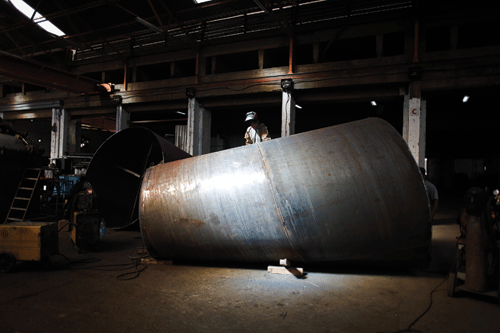
A new campaign was launched in September by the Ministry of Industry and the Association of Lebanese Industrialists (ALI) with the slogan “Your industry, your identity: Buy Lebanese.” It is aimed at giving the sector a boost in the current economic downturn, given that some 60 percent of the manufacturing industry’s sales are local.

It is a good move, but the sector could have done with greater recognition from the government of its contribution to gross domestic product (GDP), which has gone from 9 percent in 2009 to an estimated 19 percent today. Such a move could have included giving the ministry governing the sector a decent budget and pushing state agencies to actually buy Lebanese products.

The Ministry of Industry’s current budget is a measly $5.14 million, which is barely enough to pay for salaries yet alone have a decent marketing budget to promote Lebanese industry around the world. Indeed, ministerial employees have said that if they want to attend exhibitions abroad, they have to pay for flights out of their own pockets and then hope they get reimbursed.

Other countries have billion-dollar budgets to promote their industrial sectors globally, and set aside sizable allowances for trade fairs and expos, with dedicated stands to tout the nation’s wares. For instance Turkey’s Science, Industry and Technology Ministry has a budget of $1.2 billion, and the small island of Singapore, less than a 10th the size of Lebanon but with a similar population size, has a budget of $3.3 billion for the Ministry of Trade and Industry.

While these countries include commerce or trade in addition to industry, even if you combine the Lebanese Ministry of Economy and Trade’s $21 million budget with that of the industry ministry’s, it is still shockingly underfunded.

As an overall percentage of the $14.71 billion budget, the Ministry of Industry’s cut accounts for just 0.035 percent. The sector’s GDP contribution generates significant revenues for the government as well as being a major employer, accounting for an estimated 26 percent of the total 1.48 million Lebanese workforce, according to website Economy Watch. That works out to 370,250 jobs, meaning the ministry’s budget allocates just $13.5 per employee in the sector.

The Ministry of Agriculture has a budget of $59.3 million, while representing a quarter of the GDP contribution of industry, and the Ministry of Youth and Sports — that well known contributor to economic growth and prosperity — has a budget almost double that of industry, at $9.7 million. Tourism, an important economic sector, still contributes a third less to GDP than industry, but has triple the budget, at $14.6 million.

While there is the counter argument that some countries earmark billions for industry and are still not competitive, and others are competitive without much state assistance, it cannot be ignored that Lebanese industry is currently facing a lot of challenges. A higher budget for the industry ministry would no doubt help, but so would addressing other stumbling blocks, notably the endemic shortfalls in energy and infrastructure.

Where the government could show true support is by buying Lebanese. But according to industrialists, the government more often than not shuns Lebanese products for foreign brands, believing them better.

This has led to bizarre situations where the government has ordered products from France yet the good is actually made in Lebanon; the winner in this scenario is the middle man and the loser the Lebanese tax payer. One industrialist told how at a recent expo in Beirut, European companies placed orders for specialized products while the Lebanese government queried that same local company’s experience in the order application process — the deal later fell through.

Among the public there is also a certain snobbishness toward Lebanese products. “We export to 30 countries and the image of Lebanese industry is higher elsewhere than here,” said an industrialist. “A Lebanese would buy a Turkish made product over a Lebanese one, I don’t understand it.”

Whether the new “Buy Lebanese” scheme will work remains to be seen, but its effectiveness would certainly be bolstered if there was a bigger ministry budget for marketing, and the government itself began practicing what it preaches. 

Paul Cochrane is the Middle East correspondent for International News Services

October 1, 2012 0 comments
0 FacebookTwitterPinterestEmail
The Buzz

Morning briefing: 28 Sep 2012

by Executive Staff September 28, 2012
written by Executive Staff

Oman plans to boost its 2013 budget spending by 10 percent compared to this year's plan to fund new infrastructure projects, an official source familiar with the government's financial planning has told Arabian Business.

"A 10 percent hike in spending will take care of our growth to fund development projects such as airports, ports, roads, hospitals and in the energy sector," said the source, who declined to be identified.

The 2013 budget plan would be based on an oil price of US$85 per barrel and assume a deficit of about the same size as the shortfall originally projected for this year, he said.

More from Arabian Business

Iraq said on Wednesday that Royal Dutch Shell has denied starting talks with Iraqi Kurdistan to sign energy deals with the semi-autonomous region.

Sources told Reuters last week that Shell was exploring possibilities in Iraqi Kurdistan, encouraged by the example of rivals who were risking Baghdad's anger by moving into the northern region while developing oilfields in the south.

"We don't have any discussions with the Kurdish regional government about working in the region," Shell's vice-president Hans Nijkamp told Iraq's Deputy Prime Minister for Energy Hussain al-Shahristani, according to a statement from Shahristani's office.

More from Reuters

North Lebanon has an array of untapped investment opportunities, the head of the Investment Development Authority of Lebanon has said, vowing to extend the support needed to attract investors to the region’s lucrative agricultural sector.

“North Lebanon is full of promising investment opportunities, particularly in agriculture. But there are barriers that we are working to resolve,” Nabil Itani added.

He said the relatively low prices of agricultural land, affordable labor costs and the availability of raw materials were among very favorable factors that could encourage a substantial increase in agricultural investments.

More from The Daily Star

The United States has said it has signed a framework agreement with Saudi Arabia and other members of the Gulf Cooperation Council to explore ways to boost trade and investment with the oil-rich region.

The GCC also includes Bahrain, Kuwait, Oman, Qatar and the UAE. Total two-way trade between the United States and the GCC totalled almost $100bn last year, with the US running about a $24bn trade deficit.

"This important trade and investment agreement will help to grow and strengthen our economic ties with the Gulf Cooperation Council, which is a key strategic US partner in the Middle East and North Africa region," US Trade Representative Ron Kirk said in a statement.

More from Arabian Business

Iraqi Prime Minister Nouri al-Maliki has turned down an invitation by his Turkish counterpart Recep Tayyip Erdogan to pay a visit to Turkey to attend Erdogan's ruling Justice and Development Party's (AK Party) congress this weekend Today`s Zaman reported

Speaking during an interview with Iraq's semi-official al-Iraqiya television, Maliki cited another planned foreign visit in his rejection of the invitation, adding that he had penned "a letter of thanks" to the Turkish premier.

Turkish diplomatic officials confirmed on Wednesday that Maliki had been invited to attend the upcoming party congress of the AK Party, scheduled for Sept. 30.

More from Trend

A man linked to an anti-Islam video that sparked riots across the Muslim world has been held without bond after a hearing in Los Angeles, California.

A judge said Nakoula Basseley Nakoula, 55, was a flight risk and cited a pattern of deception when making his ruling, Reuters news agency reported.

Nakoula was investigated for violating probation terms after he was released from prison in 2011 for bank fraud.

He has not been detained over the contents of the inflammatory video.

More from the BBC

The United States is temporarily withdrawing more staff from its embassy in Libya's capital for security reasons, but hopes to send them back early next week, the State Department has  said.

"This is a temporary further drawdown of staff for security reasons. We will review our posture again early next week with the goal of restoring staff as soon as conditions allow," a State Department official said in New York, where Secretary of State Hillary Clinton is attending the U.N. General Assembly.

U.S. Ambassador to Libya Christopher Stevens and three other Americans were killed during what Washington has called a terrorist attack on the U.S. Consulate in Benghazi on September 11.

More from Reuters

Kuwait's parliament will not try to convene but will turn to the emir for the next move in a political standoff between legislators and the government, the assembly speaker said, which could lead to parliament's dissolution and fresh elections.

The oil producer and OPEC member has been grappling with long-running political tensions between an elected parliament and the government, led by a prime minister chosen by the ruler and by a cabinet with ruling family members holding the major portfolios.

Kuwait has been unable to hold a parliamentary session for several months after its top court effectively dissolved the opposition-dominated parliament, which was elected in February, basing its decision on a technicality.

More from Arabian Business

September 28, 2012 0 comments
0 FacebookTwitterPinterestEmail
Real Estate

Dubai back on its feet?

by Thomas Schellen & Nicole Walter September 28, 2012
written by Thomas Schellen & Nicole Walter

The regional property market is eagerly anticipating the Cityscape Global (formerly Cityscape Dubai) real estate fair, due to take place from 2-4 October.

The real issue at stake is whether recent promises of resurging real estate values in Dubai will allow the trade show to reconnect to the vibrant mood that saw the fair expand rapidly from its inception in 2002 until the 2008 financial crash.

After disappointing during the 2009 and 2010 crisis years and showing cautious optimism in 2011, Cityscape Global this year has been preceded by a flurry of project deliveries in Dubai and Abu Dhabi as well as new project announcements by major UAE-based developers.

The fair this year features Turkey as the “2012 Country of Honor,” meaning panel discussions and investor roundtables will focus on real estate development in the country, and it also has the largest international pavilion at this year’s show.

Other focal points of Cityscape Global 2012 are real estate opportunities across the Middle East and North Africa, in particular Iraq and even in East Africa. The conference program features the logistics sector as one of its themes.

Executive asked three experts to give us their opinions on what to look out for this year.

Ahmet Kayhan, Chief Executive Officer, REIDIN.com – the Dubai-based real estate information provider specialized in emerging markets

“Cityscape announced this year as Turkey year. Having opened its real estate markets to Gulf nationals – through freehold and individual title deeds, etc. – Turkey is the hottest topic for a while. That Cityscape has [the focus on Turkey] also proves that there is not much going in this part of the world; it’s a more settled market in Dubai. Other markets such as Abu Dhabi, Doha, etc. unfortunately have their own negative issues.”

Matthew Green, Head of Research & Consultancy UAE, at CBRE Middle East, a unit in global commercial real estate services firm CBRE

“In recent years Cityscape has returned closer to its roots as a business to business event rather than simply an opportunity for developers and agents to sell off-plan property. This year, Cityscape will offer a forum for established developers to showcase their wares, promote their successes and potentially launch some new projects.”

“It is important to remember that the event now has a global focus so this is really an opportunity for Dubai to promote its status as a global commercial hub and for the international community to see the significant progress that [the emirate] has made in establishing this.”

Craig Plumb, Head of Research – MENA at global real estate services company Jones Lang LaSalle

“The market certainly does not need speculative new schemes right now and I suspect that many announcements are just that – announcements that will go no further. I would expect the mood at Cityscape to be marginally more buoyant than last year (which was totally moribund), but far from exuberant.  [It will be] more of the same really – with a focus on B2B [business to business] networking, with few new launches or project sales.”

September 28, 2012 0 comments
0 FacebookTwitterPinterestEmail
The Buzz

Morning briefing: 27 Sep 2012

by Executive Staff September 27, 2012
written by Executive Staff

Saudi Arabia’s health officials have stressed that there is no threat to Haj pilgrims from the possible outbreak of a new virus in the Kingdom.

“There have been two cases of flu over a period of time. This is normal,” health ministry spokesman Khaled Al-Mirghalani told AFP.

“There are no changes to the conditions put by the Health Ministry to pilgrims,” he said.

However, authorities will remain alert to the situation, he added.

Ziyad Memish, the undersecretary for preventive medicine at the ministry, said the “new virus has been in the Kingdom for three months.” But he added that the situation was “stable and no new cases have been recorded.”

More from Gulf Business

More than $250 billion of investments in Middle Eastern rail projects is expected in the next three years, as the region undergoes major changes to its transport infrastructure.

The region has one of the lowest density rail networks in the world, with just under 34,000 km of track over a landmass of 15 million square km.

The boom in the construction of railway infrastructure is expected to double the track network to 67,000 km and create huge opportunities for local and international businesses.

This year, there are currently $156bn worth of rail projects planned or under way in the region, according to projects tracker MEED Projects.

More from AME Info

Governments in the Mediterranean need to get creative if they want major oil firms to help them tap the full potential of recent undersea gas finds, a leading industry expert told a conference in Beirut.

Speaking at the European Mediterranean Oil & Gas Exploration & Production Summit in this Cypriot resort town, Doha-based energy economist Roudi Baroudi cited two key hurdles to the launch of full-scale exploration and development in the near future.

Europe’s financial crisis, he explained, would lead to decreased energy demand, necessarily making investment in Mediterranean gas less attractive until conditions change.

More importantly, however, he warned that political risk heightened by the so-called “Arab Spring and political feuding in the East-Med” would dissuade international oil companies from diving into new projects in the region.

More from the Daily Star

Etihad Airways, the national airline of the United Arab Emirates, has announced it will fly daily between Abu Dhabi and Istanbul from January 1, 2013.

The Abu Dhabi-based airline launched services to Istanbul, the largest city in Turkey, with four non-stop flights a week in June 2009, increasing to five services per week later that same year.

The daily service will support traffic growth between Abu Dhabi and Turkey and connecting traffic to onward destinations across the GCC, Indian Subcontinent, North Asia and Australia.

More from AME Info

September 27, 2012 0 comments
0 FacebookTwitterPinterestEmail
The Buzz

Morning briefing: 26 Sep 2012

by Executive Staff September 26, 2012
written by Executive Staff

The Arab Monetary Fund has arranged a $127 million credit facility for Morocco to help the North African nation deal with rising food prices.

"The amount of the loan contributes to helping the Kingdom of Morocco confront urgent economic conditions, including the increasing value of imported agricultural products," the fund, a regional Arab body with 22 member states, said in a statement.

It did not give details of the loan, but said it would bring its total lending to Morocco so far to $1.46 billion.

More from Arabian Business

US President Barack Obama has urged global leaders to rally against extremism in an address to the UN General Assembly in New York.

Mr Obama said it was the obligation of all leaders to speak out forcefully against violence and extremism, as he framed his speech with references to the US ambassador murdered in Libya.

Unrest across the Middle East is set to dominate discussion at the summit.

More from the BBC

Two large explosions shook the centre of Syria's capital Damascus, near the military general staff headquarters, on Wednesday.

The blasts happened just before 07:00 local time (04:00 GMT) in an area dominated by government buildings.

Information Minister Omran Zoabi said two roadside bombs caused the blasts, and said one might have been inside the main military compound.

More from the BBC

Safahuddin al-Safi will join Iraqiya's Adnan Janabi and the Kurdistan Alliance's Farhad al-Atrushi on a five-member special committee charged with drafting a new oil law, after six years of political deadlock on the issue.

The committee will "negotiate the oil and gas draft law to be referred to the Cabinet, and come out with one formula, under the supervision of the Presidency (of Parliament)," according to a September 17 order signed by Speaker of Parliament Usama Nujaifi.

More from Iraq Oil Report

Iran's Revolutionary Guards unveiled a home-built long-range drone capable of reaching most of the Middle East, including the Islamic state's arch-foe Israel, state television reported.

The reconnaissance drone named Shahed 129 has a range of 2,000 km and is capable of carrying bombs and missiles, state television said. It gave no further details.

Israel has threatened action against Iran's nuclear sites, raising speculation about a possible military strike ahead of the US presidential election in November.

More from Arabian Business

A gas pipeline feeding Yemen's only liquefied natural gas (LNG) export terminal was blown up again in the early hours of Tuesday morning, the operating company said.

Yemen's oil and gas pipelines have been repeatedly sabotaged since anti-government protests created a power vacuum in 2011 that armed groups have exploited to cause fuel shortages and slash export earnings for the impoverished country.

The 320-km pipeline that supplies the $4.5-billion plant has been attacked several times by suspected al Qaeda-linked gunmen after military strikes on Islamist militants.

More from Arabian Business

September 26, 2012 0 comments
0 FacebookTwitterPinterestEmail
The Buzz

Morning briefing: 25 Sep 2012

by Executive Staff September 25, 2012
written by Executive Staff

Secretary of State Hillary Clinton has reassured Egypt's new Islamist president that the United States would continue with plans to expand economic assistance despite anti-American protests that cast new shadows over US engagement with the region.

Clinton met Egyptian President Mohamed Mursi in New York, where both are attending this week's UN General Assembly meeting, and reinforced the Obama administration's continued commitment to provide both military and economic aid for Cairo, a senior State Department official said.

"What he heard from the secretary is that she is committed to following through on what she has said we will do," the official said following the 45-minute meeting.

More from Reuters

Brent crude climbed above $110 a barrel on Tuesday, recovering from a more than 1 percent drop in the previous session, as escalating tensions surrounding Iran offset concerns about weak demand in a still-fragile global economy.

Washington on Monday tightened sanctions against Iran to curb its nuclear ambitions, while Tehran increased its rhetoric against Israel, intensifying worries about the conflict between the two and the impact on crude supplies from the region.

"The markets have been flipflopping between worries over weak demand and tight supplies, so I'm not surprised to see some volatility in prices," said Natalie Rampono, commodity strategist with ANZ in Melbourne.

More from Arabian Business

Lebanon's gross public debt reached $55.4 billion at the end of July 2012, an increase of 3.3 percent from the end of 2011 and 5 percent from July 2011, according to figures released by the Association of Banks in Lebanon.

“When measured against the size of the economy, gross public debt accounted for 136.4 percent of GDP at end-July 2012, reporting a relative standstill since year-end 2011,” said the report, which was published by Bank Audi’s Lebanon Weekly Monitor.

It added that domestic debt decreased by 0.9 percent from the end of 2011 and was up by 1.3 percent from the end of July 2011 to reach a total of $32.4 billion at the end of July 2012.

More from The Daily Star

The International Monetary Fund is set to cut its forecast for global growth next month when it updates its projections for the world economy, the head of the IMF said on Monday.

"We continue to project a gradual recovery, but global growth will likely be a bit weaker than we had anticipated even in July, and our forecast has trended downward over the last 12 months," IMF managing director Christine Lagarde said in a speech previewing the IMF/World Bank meetings in Tokyo on October 12-14.

The biggest factor weighing on the world economy was uncertainty among investors over whether policymakers in advanced economies will deliver on promises, Lagarde added.

More from Arabian Business

Morocco has awarded a Saudi-led consortium a $1 billion contract to build a 160 megawatt solar power plant, the first in a series of vast solar energy projects planned in the North African kingdom.

A consortium made up of Saudi developer ACWA Power International (95 percent) and the Spanish firms ARIES and TSC (five percent between them), beat off bids from three other groups, one of them led by Italian energy giant Enel.

The bids were evaluated on the basis of price per kilowatt/hour proposed by the competing firms, with the ACWA group offering 1.60 dirhams (0.14 euros), some 27 percent less than the nearest bidder.

More from The Daily Star

Royal Dutch Shell expects to resume production at its Majnoon oilfield in Iraq in the first quarter of 2013, a senior company official said on September 18, as a pipeline construction delay means it is likely to miss a year-end production target.

Shell then expects to lift output to 175,000 barrels per day (bpd) – the level of production required for it to start recovering costs under its contract with Baghdad – by March or April, Arne de Kock, commercial general manager for Iraq, told Reuters in an interview at an energy conference in Istanbul.

Asked when operations at Majnoon would begin again, de Kock said: "It will be some time next year. Our plans are to have mechanical completion by the end of the year. Then we will enter hydrocarbons into the system sometime in Q1."

More from BRecorder.com

September 25, 2012 0 comments
0 FacebookTwitterPinterestEmail
Comment

Little cause for optimism

by Thomas Schellen September 24, 2012
written by Thomas Schellen

American politicians have long been unpopular in the Middle East. Even before the release of the hugely offensive anti-Islamic film and Republican presidential candidate Mitt Romney’s unfortunate promise to kick the Palestinian issue “down the field”, people in North Africa and the Levant were disenchanted with the world’s only superpower.

A new poll released by Gallup on Monday – using data taken in the first half of 2012 – shows support for American leadership this year lower than at any point under US President Barack Obama. Only one in five persons in the Middle East approve of the United States’ leadership but almost three times that number disapprove, the poll finds.

The drop in average approval ratings was both continuous and quite steep, with the positive image of the first two Obama years, reflected in approval rates of 25 percent in 2009 and 2010, falling to just 20 percent in 2012.

The only country among 12 Middle Eastern nations where a majority voiced a positive view of the US leadership in the spring of 2012 was Libya. There is, therefore, more than a hint of irony that it was in the country’s second city Benghazi where the anti-film protests were most vociferous – with the US Ambassador being killed as the embassy was stormed.

The Iranians were least appreciative of America in their stated opinions, with just an 8 percent approval rate. Palestinians were the most outspoken in their opposition – while 18 percent said they approved of the US job on leadership, roughly three in four Palestinians disapproved. In Egypt, where President Obama tried to open a new chapter on Arab-American relations with his June 2009 “New Beginning” speech, two out of three respondents disapproved of his leadership.

Approval ratings of American leaders in the Middle East are lower than those in Asia, Europe, and Africa and in 2011 came out 24 percentage points below global medians for that question in Gallup research. The low intensity of trade between the US and the region (no Gulf countries were shown in the poll) and the friend-of-my-enemy problem in the Palestinian issue go some way toward explaining why the US struggles for support in the region.

But, as we approach the end of Obama’s first term, it is worth comparing Arab views on the US today with previous administrations. The George W. Bush presidency, its fiasco in Iraq and its parallel inability to deal with the Palestinian plight meant Obama had an easy act to follow. It is little surprise that the year 2008 was a low point in Arab approval rates of US leadership, with just 15 percent support.

So Obama’s relative rise in popularity is hardly to be celebrated, and may simply be because opinions could hardly have gotten worse. They spiked after the 2008 election because Obama back then spelt change and promise to people worldwide. 

How much the fluctuations in Arab perceptions of the US between 2010 and 2012 were correlated to the developments that erupted into the Arab Spring from January 2011 is a question that is hard to answer, given that the uprisings surprised its many fathers and partisans as much it did the world. Therefore no reliable polling research into the exact opinions and attitudes expressed in the Arab Spring could have been conducted freely prior to the uprisings.

The current negative outlook for Arab-US relations and a possible worsening of communication is reinforced by the slide in approval rates since that expectation-driven high in 2008. But it appears from the significant fluctuations in views of Arab populations that the disapproval of Arab populations toward American leadership is more related to divergent interests than an expression of a conflict of identities and clash of civilizations.

Unlike in 2008, when Obama came to power amid a storm of international good will, this year’s expectations for a post-election improvement in Arab-American relationships will probably be best kept very modest for the incumbent and even more so for the challenger.

September 24, 2012 0 comments
0 FacebookTwitterPinterestEmail
The Buzz

Morning briefing: 24 Sep 2012

by Executive Staff September 24, 2012
written by Executive Staff

Israel will eventually go beyond threats and will attack Iran, the commander of Iran's Revolutionary Guards was quoted as saying.

As speculation mounts that Israel could launch air strikes on Iran before US elections in November, Mohammad Ali Jafari told a news conference that the Jewish state would be destroyed if it took such a step.

"Their threats only prove that their enmity with Islam and the revolution is serious, and eventually this enmity will lead to physical conflict," Jafari said when asked about Israeli threats to strike Iran's nuclear facilities.

More from Arabian Business

Google has agreed to block all links to an anti-Islamic film inside Jordan, the country's communications and information technology minister has announced.

Atef Tel said a deal had been reached with the US internet giant – which owns YouTube – to block the video which has led to protests across much of the Muslim world.

"We asked Google to block all links to this film in the kingdom and we have had a favourable response," Tel said.

More from AME Info

Lebanese Finance Minister Mohammad Safadi has said the government is still committed to paying for a public sector wage increase that became effective in February.

The minister added that $400 million would be paid by the end of September on top of $600 million that has been settled in arrears to contractors since the beginning of the month.

Safadi rebuffed reports that his ministry was delaying payments, saying the reports were "utterly incorrect."

But he warned that if suggested tax hikes to fund the salary scale were rejected, the government would not be able to pay for the wage hike.

More from The Daily Star

Iran plans to switch its citizens onto a domestic Internet network in what officials say is a bid to improve cyber security but which many Iranians fear is the latest way to control their access to the web.

The announcement, made by a government deputy minister on Sunday, came as state television announced Google Inc's search engine and its email service would be blocked "within a few hours".

"Google and Gmail will be filtered throughout the country until further notice," an official identified only by his last name, Khoramabadi, said, without giving further details.

More from Reuters

Over 1.3 million unemployed nationals in Saudi Arabia are now receiving the unemployment allowance introduced by the country last year, labor minister Adel Faqeeh has said.

In comments published by the official Saudi Press Agency (SPA), Faqeeh praised the efforts taken by Saudi’s King Abdullah to increase employment in the country.

He also said that the country’s Nitaqat programme has helped in employing more than 300,000 Saudis including 54,000 women in less than a year.

King Abdullah had announced the Hafiz (unemployment allowance) program last year to help the increasing number of unemployed youth in the country. The program, which started in December 2011, pays unemployed Saudis SAR2,000 riyals a month for a maximum of one year. The majority of the recipients, up to 80 per cent, are women.

More from Gulf Business

September 24, 2012 0 comments
0 FacebookTwitterPinterestEmail
  • 1
  • …
  • 312
  • 313
  • 314
  • 315
  • 316
  • …
  • 686

Latest Cover

About us

Since its first edition emerged on the newsstands in 1999, Executive Magazine has been dedicated to providing its readers with the most up-to-date local and regional business news. Executive is a monthly business magazine that offers readers in-depth analyses on the Lebanese world of commerce, covering all the major sectors – from banking, finance, and insurance to technology, tourism, hospitality, media, and retail.

  • Donate
  • Our Purpose
  • Contact Us

Sign up for our newsletter

    • Facebook
    • Twitter
    • Instagram
    • Linkedin
    • Youtube
    Executive Magazine
    • ISSUES
      • Current Issue
      • Past issues
    • BUSINESS
    • ECONOMICS & POLICY
    • OPINION
    • SPECIAL REPORTS
    • EXECUTIVE TALKS
    • MOVEMENTS
      • Change the image
      • Cannes lions
      • Transparency & accountability
      • ECONOMIC ROADMAP
      • Say No to Corruption
      • The Lebanon media development initiative
      • LPSN Policy Asks
      • Advocating the preservation of deposits
    • JOIN US
      • Join our movement
      • Attend our events
      • Receive updates
      • Connect with us
    • DONATE