• Donate
  • Our Purpose
  • Contact Us
Executive Magazine
  • ISSUES
    • Current Issue
    • Past issues
  • BUSINESS
  • ECONOMICS & POLICY
  • OPINION
  • SPECIAL REPORTS
  • EXECUTIVE TALKS
  • MOVEMENTS
    • Change the image
    • Cannes lions
    • Transparency & accountability
    • ECONOMIC ROADMAP
    • Say No to Corruption
    • The Lebanon media development initiative
    • LPSN Policy Asks
    • Advocating the preservation of deposits
  • JOIN US
    • Join our movement
    • Attend our events
    • Receive updates
    • Connect with us
  • DONATE
Education planEntrepreneurshipQ&ASpecial Report

Sustainable job creation through eduployment

by Thomas Schellen September 20, 2021
written by Thomas Schellen

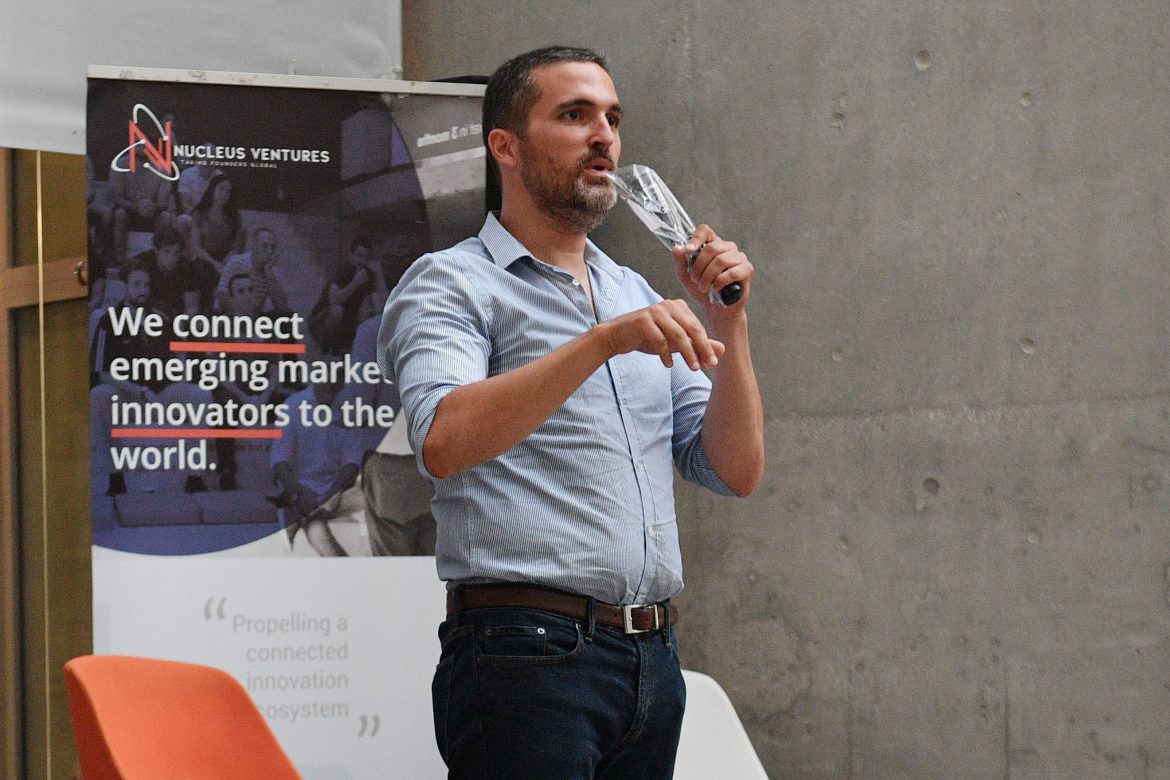
Workforce Lebanon is a recent initiative that one can see having been spliced from DNA strands of entrepreneurship, education/upskilling, and job matching. Executive conversed with Nadim Zaazaa, managing partner of Nucleus Ventures, the entrepreneurship hub which hosts Workforce Lebanon. The interview was transatlantic.

How are you connecting to Lebanon in your mind these days? 

My heart is broken over what is happening in Lebanon and wherever you go you feel that you have an anchor called Lebanon weighing you down. 

How is the program Workforce Lebanon designed? 

The program is designed for students to learn either fully virtually or in a hybrid environment any skills that will lead them to land a job in the technology sector [working] either remotely or in person.

The headline of your public relations blurb on Workforce Lebanon says that you are on a mission to create 1,000 jobs in tech. This is different from creating a skill base of employability in 1,000 people. Is your aim more about the skill base expansion or about the job creation in Lebanon? 

The idea of Workforce is not just to enhance skills. [inlinetweet prefix=”” tweeter=”” suffix=””]Workforce is an eduployment offering, which means that we also work on relationships with employers.[/inlinetweet] We are leveraging our knowledge of the sector through a relationship with employers which is long-standing as an accelerator since 2015. We are building a network of employers and we usually offer employers a role in designing the programs and determining which profiles they are looking for so that the student is matched with the most fitting employer when he graduates. This approach to employment is in fact quite trending now, especially in the US where [inlinetweet prefix=”” tweeter=”” suffix=””]employers are reverse engineering the learning journey that a prospective employee needs to go through in order to be job-ready from [the first day] when they join their company.[/inlinetweet] This is what workforce is about. It is the intersection between the employer and the skills required between basic education, college education, and job-ready skills. 

Does this mean that the WOZ organization of Steve Wozniak, which is a partner of the initiative, is also involved in this aspect of the Workforce program or are they only involved by way of the coding school partnership they have with you? 

WOZ is a content partner. We are in partnership with their affiliates but we also have other jobmatching partnerships. For example Lebnet is going to offer mentoring our graduates, Notre Dame University – the one in Indiana in the US – is offering access to the US market on the back of their support in getting students job-ready, meaning they are supporting students primarily in preparing for interviews and applications. 

Your online project description does not really spell out the minimum requirements that prospective enrollees have to have before they join the program. I would imagine that they would have to have a college education, perhaps at least a bachelor’s degree in something related to IT. Is that so? 

To the contrary. Any person interested in learning can approach us. We have many programs and students can have anything from basic internet skills and take longer/bigger programs to prepare them for the basic jobs, or they can be college graduates with degrees in computer engineering who are looking to beef up their profiles with very specialized skills. It [can be] anything in between. 

So it would be correct to say that a prospective participant in the workforce Lebanon program does not have to have an IT degree from a university? 

Yes. They key message is that there are multiple programs that require different skill levels so if you have basic knowledge of internet you can apply to the basic programs and you can also be a developer and apply for more advanced programs to give you a specialization or an edge. You can even be an advanced coder and take courses that help you in your career as well. Our offering is flexible in that regard. 

With regards to the jobs that people can hope to find after their graduation from the program, would the main prospects be in form of remote working from Lebanon or would there also be jobs that could involve people going abroad to join a company? 

The idea is that they end up working remotely in Lebanon, yeah. However, we do not restrict them from traveling if they end up traveling. We also have partnerships with universities, especially our partner [Lebanese American University] LAU to host some of those teams through industry spots there and enhance their chances of landing jobs with industrial partners of these universities. So they can work with international companies through our hubs in these universities, especially LAU. 

In developed economies, latest hourly numbers of employee contribution to GDP is above $50 per hour worked. Employee productivity in mature IT firms should normally be fairly high when compared to other industries. In startup tech ventures, this productivity is not necessarily as high in the early years. Would you expect that each one of the 1,000 jobs would have a specific implied productivity, like have to come with let’s say $200,000 in annual productivity?

We measure impact differently. We look at what is called the multiplier effect which says that one job in technology is equivalent to five jobs in adjacent sectors. You also want to see the cluster impact, meaning tech companies in Lebanon will then start working with service providers so you look at what impact these companies will have on their suppliers and providers in Lebanon. You also look at average increase in household income through the jobs created. 

But if the people are working remotely with overseas companies, would the multiplier effect for the local economy still be the same as if they were hired by a tech company here? If someone is for example working remotely, and perhaps cooking at home instead of ordering delivery to the office every day, how would the equation of redistribution of income to the community be changed? 

You are right. People working remotely is a novel situation and even in the US there is now a big question mark about where one pays taxes, where you reside or where you are employed. Those two are very different. It is an interesting and novel problem. [inlinetweet prefix=”” tweeter=”” suffix=””]For us the idea for now is that these people are generating income and bring in foreign income to the country, and will be spending it in Lebanon and be able to help their families. [/inlinetweet][The Workforce project] is more focused on the context of poverty alleviation and sustainable job creation than to be able to really measure the impact in detail, especially given how dysfunctional the situation is right now.

Are the opportunities thought to become long-term jobs or is there a large gig-economy aspect to the workspace Lebanon idea, given that remote working is the default idea?

[There are different options]. We have for example recently partnered with [Bridge. Outsource. Transform] in the field of data science services so that they can work with our graduates to offer the project management layer of outsourcing services as far as data processing and data sciences services to bill the clients. This is what they do and we collaborate with them in order to make sure that our graduates have a consistent route to the labor market and find opportunities that are more sustainable and being nurtured by other players in the ecosystem. We are exploring another similar partnership with the likes of CME who are a globally renowned development services company and software solutions provider. We are working with these employers and the LAU industrial park is also a destination where we can plug out talent so that they are working remotely and do that sustainably from Lebanon. 

Are there any commercial investors in the Workforce Lebanon project who would expect a financial return? 

No. Workforce is for the time being an impact [investment] initiative. We are funded by donors such as [United Arab Emirates-based] Al Ghurair Refugee Education Fund in partnership with DOT – Digital Opportunity Trust Lebanon. We also have [the United States Agency for International Development] USAID as a partner supporting us, and at this moment we have around 190 students in our programs. None of them pays a penny. 

Over what period have these 190 students been enrolled? 

We started in January, so we have been operating the program for about six months. 

Can you say anything about your expected attrition rate, or inversely the retention rate of enrollees? 

We are looking at 60 to 80 percent retention rate. At the time being [retention] is about 60 percent and we want to push this up to 80 [percent], meaning a drop-out rate of 20 percent. Ideally, Thomas, [inlinetweet prefix=”” tweeter=”” suffix=””]we want to have 1,500 students supported to run through the Workforce program, of which 1,000 would actually land jobs. [/inlinetweet]

How many of these prospective 1,000 job owners would then actually find gainful employment in Lebanon and produce something locally for Lebanon, do you imagine? 

I can’t answer that. I don’t know the exact figure. We did not look at this and also we don’t see a difference between jobs created in Lebanon for Lebanon or jobs created in Lebanon for abroad. I [will be able to] tell that a few months down the line, once we start having a sustainable [supply] of graduates.

But in terms of the labor skill base in Lebanon, you would contribute to improving it wherever the graduates go? 

Absolutely. There are two KPIs for us. One the number of students we train – which is 1,500 at least – and [two], the number who land sustainable jobs. 

If we note that there does not seem to be a large majority of people who want to stay in Lebanon these days, would the Workforce Lebanon program seek to block further brain drain? 

We are solving these one problem at a time. One thing we are considering is the creation of a sort-of income sharing agreement for our graduates, so that, if they do leave the country, pay back whatever scholarship they got which will then enable us to train another person. Effectively this is creating a circular impact. 

So a social impact circular economy sort of thing? 

Yes. If you land a job and leave [the country] all we ask is that you pay back what you received from us in scholarship so that we can sponsor a new student. 

I suppose that would be a voluntary obligation, or would it be a contractual one? 

We could make it a contractual one. I think this would be a very fair aspect. 

Does the overall program have a built-in time duration or date of expiry? 

We hope to achieve the 1,000 [graduates who find jobs] as soon as possible and this is our first hurdle. We will work tirelessly to provide scholarships and run programs until we have secured 1,000. That will be our first achievement. 

So would there be a possibility that after exhaustion of the current grant money, you would look for follow-up funding?

We are talking to a lot of donors. We are sprinting toward that first objective but that doesn’t mean we will stop at that. We will build on this for sure in the future.

September 20, 2021 0 comments
0 FacebookTwitterPinterestEmail
Special Feature

Afghanistan’s Bounty

by Adam Pletts September 16, 2021
written by Adam Pletts

Tracking the global network of an opiate economy

After seizing power in Afghanistan, the Taliban have promised to put an end to opium production, while the country remains the world’s largest illicit opiate supplier after a decade of failed efforts to eradicate its trade. A sincere pledge or empty words?

Before the dust settles in the country, it is still early to speculate about how continuing or ending the opium trade will impact terrorism, the Afghan economy, and the war on drugs in Europe and Russia, the two largest markets for opiates.

With so little progress in eradicating the opium trade achieved over the past 10 years, a Special Feature published by Executive is as relevant today as it was in when it was first published in 2011, and it provides key insights into the issue.

https://www.executive-magazine.com/wp-content/uploads/2021/09/SF_afghanistan-heroin-143_LEV_syria-95.pdf
September 16, 2021 0 comments
0 FacebookTwitterPinterestEmail
CommentEconomyEntrepreneurshipSpecial Report

E-learning for better job preparedness

by Mona Itani & Yasmeen Kaissi September 15, 2021
written by Mona Itani & Yasmeen Kaissi

The shift from traditional to unconventional teaching methods, including online and blended learning, was extremely timely for educational institutions and their teachers as it helped them finally step into the new learning methods of the 21st century. Prompted by the restrictions imposed by the COVID-19 lockdown, educational institutions realized the importance of this digital shift so that they are no longer lagging when it comes to adequately preparing the youths with skills that include learning agility and working in teams remotely to name a few. In our fast-paced and everchanging world, rethinking the way we learn is the only way we can keep up with it. As e-learning guru Debadrita Sengupta says: “A quintessential skill in the modern business world is to be able to learn, unlearn, and relearn.” 

Education gear shift

The current pandemic took the world by storm, especially schools who have been fixated on traditional teaching methods for a very long time. While technology has changed a lot of industries drastically and even demolished some, such change has been particularly slow in the educational sector. [inlinetweet prefix=”” tweeter=”” suffix=””]Despite the fact that many educational institutions and schools have integrated technology in their teaching methods, conventional and traditional teaching methods were still very much dominant[/inlinetweet]. Face-to-face interactions between students and their teachers have always been deemed essential for effective learning. It is safe to say, however, that the pandemic shifted the whole system and gave schools, teachers, and students no other choice but to adopt remote learning. This shift incentivized the educational sector as a whole to catch up with the rest of the world and ride the wave of digital transformation. Despite the fact that many people criticized this shift for various reasons, we believe that using unconventional teaching methods will do the students good in the longer term. Innovative and blended teaching methods were introduced because of the pandemic but are here to stay after it. Why? Because they offer students a skillset that is otherwise not learnt, the most important of which is being agile. Today, these skills, among many others, can make or break one’s career.

In-roads into 21st century skills 

In order to bridge the gap between the education system and the needs of the new job-market, Riyada for Social Innovation SAL launched Shabab Lab in July 2021, the first social innovation elearning platform in the Arab world. Shabab Lab provides schools and educational institutions with a unique opportunity to complement their efforts to provide a high-quality education through validated and tested hands-on self-paced online programs that integrate technology, entrepreneurship, and the social good in a coherent and seamless way. Designed by professors at the American University of Beirut, the platform has already partnered with prominent international schools in Lebanon and the Arab region. Some of the Lebanese schools which have tested the platform and signed-up for 2021-2022 programs include International College, American Community School, Brummana HighSchool, College des Saints Coeurs Ain Najm, and Rawdah High School. Shabab Lab’s programs provide highschool students with a head-start preparation for the future of jobs as they require them to engage in team-work, design thinking, market research, ideation of solutions to social and environmental problems in their communities, business planning, solution prototyping using a newly learned technology, and pitching. By undergoing these action-based programs, the youths transform into responsible global citizens that help make the world a better place. Through the project-based programs offered in both English and Arabic, students are provided with a life-change experience as they create technology solutions for the social good and become the changemakers that their communities need. [inlinetweet prefix=”” tweeter=”” suffix=””]In addition to schools, many corporations, such as mobile operators, and iNGO’s, such as UNICEF and other United Nations (UN) agencies, are paying more attention to youth empowerment and upskilling as part of their agenda to prepare a skilled pool of talents. [/inlinetweet]Moreover, many governments in the Arab world, especially GCC countries that have outlined their strategic vision and which include innovation and developing the knowledge economy as priority areas, are investing money and resources to provide their youths with similar opportunities to strengthen their entrepreneurial and digital skills and to become responsible and innovative citizens in their countries who can transform challenges into opportunities and flip social frustrations into solutions. 

Schools subscribe to the Shabab Lab platform to provide their students with access to the fullfledged programs that are present on the platform for high-schoolers starting with Grade 10. Through programs titled “Web for Change” for Grade 10 (already on the platform), “AR for Good” for Grade 11 and “AI for Good” for Grade 12 (launching in Fall 2021) students learn to develop new technology that is in demand by the job market. Moreover, they identify a problem under a specific social/environmental theme based on the UN Sustainable Development Goals (SDGs), and develop a prototype and a business plan to prove that their project idea to solve this problem is indeed feasible and sustainable. Some of the main outcomes include an enhanced entrepreneurial mindset and a skillset that includes both hard and soft skills such as technology development, teamwork, communication skills, community engagement and business planning. The created pitch decks are assessed by expert jury members where all teams compete in a regional competition over valuable in-kind and monetary awards. So far, over 50 social and environmental projects have been created and pitched through the Shabab Lab platform in 2 editions of the “Web for Change” program with over 180 student participants coming from more than 15 schools. 

In addition to the school offering, Shabab Lab is currently expanding its free content available to anyone who signs up on the platform. This content includes courses on social innovation and design thinking, and in the making is a series of online courses/videos on career orientation, neuroscience and learning, and open innovation to name a few. These courses expose students to areas that are normally emphasized in the curriculum and are being prepared in partnership with world-renowned experts in their domains and will enable Shabab Lab to become the “Coursera for high schoolers in the Arab world.” 

September 15, 2021 0 comments
3 FacebookTwitterPinterestEmail
AnalysisEducationEntrepreneurshipSpecial Report

Pure education

by Thomas Schellen September 14, 2021
written by Thomas Schellen

Education is the public good that, economically spoken, has the largest implications for development of human capital and wealth. At the same time, the public good of education is rooted in non-economic values that are not amenable to the profit motive. Moreover, this public good is based on human interaction, and ideas such as online college courses, for all their stickiness since the dawn of the collegiate internet, have not displaced the time-honored practices of tertiary education on physical campuses.

Digitized education has at least until last year not transpired into the magnificent revolution of attainment and opportunity that social visionaries have been so fond of in their belief that the educated person will be the better person. But something has changed in the pandemic and infodemic of 2020.

Thus today, education more than ever is among those fields that tech entrepreneurs, and the financiers, analysts, and facilitators of digital economies, love to label as “xyz-tech” (now must one say Fintech or better Techfin?) and hyperventilate about. As the pandemic of 2020 pivoted digital education needs from more efficient classroom tools to the urgent improvement of remote teaching and learning experiences, the previous hyping up of “edutech” startups was boosted to another, bubbly appearing, dimension of both genuine need and investor frenzy. 

Over the past year, this frenzied edutech race was notably demonstrated in the People’s Republic of China, the country with the undisputedly largest (but only in one disputed international ranking the highest achieving) education system. According to studies cited in recent news stories on governmental decisions to reign in wild edutech, well over 80,000 new edutech enterprises were formed in China in 2020, and investors poured the equivalent of $16.3 billion into the sector. This excess inflow of funding further distorted the immense Chinese edutech market. Having been previously nurtured into a $12 billion (2016 figures) online tutoring market by the country’s high-pressure, merit and certification oriented education system, online tutoring ballooned last year to 40 percent out of a $100 plus billion total for-profit tutoring market. 

This commercialization of education provision and families’ hunt for educational credentials for their children grew to a point where the Chinese government this July deployed opinion channels and regulatory means to limit for-profit edutech operations. Witnessing intense for-profit growth through financial investments and edutech startup formations, along with very recent government responses, the country at this moment can serve as example for the edutech boom’s upsides and downsides.

Opportunity from misery

Given the education sector’s and the for-profit online education market’s overriding social and economic importance in combination with the cultural predilection of the Lebanese to invest in their children’s education, it stands to reason that any bit of successful edutech innovation in this country’s entrepreneurship ecosystem can be of exponential economic and social value, an antidote to today’s Lebanese desolation. 

To investigate how the universal fascination with edutech looks in the Lebanese entrepreneurship context in the era after the central bank’s Circular 331 and its boosting of bank-backed ecosystem investments, Executive discussed with three edutech startups. We conversed with Kamkalima, an example of a mature startup which has grown into its own sweet spot by filing very specific classroom needs; eFlow education as example of an impact-investment driven one that focuses on the needs of i-NGOs which are serving marginalized groups and that used the pandemic as its springboard for its first growth spurt; and Catalysis as one that, while in significant ways the fruit of the lockdown and economic malaise of Lebanon, is in this summer of 2021 just beginning its push into what it expects will be a viable niche at the intersection of wellness and education. 

A trend intensified rather than new

The proposition of inventively infusing education with tech entrepreneurship has been appealing to Lebanon’s educative minds from the induction of the entrepreneurship ecosystem in the early 2010s. In any of the seven years until 2019, a demo day wouldn’t have been a typical one if an acceleration program’s graduates didn’t include one or more edutech or school related startups, such as a school management platform, Arabic language teaching, STEM (science, technology, engineering and math) gamification, or some sort of education marketplace concept. 

The founders of these startups often had experience with teaching or tutoring as either providers or recipients. And by the 2020/21 academic year, some of their bets on education already paid off well enough, despite or because of Lebanon’s many problems of late. Synkers, the Beirut based edutech marketplace for tutoring – that has seen increasing popularity with learners prepping themselves for tests such as the SAT as with expat and local tutors – has this summer been acquired by UK-based private schools conglomerate Inspired of Lebanese-British entrepreneur Nadim Nsouli. The marketplace is now, under the new name Ostaz but with unchanged local leadership, aiming for global expansion.

That edutech is today drawing the attention of global school operators and big publishers in the field of education is in itself unsurprising, given that no individual in the knowledge age can evade exposure to education. The value of education is immeasurable, even if the rise of the credentialed and commoditized illusion of earned knowledge in the context of the knowledge economy makes it well worth reiterating time and again that gaining a good education and acquiring a prime university degree are no more necessarily synonymous than the ability to afford a Koenigsegg or Ferrari is with the ability to drive fast gracefully and responsibly. 

What may be astounding to outsiders of the Lebanese cultural mix where hunger for measurable success, and thirst after showing it off, encounters strong educational traditions in the best European sense, is that the three edutech entrepreneurs in Executive’s purview are displaying much more than just profit motives for their engagement with digital transformation of teaching and learning. Each in its different way is addressing a none-too-obvious niche that their founders see themselves as specially qualified and passionate to serve. Moreover, the startups under our examination have been performing quite admirably: they have not only been driven to higher levels of activity by the 2020 pandemic but managed to unearth funding or significant financial opportunity despite the new barriers in access to funding that have railed the Lebanese entrepreneurship ecosystem this year and last. 

Kamkalima

Kamkalima, the mature startup focused on the Arabic classroom, was incorporated in Lebanon in 2015 and in the United Arab Emirates in 2019. Cofounder and chief executive officer Siroun Shamigian tells Executive that after quick initial percentagewise growth during the launch year and an intermediate slackening of nonetheless continued growth thereafter, the year 2020 brought a clean doubling of users, schools that rely on its Arabic teaching and classroom tools. During the spring 2020 phase of the 2019/20 academic year that was affected by coronavirus lockdowns, “we went free for any school in any country. Because of that, we experienced user growth, not financial growth, of more than 100 percent,” she explains. According to her, in the past two years over 4,000 students in Lebanon alone benefited from Kamkalima for free. “In this academic year, which means [the 12 months from] September 2020, we had around 40 percent growth in paying students. For the 2021/22 academic year, we are projecting even higher growth on basis of new partnership agreements, opening of new markets, and because of COVID change impact on mindsets”, Shamigian adds. 

The business concept of Kamkalima is software-as-a-service (SaaS) and business-to-business In collaboration with SPECIAL REPORT 44 executive-magazine.com June – August 2021 Labor education (B2B), meaning that currently only schools and not individual learners are targeted as contract partners. However, the company is preparing new products that will meet demand from individual learners of Arabic and expatriate Arabic-speaking parents who want to teach their children the tongue of their forebears. According to Shamigian, all materials that Kamkalima developed for its content library are not arabized imports but produced as original content by experts from different Arab speaking countries. 

In her experience – which is the experience of an “accidental entrepreneur” whose teaching journey led her to discover and respond to the need for better digital tools in classrooms that teach Arabic – [inlinetweet prefix=”” tweeter=”” suffix=””]there are significant time savings and improved efficiencies for the Arabic departments of schools that avail themselves of Kamkalima’s four-pronged platform for students, teachers, Arabic department coordinators, and supervisors of school networks.[/inlinetweet] Shamigian cites high renewal rates and far above-average net promoter scores – a measure of customer satisfaction – as evidence. 

This notwithstanding, she notes that the path of selling the platform has been a path of fears and resistance. “As an edutech we are following the path of difficulties, because we sell the concept before selling the platform,” she says, referring to often encountered cultural perception barriers against usage of electronic means in the teaching of Arabic. 

Other fears to overcome originate from general tech weariness. “For teachers to feel comfortable with technology, they have to understand that technology is not their replacement. On the contrary, it is a force to support them and make their job easier while improving student engagement,” she elaborates. 

These conceptual hurdles and the small fact of the prevalence of bureaucracy in school systems act as stronger access barriers in Kamkalima’s field of specialization when compared with other edutech endeavors such as tutoring marketplaces. 

Kamkalima achieved initial funding from own sources, followed by seed funding and then a Series A financing round of $1.5 million led by Lebanese venture capital (VC) fund Phoenician Capital. This round also involved the entrepreneurship ecosystem stalwarts iSME and IM Capital. 

Involving Circular 331 money, the funding from this round became partly inaccessible under the liquidity crunch of late 2019. But the venture was undeterred and Kamkalima is currently preparing for a substitute Series A funding round with engagement of regional investors and VCs, including local ones. 

The new round is projected for completion in first quarter of 2022, and the still unannounced funding target is expected to be in the common range for Series A. The funding will be dedicated to scale the enterprise whose ambitions entail rolling the platform into new geographic and topical markets, adding new products, including one game app teaching letters to younger children, and entering new business and consultancy partnerships. 

Notwithstanding the vision of Kamkalima’s market internationalization by founders Shamigian and Nisrine Makkouk, and the enterprise’s second incorporation in the UAE, the startup is lastingly committed to Lebanon as its operational base. Despite of the serial shocks that the Lebanese economy suffered over the past two years, the enterprise did not lay off any employees but took several new hires into its team of, today, 21 persons, all but two of whom are based in Beirut.

Recalling fondly how Makkouk and herself, two former teachers with no entrepreneurial pedigrees, were emboldened with “big and uncommon” trust by Kamkalima’s launch investors, IM Capital, Shamigian says, [inlinetweet prefix=”” tweeter=”” suffix=””]“The value of being in Lebanon is the team, plus the investors. Being in Lebanon and having access to Lebanese talent helped us a lot. The crisis will end at one point and we want to be part of the rebuilding.”[/inlinetweet]

eFlow education

The eFlow Education startup of 2020 is a child of serendipity in the midst of chaos, although it defines itself far more dryly as “educational cloud based platform powered by an interactive chatbot that enables learning delivery and management,” before informing site explorers that eFlow conversational course formats can be accessed via common social media platforms. 

The startup was conceptualized by entrepreneurs Bassel Jalaleddine, computer engineer and co-founder of online tech course platform Cherpa Education, and Samer Bawab of mobility app Carpolo’s startup fame. The pair built their solution in response to a request for solving a problem that Near East Foundation (NEF, a non-governmental organization that was founded over a century ago in the US as The American Committee for Syrian and Armenian Relief) had met when it sought to communicate with its beneficiaries through common messaging channels. 

In order to sort out the communication discordance that bothered NEF, the tech entrepreneurs developed a chatbot that would solve the problem. In the process, the enterprising minds came to suspect that the challenge of efficient communication of education content to disparate and technically disadvantaged user groups was not an isolated problem of one international NGO. 

This suspicion turned into a hypothesis of latent NGO demand for a tool that would facilitate communication of educational content to poor children by smartphone. This demand hypothesis was confirmed when temporary school closure responses to the COVID-19 pandemic were first imposed across the region. “When the pandemic struck, the schools and NGOs did not have a remote learning plan for their beneficiaries,” cofounder Bawab tells Executive. 

eFlow’s offer of a solution that allowed providing learners with content via easy-to-access channels that conveyed a familiar user feel, as well as managing their attendance from diverse locations in a well-coordinated way, brought immediate responses as six NGOs signed up to eFlow’s services within the first six months. Even better for the startup, the NGOs’ needs were not just temporary. 

“We saw huge interest when we sent out our marketing messages. However, there was already serious inefficiency in the way NGOs were operating with the refugees and marginalized communities. They were spending enormous amounts of resources – money – on solutions that did not work, or were dispatching field officers to the areas and neighborhoods but could not properly track data. We found a need in this space of humanitarian education and awareness,” Bawab says. 

According to Bawab, NGOs working with students in rural areas during the pandemic initially moved to managing their beneficiaries via WhatsApp groups but this did not go well at a moment when the schools and NGOs did not have a remote learning plan for their beneficiaries. Challenges that the NGOs had to deal with included learners who did not know how to use a laptop computer, or who did not have much internet connectivity, or who otherwise had barriers against environments such as Google classroom. 

“We had to come up with an alternative mobile solutions for [the beneficiaries and NGOs] to still get content and educational materials without spending too much time on training them on using platforms. We took advantage of their familiarity with WhatsApp and sent them materials, saving the NGO time and stress,” Bawab explains. 

eFlow’s user base, which reached 2,000 learners in the first three months of operations, quintupled to 10,000 in the three months to July 2021, he adds. The client base by middle of this year numbers seven NGOs, including Jordan’s Queen Rania Foundation, Mentor Arabia, Relief International, and UNICEF. About half of current users are based in Lebanon, Jordan, and Iraq. Beneficiaries also are served in Oman and the United Arab Emirates. [inlinetweet prefix=”” tweeter=”” suffix=””]Outside of Arabic-speaking countries, eFlow pilot ventures are running or being set up in Latin America (Mexico, Peru and Costa Rica), as well as Zimbabwe. [/inlinetweet]

Bawab says that the startup, apart from an angel investment of $35,000 for 10 percent of equity, relied on own resources for funding. It to date achieved revenue of $150,000 under its variant of the B2B business model whereby paying client NGOs contract the startup for education projects. Projects are free of charge for learners who also are supported by the respective NGO with the required connectivity and the devices they need to access the educational content. eFlow is enrolled in the Bloom Accelerator program, in which it is a grantee of $10,000, and in terms of accolades last month was among global winners of a Seedstarsmanaged competition called The Migration Entrepreneurship Prize. 

The both socially and educationally tinged startup has been admitted to the portfolio of impact investment fund Village Capital and is slated to receive $100,000 worth of IT tools and support on basis of Village Capital’s partnership with IBM. eFlow is currently undertaking preparations for a pre-Series A funding appeal looking for $500,000 to $1 million, the exact timeline of which has not yet been determined. Funding in the round would be sought from a strategic investor or from a VC fund with educational focus and expertise. 

The company did not try to register legally in Lebanon as first step but went straight to Dubai. Its incorporation there, however, did not change the startup’s existential anchoring in Beirut. According to Bawab, the team – currently 12 full-timers – is based in Beirut, and planned hires should expand this team to more than 20 and possibly as many as 30 by the first quarter of next year. 

The skillsets that the company is looking for in new hires range from web developers to content designers and sales experts. Its operational focus in the second half of this year is to acquire more clients, get more users, and more use cases, Bawab says. Prospects that the startup is also seeking to explore include the corporate social responsibility market. “Corporate training is another big opportunity for us but for now we are focusing on marginalized communities, refugees – people that may live in camps or may face trauma from war and migration,” he adds. In its longer journey, he envisions the Lebanese startup as entity that could be acquired by a big name in international educational publishing or even a communications giant, be integrated into a leading international educational NGO, or become a tech department of UNICEF. 

Catalysis

Equally far from credentialism and base profit motives as the two previously described edutech startups is Catalysis, the brainchild of budding entrepreneur Lara Shabb. Shabb, who appears to have no difficulty impressing not only her colleagues but even faint acquaintances with natural, entrepreneurial dynamism, shifted from the path of an employee to being a hopeful edutech entrepreneur as the Lebanese crisis unfolded. (Full disclosure: she accepted a short engagement as Executive’s managing editor in fall of 2020, and worked with the magazine for several months). 

Combining her expertise in digital communication tools with her personal dedication to wellness and spiritual growth, she designed her startup as “a marriage of e-learning and social competence,” which she aspires to realize as nexus of wellness and education. “Our niche is wellness, everything related to fitness, mindset, coaching, meditation, and the product we are building is positioned to meet needs not fully served by either of two verticals,” Shabb says.

In her view, domineering social platforms of the Facebook kind understand the paradigm of community but are void of values whereas teaching platforms such as leading educational content aggregator Mindvalley – the personal growth and wellbeing focused platform’s course offering includes diverse teachings of everything from spiritual evolution to body transformation, from conscious parenting to millennial entrepreneurship – are void of community, besides being stuffed with lengthy, and expensive to produce, video presentations. 

[inlinetweet prefix=”” tweeter=”” suffix=””]To differentiate her wellness education hybrid, Shabb aims to administer “bite-sized” wisdom videos that will be consumed on the smartphone and also can be produced with a minimum of specialized audio tools and everyone’s essential digital device. [/inlinetweet]“We encourage using iPhone and headphones when filming”, she says, and enthuses, “Many teachers have much to share but cannot compete at that level, so the home smartphone clip is the answer of Catalysis. We are building in the space where you get the best of the platform world and the best of the education content world.” 

She concedes that the startup is still tweaking its minimum viable product, which is due to be completed in short order, and revealed to the virtual world as the Catalysis platform before the fourth quarter of 2021. 

In financing terms, her venture has benefited from a tech grant under the umbrella of the United States Agency for International Development (USAID). Owing to this grant, the engineering of the site is taken care of and being implemented by a team of fresh engineers from Zahle who are working on this project under the mentorship and supervision of expert computer engineers. Shabb describes the engineering cost of Catalysis, which is currently in beta testing, as the startup’s biggest expense – worth between $50,000 and $100,000 to the startup and covered by the recent tech grant that was awarded to the project under USAID. 

The only expenditure of own funds was to cover the cost of establishing the brand. According to Shabb, bootstrapping and volunteer efforts by her handpicked project collaborators accounted for most of the non-engineering work that has been invested since the startup’s ideation at the beginning of this year. The worsening depreciation of the Lebanese lira was the drop that made her creative reservoir overflow into startup action. [inlinetweet prefix=”” tweeter=”” suffix=””]“The idea was to allow teachers to put online what they already know in order to create a passive income stream in dollars. [This was] because I run a wellness course and saw that all of my companions were basically making nothing for the work they were doing. [/inlinetweet]This work is really needed, coaching, energy healing, sound healing”, she says. 

She adds that about 50 handpicked teachers have signed upon her project, including relatively unknown but highly knowledgeable practitioners who also have day jobs besides their chosen callings and educational roles, along with a small selection of better known instructors and some that are international stars in their fields. However, any individual registering on her site will not be classified as “teacher” or “student” but as member of the community. Shabb envisions that teachers will bring their micro-followings to the site and help expand its reach organically. 

Members who upload videos will retain their intellectual property (IP) over their contributions and will be able to seek monetization under two different formulas. According to Shabb, all content will have to comply with Catalysis’ objective for “abundance, community, and service,” and content that the site administrators deem to be of insufficient value vis-à-vis these requirements, is liable for being flagged and removed.

On top of the satisfaction of owning their IP, content providers to the site can classify their video clips as free offerings, premium, or attach a course fee or bundle fee. This corresponds to the Catalysis business model, which foresees offering free access to entry level users in combination with subscription based and fee-based access on the higher content levels. Teachers uploading premium content will receive shares of subscription income as far as applicable and on the highest content level Catalysis will take a cut, projected at 10 percent, of the fees that teachers charge for their top offerings. Pricing power will be the privilege of each teacher, with the market expected to regulate pricing via supply and demand. 

In this sense, the business model of Catalysis appears to be more peer-to-peer marketplace than business-to-consumer (B2C). Committed to lean enterprise principles, the startup will initially focus on the MENA region as its addressable market. Transactions will be dollar-based (with eventual options for teachers to charge their Lebanese adherents in local currency at the rate they choose). 

Shabb does not plan for any big and costly marketing campaigns. The longer term vision for the venture is facilitating wellness education, achieving educational influence, and solving the problems of independent teachers – inclusive of solutions such as payment gateways – who crave to embellish their educational influence but may lack tech skills and marketing knowledge. A second correlated power of Catalysis will be organizing wellness conferences and events, beyond which it is Shabb’s dream to penetrate the corporate market and generate rapid transformations there, fulfilling the promise of Catalysis.

September 14, 2021 0 comments
0 FacebookTwitterPinterestEmail
BusinessEducationLeaders

Virtue out of necessity

by Executive Editors September 13, 2021
written by Executive Editors

The convergence of developmental strands – say the convergence of technology, business, medicine, and culture – is a tide that waits for no woman in Lebanon. The simple logic that demands of Lebanese to prepare for the future even in the midst of an epochal disaster is that the race to the future is progressing globally even as the world’s attention in the summer of 2021 has been preoccupied with downside trends such as terrorism, aggressive political fundamentalism, and war risk. 

[inlinetweet prefix=”” tweeter=”” suffix=””]Education and entrepreneurship are perennially and rightly touted as Lebanese predilections[/inlinetweet]. Actually, humans of any culture appear predisposed to seek knowledge and pursue enterprise with different degrees of intensity that are determined both individually and on the level of group and civilization. Work is a universal human need, and more so than ever in the age of digitization, automation, artificial intelligence, and the internet of things.

Convergences of global importance will also not be deterred by climate risk and other “green swans,” or predictable global calamities where only the day and magnitude of the next catastrophe are uncertain. One convergence of great interest for Lebanon’s future is the changing and intensifying interconnectedness of education, entrepreneurship, and human work. 

Considering what we humans know and aspire to today, [inlinetweet prefix=”” tweeter=”” suffix=””]the future of work and entrepreneurship and education from the 2021 vantage point looks like one that will include convergences of digital, virtual, social, and human creativity components[/inlinetweet]. If enlightened and responsible capitalism proves to be a sustainable trend that continues similarly to the trend that has led from the industrial to the knowledge economies, humanity will see further reductions of the barriers between work and play, entrepreneurship and economically meaningful education, purpose of the whole and individual interest.

Among the helpful outcomes of the COVID-19 pandemic and the unending chain of coronavirus scares that have traveled the world in the past 19 months (and counting) was to alert the world to the imbalances between overpaid extractive financial work done by the top crop of credentialed graduates on one hand and frontline service jobs and humanitarian work on the other. 

In slightly simpler terms, the importance of jobs from driving buses to supporting the infirm and sweeping the streets, and the dignity and worth of the people who do them, has been illuminated and highlighted relative to the importance of those who juggle numbers and ratios, words and phrases, or cast memes by any other art.  

Reconsiderations under a digital filter

[inlinetweet prefix=”” tweeter=”” suffix=””]Education and labor training in the emergent digital age appear to be closer aligned than in many ages[/inlinetweet], perhaps as integrated as in the times when parents were the main conveyor of simple trades like hunting, farming, carpentry, building, etc., to their offspring, usually in the socially prescribed form of father-son transmission of skills, experiences, and rituals.

While this simple mold has been unsuited for the complexity of lives from the early industrial ages onward, the question if we work to live or live to work has been a false dichotomy of industrial and post-industrial economies. The contradiction was imposed on man because of badly judged and wrongly assessed externalities and oppressive behaviors, including (usually male) human managerial behaviors and exploitative attitudes of the industrial capitalist ages. In the digital age, neither externalities nor oppressive behaviors can by any rational expectation be erased from the human race, but they might diminish. 

But with all convergence of entrepreneurship and productive education in a context of meaningful work, there always will be the necessity to develop higher balances. On one side of the scale of education, good impulses of playful learning and universality of knowledge today fulfill an age-old dream of empowering people to seek a life of opportunities through better education. On the other side of the scale, challenges pile up: knowledge is not the key for a good life and mature behavior. 

Commodification of knowledge raises the question if there is too much of it, if a whole society can be impaired by too much information (TMI) and knowledge over-accumulation, more detrimental than obesity from habitual overeating. Education plays a huge role in the observation that societies have over the past 50 years become increasingly trapped in dichotomies of winners and losers where over-dependence on the ideology and rhetoric of rising has paved the road to the tyranny of merit, American thinker Michael Sandel tells us. 

Scratching the surface of great ambitions

All this goes beyond the scope of a simple magazine, print or online. It is a no-brainer that Executive can only scratch at the links between entrepreneurship, education, work, and public goods in the Lebanese society at a moment when work is scarcer than ever, education is a luxury that gets unaffordable, and entrepreneurship is besieged by erosion of critical hard and soft infrastructures. 

Not to mention public goods. Public goods have been eviscerated in corruption and self-interest from the level of the government minister and politician in power to the every-man hoarders or gasoline and medicines.   

All troubles of Lebanon and inequities of our magazine notwithstanding, Executive has researched the relationship of entrepreneurship, education, and labor in this issue and found laudable initiatives. And for being highly commendable, it does not matter if all these initiatives in the adjacent fields of labor education and entrepreneurship will be successful (discussing the likelihood is moot), or created under the entrepreneurial dictate of trying to do something, anything productive at all, in the middle of the worst economic draught of history in order to be prepared for a better future. 

Undertaking our – impeded by circumstances – research into these subjects of entrepreneurship and labor education, we have taken to heart the underlying thought which Jerome, the patron saint of translators, has penned in late antiquity and which just might be the definition of true resilience: facis de necessitate virtutem (you make a virtue of necessity). This meme can be expressed in many idioms. A German proverb calls it Aus der Not eine Tugend machen. Colloquial American might call it making lemonade when being handed lemons. For the online reality, one could describe it as looking for the meaning of friendship on Facebook, or using this generation’s widespread addiction to social media to make people receive a constructive moral message. It all is the same: turn something bad into something good. 

This means [inlinetweet prefix=”” tweeter=”” suffix=””]Lebanon, for improving its preparedness for the dawning age of digital equity, ought to invest in unceasing efforts to rewrite the national relationship of entrepreneurship, technology, education, and work[/inlinetweet]. Or, in an adaptation of Sandel, now is the right time to agree and act upon the insight that “to renew the dignity of wok, we must repair the social bonds the age of merit has undone.”

There is one final aspect to all possible futures that matters perhaps more than even the quality or the ease of education, the usefulness of what we learn for our work lives and careers, and the fact that learning is the opposite of credentialism: the question of character and heart. 

In Lebanon today, this character question compels itself as proposition of total disgust with the system and its private and public institutions and entities. Can one invest herself or himself into a country that is perceived to be a total turn-off by its citizens of all ages, hedonic orientations, personal beliefs and organized faiths?

[inlinetweet prefix=”” tweeter=”” suffix=””]Education that is better integrated with entrepreneurship and work, has immense benefits[/inlinetweet]. However, up to now neither the dissemination of more knowledge and labor education nor the successful pursuits of tech entrepreneurs have brought Lebanon inclusiveness and tolerance in such a self-perpetuating cycle where tolerance promotes inclusiveness and inclusiveness enhances tolerance. The country is yet plagued with juxtaposed and equally corruptible concepts of rule by ambiguous technocrats versus rule by self-proclaimed populists. As a sage of the knowledge age once said, we should set the center of our character not in a truth but in the heart.

September 13, 2021 0 comments
0 FacebookTwitterPinterestEmail
Brand Voice

BUSINESS PARTNERSHIP BETWEEN LOYALTY BROKERS AND NASCO LEBANON

by Nasco & Loyalty Investment & Insurance September 8, 2021
written by Nasco & Loyalty Investment & Insurance

Mr. Gino Nader and Mr. Abraham Karabajakian are pleased to announce to their clients, employees and stakeholders the signing of the new Business Partnership between Nasco Lebanon and Loyalty Brokers.

At a time when our country needs consolidation as a base for revival among so many other things, we view this “Business Partnership” as an example of how to set considerations of ego and prestige aside and make room for common sense initiatives that privilege cooperation.

We are confident that our Business Partnership will provide our clients with an even higher level of service and a better all-round professional experience. But we also view this alliance as a precedent and example for other brokers who might find that their interests and those of their clients are best served in this way. 

Under the Business Partnership agreement, Loyalty Brokers and Nasco Lebanon will join forces and build on the synergies made possible by the combined weights of their insurance portfolios, the complementary capabilities of their teams and the harmony that proceeds from their convergent professional values, business culture and principles. 

With the managerial talents of MM. Khalil Tawil and Rabih Kanaan at the helm, we feel confident that Nasco and Loyalty clients will be in the best of hands.

Beyond Lebanon’s borders, the Business Partnership will allow Loyalty to leverage Nasco’s presence in its different territories in a win-win alliance of talent, will and enterprise.

Gino Nader and Abraham Karabajakian 

September 8, 2021 0 comments
2 FacebookTwitterPinterestEmail
BusinessEconomyEntrepreneurshipQ&ASpecial Report

A new acceleration concept

by Thomas Schellen September 8, 2021
written by Thomas Schellen

Once upon a nascent ecosystem, the entrepreneurial minds in Lebanon were many but funders were few and support systems, such as incubators and accelerators, as rare as an honest politician. Then came the central bank’s Circular 331 and a splurge in venture funds and acceleration programs – many of which have vanished or been forced to retrench with the cessation of bank-fueled entrepreneurship initiatives. To interact with an example for an acceleration entity of the post-331 age, Executive sat down with David Munir Nabti, chief executive officer of new growth accelerator, Bloom. 

You run a new acceleration program called Bloom and have been something of a fixture in the ecosystem for the past decade at least. However, it seems you are like an entrepreneurship nomad who carries his office on his shoulder and is not operating from a physical office. Why did you make this choice and what are your aims beyond having no physical head office? 

I like finding healthy and inspiring environments (shows images of working in outdoor locations). But I also like connecting with different people. We like organizing discussions and hosting events in different places, and I’d love to do more of that. 

So despite operating in the virtual space, you are aiming for more events where people attend in person?

Yeah. The way in which we have been doing things in different phases over the last 13, 14 years, has been that we have been creating co-working spaces and then worked from co-working spaces and community spaces. We worked from here at [Beirut Digital District] BDD for a long time, and we worked from antwork for a while. All of these places are great and we need a lot more of them. In our role, though, we shifted to being online. We are now working with different groups and accelerators in Lebanon and in the region. We are now working with accelerators in seven countries, and we want to help them to do more stuff to leverage the online world […] but the physical community spaces are still super important. So ideally from our side at Bloom, we can work with dozens or hundreds of different community spaces in programs around the region and help them.

You say ‘we as Bloom”. What is this new brand and what is its heritage?

In the previous versions, where we were working in physical spaces, we had launched AltCity [in 2011] and prior to that there even was [a venture called] Rootspace. The idea for [the AltCity] launch really was that we wanted to see how we can create an alternative approach to a city, a version that we dream […] it was somehow utopian but also very practical in that we were living in it and making it real. It went very well, although we launched AltCity just around the same time as the crisis in Syria started really getting worse. 

How is your view on how much the future of acceleration and entrepreneurship will be online only, or how much will be happening in hybrid online and physical collaborations, and how much will be face-to-face training and discussion events?

I think there will be a lot more online only but I agree that the highest quality experiences will continue to be a hybrid mix.

Was your decision to move into online from the previous AltCity model triggered by the pandemic?

No. We shifted to that [model] about three and a half years ago, well before the pandemic. The model of AltCity originally was that we wanted to bring some of the benefits of innovation parks or incubation spaces in some way and combine this with the model of something like Starbucks. The idea was for a co-working cafe and literally to have 30, 40, [or] 50 of them around Lebanon. This was the original idea… but for whatever reason, it did not work here. We were running multiple businesses on a string line staff, on too small a budget, [and] the economics did not work quite out. It was exhausting and we were not having the impact that we wanted to have. So we and the team asked ourselves what things are going well and what things are not going well, and we changed the model. That is when we started shifting to the programmatic model, moving from a spatial office to a program office, and then we started to think a few years later if we could go fully online and do things more efficiently. 

This is how we shifted to running online programs but also programs for programs. So we are still running accelerator programs but we are working more with other accelerators and other programs that offer education experiences. We have the tools and methods to help them run more effectively. We have ambitious goals. Our goal is that in the next two years, we want to graduate around 10,000 people from our programs. This can only work through a combination of three methods. One is direct programs that are supporting enterprises, [the second] is working with accelerators. It is sort of a community experience where we all learn from each other. The third is through the tools and software that we are building, which is the Bloom technology side.

Is this software something that you develop and provide as software as services (SaaS) model?

Yes, we are building it as a SaaS model. We are using some aspects of it internally now, and we will be rolling out the private data side in the next three to four months. Hopefully by [the third quarter] of this year, we will be expanding data users and soon after launching more publicly.

How would you compare your operation at the time of AltCity with the online operation of Bloom?

There are pluses and minuses of both environments. There are pluses to being in a physical space together. One [plus] is giving the people a more dedicated space to focus and also there are aspects to people being in a room together to brainstorm. There are things that are being helped by being in a physical space versus an online space, and I think the more valuable relate to serendipity, it is the random connections [that are created] as people go to the coffee machines to get coffee, or go having lunch together, bump into each other from different project teams and share some ideas. Those things are really powerful, not just for a team but for an ecosystem. These are things that we are working to address in the online environment. We have created for example casual team lunches [online] where people get together and chat about different topics, and we are seeking to have more balance between focus times and casual interaction time. 

There are also benefits of the online space. Physical spaces can first of all be incredible distracting, and there are reports asking how many hours in an 8 or 9 hour workday people are actually doing work. There are studies showing that open plan offices are distracting for people doing team work. And it is team focused work that is actually most effective. We are trying to find ways that can help team members to focus their time and be able to engage the right people wherever they are.

You say you aim for 10,000 graduates from the various entrepreneurship and acceleration programs. What would have been the maximum number of graduates that you could have dreamed of under the AltCity model?

When we were running the early stage programs a few years ago [at AltCity], they were in person. We were running one pre-accelerator and two accelerators, working with around 20 teams per year [in the accelerators] and with around 60 teams in the pre-accelerator. About 100 were going through an early training program. When we shifted to online we did not just change [from having a focus on greater Beirut] to have people from other countries, but [added] the two different models that we are trying to expand on. 

It sounds like you are in the process of multiplying your impact through distributed partners, almost like a franchise restaurant.

Exactly

It is through this aspect of communities of practice that you also want to help building effective communities of learning specifically in the acceleration space? 

This is part of our programs and we are working to build it into the software which focuses on the three pillars, which, by what we have seen in the world of entrepreneurship acceleration, is a new approach. One [pillar] is wellbeing and engagement, the second is focused on universal skills, and the third is focused on organizational development. 

How many people are in the team of Bloom? How many of them are developing the software suite?

Our team is in six countries now, and we are running programs in eight countries. In Lebanon, Jordan, Palestine, Egypt, Tunisia, Algeria, [and] Morocco, plus we are working with a group of Iraqis that are in Turkey. Our team is in Lebanon, Egypt, again some Iraqis based in Turkey, France, Holland, the UK, and Qatar. We have 16 full time and another five part time, as consultants and stuff like that. There are about a third that are just focused on the programs, a third focused on the software side, and a third supporting both sides.

How much of your team is in Lebanon and how much of your total operational activity is centered in Lebanon at this point?

It probably is about half-half [in terms of team location], but we do have some people who go back and forth, spending some time here and some abroad. In terms of our operations, and the teams we are supporting [in Lebanon and in other countries], it is also about half-half, except that we have different roles in these two programs. For the program that is in Lebanon with the 50 enterprises, we are the main group managing [it] and managing the deployment of funds, etc. In the program where we are supporting groups in seven countries, we are leading the implementation of the training of the accelerators, the metrics and a lot of those activities, but are not dealing with the deployment of funds.

And where are you incorporated?

We are incorporated as a non-profit here in Lebanon and also exploring how to best incorporate outside of Lebanon. We are going to be incorporating both as a social enterprise and as a non-profit outside of Lebanon. We do have a sort of non-profit fiscal sponsorship arrangement in the US.

Does that mean you want to migrate from a non-profit to a for-profit but social enterprise state of existence?

I think we will always have both the non-profit and the social enterprise approach. We definitely want to make the social enterprise self-sustaining and hopefully profitable, so can we can be expanding our R&D, our tools, run more programs, and be more effective. That would enable a lot of benefits that are somewhere between much more difficult and impossible [to achieve] with a non-profit approach. We will always have a very strong focus on trying to reduce inequality. This is our core driving value. 

It seems to be a challenge right now to pay people outside of Lebanon who are working with a Lebanese entity. How do you handle this?

We are very lucky that our funding is primarily from outside of Lebanon and for different projects. Thus we have fresh funds that are not in Lebanese [pounds].

And you circle them through Lebanon?

For the most parts. We are trying to see how we can be hiring more both for our team and for enterprises [in our programs]. We have two programs that touch on Lebanon but one is fully focused on Lebanon. It is working to support 50 enterprises through eight accelerator cycles over the coming year. We are going to see how we can help them grow outside of Lebanon, but be growing their teams inside of Lebanon. 

Did the liquidity crisis of 2019 have a very severe impact on you?

It did not change our model very much. Of course it did change our operations, the way we deal with aspects of currency exchange, transfers and funds, etc. We also did lose some funds that got locked. 

However, the challenges presented by [the economic collapse were ones that] I was fearful of for many years prior. 

Is it correct that you had a seed funding that came from outside under a non-profit paradigm?

We had pilot funding from several different sources, all of which has been either from outside of Lebanon or personal funding. We as co-founders have put in a substantial amount of our personal funds and of course a lot of uncompensated time and opportunity cost. But we had some seed funding to help with development.

When you say co-founders, this is you and who?

For the different elements over the years, there have been different co-founders. For the Bloom platform it is this gentleman Bilal Ghalib and myself. He is Iraqi American and also lived in Lebanon for a number of years.

Through the Bloom acceleration program, are you taking equity in any of the companies that you are accelerating?

We are not taking equity. There is grant funding that is supporting the program [of accelerating accelerators] and grant funding that is supporting the companies. 

Some previously prominent acceleration programs have taken equity in the hosted companies, channeled foreign or local investments, or focused on grants. Do you see one of these methods as preferable? 

I think all of these forms of finance are needed and we are running programs in all of these different flavors, equity based, grant-based, and even fee-based programs. These all are helpful and we need more of them in Lebanon and in the region. We need to give more options to startups for them to decide what is most appropriate [in response to] what they are looking for.

You as Bloom do not operate with an own investment fund, right?

We do not have a private fund. It is something that we have spoken about previously and would be happy to explore with people but part of [not having done so] is because there are only so many hours in a day.

Are any startups in your program ready for demo days, or do you sense any tech companies emerging from the underbrush that would by local standards be unicorns?

The program that we are running in Lebanon is focused on existing companies, not early stage startups. These are companies that have already had some traction and we will have a very exciting demo day in a couple of months. The venture capital world often looks for unicorns but strong economies are not usually made of unicorns. They are made from a lot of good SMEs. From this aspect, our objective was not to find unicorns, but to focus on sustainable job creation inside of Lebanon. Some of the companies are definitely investible and have mobilized investments but our focus really was on which groups can be sustainable creators of more jobs in Lebanon. Inclusive jobs. 

September 8, 2021 0 comments
4 FacebookTwitterPinterestEmail
AnalysisEconomyEntrepreneurshipSpecial Report

Community and connectivity nurturing productivity?

by Thomas Schellen September 7, 2021
written by Thomas Schellen

Amina, Rachelle, and Peter are young urban professionals active in graphic design, in digital marketing, and in remote consulting. When Executive makes their acquaintance, they have stationed themselves at a long office table in the foyer of a co-working space at the Beirut Digital District (BDD). In this quasi-public space, they are working, each on their own account, a few meters away from two containers (construction site type) that are holding further “hot desks,” short-rental desks in one of the BDD’s dedicated co-working areas.

Hot desks are non-individually assigned work spaces which, in the case of BDD, are at the disposal of the office space provider’s registered subscribers, such as freelancers and micro-entrepreneurs, on a first-come first-served basis. Not a place where you settle down with your favorite potted plant, coffee mug, or other personal keepsake, but an instantaneous environment for individual creativity. “I am a graphic designer and work in creative spaces. What I love about this community is that it is an open space, which makes it easy to connect to people and move around,” Peter volunteers.

The universal questions on anything work-related today are of course about power and basic connectivity. Asked if it was community or infrastructure that drew them to the BDD co-working space, Rachelle interjects that for her, the motivating fact was “definitely infrastructure,” and Amina concurs. Peter, while reiterating that community is crucial for him, also concedes that co-working would not live up to its entrepreneurial promise if it weren’t rooted in the reliable provision of connectivity and all the productivity boosting that elements, even as basic as electricity in these difficult times, can facilitate. 

All three – whose professional focuses are as different as their characters, which already at the first encounter reveal themselves as ranging from studious to dynamic – agree that the community is something they benefit from, but confess with a laugh that their character disparities of ebullience and quietude are recipes for short disruptions of attention in the confined co-working area.

A sizzling need for digital work safety

And the young professionals who have all opted the last few months or even days to bet on co-working, are far from the only ones. According to BDD’s chief growth officer Ralph Khairallah, Beirut’s preeminent cluster at the juncture of real estate and tech entrepreneurship has, by mid-2021, reached overall greater occupancy than at any previous time in the almost 10 years of its existence and is now populated with at least 1,600 to 1,700 persons – entrepreneurs, NGO-staffers and employees at established enterprises that took refuge at BDD after the Beirut Blast.

In terms of its dedicated co-working areas that are distributed over three of its buildings, the district has reached capacity and has to waitlist people wanting to sign up for a co-working place. “We are fully occupied and have a waiting list of people who want to join BDD,” he enthuses.

High demand is not just the situation at BDD. Antwork is a co-working space that was established in 2016/7 in a restored building cluster along West Beirut’s Spears Street and that has since opened additional locations in Beirut (an ecommerce-centered space in Dora), Saida, Limassol, and, this spring, Amman. At Antwork’s main Spears campus, the idea of co-working saw – in a nice parallel to the sources of the demand wave seen at BDD – its greatest increase in acceptance by the entrepreneurial sector, business community, and third sector entities from the beginning of this year, says Zina Dayani, the enterprise’s CEO.

According to her, Antwork, with 367 desks and private offices, is 100 percent full and has a growing wait list, similar to BDD. “The wait list is much longer when comparing mid-2021 to end of last year,” Dayani tells Executive.

It is not only in central locations where co-working is seeing new demand, internationally as in Lebanon. Suburban and academically affiliated spaces are usually smaller than the leading co-working operations in an urban market but they have their own appeal and clienteles. However, independent co-working spaces that are somewhat remote from the real estate-tech entrepreneurship complexes in the middle of Beirut, for example the Submarine co-working space in the Jnah district, also saw an implosion of demand in 2020 and reversal of this downtrend into new growth in the first half of this year. 

“At the beginning of the COVID pandemic and the devaluation of the currency, most co-working spaces, and I have seen it at the Submarine space, were battling with COVID-19 restrictions and devaluation of the currency,” says Nour Alwan, an entrepreneurship ecosystem enabler who has been involved with co-working and entrepreneurship since the middle of the past decade. 

In her experience at Submarine, the overwhelming drop in usage turned into new demand on the strength of the co-working space’s investments in infrastructure – a buildup of supply redundancies and security in generators and internet connectivity. Ideally, co-working spaces should have both, the spirit of community and the infrastructure, Alwan notes, “but in Lebanon, you cannot have it all. Today, under the circumstances, infrastructure is key. Startups won’t be able to work, won’t be able to produce and profit if they don’t have the appropriate infrastructure.”

Also at the Smart ESA entrepreneurship hub, which is attached to the École supérieure des affaires (ESA) in Hamra, co-working demand surged in 2021 and the academically-minded hub has been filled up to about half of its 100 seats. With interest in co-working facilities being on the increase, the remainder of available seats will in part be kept from the market for use by Smart ESA’s cohort of newly admitted startups, chief executive Jihad Bitar tells Executive. 

“Co-working at Smart ESA is seeing renewed demand, but different than before. Teams split their physical attendance time for different reasons that range from [scarcity of] petrol to employee demand to work from home,” he explains. Making previously unheard-of requests, such as seeking spaces to seat half of their teams in rotation, startups are requesting an increased degree of flexibility from operators of co-working spaces, he adds.

With their approach favoring, albeit sometimes chaotic, community over ploughing away in isolation, Peter, Rachelle, and Amina, the three who Executive met at BDD co-working, are clearly part of a large and growing crowd of the digitally working who are receptive to this work environment. Moreover, they are also examples for the added twist that favors this co-working environment in Lebanon. This crucial twist is availability of air conditioning, internet, and profane electricity.

Notwithstanding the lockdowns-induced disruptions which last year deterred clustering of people in physical offices and the related accelerating trend towards home offices and remote working in Lebanon as in most countries, it appears to be the specific need of basic entrepreneurship infrastructures – which in the case of Lebanon are increasingly scarce and cherished amenities – that has this year visibly accelerated the demand for co-working spaces in the local entrepreneurship ecosystem. 

Another notable external factor in favor of Lebanese co-working spaces is the confluence of demand for stable and safe basic tech infrastructure with an increased desire of the country’s digital-era professionals to earn hard cash by working remotely for foreign clients. This combination has firmly positioned co-working spaces as the best bet in the ongoing recovery and realignment of the Lebanese entrepreneurship ecosystem. For an interesting but less important additional internal driver in favor of co-working culture in Lebanon, one can further speculate that the convivial character of this work environment is a good match with the general ease by which many young Lebanese interact socially.

Digitally promising but all new? 

While co-working is associated with the internet, tech entrepreneurship, and the culture of the digital age, neither the basic idea nor the economics of co-working seem to actually be innovations of the digital age as much as they are twists on a very old story of productive work. The need to find a shared place to work under the social mores of the respective age might, for example in the industrial era, have been met in a profoundly physical venue, a place as venerated as the dusty halls of a university library, as exclusionary as a restrictively administrated club in the city, or as convivial as a café on Vienna’s Ring boulevard.

In another, longer gone, era, what the digital era calls a co-working hub could even have been happening at an Athenian school of philosophy, such as the academy of Plato or its nearby competitor, the garden of Epicurus. But whatever the name by which the activity is known, clustering of human creativity, economic agency, relevant skills and mentors is core to the productive aggregation of intangible human and social capital of any economic era, be that pre-capitalist, industrial, knowledge, or post-knowledge economy. In this sense, irrespective of the period’s label, collaborative spaces for economic activity remain manifestations of human capacity for organization of labor as a task that is modulated by the tense interplay of individual ambition and team work.

From the macroeconomic and macro-social perspectives, constituent parts of the collaborative work narrative are the division of labor, the clustering of comparable skills into an expanded and easily accessible labor pool, the ambivalent practice of rentierism, and the financial dictates of matching revenue prospects with long-term obligations. Ignoring any of these elements of productive work comes with a high risk, and in some socioeconomic settings near certainty, of either moral or financial peril.

Co-working challenges for Lebanese entrepreneurs

In the 1990s, when computers and ICT connectivity made rapid and decisive inroads into life in Lebanon, early local varietals of digitally enhanced co-working could have been the internet cafés of Beirut that were popular among youth, or hospitality venues with WiFi, such as the basement of Starbucks in Hamra. The first serious buds of co-working culture in Lebanon came to bloom a mix of internet-cafe cultures and self-funded private initiatives in the 2000s, roughly at the same time as the concept started to gain traction internationally with some very large investments into co-working startups such as US-based and famously Softbank-funded WeWork.  

The next decade infused the nascent Lebanese entrepreneurship environment with the, predominantly financial, vigor that was sparked by the famed Circular 331 of the Banque du Liban, Lebanon’s central bank. Along with new venture capital firms, incubators, accelerators, and the birth of the Beirut Digital District, co-working spaces became noted propositions for builders and mappers of this new entrepreneurship ecosystem. 

But while some international co-working operators, again most notably WeWork, achieved meteoric growth in the early 2010s, the local market of shared office spaces, although successful of sorts, was less ebullient. Some concepts that emerged in the past decade – such as a plan to establish a journalism co-working hub – fell victim to circumstances. Several newly created, small co-working spaces for startups did fold after a year or two.  And in terms of cultural resistance, there could be discouraging responses with which established businesses demonstrated their attitude, or lack of a clear grasp, vis-à-vis the concept of digitally powered third-party work environments.  

Ergo, [inlinetweet prefix=”” tweeter=”” suffix=””]Lebanese co-working entrepreneurs, from visionary community builder altcity to the top players such as Antwork, encountered challenging periods already before the country got submerged by crises[/inlinetweet]. According to Dayani, after two years of early growth at Antwork, 2019 from its first month was the venture’s most challenging year in financial and operational terms. “I remember how in our first board meeting of the year [2019], we had to discuss doing cost savings and doing everything we can so we can survive that year. We were looking to raise funds and people were not responsive.  Everybody had cash problems. Liquidity was very scarce even at the smallest levels. Entrepreneurs and startups were finding it hard to make commitments,” she says, noting how these difficulties foreshadowed the stresses that the entrepreneurship ecosystem and the entire Lebanese economy would be exposed to in the latter part of the year.

The inflection point

In contrast, in 2020, the year when everything morphed from entrepreneurship ecosystem 1.0 (system 331) to ecosystem 2.0 (system non-331) Antwork passed through a positive inflection point. This shift followed soon after the detrimental first shocks of coronavirus lockdown scenarios had passed. Potential tenants of co-working spaces suddenly showed themselves as hyper-sensitive to risks that they had never felt before. “They wanted to feel safe, and the touchless experience became a big thing, [in contrast to before] when we had it and nobody understood it,” Dayani says.

The idea of what she calls “touchless” interaction in running an enterprise at Antwork suddenly made sense to people who had hitherto scorned it, Dayani says. She adds that she sees the hybrid model of home office and physical presence at an office not as an “either-or” choice for enterprises but as a convergence of varied needs, for the accommodation of which the Antwork platform has been developed.

At BDD, the initial shock of COVID-19 was equally severe but soon replaced with desire for hands-free office solutions by ecommerce companies and other digital business that started thriving in the pandemic. “COVID affected us severely and people stopped coming to their offices. [But then] we got businesses that focuses on the touchless economy, which means they have technology-heavy needs,” Khairallah tells Executive. 

Concurring with Dayani’s perspective that the hybrid model looks strongest for setting the future of co-working, he adds that academic research into companies’ needs for future office work is something that is being undertaken in Lebanon in partnership of AUB and BDD. “Co-working is changing but definitely becoming more important. What we are seeing [in terms of corporate survey responses to co-working research] so far, is that hybrid is the preferred option. People have gotten used to working at home, but they need the office and need a co-working space at the office,” he comments. According to him the coming models of hybrid work environments will have to satisfy new and complex needs by offering operational solutions as well as by creating new hybrid work cultures which providers such as BDD could develop in partnership with enterprises and large corporations.

Green shoots and questions

A further indicator for the appeal of co-working as local investment option because of the large demand for creative work opportunities by tech talent in conjunction with an oversupply of vacant spaces that can be repurposed for co-working was the recent inauguration of a co-working space in another Beirut business cluster. At Galaxy Center, a shopping mall, boarded-up windows and dormant escalators make for a forlorn atmosphere, with just one cafe open for business. Here, Smart Spaces, a new co-working space was set up with capacity of 65 spaces and support structures, occupying two floors of a former retail clothing store.

For the operator of the new space, investments in fit-out and a solar roof for electricity generation was an opportunity to attract talent from the area that could use the space for a symbolic monthly subscription fee of $10 and possibly be activated to fill needs of the center’s corporate parent group. The co-working space is geared towards advertising related apps, Chief Executive Jamil Ghaith tells Executive.  “We are a big offshore Lebanese company. We have our kitchen here in Lebanon but we operate in Middle East and Europe. We have platforms for freelancers to do online campaigns and already outsource some work to Russia and South East Asia. So we thought it is a good time to get some Lebanese people,” he says.

A nagging question in the cum-corona-virus world is of course how far work patterns will revert to the old ways. From where Dayani is positioned, the new coworking culture is here to stay. She says that he impact of Covid-19 has given “everyone a very clear idea of what hybrid and co-working means. It became more accepted and more interesting to all types of businesses. We feel that we are very well placed to capture this momentum, because we have been preaching this for the past four years.” Dayani concedes, however, that the enterprise is now faced with the question on how to take this model forward. “This is what we are working on,” she says, hinting at further expansion in country and Mediterranean peers.  

Economic tremors reshape co-working profitability

The limited exposure to property risk in the current economic situation might be to the advantage of the, in international comparison, small or medium co-working operators in the country. In principle, what essentially is a for-profit real estate venture before it can be a community, a co-working space must make profits from tenancy. But a large operator invariably has to balance long term obligations on the grade A office properties they own or, more often, lease with the uncertain timeframes of short-term tenancy that can fluctuate immensely.

This has the effect that profitability of co-working operations tends to evaporate during crises. Thus in the course of the global coronavirus recession of 2020, large and small operators all around the world suffered setbacks that have yet to be recovered with new demand. At least one very large listed co-working operator has recently reported significant losses even for the first and second quarters of this year. IWG Plc, an international office space holding headquartered in Switzerland and traded in London that operates well-known co-working and office rental brands (most notably Regus and Spaces), in August announced a widening of losses for H1, 2021, to 183.4 million pounds Sterling ($250 million), from 176.2 million a year ago.

Real estate investment experts also were not horribly surprised that, despite the prophesied revolutionary synergies of real estate and tech entrepreneurship in the co-working narrative, the short history of digitally empowered co-working spaces in the 21st century has already produced one very large hype-and-bust scenario. This was the notorious case of the aforementioned globally operating WeWork – a 2010 co-working startup that rose to unicorn status, peaking at $47 billion in presumed value in January 2019, only to come down to a valuation of $12 billion or less within the space of eight months.

The moral dilemma of visionary rentierism

Morally, the WeWork story went into hubris mode in its own way with a vision of a new future that the match of real estate and co-working would be creating. Its marketing blurb promised to “revolutionize the way people and companies work.” This purported culture or ideology of “we,” which manipulated millennials’ thirst for community, was for some critics interwoven with a nasty narrative of the WeWork co-founder Adam Neumann as a self-proclaimed tech messiah and his allegedly brainwashed acolytes.

Underlying the hype of the co-working narrative, however, is the same old question of rentierism. Both as social and as financial assets, for-profit real estate can produce genuine returns only on basis of the creation of value-added. This added value must enlarge and ideally exceed the return which is produced solely by the fact that any clustering of economic power in an urban setting brings rental income to the owner of any property, such as an office, located there – without such proprietor having necessarily a justified moral claim to this ‘economic desert.’

Economic rents are gains from agglomeration that accrue to property owners and to professionals, and research has highlighted the growing contradiction between the persistently spatial and predominantly national determination of policies with rent-producing effects and the growing internationalization of social and digital networks that cannot be adequately taxed on grounds of national policies. In other words, economic rents are costly and unproductive distortions of digital transnational economies.

This dilemma of unearned and undeserved rent taking can easily cause inequity in productivity conditions, namely as soon as a productive hub is deprived of public investments that depend on the volume of taxes that are collected – but under a digital economy with many remotely working professionals not collected in fair form at the point where economic value is added.

For community-trumpeting operators of commercial co-working spaces, this growing dichotomy between public involvement (including taxation and investments) and productivity might, quasi by way of a balance sheet of tangible and intangible profit and loss, raise a dual economic and social survival question of a co-working space’s sustainability: Will operators then in the long run have enough foresight to, by continually reinvesting and developing even in absence of adequate public investments and policy incentives, sustainably add more value to its tenants’ productivity than it extracts in private profits?

The question internationally appears to have near-term macroeconomic implications up to the level of taxation and management of public goods. For local operators, however, this intriguing systemic question is in all likelihood moot. Much closer to the survival question of co-working spaces is the here and now of the Lebanese economy. According to Khairallah, the multifaceted crisis of Lebanon brought an even larger load of challenges to co-working operators as stakeholders in the entrepreneurship ecosystem. These challenges were the COVID-19 pandemic, the thawra protests, the banking and liquidity crisis, the demise of funding backed under central bank Circular 331 plus the impact that this caused on the entrepreneurship ecosystem, and lastly the instability caused by economic political malaise of Lebanon.

Most of the tornado that disrupted co-working operators along with other stakeholders in the Lebanese entrepreneurship ecosystem must be accepted as external shocks that operators could do little to avert, but some of the fallout was perhaps managed better by co-working operators than by businesses with less entrepreneurial mindsets. Co-working operators have told Executive that as far as the operational detail of profitability of local co-working spaces in the 2020 economic crisis, they handled the lira and liquidity quagmire with a lot of flexibility and a strong dose of understanding for their clienteles. 

“We did very good cash flow management during the period when we were getting paid in lollars as well as Lebanese lira,” says Khairallah, emphasizing that BDD accepted shouldering of many costs because it made “efforts to maintain a community rather than just a rental [property].” At Antwork, tenants were accepting that the co-working operator has moved to “adjusting prices every few months,” Dayani says. She adds “We started adjusting [rates] with new contracts but until today allow anyone to pay how they want, in Lebanese, checks, transfers, fresh dollars, and we are very flexible on payment terms.” 

According to what both operators tell Executive, the reorganization of tenancy relations was done in such a way that mutually agreeable payment arrangements were sought, including facilitation of settlement of rents and subscription fees by check and Lebanese dollar transfers under existing contracts. In turn, tenants were portrayed by operators as understanding of the need to price contracts with a view to dollarized maintenance costs where imported materials would be involved. Nonetheless, for the overall industry, the pricing of tenancy packages became a major question that providers took time to get right, says Alwan.

Going forward in the near term, the challenges are not fading. It seems highly improbable that co-working spaces in Lebanon will find it easy to fulfill the self-chosen mission as entrepreneurship bastions by providing what has been looking for over a year – and in the past few weeks even scarily more so – like islands of sanity and stability surrounded by a rising tide of scarcities. However, the longer term outlook of co-working in Lebanon might benefit from the ongoing and today far from clear shifts in work cultures that can only continue in an increasingly digitized and globalized world of work and remote work. In the long run, it might all be determined by the ability of local co-working spaces to stick with their chosen missions of supporting community and entrepreneurship in changing digital environments. 

September 7, 2021 0 comments
0 FacebookTwitterPinterestEmail
AnalysisEconomyEntrepreneurshipSpecial Report

Contrarianism squared

by Thomas Schellen September 6, 2021
written by Thomas Schellen

After nearly two years of a state in turmoil, the tide of bad news in Lebanon has reached the point where everything appears broken and almost nothing looks like it would ever function again. And it is true. To a point. Nothing in Lebanon is fully functional today, for example the entrepreneurship ecosystem. 

This system, which has for the last decade been hailed as one of Lebanon’s biggest economic options, has been thrown back to where it was before 2013, sighs Nicolas Rouhana, general manager of IM Capital. 2012-13 was the time when the ecosystem was kicked into rapid formation by what Rouhana describes as a shock of half a billion dollars, namely the issuance of Circular 331 by Banque du Liban (BDL), the central bank of Lebanon, which set the stage for practically all investments into the entrepreneurship ecosystem over the following years.

Stripping down the pillars

However, the ecosystem that formed under the curating values of guaranteed funds and rational looking financing risks, was not driven equally well by policy and legal infrastructures as it should have been. This hints at the oddity of the system.

IM Capital, a key player in the financing of promising startups for as long as the ecosystem has existed, remains a pillar of its financial infrastructure because of its broad support mandate and nourishment with hard cash (both courtesy of the United States Agency for International Development, USAID), as well as its integrity and independence from the Lebanese public sector and banking. But it has lately been confronted with gaping holes in what used to be an imperfect but nicely growing landscape of fellow financial players, venture capital (VC) organizations, startup programs, accelerators and incubators, ancillary services providers, etc. 

Of those, many noted actors such as the Hult Prize and the Flat6 Labs accelerator have exited the Lebanese stage. Such demises – and the host of incomparably graver national misfortunes which are so well known that repeating them would be an exercise in dullness – have left the remaining entrepreneurship ecosystem entities at times in situations where they feel that parts of the system have been amputated, to the point of it no longer making sense to act “because one cannot clap with one hand,” Rouhana says. He notes for example that startups face immense problems because of disruptions in the administration and the banking sector, creating insurmountable barriers against basic business acts such as registering companies and opening bank accounts.

The disassembly of systemic components in the public and finance sectors was exacerbated by disruptions of funding flows or invested companies and new restraints on the financing of startups. Again, no need to reiterate what the monetary disaster of 2019-21 to date did to the accessible bank balances of those enterprises. This has led IM Capital and other members of Lebanon’s VC Association to last year set up an “SOS Fund” under a paradigm of rapid fundraising. “The SOS Fund has fresh dollars and lollars and we invest directly,” Rouhana explains, meaning that the SOS Fund, capitalized by the participating limited partners, made one-shot investments into the most promising startups in the portfolios of participating VCs. 

Deployment issues were, according to Rouhana, also encountered by angel investors, where investment opportunities in advanced startups with larger financing needs were hit by currency restraints of angel funds. In response to this challenge, the angel funds that have been created in collaboration with IM Capital were pivoted into an angel accelerator fund for early startups.

In retrospect analysis, the financial hopes for funds that had been fueled under the regime of the BDL’s Circular 331 could not but vanish with the financial instability phenomena and loss of investor trust in late 2019. “After the crisis. there were reputation issues with 331 funds because they all were based on banks that had blocked depositors’ funds and because capital calls were done in LBP on the 1,500 rate, meaning they could not produce anything useful in terms of real cash,” explains Rouhana.

But reorganization and reform of the financing layer of entrepreneurship was not the only struggle that was cast upon financial stakeholders. The climate in the national economy, and with it the atmospheric pressure in the entrepreneurship ecosystem, has had other repercussions according to ecosystem stalwart Rouhana who more than once in his interview with Executive resorts to terms like “back to square one” and “firefighting.” 

Acknowledging that the current period is a hard time for anyone to be active in the entrepreneurship ecosystem and that people just want to escape from the political environment, Rouhana says this makes it even harder for the remaining ecosystem players to operate. “All these support structures disappeared. There are few, us and others, who remain, but you need deal flow and people to do all these things. We are really back to square one,” he says, adding, “Today, what makes a difference, is what you did post October 2019. Everything is recent. We are firefighting and we will see if we can rebuild.” 

Other stakeholders at the ecosystem’s backbone share the pain of working, in a political economy context that takes the concepts of uncertainty and unreliability of everything (and of political promises specially) to heights never seen before, with an entrepreneurship development line that has been degraded from a sophisticated ecosystem into a disjointed assemblage of stuttering bits and pieces. But like Rouhana, they also display a sort of contrarian determination to keep going, for the hope of rebuilding and the sake of the many stakeholders that rely on them. 

Thus exerting herculean efforts in nurture of endangered green shoots in finance, startup acceleration and the likes, these ecosystem stakeholders all the while also exude peculiar emotional or spiritual vibes. One such notion is that confidence – an overused and empty term in many mouths today – is today still a tiny bud with a long and difficult journey of recovery still to come; another that a professed and fake resilience – meaning a malpractice of adapting to keep operational in the face of ever more political evil – has to pivot to true resilience of demanding economic and social rights for one and all.

For Nadim Zaazaa, managing partner in entrepreneurship-themed multi-tasking enterprise Nucleus Ventures, the pain is undeniable. “I think the short term prospects are very dark – we are minimizing losses and have a huge talent drain. More importantly, we have what you call the stay-drain, the fact that a lot of talent that remains in the country, is working remotely for foreign employers. There is income in the country but the value creation is taking place outside,” he tells Executive. 

In Zaazaa’s view, the single remaining advantage of Lebanese entrepreneurship is the improved competitiveness in terms of labor pricing. Even then, he sees scant light at the end of the financing tunnel or in terms of existing good entrepreneurship initiatives. “I think rebuilding an investment landscape in Lebanon requires a reset of the regulatory environment and getting investor confidence back, which we are lacking. We don’t have the banking sector and the basic infrastructure for [winning investor confidence back], so realistically speaking I think the investment landscape has been rubbled. There are deals but they are not concerted and it will take time to rebuild that landscape. And a lot of painful changes,” he says. 

Although he asserts that human capital who remain in Lebanon under these circumstances are not necessarily contributing greatly to value creation in the country, he still sees a narrow path of opportunities. “There are three to four universities who are going to be Noah’s arch for entrepreneurs – they will be what remains [of the ecosystem] and what can be nurtured. This Noah’s arch will in my opinion be the only viable reset of Lebanon’s economy,” he says, adding that this assessment has motivated Nucleus Ventures to shift from being governmentally funded to partnering with university innovation systems. 

New acceleration prototypes 

The perhaps second-most prominent layer of ecosystem components, after the financing players with their eternal lure of presumedly (but never really) easy money, were the incubators and accelerators. The impact on these engines of entrepreneurial contents was no less severe than the impact on the financing pillar. However, the withdrawal and retrenching of some well-known entities was juxtaposed with the entry of players of a different type. 

“There is a change in the ecosystem in terms of accelerators and startups. You have new accelerators popping up,” says Jihad Bitar, CEO of academically aligned acceleration program Smart ESA, which in 2017 (late in comparison to other accelerators in the old ecosystem) was established in association with the École Supérieure des Affieres (ESA) business school and has since grown notably in terms of both facilities and programs. 

Yet instead of funding that was enticed into the ecosystem under Circular 331, the new accelerators are equipped with monies by international development agencies and donors, and operate with a model of grants. “Donors are seeing that entrepreneurship is one way to help Lebanon rebuild. Big organizations want to go beyond humanitarian help to Lebanon into rebuilding an economy and see entrepreneurship as part of this,” Bitar explains.

Munir Nabti, co-working veteran and long-time advocate of social enterprises, is one of the exponents of the new type of acceleration that has come to the Lebanese (and regional, see interview page XXXX) ecosystem. More than a mere executive at the helm of new accelerator Bloom, he is his ever-optimistic self. Asked about his evaluation on the ecosystem today, he aims at putting the latest troubles into some perspective by telling Executive that the system’s stakeholders have seen cycles of ups and downs, including the establishment and closures of systemic entities over the past 13, 14 years. 

While he agrees that there are plenty of new barriers and challenges to work through, he emphasizes that he sees new efforts for growth and collaboration in terms of accelerators, and elsewhere. “We are working on fostering the collaboration of accelerators and had several sessions that we want to keep expanding and have more ecosystem discussions. So I think there is definitely opportunity to build a really thriving ecosystem that not just helps keep people here and supports enterprises but that also helps to launch enterprises and attract enterprises from abroad to Lebanon,” Nabti enthuses. 

Building block by bock

Ralph Khairallah, the chief growth officer of the Beirut Digital District (BDD) – the central real estate cluster and community hub that provides tech enterprises and ecosystem stakeholders with many increasingly scarce services – sees Lebanon’s entrepreneurship environment in transition from ecosystem 1.0 to 2.0.

In his opinion, the ecosystem 1.0 was in many regards a trial version, or trial experience, from which operators as well as startups could learn. “Everybody was learning. We as startups were learning and even the investors and mentors were learning along with the first batches of startups. Eventually everyone has matured and we now know better how to place our bets,” says Khairallah, who before joining BDD had gained experience as co-founder of a startup. 

Instead of the previous system that had bubble aspects and might have attracted minds into entrepreneurial gambles, operators under ecosystem 2.0 are fated to build on solid grounds and manifest as profitable industry for bringing fresh investments from abroad. “Innovation and digitization is the future. This was not a wrong bet for BDD, and today is the time to get the most out of this bet,” he adds. 

According to Khairallah the performances of successful investors, startups, SMEs and even NGOs in Lebanon during the crisis reflect globally very favorable economics for the digital sector, an impact that is visible in the high demand for co-working spaces in Lebanon that has improved in 2021 to date. 

Interacting with ecosystem stakeholders in this summer of 2021, Executive actually found the number of viable appearing startup companies and exorbitantly dynamic founders (which are not by default the same things) to be surprisingly large. 

From manufacturing startups and an online media startup to regrettably nontransparent and communication-averse e-commerce mall operators (too many of which declined Executive’s requests for information and interviews to allow for writing of a viable story), new social enterprises and some very intriguing edutech startups (see story page XXXX), the magazine’s team found more, and more diverse, reasons for profiling of startups – and editorial excitement in doing so – than in several preceding investigations of the respective years’ latest entrepreneurship novelties. 

Viable old recipes, spun anew 

This impression actually jibes with what Smart ESA’s Bitar observed when he describes a trend among applicants for acceleration programs and startup competitions. “Fewer entrepreneurs are left but those that remain are more serious. The average age is higher, many being experienced people who lost their jobs or quit their jobs and see this as the right time to create something. This brings a bunch of experienced people to the market,” Bitar notes, audibly glowing about the good assessments that Lebanese startups received in June at the awards ceremony of a startup competition by name of Prix Entrepreneur ESA-HEC Paris, on which Smart ESA worked in the first half of 2021 in collaboration with French business school HEC Paris.

Judging from remarks that Bitar made in earlier interviews with Executive, the experience of seeing improved commitments and better drives in overall shrinking numbers of startups, and ergo a gradual increase of quality in ecosystem beneficiaries, seems to be a trend that has begun already before the crises of 2019 and the following years struck Lebanon’s entrepreneurship aspirants.

The insight that longer-term trends in the Lebanese entrepreneurship annals have not actually been totally altered but at most further accentuated over the past two years of serial crises, however, should not astound. Other trends that have been highlighted in the recent past, have similarly been in existence before the crisis. Particularly the idea that Lebanese startups are well advised to maintain their “kitchen,” development, and back office activities in the country of their origin but cannot sustain an optimal trajectory of growth by focusing on the local market and therefore should from inception prepare and seek access to capacious and stable markets in the region or elsewhere, is not really new. 

Still, it is indubitable that Lebanese startups – with some very specific and rare exceptions – today have not only every incentive but almost an obligation to start their market journeys by immediately going abroad and hopefully generate income that will flow back to Lebanon. Owing to the entrepreneurial ingenuity and adaptability of locally incepted startups that are not afraid to jump abroad, maker and manufacturing startups thus represent good hopes even if any wishes must be abandoned to see such companies serve firstly the Lebanese market or be listed on an electronic financial market in Beirut. 

Among the other bits and pieces that are momentarily working and being developed in the entrepreneurship ecosystem, those deserving most attention appear once again to be based in the financial realm. On the investability level, the comparative advantage of having discounted valuations in terms of talent-power intensive startups for example in edutech has the ability – nicely demonstrated by the acquisition of tutoring marketplace Synkers – of reeling in foreign strategic investors to viable Lebanese companies. 

On the access-to-finance level, the paradigms of impact investing and development investing, with all the inherent self-interests that such paradigms entail, offer what ecosystem stakeholders Nabti and Rouhana perceive as unused potentials. Nabti suggests that by working together, highly reputed funds and impact-themed operators in the ecosystem, could mobilize “substantially more funding than what has already come to Beirut” from potent investor groups, including diaspora groups. 

“I think a lot of funding doesn’t come to Lebanon because there aren’t enough groups that can easily deploy money. If we can figure out a model of having 10 accelerators work together with aligned basics, methods of approaches, we [as unified stakeholders] can go to a donor and say: Hey, we want to support 1,000 companies over the coming five years, 1,000 startups in Lebanon, and have proper accounting and proper mechanisms for collaboration, etc.,” Nabti proposes as method which could tap into funding levels from donors and impact investors that are not in the thousands and hundred thousands of dollars but in the hundreds and thousands of millions. 

Such pathways of thinking audaciously and big might seem theoretical to some who have lost every ounce of trust that the future can hold good news for this country but in fact, there are funding activities already underway in the ecosystem and plans for more funds. IM Capital’s Rouhana discloses that his team, which has been very busy with implementing the SOS Fund and angel accelerator fund, is preparing the launch of a new fund towards the end of this year. This fund is expected to have a life cycle of five to six years and include a share of fresh dollars, aiming for fast delivery and total size similar to that of the (not yet fully revealed) $12 million SOS Fund. “We will look at companies and their investment readiness. Investment criteria will be export potential and growth potential of SMEs,” Rouhana says.

Funding sage Rouhana, having been able with IM Capital to convince USAID of the need for a new fresh-dollar fund of $20 million, a big step up from a previous first funding of $15 million in the context of the previous ecosystem, concurs that a new and much larger series of positive financial shocks might be in order. “What is needed is perhaps $40 or 100 million per year in order to make a difference and shake the system and bring back what was lost in terms of confidence,” he says. 

But any assessment of the entrepreneurship ecosystem’s realistic new investment paradigms and need for a systemic pivot, while an obvious necessity for more reasons than one wants to count, also today highlights again that the ecosystem’s first incarnation had aspects of a prefab structure that came into being in one concerted rush under the impetus of the central bank’s Circular 331. 

Any ecosystem fully deserves this name only if is something organic. Also, it will be more resilient, the more organic it is. In one of Executive’s many musings on the entrepreneurship ecosystem during the past eight years, our then colleague Matt Nash, in an article published five years ago, argued that most natural ecosystem disruptions are fast and furious but that the impact of Circular 331 by contrast was more comparable to climate change. 

The BDL-approving metaphor may raise some eyebrows today, on several fronts. One, the ecosystem’s disruption over the past two years, and the role of the Lebanese financial sector in it, was anything if not fast, furious, and debilitatingly painful. The second protest note might say that reliance on one-sided and distortive intervention at the start, however well-meaning, brings immense risk at the next inflection point where it then can occur and become, as Rouhana stresses, more of a curse than an asset. 

But the country’s entrepreneurship ecosystem also shows the truth that the creation of the ecosystem by push from the central bank was at the time one of the best things that could happen in the Lebanese economy and that what is dysfunctional or disassembled today is not in all cases completely dysfunctional, or broken beyond repair and systemic redemption.

Both realities – the dismal situation of everything economic and the remnants of preserved functionality – apply to the entrepreneurship ecosystem. This piece of jewelry of the Lebanese economy, quasi its diadem of innovation, is partly broken, partly disassembled, and in many respects dysfunctional. It cannot escape from being part of this country. But at the same time, the entrepreneurship ecosystem in this dismal summer of ‘21 retains key characteristics of what it was from 2013 to ‘18 and early 19: a system of more – more hope and vigor than some other segments of the economy – and a system of new beginnings. 

September 6, 2021 0 comments
1 FacebookTwitterPinterestEmail
AnalysisEconomy

Between a rock and a hard dollar

by Diala Ghalayini September 3, 2021
written by Diala Ghalayini

Lebanon, the country once known as “The Switzerland of the Middle East” for being a prosperous banking hub with the only secrecy laws in the region, is now in the midst of a financial crisis that is inextricably entwined with the fate of its banking sector. A liquidity and financial crisis erupted in 2019 after years of mismanaged, ad hoc fixes to deeply-rooted economic, social, and political plights. As ruling elites abandoned their feeble and fake solution attempts, the crisis was compounded by the COVID-19 pandemic and the Beirut port explosion, further aggravating the already chaotic scenario. To date, the state has not yet managed to pass on a feasible, full-on restructuring program with long-term efficacy, and the many prevailing crises, namely economic and financial, continue to spur in the absence of capable leadership. 

Trial and error

In what were supposed to be efforts to appreciate or even stabilize the Lebanese pound against the dollar, on May 10, 2021, Banque du Liban (BDL), the Lebanese central bank, launched “Sayrafa”, an electronic currency exchange platform. Law firm Melki & Associates, in an internal translation that explains the content of basic circular 157 on Sayrafa to English- speaking audiences, says that “the purpose of this platform is to identify the exchange rates at any point in time and to allow the BDL to supervise and intervene when needed.” Its debut rate on May 17 was 12,000 Lebanese pounds to $1. “The Sayrafa platform was supposed to bring down the FX rate. In fact, it had an adverse effect, the reason probably being some abuse, some arbitrage in the market,” says Khaled Zeidan, an expert in investment advisory and financial markets. Whenever there is more than one exchange rate for a currency in one market, this creates room for manipulation, with people buying and selling to benefit from the discrepancy between the rates. In Lebanon, there are four rates for the dollar: the official 1,515 Lebanese pounds peg, the 3,900 Lebanese pounds bank exchange rate; the 12,000 Lebanese pounds rate on Sayrafa; and the black market rate which had been fluctuating between 17,000 and 22,000 Lebanese pounds in the month of July 2021. This creates room for extensive arbitrage by buying at the lowest possible price and selling at the highest. 

The most recent of the BDL’s extemporary solutions, followed by basic circulars 151 and 157, is basic circular 158, issued on June 8, which allows depositors who have foreign currency creditor accounts opened before October 31, 2019 to withdraw a monthly amount of $400 in so-called fresh dollars (dollar bank notes), and another $400 in Lebanese pounds converted at the exchange rate of the Sayrafa platform, only half of which can be withdrawn in Lebanese pounds from the account, with the other half is reserved for credit or debit card transactions. The central bank has defined the eligibility of depositors, by setting strict limitations not only on accounts, but also on depositors. Only natural persons, excluding those who have transferred an amount exceeding $500,000 abroad between July 1, 2017 and August 27, 2020 without repatriating 15 percent of the amount and depositing it in a special account blocked for five years, are allowed to benefit from the circular. This stipulation has the effect of reducing the number of beneficiaries by a non-disclosed percentage. If they wish to benefit from circular 158, however, qualified depositors should forsake their right to benefit from basic circular 151, which allows depositors to withdraw cash from their foreign currency account in LBP at the market exchange rate which is currently 3,900 Lebanese pounds to $1, compared to the black market exchange rate which varied between 17,000 and 22,000 Lebanese pounds in the month of July, thus instigating a haircut above 75 percent. Zeidan tells Executive that according to his friends and associates from different banks, there has not been much demand on circular 158. Depositors don’t want to lose access to 151 given that the latter is more comprehensible and user-friendly in terms of restrictions. He adds, depositors do not believe that banks will be capable of honoring it for too long, and this is where the psychological barrier kicks in.

Questions that breed more questions

[inlinetweet prefix=”” tweeter=”” suffix=””]Every Lebanese depositor has the right to know the fate of their deposits. Whether they choose to benefit from the BDL’s circulars or keep their deposits in their bank accounts, a clear identification of what the future holds for their life savings would go a long way[/inlinetweet]. Depositors are not well informed about their legal rights in relation to the circulars, confirmed a random sample of depositors approached by Executive for this story. Their unified opinion implies that they do not know what is best for them, as they think they are incurring huge losses no matter the scenario they choose to go by. With confidence going further down the drain in the government and the banking system, depositors cannot choose their way to go, but they are definitely inclined towards exiting the financial system in the least loss incurring method.

Paradoxically, the BDL issued circular 158 while the government was drafting a capital control law to legitimize and organize the capital controls enacted by the banks. Paul Morcos, founder of JUSTICIABeirutConsult law firm, remarks that whenever the law is issued, it will prevail over any administrative decision including that of the BDL. “This is when the latter has to issue new circulars abiding by the course of law and amending circular 158,” says Morcos. The real question now becomes, what is the reason behind the law delay, or in other words, why was it replaced by a tentative circular? Is the issuance of the law undesirable by the state officials and bank shareholders in first place to move on with their illegal capital controls? Is it realistic as some business experts alleged? Or are they distracting depositors from their iniquitous deeds – namely the subsidy lifts, electricity cuts, fuel shortages, etc. – with the hassle of setting a contract with Lebanese banks that are further complicating the process by limiting the benefits of depositors even more? Or should we instead choose to go in good faith, as Zeidan opines, settling for the idea that the institutions of the country are trying to come up with the best they can to alleviate the situation of the general public? The answer remains hazy. 

“Basic circular 158 could be challenged before the administrative court for not having guaranteed equal chances for citizens by virtue of article 7 of the Lebanese Constitution that clearly stipulates that all citizens have to be equal under the law,” says Morcos. To challenge a law, you need a specific number of parliament members to present a formal challenge; a circular on the other hand can be challenged by a single natural person before the administrative court. “In order to challenge it you need to have an interest and a standing,” states William Melki, partner at Melki & Associates. There are two ways in which a citizen can go forward with the process; a depositor’s first option would be to start benefitting from the circular and then challenging it for not reaping benefits to the extent that he/she wishes. Otherwise, a depositor has to take a written statement by the bank to the court stating why he/she does not benefit, and would challenge it accordingly. However, as per Melki, banks are not giving out such statements, making it even a more strenuous of a process. 

The options for ill-fated Lebanese depositors amount to four. Initially, they can choose to settle for the $800/month of circular 158, or more precisely the variations of 158 under bank contracts.

Another option would be disregarding 158 for the sake of 151, meaning depositors can withdraw cash from their foreign currency account in Lebanese pounds at the exchange rate (bank rate) set by the BDL which is currently 3,900 Lebanese pounds to $1 compared to the black market exchange rate. Banks are also allowed to set their own limitations; they can apply the circular at their own pace; “The ‘limits and procedures set by the bank,’ referred to in this circular, are similar to those imposed by banks on the cash withdrawal of US dollars. Lebanese banks will therefore have significant flexibility in the application of this circular,” states the internal translation of circular 151 by Melki & Associates. 

A depositor can also opt for buying valuable assets using checks, also at 3,900 Lebanese pounds to $1 – that is if the buyer does not insist on fresh dollars. The haircut on the dollar amount in such transactions exceeds 80 percent as at end-July 2021. 

The fourth and last option would be to keep their money at the bank, taking into account the expected haircut and accepting the future risk that is disputed in the framework of a capital control law, although the Association of Banks in Lebanon states otherwise. However, the BDL cannot decree a mandatory haircut, it can only lay down the conditions of a contractual voluntary haircut, just as it does with its circulars 151 and 158. Parliament legislation is the precondition for imposing a legal haircut on large – or, much more unlikely, all – deposits at banks, but one must not forget that there also is a loss of purchase power attributable to raging inflation. 

Aside from adopting one of these not very remunerative options, depositors might choose to utilize two or more of them together, in efforts to recoup the utmost possible under their varied needs. As Zeidan advises, one should keep a small amount of cash at home to increase preparedness for any shock in a disruptive environment such as that of Lebanon. In his longer-term view, he says that as the size of total liabilities of the BDL shrinks, and if banks are successfully able to maintain the asset side, meaning the reserves and the gold, intact, any form of haircut will be dramatically reduced with time. On that account, depositors can keep some liquidity in their bank accounts for future gain, or more accurately, for loss compensation. Lastly, Zeidan affirms: “I would highly recommend that if you find valuable assets that you can buy with local dollars, do so, because medium to long term, I think that financial assets will fare less well in general than hard assets.” 

Financial exclusion

Zeidan asserts that the global language of the past 5-10 years has been financial inclusion. It promotes bank stability by keeping the state abreast with the flow of money according to Zeidan, and by increasing economic activity along with the velocity of money according to the Center for Financial Inclusion. The Lebanese banking practice of the last two years since the 2019 liquidity crisis has been the diametrical opposite of the worldwide sought-after. Whoever managed to draw money out of the system has them sitting in a safe, inviting troubles. Not only does it affect the country socially, but inert money also does not interest the economy, as it might eventually find its way out of the country. Our financial tools are also contracting, with credit cards being denied by most of retail stores, restaurants, etc., and that constitutes another obstacle to financial inclusion. 

Melki agrees that currently operating or at least semi-operating banks are under the risk of bankruptcy. However, he predicts the expansion of branches of foreign banks in Lebanon as well as the merging of Lebanese banks with one another to meet the capital requirements enacted upon them by the BDL, otherwise the situation will result in bank bail-ins. Melki contends that BDL governor Riad Salameh is good at matching investors so he will probably find banks a way out of bankruptcy. The tough part however is reengaging previous depositors in the financial system, and this will definitely not happen overnight. Confidence needs to be restored by a competent leadership that is transparent and willing to undertake a tough restructuring journey. 

A vision forward 

Many experts and advisors are coming up with rescue plans for Lebanon, and banking sector restructuring hits the headlines. Distributing the losses is part of the process, but the focus needs to be shed on the importance of rebuilding new sectors or enhancing already existent ones, competitive enough to spread out in the region. Once we ideate and define our role, setting up our various policies – economic, social, political, financial, etc. – becomes easier and much more effective, says Zeidan. 

Confidence is a major part of the narrative; it is an essential cornerstone at the basis of Lebanese relations with the international community as well as with the public. And even if confidence is restored, the banking sector’s standing in the country will differ, affirms Zeidan: “I do have a theory that the banking sector will no longer be the sole gatekeeper of the finances of the country, nor the economy of the country. I think the banks at best will be one of many other gatekeepers.” He adds: “You need fresh equity and capital from overseas, you need new management and banks, you need stability, and again, confidence.” If the International Monetary Fund were to be part of the process, we need it most for the discipline and due diligence. We need to embark on risk capital with the inert money and initiate businesses that generate value through exports and allow room for self-sufficiency to decrease imports. But more and most importantly, we need to establish a well-structured, comprehensive plan excluding contradicting and overlapping decisions by the various institutions of the state.

September 3, 2021 0 comments
1 FacebookTwitterPinterestEmail
  • 1
  • …
  • 29
  • 30
  • 31
  • 32
  • 33
  • …
  • 686

Latest Cover

About us

Since its first edition emerged on the newsstands in 1999, Executive Magazine has been dedicated to providing its readers with the most up-to-date local and regional business news. Executive is a monthly business magazine that offers readers in-depth analyses on the Lebanese world of commerce, covering all the major sectors – from banking, finance, and insurance to technology, tourism, hospitality, media, and retail.

  • Donate
  • Our Purpose
  • Contact Us

Sign up for our newsletter

[contact-form-7 id=”27812″ title=”FooterSubscription”]

  • Facebook
  • Twitter
  • Instagram
  • Linkedin
  • Youtube
Executive Magazine
  • ISSUES
    • Current Issue
    • Past issues
  • BUSINESS
  • ECONOMICS & POLICY
  • OPINION
  • SPECIAL REPORTS
  • EXECUTIVE TALKS
  • MOVEMENTS
    • Change the image
    • Cannes lions
    • Transparency & accountability
    • ECONOMIC ROADMAP
    • Say No to Corruption
    • The Lebanon media development initiative
    • LPSN Policy Asks
    • Advocating the preservation of deposits
  • JOIN US
    • Join our movement
    • Attend our events
    • Receive updates
    • Connect with us
  • DONATE