• Donate
  • Our Purpose
  • Contact Us
Executive Magazine
  • ISSUES
    • Current Issue
    • Past issues
  • BUSINESS
  • ECONOMICS & POLICY
  • OPINION
  • SPECIAL REPORTS
  • EXECUTIVE TALKS
  • MOVEMENTS
    • Change the image
    • Cannes lions
    • Transparency & accountability
    • ECONOMIC ROADMAP
    • Say No to Corruption
    • The Lebanon media development initiative
    • LPSN Policy Asks
    • Advocating the preservation of deposits
  • JOIN US
    • Join our movement
    • Attend our events
    • Receive updates
    • Connect with us
  • DONATE
Finance

Prying open privacy

by Joe Dyke March 3, 2012
written by Joe Dyke

Financial wherewithal was not a quality Lebanese poet Khalil Gibran naturally inherited; his father was a gambling addict who was imprisoned for embezzlement. But given his penchant for priceless wisdom, perhaps the Lebanese banking system would be sage to heed of one of Gibran’s most famous sayings: “If you reveal your secrets to the wind you should not blame the wind for revealing them to the trees.” 

Lebanon’s financial sector has long relied on the country’s banking secrecy laws, some of the toughest in the Middle East, and the country has, for decades, encouraged the powerful and affluent from across the region to use it as a safe house for capital. Yet, despite Gibran’s warning, word has gotten out and awoken some altogether more powerful beasts, with Western countries claiming Lebanon’s secrecy laws help their citizens avoid tax. Recent events, both in Lebanon and internationally, suggest those countries will look the other way no more and Lebanon’s secretive system is under threat.

Near the beginning of 2011 it emerged that the United States Department of the Treasury had designated Lebanese Canadian Bank as a money laundering concern, claiming it was acting as a washing machine for Hezbollah cash. To prevent a catastrophic collapse in confidence in the sector, Bank du Liban (BDL), Lebanon’s central bank, intervened, eventually facilitating LCB — minus the suspect accounts — being bought out by Société Générale de Banque au Liban. The LCB crisis proved seminal for the industry, with a December article in The New York Times alleging pervasive cooperation between LCB and Hezbollah in laundering money, bringing the crisis back into the international consciousness.

While the banking sector tried hard to regain confidence some of the mud stuck, and it has struggled to regain its international reputation. A compliance officer of a major Lebanese bank, talking on condition of anonymity because he was not officially permitted to speak to the press, admitted it signalled change in the industry.

“After the LCB it has become much more important for banks to have the backing of the international community. It has made all the Lebanese banks more concerned,” he said.

Fighting the FATCA

The crisis in confidence comes amid increasingly tough attitudes towards banking secrecy globally. In particular, the US has indicated that it going to go tough on those countries that act as havens for tax avoidance through the new Foreign Account Tax Compliance Act (FATCA).

Under the law, which comes into force in July 2013, non-US banking institutions will have to provide transaction details of all customers with American citizenship and a balance of more than $50,000 in their accounts, to the US Internal Revenue Service (IRS) annually. If they fail to do so they will have to pay 30 percent of the interest, dividend and investment payments due to those clients to the IRS. More worryingly for the banks, they could be deemed ‘non-compliant,’ making it difficult for US institutions to continue working with them, or for them to continue to trade in dollars — the same issue that saw the closure of LCB. 

The compliance officer, however, admits that there may still be loopholes. If a client, for example, spreads his money between banks he can avoid hitting the limit. “If you have $45,000 in our bank and $45,000 in five others it is not reportable,” he said.

Camille Barkho, manager of money laundering advice firm Amerab Business Solutions, explains that the law transforms the role of banks, particularly in a secretive financial system like Lebanon. “Let’s say I am a Lebanese-American, at any time my account hits the threshold the banks I work with are obliged every January to report directly to the IRS every transaction I have made,” he says. “FATCA changes the rules so that foreign banks have to take part in identifying US citizens, assessing who is eligible to be investigated and reporting it to the IRS.”

This is clearly incompatible with the banking secrecy rules in the country, based around the 1956 law which was amended in 2001 in the form of Law 318. Within that legal framework banking secrecy can only be terminated in a small number of circumstances, including if a client files for bankruptcy, becomes subject to legal proceedings or dies.

For this reason the Lebanese central bank initially sought to preserve banking secrecy by urging banks to just pay the fees on their clients accounts to the IRS.  

“Our recommendation to the banks is going to be to go for the 30 percent option because the other option is legally difficult,” he said. “It would involve the IRS auditing their banks, which is not in line with Lebanese laws and would also create much litigation, which, reputation wise, is not recommendable.”

However it appears attitudes have softened in the past year, with banks coming to the conclusion that they can no longer fight the tide of pressure from the US Treasury. Asked if his bank would abide by the FATCA law, the compliance officer said: “We are forced to. We live in a world where the US is the dominant force and the dollar is the global currency, we can’t just ignore that.”

He admitted that this could mean an end to banking secrecy, for Americans at least.

Outside the law?

However, the current legal framework in Lebanon may prevent banks from complying with FATCA even if they want to. Lebanese anti-money laundering legislation revolves around Law 318, which explicitly does not mention tax avoidance. The most common way to lift banking secrecy currently is through raising suspicion under Law 318; therefore, for the banks to supply the IRS with the information without a waiver from the customer could be a breach of the law.

Barkhro says he believes that for any Lebanese institution to comply with FATCA it would require Law 318 to be amended to include tax avoidance. Paul Morcos, founder of the law firm, Justicia Beirut Consult, and an adviser who works closely with the BDL, is less certain but said that an amendment has been discussed by the central bank. The BDL did not respond to repeated requests for confirmation.

But if reforms are needed, perhaps somebody should tell the parliamentarians. The head of the parliamentary finance and budget committee, Member of Parliament Ibrahim Kanaan, admitted he was not familiar with the intricacies of the FATCA law and said he hoped the BDL could deal with the issue without needing to change the law.

“Money laundering is an issue that is of concern to us and the central bank and the government,” he said. “It should be dealt with by different measures but these measures could be decisions taken, initiatives to control the cash flow, to try to see any way regulations could be more effective. I don’t know if it needs an amendment to the law.”

The downside of any such change to the law would be the effect it could have on remittances. In February, the World Bank estimated that money sent from the Diaspora had remained constant at around $7.6 billion in 2011, despite overall financial inflows falling 18 percent. In an economy with a gross domestic product of around $40 billion, that equates to around 20 percent of the country’s economy.

Adding tax evasion in foreign countries to the items recognized under Law 318 would mean that all remittances would have to have been taxed before they entered the country. If, for example, a dual British-Lebanese citizen brings money into Lebanon without paying tax in the UK and puts it in a Lebanese bank, currently there is no legislation under which he can be prosecuted. If the amendment were passed then these accounts would be open to scrutiny under Law 318, not just for Americans but all remittances.

“You have diaspora who transfer their money to Lebanon and the source of money might be considered tax evasion in American law, especially in the US where they have to pay high taxation rates,” said Morcos. “It is not in the interests of the Lebanese economy to classify tax evasion as a money laundering crime. It could prevent Lebanon from benefiting from huge amounts of transfers coming from abroad; it would have a very negative effect.”

According to Byblos Bank, at least 45 percent of households in Lebanon have at least one family member abroad who sends home some form of remittance. Some send more than others, but Nassib Ghobril, head of research and analysis at the bank, estimated that on average Lebanese emigrants are worth about $1,400 per capita every year to their home country.

The compliance manager admits that the changes would “certainly” have negative consequence for trade: “It is going to affect the business but it’s is not easy to know the full impact yet.” 

These difficulties with estimating the effect are even more pronounced as the $7.6 billion does not include the remittances that are brought into the country in cash. According to Morcos, Barkho and the compliance officer, if Lebanon wanted to comply with FATCA and change its laws accordingly, effectively cash deposits would have to be justified by the depositor to see if they are taxable — thus ending the days of ‘no questions’ over where cash comes from, and the consequent attractiveness of the Lebanese banking sector.  

The government and the banking sector are caught in a bind. If they carry out the reforms, they risk undercutting the remittances that keep the economy alive, if they fail to do so, they risk irking the international community and undermining confidence in the sector.

The Secretary-General of the Association of Banks in Lebanon (ABL) Makram Sader admits they are concerned about the effect FATCA could have on the sector, but denies that Lebanon's secretive system is more susceptible than any other country’s. “We are as concerned as any other bank in Asia, Europe or emerging [economies],” he said. 

The third way?

Karlheinz Moll, founder of the German firm SPIROCO Consulting, which focuses on FATCA, equates Lebanon’s two potential paths to being a choice between the two tax-havens of Switzerland and Singapore. Switzerland has announced concessions to its banking secrecy laws in recent years in an attempt to tame the anger of the international community, while Singapore has remained hostile to any reform of its banking system.

“Switzerland is in very strong dialogue with the US Treasury and the IRS and I expect they will reach an agreement [on FATCA] at some point, whereas Singapore is not yet actively approaching them,” he says.

There may yet be a way to square the circle. The most recent draft of the FATCA law, released in early February, contained a surprise for many bankers. Previously the assumption had been that the only agreements that would be signed were between the IRS and individual banks. However, the new draft contained a direct agreement with five European countries: France, Germany, Italy, Spain and Britain. The deal commits both sides to helping each other target tax evasion, but requires the US to work with these states to find their tax-dodging nationals in the US as well. 

Given that Lebanon does not have any sort of global income tax, however, the country may not have equal bargaining power with the IRS, though Moll believes that if Lebanon approaches the IRS with other countries in the region, it could achieve a similar agreement. 

“They will have to go to the IRS to get a deal. This is what the European governments are doing: they are going government to government,” he said. “Everyone in the region should sit together and say ‘let’s write to the IRS and enter a bilateral agreement that banks don’t need a contract and full disclosure, but we will supply you with some information’.”

Moll also pointed out that the Organization for Economic Cooperation and Development-led initiative TRACE aims to make information exchange agreements the standard method of fighting tax evasion, and thinks Lebanon could benefit from this: “You can get a special agreement but you have to approach the IRS. You have to go to them as they are not going to come to you.” Executive queried BDL officials regarding whether they were considering such agreements, but they failed to comment.

If such a deal is not stuck, the omens are not good. Without the correct planning the Lebanese banking system faces an unenviable choice: between opening up and potentially scaring away remittances that fuel the economy, or staying secretive but risking American censure. Whatever changes the government makes, the decision will be weighty, and the financial sector and remittances are too important to the economy to get it wrong.

March 3, 2012 0 comments
0 FacebookTwitterPinterestEmail
Finance

Lebanese capital markets

by Marwan Mikhael March 3, 2012
written by Marwan Mikhael
The healthy financial results released by top Lebanese banks at the end of January 2012 offset investors’ worries over the regional security situation and its implications on Lebanon. Hence, the BLOM Stock index (BSI), Lebanon’s equity gauge, moved in whipsaws between a lower band of 1,163 and its highest band of 1,184 points before ending the five-week period in green. The BSI rose 1 percent to settle at 1,183 points, widening its year-to-date performance to 0.57 percent.

 Trading activity on the Beirut Stock Exchange (BSE) was subdued between January 16 and February 17, as the daily average volume of trades per month decreased to 196,470 shares worth $1.45 million, as opposed to 237,574 stocks valued $1.42 million recorded in the preceding four-week period. On a regional comparative scale, the Lebanese equity benchmark index underperformed the S&P Pan Arab Composite Large Mid Cap index that rose 5.7 percent from its previous close on January 13. Moreover, the BSI failed to outperform the MSCI Emerging market index that grew 5.8 percent to 1,049 points. 

With respect to stock activity, the financial sector grasped the lion’s share of trades on the BSE accounting for 71 percent of the total value traded while real estate stocks represented the remaining 29 percent. The BLOM Bank GDR stock rallied during the past five-week period, rising 5.2 percent to $7.68. On the other hand, Audi stocks witnessed a mixed performance as its GDR and listed stocks advanced by a respective 6.5 percent and 5.2 percent to $6.35 and $6.01, while its preferred stock class “E” slightly fell by 0.1 percent to $100.4. Byblos stocks closed all in green; its common stock advanced by 1.86 percent to a two-week high of $1.64 whereas its preferred stocks 2008 and 2009 rose by 0.49 percent each to align at $102. It is worth highlighting that the top three banks in Lebanon, Audi, BLOM and Byblos, reported a respective net profit of $364 million, $331 million and $179 million for the year 2011. 

On the other side, Bank of Beirut and BEMO common stocks retreated by 0.52 percent and 6.4 percent to settle at $19.3 and $2.2 respectively. BLC Bank listed during last week of January 400,000 new Class A preferred shares and 550,000 Class B preferred shares on the BSE.
 
Lebanese Eurobond prices remained high and stable with limited offers during the past five weeks as investors waited for the new possible swap for the bonds maturing in 2012. The BLOM Bond Index (BBI) remained almost flat, adding a slight 0.1% from its previous close on January 13 to hit a level of 111.1 points. This cut the portfolio’s weighted effective yield by 8 basis points (bps) to 4.70% and the spread against the US benchmark yield by 11bps to 396bps. Five-year issues of Lebanon’s credit default swaps (a proxy for a country’s default risk) stood at 480-500bps compared to 465-495bps on January 13. On a comparative scale, Saudi Arabia and Dubai credit default swaps reached 132-141bps and 398-411bps respectively.
March 3, 2012 0 comments
0 FacebookTwitterPinterestEmail
Real Estate

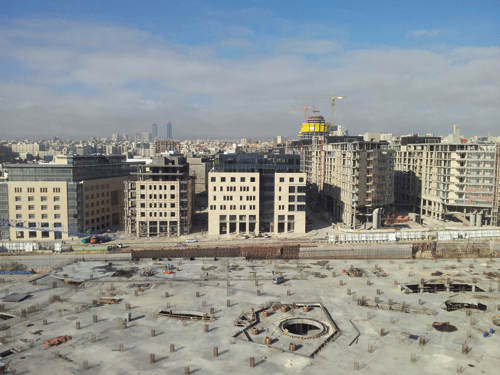
A skyline of skeleton towers

by Peter Speetjens March 3, 2012
written by Peter Speetjens

Reflecting the blue skies above, the Jordan Gate towers are the tallest — and arguably the emptiest — buildings on the Amman horizon. King Abdullah II in 2005 laid the foundation stone for the prestigious project, which was said to become the business address in the Hashemite Kingdom. Since 2009 however, the two giant cranes standing next to the towers have remained idle. The top floors have never been built and part of the glass exterior has come off. Today, the $300 million project remains a grim reminder of the days when the sky seemed the limit for Amman real estate.

The Jordan Gate was an initiative of the Gulf Finance House (GFH), a Bahrain-based investment firm badly hit by the 2008 financial crisis. GFH needed a $300 million loan to stay afloat and in 2010 escaped default only by agreeing to postpone the final repayment of $100 million. According to a prominent Jordanian contractor, who wished to remain anonymous due to fears public comments could jeopardize his business, GFH was not able to pay Al Hamad Contracting (AHC); instead, it offered the Sharjah-based firm the unfinished towers. Executive asked GFH and AHC to comment, but both declined.

“What happened is simple: the bubble burst,” said Wael Jaabari, owner of the large Jordanian real estate agency Abdoun Real Estate. “The developers had a business plan based on selling office space for some $4500 per square meter (sqm), which was, perhaps, feasible before the 2008 credit crunch. Yet they better get used to the new reality and swallow their losses. Maybe they can still rent out part of the building.”

“Compared to the peak prices of early 2008, prices in west Amman, depending on a property’s location and quality, have decreased by some 25 to 60 percent, while prices in the outskirts have decreased by some 80 percent,” said Jaabari. As an example, he refers to his office in Abdoun, a prime location, which he bought in 2010 for $1,200 per sqm, while a few years back people were paying up to $3,000. 

And yet the Jordan Department of Lands and Surveys (DLS) last January reported that the real estate market grew by 8 percent in 2011 to amount to nearly $9.8 billion, following a 25 percent increase in 2010. Hopeful signs of recovery, although the increase follows upon a decline of more than 30 percent in 2009 alone. When compared to 2007, the 2011 market is only 14 percent larger.

There are other reasons to treat the DLS statistics with care. “One government measure to boost trading was to abolish the real estate registration fee of some 10 percent,” said economist Yusuf Mansur, chief executive officer and owner of Jordanian consulting firm EnConsult. “Today, a government employee estimates the value of a property or land, which is generally higher than what the contract states. What’s more, the sales of a small number of commercially viable plots of land boost and obscure the overall picture.”

Boom & Burst

The reasons behind Jordan’s real estate boom prior to the crisis are well known. The 2003 United States-led invasion of Iraq forced many Iraqis to flee to Jordan. Some arrived, quite literally, with suitcases full of money, which they used to buy homes in Amman’s affluent western section. Price increases of up to 400 percent were recorded and real estate trading increased by a whopping 74 percent and 48 percent in 2004 and 2005, respectively.  The Amman market was awash with cash and seemingly everyone wanted a piece of the pie, including many foreign investors. An ABC Investments report states that 1,247 new construction companies were established between 2004 and 2008, of which 339 companies were established in 2008 alone. 

Today, the days of plenty seem long gone indeed, if only for the fact that loans are not as easy to come by. The Central Bank has imposed a strict ceiling of 20 percent of customer deposits on the amount of facilities granted by banks to the real estate and construction sector. “Banks are less lenient regarding real estate loans,” said Jaabari. “For a while, they permitted firms to postpone payments. Pay a bit now, a bit later. Now they just want their money. As a consequence, we no longer have pinball property development. No more building to speculate and sell; it’s a buyer’s market.”

The Jordan Gate project was not the bubble’s only victim. The GFH initially also intended to build the $800 million Royal Village — a project that never saw the light of day. The same is true for The Living Wall, a project that is anything but alive. An enormous billboard still reminds Amman of the six luxury towers and Buddha Bar that were set to arise. In 2006, the project was even named Best Future Commercial Project at Cityscape Dubai. Today it remains a huge hole in the ground. 

The Living Wall was the brain child of Mawared, a state-owned developer with close ties to the military, which has been tainted by a series of corruption scandals. Its former CEO, Akram Abu Hamdan, has been detained for allegedly pocketing millions of dollars.

Dubai World’s Limitless Towers did not even dig a hole. A massive marketing campaign prior to the crisis stressed the towers’ height: at 200 meters they would dwarf even the Jordan Gate, while the suspended swimming pool, at 125 meters, would be the world’s highest — would being the operative word, as the $300 million project was never even started.

Another failure concerns the $1 billion Saraya Aqaba resort. Construction started in 2006, yet has been stalled since 2008. Saraya Holdings, largely owned by former Lebanese Prime Minister Saad Hariri, also planned to build a $700 million Dead Sea resort. Announced with much fanfare at the 2007 World Economic Forum, construction never started. The same is true for the company’s regional projects. Small wonder therefore that the Saraya Holdings headquarter, which Hariri planned to build at his brother Bahaa’s Abdali Project, has been stalled as well [see box].

Abdali stays Afloat 

“The Abdali Project was not spared the effects of the global financial crisis like so many other large, mixed use developments,” said Salim Majzoub, deputy CEO of Abdali Investment and Development. “Since the start of the crisis, not a single investor has pulled out; however, construction work on some of the projects was halted for a period of time. Currently, some 15 percent of the developments in ‘phase one’ are on hold.”

With an estimated cost of $3 billion, the first phase of the Abdali Project foresees, among other elements, the construction of 12 mixed-use buildings and a shopping boulevard and mall, which are the heart of the 1.7 million sqm regeneration development in central Amman. The project is a joint venture between Jordan’s Mawared and Horizon, a Lebanese property developing firm established in 2002 by Bahaa Hariri. Both Mawared and Bahaa Hariri own 44 percent; the remainder is in the hands of Kuwait Projects Co.

If a tree falls in the forest…

As a forest of construction cranes continue to operate at Abdali, the project seems to have survived the onslaught that followed the 2008 crisis. “Approximately 75 percent of the mid-rise developments within the project will be ready for opening in 2012,” said Mazjoub. “They mainly consist of ‘Grade-A’ commercial and luxury residential space. The Abdali Boulevard has been over 80  percent completed and construction has started on the Abdali Mall, which is due to become operational by the end of 2013.” 

Since 2008, the project has received several loans from Arab Bank, BLOM Bank and Bank Audi, with work underway on a number of banks’ offices, as well as offices for Saudi Arabia’s Rajihi Cement and Lebanon’s MedGulf. Also, five towers are being built, among which are the Rotana Hotel Tower (“the highest in the Kingdom”) and a DAMAC residential tower. The Emirati developer reportedly faced some financial woes, yet found new partners to complete the 34-story building, though abandoned the initial idea of building a total of 7 luxury towers in the Jordanian capital.

The Abdali Project is arguably the most prestigious in the country. Modeled to a large extent on Solidere’s downtown Beirut project, it aims to become the new (commercial) heart of Amman. Its failure would be an absolute disaster for Jordan’s international standing. It remains to be seen however, if the project will finally be executed as planned on the drawing board. 

A planned university and medical city, reportedly, have already been cancelled. In the project’s $2 billion second phase are another nine high-rise towers and 25 mid-rise buildings. Seeing the fate of the twin coffins of the Royal Gate — and the many, many other plans to build Jordan’s biggest this and tallest that — perhaps a slightly humbler version is not entirely out of place.

Saraya dream turns sour

The Lebanese daily Al Akhbar reported on February 13 that King Abdullah of Saudi Arabia had saved Saad Hariri from bankruptcy by offering him a $2 billion interest-free loan. The latter firmly dismissed the report as Hezbollah propaganda. True or not, rumors over Hariri’s financial health have been persistent and if his real estate endeavors are anything to go by, then a major Saudi bailout would not come as a surprise.

Saad Hariri is the chairman and majority shareholder of Saraya Holdings, a Dubai-registered firm that aims to develop “luxurious mixed-use tourist destinations”. Its first and flagship project was announced in May 2005 at the World Economic Forum: Saraya Aqaba, a $1.2 billion mixed-use resort built around a man-made lagoon. In partnership with, among others, Arab Bank, the project had an initial capitalization of $242 million. It raised a further $120 million by issuing shares. 

Other project announcements followed in quick succession. In September 2005, Saraya Holdings, Arab Bank and the Emirate of Ras Al Khaimeh signed an agreement to launch the $500 million Saraya Islands. In February 2006, Saraya and Arab Bank launched a $250 million real estate investment fund. In June 2006, Saraya signed a deal with Oman to create a first-class beach resort south of Muscat. In 2007, it announced a deal to create a $700 million Dead Sea resort and a luxury resort on Russia’s Black Sea coast. Then came the ‘Big Bang’ of 2008, and suddenly things turned very silent indeed at Saraya Holdings. Work at Saraya Aqaba, by the construction arm of Hariri-owned Saudi Oger, had started in January 2006 but was stalled in 2008. Executive requests to Saraya Aqaba for further information on the matter were declined.

Last year, a former Saraya employee told Jordan’s Jo Magazine that Saraya Aqaba’s business model was based on one-third equity, one-third loans and one-third pre-sales. A model quickly undermined, he said, as the project’s estimated cost ballooned from $700 million to $1.2 billion. “The company grew incredibly quickly,” said a prominent Jordanian contractor and former employee of Saraya Aqaba, who wished to remain anonymous due to fears public comments could jeopardize his business. “It seemed they were trying to inflate the brand name in order to go public. Then the crash happened and we had to scale back dramatically. The marketing department in Amman alone went from thirty-five employees to just four or five. We thought it would get better, but the CEO, Ali Kolaghassi, eventually admitted that it wasn’t looking good — and that’s when many of us lost our jobs.”

While most Saraya projects are “on hold”, there is a chance that Saraya Aqaba will still rise from its coma. In October 2011, the company announced a new cash injection of $240 million by an unnamed Abu Dhabi investor, which follows a previous $350 million injection by Saraya Holdings’ Aqaba partners Arab Bank, the Aqaba Development Corporation and Jordan’s Social Security Corporation.

By February 2012, with work at Aqaba still yet to be resumed, the company issued a rare press release promising to begin discussions with clients who had bought homes in Saraya Aqaba. “We do appreciate the patience of our customers and look forward to addressing their needs within the coming weeks,” wrote Saraya Aqaba’s general manager, Saud Soror. Whether that means Saraya’s dream world of villas, townhouses and a lagoon will indeed manifest, one can only wait and see.

March 3, 2012 0 comments
0 FacebookTwitterPinterestEmail
Society

Snap, crackle and pop-ups

by Ellen Hardy March 3, 2012
written by Ellen Hardy

Life is tough for Lebanese designers. Despite unreliable spending and tourist numbers in a contracting economy, retail rents per square meter per year range from $400-$2,000 in malls, and are totally unregulated elsewhere. Multi-brand stores are reluctant to support local names, and even established retailers rely on holiday seasons to boost slack sales. This makes setting up shop a daunting prospect for small local businesses that need to boost their brand presence and client bases while running on minimal staff and overheads.

Some brands are therefore operating ‘limited edition’ or seasonal stores, which are as blink-and-you’ll-miss-them as Lebanese profit margins themselves. They are inspired by the trend in America and Europe for ‘pop-up shops’, which in some cities have become ubiquitous in their popularity. Opening sometimes for days or even hours, these stores offer unique products and experiences, from Hermès pitching its scarves and swimwear to summer crowds in the Hamptons, to ‘Alcoholic Architecture’ by Bombas & Parr, which filled a venue in London with vaporized gin and tonic. Brands love the marketing buzz and sales hike — qualities that are exceptionably valuable to Lebanese designers struggling for a foothold.

Temporal retail

“It’s not that sales increase twofold during the holiday period like Christmas and August, it’s that they increase seven to eight times,” says Nayla Assaf, whose casual contemporary clothing line En Ville has been selling wholesale to multi-brand stores in Beirut and Amman from a studio in Ain El Mreisseh since early 2010. She convinced Solidere to let her and six other brands take over a line of empty shops in the Souks for six weeks over Christmas and the New Year. 

“At this point in time it did not make sense for me to open a permanent shop,” says Assaf. “So I wanted to tap into that holiday buzz and holiday crowd… by choosing a really prime location with lots of tourists.” Unlike other locations that were overpriced and whose owners were reluctant to draft temporary contracts, Solidere listened to Assaf’s case that “we’re entrepreneurs, we’re Lebanese, those shops are empty… but equally we’re going to bring people. We have our own mailing lists, we have our own contacts.”

For a “symbolic” rent, these retailers could test the location and market, meet new clients and boost sales. Compared to her sales for the same period the previous year, Assaf scored an increase of around 150 percent, offset by incidental expenses like staff, décor, packaging and the DJs and catering that were an essential part of the “buzz”. Two of the pop-ups — jewellery designers Joanna Laura Constantine and Smartiz handbags and accessories — decided to extend their contracts on the site across Valentine’s Day and Mother’s Day. Joanna Laura Constantine, 90 percent of whose customers are in the United States, says that “the potential of the market in the Middle East had low expectations for me until I opened the pop-up store,” which exceeded her predictions “20 times over”. 

Elsewhere, Rouba Mortada’s paper products and homeware brand Choux à la Crème sells in a few local outlets, in Monocle stores worldwide and at Liberty in London, but she is not ready to commit to a Beirut boutique of her own. Instead, she opened her fourth-floor Clemenceau design studio to the public for two weeks in December, selling her standard and Christmas collections with special packaging and snacks on offer. A couple of posters and a Facebook group advertised “for two weeks only” and “limited edition pretty things”, generating 22 percent of her annual turnover. Simply, Mortada says, “it makes more sense and more money for me to sell on my own,” and the use-by date on a retail space can intensify this advantage. “It’s a whole experience,” says luxury brand consultant Marie-Noelle Azar from the agency Whyte Mulberry. “You’re selling them the product that they might not necessarily need but… because they know that in a week you won’t have it, they need to buy it now.” Mortada sees this potential as unexplored by established Lebanese brands: “One of the frustrations about Beirut is that it tends to run in the same circles… so I wouldn’t be surprised by any of the creatives doing a pop-up shop here.”

Seductive synergies 

For Nour Sabbagh and Nur Kaoukji, their ‘Beirut Loves’ pop-up experience is an end in itself rather than a test run or a boost to an existing brand, opening for 15 days a year and focusing on products from a different country each time, starting in 2011 with ‘Beirut Loves Jaipur’. 

“We both knew that we wanted something ephemeral, something that was a store and an event mixed into one,” says Kaoukji. “We imagine the store to be a kind of suitcase, something exciting we bring back from our travels.” They, too, scored a deal on a Downtown location. “People were initially surprised that we were only going to be present for 15 days, but that factor pulled them back. We received a lot of client’s details who were keen to be notified about our next pop-up.” For them, consumers are in a mood to be seduced by such projects. “One can sense their longing for this personal connection and we believe that this is going to affect businesses in the long run, the trend of the ‘one off’ or the handmade is growing stronger.”

Azar sees the pop-up trend in Beirut as an underdeveloped tool that, done properly, can bring together the best in online media, marketing and creative sales. “In terms of maturity… it’s still who you know that’s going to come and who you know that’s going to buy, it’s not commercial,” she says. “When pop-up stores started in Europe and the US they started in the main street where they know that they have traffic and they know that if they get the right product to this traffic they’re going to sell — you don’t have that here.” In an environment that lacks syndication, low-cost retail space or a healthy market for carefully crafted, locally branded goods, entrepreneurial artisans have always relied on exhibitions and exhibits to spread the word about their work; pop-up stores work on the same principle but with significantly more business benefits.

And when the store itself is the must-have limited-edition accessory, the possibilities are endless. Sara Darwiche at Chouchic.com, an invitation-only online boutique for the Middle East that deals in luxury labels, describes her marketing strategy as “a continuous virtual pop up store for a variety of high-end brands and trend setting styles [and] themes with a twist”.  

Daily sales at noon are driven by membership and email alerts that cause “a daily flood of transactional traffic,” she says, for a “business model based on scarcity, selection and urgency,” where “hundreds of thousands of shoppers compete online for the limited inventory… we expect the majority of the ‘hot’ items to be sold within the first 10 minutes, with the bulk of sales occurring within the first 90 minutes.” 

Attempting this sort of daily rush in the physical world, Hania Yaffawi from local multi-brand store Depeche Mode opened concept store 6:05 Downtown in January. Rather than spending money on traditional marketing, the store relies on the media and buzz generated by a daily cocktail hour with a DJ and weekly events with artists and musicians. If every day offers a unique or unusual experience, the theory goes, the clientele will be more diverse.

Big players in the industry are also waking up to the benefits of limited-edition, unusual events to hook customers. Retail rents at ABC Dbayeh might run at an estimated $1,000-$1,200 per square meter per year, but 205 square meters have been dedicated rent-free to temporary stalls for Lebanese designers for three months of 2012. The designers promote their wares in a new forum, and ABC benefits from corporate social responsibility brownie points, plus a percentage of the sales and publicity. As Azar says, it is a “win-win situation.”

March 3, 2012 0 comments
0 FacebookTwitterPinterestEmail
Society

Colored by uprising

by Executive Contributor March 3, 2012
written by Executive Contributor

As headlines are dominated by the Syrian political crisis, new exhibitions in Damascus have drawn to a halt. But the city’s art gallery doors are still open. 

The conflict seems unlikely to deter the Syrian contemporary art boom that has lit up the market over the last five years. In 2007, a major work by Safwan Dahoul, a leading and much coveted Syrian painter, sold for $10,000. Today it reaches $150,000. The post-9/11 appetite for Arab culture may have played its part; as titles on Islam and the Middle East flew off the virtual shelves of amazon.com, art from the Middle East also experienced unprecedented international attention. 

Compared to artists from Lebanon, Morocco and Egypt, who were already relatively exposed to global galleries and collectors, Syria revealed itself to be an oil well of untapped talent, paint being the asset. Artwork prices soared, contemporary art galleries mushroomed and reports such as “Syrian Art Sizzles” (Time Magazine, Sept 2008) and “Damascus Evolves Into a Hub of Mideast Art” (New York Times, Nov 2010) saluted the awakening. 

“The talent hiding over the last five or six years was the surprise factor, the shock factor, that made them globally interesting,” says Khaled Samawi, the owner of Ayyam Gallery, a blockbuster art enterprise with a roster of some of the most highly-valued Arab artists — the majority from Syria — and a triad of exhibition spaces in Damascus, Beirut and Dubai. “When we first opened in 2006 to 2007, in Damascus, it was absolute golden years. I’d say once a week a private jet would land from the Gulf or somewhere, who had come to Damascus just to visit Ayyam.” Samawi, a former hedge fund manager, has spearheaded the rise of Syrian contemporary art, with a smaller cluster of galleries, such as Damascus’ Tajalliyat Art Gallery, and auction houses Christie’s and Sotheby’s following suit.  Most of Ayyam’s artists, such as Asaad Arabi and Oussama Diab, have seen their paintings rocket in value five to 10-fold, thanks to Ayyam’s polished and well-publicized exhibitions, record-breaking auctions and young artist competitions. By providing their artists financial stability and access to an international hit list of collectors, the market has grown so much that Edge Capital, a venture capital and private equity holding company, is now choosing to invest in Ayyam’s expansion. New galleries in London and New York will open in the next two to three years, a major triumph for Middle Eastern art. Samawi sees it as a “vote of confidence”, both for the artists and collectors, giving “the scoop” to Executive before the official press announcement. 

Fearless expression

The investment strikes at the right time. The political uncertainty embroiling Syria is inspiring a new drive in contemporary art: angry, poignant and provocative. “They’re painting the best art they’ve ever produced. It’s painful, humanitarian art,” Samawi describes it. 

“For years people have been living under fear, and now the fear is gone. Now artists can express themselves. There are no more taboos. They can talk about the president, the power, the party,” says Ammar Abd Rabbo, a Paris-based Syrian photojournalist who exhibited “Coming Soon”, a series of portraits of pregnant women, in Beirut last February. He believes there is a new, powerful generation of young Syrian artists in the making, “born from the crisis and revolution.” 

Some art has already left Damascus’ citadel. “In Army We Trust”, a radical set of paintings by Thaier Helal, sold positively at Ayyam’s Dubai gallery earlier this year, despite its provocative title. Established artists Mohannad Orabi, Mouteea Murad, Kais Saman and Omran Younes have abandoned their solitary ateliers and transformed the empty Damascus gallery — which stopped hosting new exhibitions four months ago — into a remarkable shared workspace. The ferocious art being produced, both in quantity and subject matter, is broadcasted on a live feed from Ayyam’s website. “It’s probably the busiest the gallery has ever been,” says Samawi, who has offered the space as a cultural refuge to citizens surrounded by violence.

“We started the workshop to see this situation in a different way. There is a huge power inside us, and we have to make these ideas and feelings visual,” says young Damascus-born painter Mohannad Orabi, whose work is becoming “more realistic, more emotional.” The eerie, blackened eyes of his human figures are unmistakable, but Orabi now paints them “open.” “Now,” he says, “you can see the detail inside and the sparkle. This sparkle is a kind of hope.”

March 3, 2012 0 comments
0 FacebookTwitterPinterestEmail
Society

Banquet on the bay

by Ellen Hardy March 3, 2012
written by Ellen Hardy

Even by the standards of a city where you can dine at the tables of multi-Michelin-starred chefs one night (Yazhou, S.T.A.Y.) and be seen eating out at global trendsetters the next (Momo at the Souks, Gaucho), Zaitunay Bay is piquing interest. Pitching as it does a complex of 17 new restaurants, five retail outlets and a public promenade into the heart of the commercial district at a cost of $160 million, the brainchild of Beirut Waterfront Development (BWD) is a bold attempt to recreate the area’s pre-war sense of glamour and community. But what is it like for the local businesses whose hopes are riding on the project’s success? 

Two concepts, Cro Magnon Steakhouse & Bar and St Elmo’s Seaside Brasserie, are the work of one set of five Lebanese investors, and for them, the location sealed the deal. Though rental prices in Hamra and Ashrafieh may have been anywhere from 10 to 20 per cent cheaper, “We wouldn’t have come on board if it wasn’t Zaitunay Bay,” says one of the investors, Mazen Fakhoury. Employing some 100 people between the two restaurants, Cro Magnon is a high-end, glamorous steak house, and St Elmo’s a more casual brasserie with a slew of theme nights. Putting together the $4.5 million initial investment required a special chemistry between the five shareholders, who came together through casual meetings and are mostly newcomers to the hospitality industry. Operations manager Joey Ghazal is the most experienced restaurateur of the group, with over 14 years in the restaurant industry in Montreal and London. He is joined by engineering and financial investment services CEO Houssam Batal, nightclub public relations and communications veteran Ramzi Traboulsi, oil and gas expert Mazen Fakhoury and finance professional Rami Batal. 

Ghazal and Traboulsi first met with the BWD in February 2010, when they proposed a casual seaside brasserie. Learning that the landlord was also insisting on having a steakhouse in the project, they ended up signing the leases for two restaurants in December. “There are a lot of back office and operational expenses that you incur,” explains Ghazal, “and it’s obviously better to take those on over two profit centers.” On this day February, as the five settled into their distressed leather armchairs at Cro Magnon to sample their own menu of prime steaks and seafood, single malts and cigars, more than a desire to make a quick, high return on their investments ties them together. “You have to feel that there’s a measure of trust, a foundation of business understanding,” says Ghazal. All the investors contribute their business wherewithal; Rami Batal, for example, already has accounting and finance infrastructure in place for his other companies, so can manage the back office, while Traboulsi contributes PR expertise. “They’re their own number one clients,” winks Traboulsi. Established businessmen with a taste for the finer things in life, they came on board for the chance to bring a type of restaurant to Lebanon that they’ve admired abroad. “We are people who travel a lot and… appreciate the best class restaurants in the world,” says Houssam Batal. As such, he explains, they are long-term investors, not out to make a quick buck. They “hope to be able to pay back our investment in three years… you expect to double your money at least within the first five years maybe.”

Working with Zaitunay Bay ensured that there would be no competing concepts on the site; the most intense negotiations were over the specific concept briefs. After that, says Ghazal, apart from external design issues, the BWD was surprisingly hands-off — though citing problems with ventilation and delivery access, he notes wryly that the complex overall “could have been designed by someone who has some knowledge of the restaurant industry. It wasn’t.” Other niggles of opening a restaurant in Beirut — such as a lack of qualified staff and the terrible truism that political uncertainty hangs over everything — are a standard part of the deal. Just two months into operation, it is too early for Zaitunay Bay to release meaningful footfall and revenue figures, but Ghazal will say that “the landlord assured us they were going to do everything in their power to ensure a certain amount of footfall per week or per day, and the project has kept its promise.”  

Like most restaurant businesses, the shareholders are open to including other investors and franchising the concepts to other territories in the future. As Zaitunay Bay looks ahead to spring, its many partners will be hoping to see their investments flourish. “It’s a high risk, high reward country,” concludes Houssam Batal, and one that is unlikely to lose its appetite.

March 3, 2012 0 comments
0 FacebookTwitterPinterestEmail
Society

A crown for the wrist

by Michael Karam March 3, 2012
written by Michael Karam

Ask anyone on the street what he or she thinks the world’s most luxurious watch brand is, and they will probably say Rolex. They’d be wrong. But perception is everything, and the timepiece that is regarded as the sign that you have made it — a person to be reckoned with, a person imbued with a hint of rugged glamour — is indeed a Rolex. There are more accurate watches, more expensive brands and more prestigious brands, but Rolex has captured our imagination like no other.

Don’t get me wrong. There is no sleight of hand here. They are not, in luxury watch terms at least, overpriced (unlike some brands I could name). They are supremely well made and they will last forever. I should know; I have a steel Rolex Oyster Perpetual Datejust made in 1963. It still keeps immaculate time and has been serviced a maximum of four times in its life. It also looks almost identical to the current model — the only difference is an extra 2mm in the diameter, a sapphire glass and a quick date changer. So in a global luxury watch market that has gone bonkers in the last 20 years, Rolex has both pedigree and consistency.

The company was founded in London in 1905 by Hans Wilsdorf and Alfred Davis and moved to Switzerland in 1919 after the First World War. By 2003, Rolex was earning revenues of $3 billion annually, according to Stern Business, with BusinessWeek ranking it the 71st most valuable brand in the world in 2007. Like Patek Philippe, arguably the most prestigious watch brand in the world — and unlike other luxury brands such as Vacheron Constantine and Jaeger Le Coultre, both of whom are owned by the Richemont Group — Rolex is still a private company, a factor that arguably adds to its aura of distinction.

So what is it about Rolex’s enduring appeal? Luxury aside (Rolex caters to all tastes, even producing some eccentric designs for those who like a bit of diamond-encrusted bling), I would wager it is the fact that no other watch has as much history, glamour, sex appeal and adventure, allied to reliability and looks, wrapped up in one brand. 

 Take the Rolex Submariner, the iconic diving watch that was worn by Sean Connery’s Bond on a fabric NATO strap — to lady-killing effect — or the Explorer, the equally famous black-faced chronometer. You aren’t just buying a watch, you are buying into the very fabric of 20th century achievement. Omega is the only watch brand that comes close to matching this heritage (its Speedmaster was famously worn on the moon) but Rolex, with its functional designs and almost onomatopoeic name, has captured more of the public’s imagination, allying itself with sports stars, musicians and scientific pioneers the world over. Not surprisingly, Rolexes are among the few brands with a strong resale value, especially for the iconic Daytona Cosmograph with its famous Zenith “El Primero” movement, and the other professional models. 

 But at the end of the day, it’s all about owning the item that you love. And as my wife found out, Rolex watches are very desirable. She does not share my obsession with watches, but over the years has faithfully tramped round showrooms or stood patiently as I peered in shop windows like an excited schoolboy. For her a watch is a watch. It tells the time. Who cares if it’s manual, automatic or quartz, or if it’s a 36mm or a 45mm? But on New Year’s Eve, while I tried on a new Explorer II (now 42mm and with an orange 24 hour hand, if you must know) in the Rolex showroom in Beirut, she pointed to an Air King in brushed steel with subtle blue numeral batons on an off-white face. “I like that a LOT,” she said. It was the first time she had ever really expressed a genuine interest in a watch. What could I do?

March 3, 2012 0 comments
0 FacebookTwitterPinterestEmail
Society

Tender teachings

by Ali Kazma March 3, 2012
written by Ali Kazma

At any given moment in a randomly selected Lebanese café, one will likely spot an eight-year-old girl amusing herself with the newest iPad or other high-tech device. It is difficult to imagine that said young girl realizes that what she holds in her hands is worth more than what thousands of Lebanese families make each month. These children are being raised to see expensive things — and money itself — as playthings, and what many are not learning as they grow into adults is that financial success requires them to see money as a tool, not a toy.  

In Beirut and other metropolitan areas, conspicuous consumption seems to be the order of the day. It is becoming all too easy to forget that almost 30 percent of the country lives in poverty, according to the United Nations. With all of this country’s outward displays of wealth, what’s slightly less apparent is how much of our nation’s youth is clueless about the true value of money, and the risks this financial illiteracy poses to the country at large.  

While Lebanon was lucky enough to be relatively insulated from recent global economic crises, all over the country one can see the effect that poor money management is having on the nation as a whole. We live in a culture of waste at every level in our society — from the government sector to the corporate realm, and we often see examples of poor financial decision-making at work within individual homes. Consumer debt levels are climbing, while our public debt is estimated at a jaw dropping $54.3 billion, roughly 133 percent of GDP, among the highest ratios in the world. Lebanon exports relatively little aside from much needed human capital, but our taste for extravagant things still sees us importing products and luxury items at considerable levels. The Lebanese economy is increasingly dependent on remittances from those living abroad, but given the recent economic crises around the globe, this dependency will only make us more susceptible to market fluctuations elsewhere.  All together, if this continues unchanged, it is a recipe for national disaster.  

Nipping the bud

We must combat these dangerous practices that place our entire economy at risk, and it is imperative we start the fight early. If we ever hope to witness the success borne from a financially responsible citizenry, we ought to begin by teaching Lebanese youth to respect and understand the value of a lira, by teaching them how any economy works: You work hard for financial rewards, and then you must make important decisions regarding how to best and most efficiently use those resources. 

Understanding how money is earned, and learning through vivid and detailed first-hand experience how to make informed and conscientious financial decisions, will give our children the best tools to succeed in the modern world. Some parents already do this by involving their little ones in the purchases they make everyday. Parents need to let their children see and understand that money is not something to be toyed around with. Giving children strict allowances and spending limits, as well as explaining our own financial decisions, will help train youth to cope with the kind of financial choices they will be forced to make later on. 

Outside the home, Lebanese parents and policy makers should begin to encourage activities for our children that will help us instill these important financial values early on. Fortunately for parents, teachers, and children alike, there are facilities popping up all over the globe that are developed with just this goal in mind, and one is set to open in Beirut in the summer of 2012. These facilities employ a concept called “edutainment,” and are rich, highly interactive mini-cities with functioning kid-sized economies that encourage children to learn the value of money by role-playing through numerous careers, earning “cash,” and offering choices on how to invest that money throughout the facility, with not all choices being equal. 

Though money might not be a toy, if we aim to take a playful approach in transmitting these important economic practices, learning how to be financially responsible can still be great fun. If we do not, the opportunity to address our current state of financial illiteracy will skip another generation.

March 3, 2012 0 comments
0 FacebookTwitterPinterestEmail
The Buzz

Promise and peril

by James Reddick March 3, 2012
written by James Reddick

Above the vast expanse of the East African plains, signs of human life finally come into view. Hardly the congested maelstrom of its neighboring capital cities of Kampala and Nairobi, Juba spreads outwards in moderation, a seemingly sedate outpost along the Nile. As the plane circles, the thatched, pointed roofs of tukuls, mud huts not usually befitting a nation’s capital, appear, dotted among the city’s more robust structures. 
    
After touching down, the weary arrivals pile into the stiflingly claustrophobic room that makes up this “international” airport’s baggage terminal and immigration hall. Some are returning home after years away, having left to escape the war and to seek out opportunity in neighboring Uganda and Kenya, or beyond, and anxiously await the reunion beyond these walls with their long-separated families. One man spots a woman outside — most likely his mother — and waves excitedly. She puts her hand to her face in exaggerated joy. Drawn back by the promises suggested by independence, and the prospect of lasting peace, what is actually to come for this man and other returnees, and for those who waited out the continent’s longest running civil war, is increasingly uncertain.
    
On the streets of Juba, and other semi-urban centers like Rumbek and Torit, the excitement in late 2011 remained palpable. The boyish face of John Garang, the founder of the Sudan People’s Liberation Army, which fought and won against Khartoum’s rule from the North, stares down approvingly from billboards throughout the capital, and t-shirts commemorating the July 9 day of independence are still very much the fashion du jour. But while nobody expected an easy transition to statehood for the world’s newest nation, just how calamitous an infancy it has proved to be has shocked those who for so long sponsored the idea of a sovereign South Sudan.
    
Nearly 40 years of civil war since united Sudan’s independence from British control in 1955  have naturally taken their toll — all the more so since one of the costs, and a principal motivation, of that guerilla war with the predominantly Arab North was a deprivation of development in the South. In terms of infrastructure, the country is virtually starting from scratch, with no homegrown electricity generation, 100 kilometers of paved roads in a country of approximately 660,000 square kilometers and no running water. In late fall of 2011, at the end of the rainy season, huge swaths of the country — nearly all of the northern half — were inaccessible by car, and even those routes with “safe passage” were a pock-marked mess, littered by the carcasses of trucks and vans left to rot after succumbing to one of many craters. For South Sudan, infrastructural development should be the number one priority of the new government, but the persistent threat of violent conflict both with Khartoum and among communities within the south is siphoning its resources and attention.
    
Cattle raiding — the practice of stealing another group’s livestock — is certainly not a new phenomenon among the country’s largely pastoral communities, but the scale of the raids and the collateral damage inflicted on civilians have escalated dramatically. At a certain point the term “cattle raiding” no longer does the violence justice; in December, a series of cyclical clashes between the Murle and Lou Nuer tribes in the largest and least developed state, Jonglei, prompted the release of an open letter by the Lou Nuer calling for the extermination of the rival group. In due course, “6,000 to 8,000” Lou Nuer youths brazenly attacked Murle villages over the span of several days and killed more than 3,000 people, according to a local commissioner (the figure has yet to be confirmed by the government). Despite tracking the column of fighters for weeks, neither United Nations peacekeepers, nor the SPLA (South Sudan’s army) soldiers deployed to prevent their approach were able to intervene, as the raiders’ forces dwarfed their own.
    
And particularly troubling in post-independence South Sudan are relations with the North, as the prospect for a return to war grows more imminent by the day. The two are linked by oil, a vital resource for both struggling economies, the majority of which lies in South Sudanese territory. Once extracted, however, it must pass through the North, up to Port Sudan. Since independence, the two sides have been unable to agree on a transit fee for the oil, leading Khartoum to seize shipments and Juba to halt its pumping altogether in January. And as the North suppresses an internal rebellion on its southern front, it has bombed the disputed town of Jau on multiple occasions, wounding several SPLA soldiers, as both sides mass forces along their respective borders.
    
This was not the narrative envisioned by John Garang, nor by those who danced in the streets on July 9 in cathartic jubilation. And it is certainly not the foundation of a new and better life envisioned by returnees — neither the more than 100,000 from the north, nor members of the diaspora who bring with them technical skills essential towards rebuilding a country. Blessed by largely untapped natural resources, South Sudan has the potential to be an economic powerhouse in East Africa, but the same conflict that has stunted its growth for decades continues to fester.
    
Back in the arrivals hall, the developmental depths out of which this nascent country will need to rise are on full display. The returnee jostles for position at the end of a conveyor belt, which unceremoniously dumps a suitcase to the floor while its owner scrambles to retrieve it, pushing people aside, before the next one falls on top. At the immigration desk, desperate hands wave passports at the two unfazed officials while a European NGO employee argues with another who has rebuffed her visa. It is not an easy thing to leave Juba Airport. Finally, passports stamped, bags collected and blood pressure high, the man steps out into the late morning sun of South Sudan, the world’s newest nation.

March 3, 2012 0 comments
0 FacebookTwitterPinterestEmail
Society

Porsches for courses

by Yasser Akkaoui March 3, 2012
written by Yasser Akkaoui

Las Palmas sprawls along the coast of the third largest of the Canary Islands archipelago, scattered in the warm seas just beyond the northwest coast of Africa. From a satellite’s eye view, the island is almost a perfect circle; Gran Canaria, with a surface area of 1,560 square kilometers, centers around its highest peak, the extinct volcano Pico de Las Nieves — the ‘peak of snows’ — at 1,949 meters. It’s a long way from Lebanon, and yet the charms are superficially similar: you can spend your days basking in balmy weather, draining the cocktail bars while admiring the snow-capped peaks above. It’s a superb destination for a Porsche press trip to test out their gleaming new 911 Carrera Cabriolet, but it also reminds you how pollution and traffic impede top-down driving in Beirut.

Until now, the choice between coupé and cabriolet might have been an agonizing one for someone considering dropping in the region of $100,000 (depending on customs fees) on the car of their dreams. Supreme performance from a coupé, or the style and freedom of a cabriolet with some compromises on the frame and engine? Now, a new intelligent lightweight design for the hood and all-aluminum frame for the body means that when the hood is up, the silhouettes of the coupé and the cabriolet are barely distinguishable. And, both of the 911 Careera Cabriolet and the sports version have the same engine as the 911 Carrera Coupé equivalent: 3.4 and 3.8 liter boxer engines, respectively, with 350 and 400 horse power. The driving power has been ratcheted up as well, with electro-mechanical power steering and, for the Carrera S, Porsche Torque Vectoring with differential lock featured as standard.

Foot to the floor

These features were amply put to the test spiraling up the sides of Pico de Las Nieves in a yellow Carrera S the morning after our arrival. The car, with its significantly reduced weight from previous models and torque of 390 Newton meters at 5,600 revolutions per minute, ate up the roads and cornered elegantly. 

The fantasy trip came to an end on the sands of the Las Palmas autodrome. In this environment you really test the car, and the fact that these are seriously high quality racing sports cars comes to the fore. Handling them requires reaching top speeds of around 286 kilometers per hour and taking curves brutally fast, and after putting the pedal to the floor for two to three laps you have to cool the car down for one slow driving lap, a process that really drives home its racing credentials.

After honing my embrace of the car and witling down my lap time through the day, needless to say, I left Las Palmas with a smile on my face.

March 3, 2012 0 comments
0 FacebookTwitterPinterestEmail
  • 1
  • …
  • 341
  • 342
  • 343
  • 344
  • 345
  • …
  • 686

Latest Cover

About us

Since its first edition emerged on the newsstands in 1999, Executive Magazine has been dedicated to providing its readers with the most up-to-date local and regional business news. Executive is a monthly business magazine that offers readers in-depth analyses on the Lebanese world of commerce, covering all the major sectors – from banking, finance, and insurance to technology, tourism, hospitality, media, and retail.

  • Donate
  • Our Purpose
  • Contact Us

Sign up for our newsletter

    • Facebook
    • Twitter
    • Instagram
    • Linkedin
    • Youtube
    Executive Magazine
    • ISSUES
      • Current Issue
      • Past issues
    • BUSINESS
    • ECONOMICS & POLICY
    • OPINION
    • SPECIAL REPORTS
    • EXECUTIVE TALKS
    • MOVEMENTS
      • Change the image
      • Cannes lions
      • Transparency & accountability
      • ECONOMIC ROADMAP
      • Say No to Corruption
      • The Lebanon media development initiative
      • LPSN Policy Asks
      • Advocating the preservation of deposits
    • JOIN US
      • Join our movement
      • Attend our events
      • Receive updates
      • Connect with us
    • DONATE