• Donate
  • Our Purpose
  • Contact Us
Executive Magazine
  • ISSUES
    • Current Issue
    • Past issues
  • BUSINESS
  • ECONOMICS & POLICY
  • OPINION
  • SPECIAL REPORTS
  • EXECUTIVE TALKS
  • MOVEMENTS
    • Change the image
    • Cannes lions
    • Transparency & accountability
    • ECONOMIC ROADMAP
    • Say No to Corruption
    • The Lebanon media development initiative
    • LPSN Policy Asks
    • Advocating the preservation of deposits
  • JOIN US
    • Join our movement
    • Attend our events
    • Receive updates
    • Connect with us
  • DONATE
Real Estate

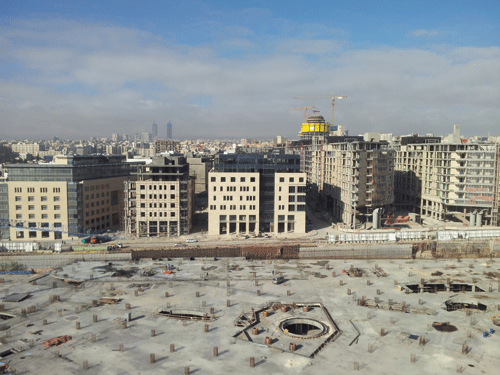
A skyline of skeleton towers

by Peter Speetjens March 3, 2012
written by Peter Speetjens

Reflecting the blue skies above, the Jordan Gate towers are the tallest — and arguably the emptiest — buildings on the Amman horizon. King Abdullah II in 2005 laid the foundation stone for the prestigious project, which was said to become the business address in the Hashemite Kingdom. Since 2009 however, the two giant cranes standing next to the towers have remained idle. The top floors have never been built and part of the glass exterior has come off. Today, the $300 million project remains a grim reminder of the days when the sky seemed the limit for Amman real estate.

The Jordan Gate was an initiative of the Gulf Finance House (GFH), a Bahrain-based investment firm badly hit by the 2008 financial crisis. GFH needed a $300 million loan to stay afloat and in 2010 escaped default only by agreeing to postpone the final repayment of $100 million. According to a prominent Jordanian contractor, who wished to remain anonymous due to fears public comments could jeopardize his business, GFH was not able to pay Al Hamad Contracting (AHC); instead, it offered the Sharjah-based firm the unfinished towers. Executive asked GFH and AHC to comment, but both declined.

“What happened is simple: the bubble burst,” said Wael Jaabari, owner of the large Jordanian real estate agency Abdoun Real Estate. “The developers had a business plan based on selling office space for some $4500 per square meter (sqm), which was, perhaps, feasible before the 2008 credit crunch. Yet they better get used to the new reality and swallow their losses. Maybe they can still rent out part of the building.”

“Compared to the peak prices of early 2008, prices in west Amman, depending on a property’s location and quality, have decreased by some 25 to 60 percent, while prices in the outskirts have decreased by some 80 percent,” said Jaabari. As an example, he refers to his office in Abdoun, a prime location, which he bought in 2010 for $1,200 per sqm, while a few years back people were paying up to $3,000. 

And yet the Jordan Department of Lands and Surveys (DLS) last January reported that the real estate market grew by 8 percent in 2011 to amount to nearly $9.8 billion, following a 25 percent increase in 2010. Hopeful signs of recovery, although the increase follows upon a decline of more than 30 percent in 2009 alone. When compared to 2007, the 2011 market is only 14 percent larger.

There are other reasons to treat the DLS statistics with care. “One government measure to boost trading was to abolish the real estate registration fee of some 10 percent,” said economist Yusuf Mansur, chief executive officer and owner of Jordanian consulting firm EnConsult. “Today, a government employee estimates the value of a property or land, which is generally higher than what the contract states. What’s more, the sales of a small number of commercially viable plots of land boost and obscure the overall picture.”

Boom & Burst

The reasons behind Jordan’s real estate boom prior to the crisis are well known. The 2003 United States-led invasion of Iraq forced many Iraqis to flee to Jordan. Some arrived, quite literally, with suitcases full of money, which they used to buy homes in Amman’s affluent western section. Price increases of up to 400 percent were recorded and real estate trading increased by a whopping 74 percent and 48 percent in 2004 and 2005, respectively.  The Amman market was awash with cash and seemingly everyone wanted a piece of the pie, including many foreign investors. An ABC Investments report states that 1,247 new construction companies were established between 2004 and 2008, of which 339 companies were established in 2008 alone. 

Today, the days of plenty seem long gone indeed, if only for the fact that loans are not as easy to come by. The Central Bank has imposed a strict ceiling of 20 percent of customer deposits on the amount of facilities granted by banks to the real estate and construction sector. “Banks are less lenient regarding real estate loans,” said Jaabari. “For a while, they permitted firms to postpone payments. Pay a bit now, a bit later. Now they just want their money. As a consequence, we no longer have pinball property development. No more building to speculate and sell; it’s a buyer’s market.”

The Jordan Gate project was not the bubble’s only victim. The GFH initially also intended to build the $800 million Royal Village — a project that never saw the light of day. The same is true for The Living Wall, a project that is anything but alive. An enormous billboard still reminds Amman of the six luxury towers and Buddha Bar that were set to arise. In 2006, the project was even named Best Future Commercial Project at Cityscape Dubai. Today it remains a huge hole in the ground. 

The Living Wall was the brain child of Mawared, a state-owned developer with close ties to the military, which has been tainted by a series of corruption scandals. Its former CEO, Akram Abu Hamdan, has been detained for allegedly pocketing millions of dollars.

Dubai World’s Limitless Towers did not even dig a hole. A massive marketing campaign prior to the crisis stressed the towers’ height: at 200 meters they would dwarf even the Jordan Gate, while the suspended swimming pool, at 125 meters, would be the world’s highest — would being the operative word, as the $300 million project was never even started.

Another failure concerns the $1 billion Saraya Aqaba resort. Construction started in 2006, yet has been stalled since 2008. Saraya Holdings, largely owned by former Lebanese Prime Minister Saad Hariri, also planned to build a $700 million Dead Sea resort. Announced with much fanfare at the 2007 World Economic Forum, construction never started. The same is true for the company’s regional projects. Small wonder therefore that the Saraya Holdings headquarter, which Hariri planned to build at his brother Bahaa’s Abdali Project, has been stalled as well [see box].

Abdali stays Afloat 

“The Abdali Project was not spared the effects of the global financial crisis like so many other large, mixed use developments,” said Salim Majzoub, deputy CEO of Abdali Investment and Development. “Since the start of the crisis, not a single investor has pulled out; however, construction work on some of the projects was halted for a period of time. Currently, some 15 percent of the developments in ‘phase one’ are on hold.”

With an estimated cost of $3 billion, the first phase of the Abdali Project foresees, among other elements, the construction of 12 mixed-use buildings and a shopping boulevard and mall, which are the heart of the 1.7 million sqm regeneration development in central Amman. The project is a joint venture between Jordan’s Mawared and Horizon, a Lebanese property developing firm established in 2002 by Bahaa Hariri. Both Mawared and Bahaa Hariri own 44 percent; the remainder is in the hands of Kuwait Projects Co.

If a tree falls in the forest…

As a forest of construction cranes continue to operate at Abdali, the project seems to have survived the onslaught that followed the 2008 crisis. “Approximately 75 percent of the mid-rise developments within the project will be ready for opening in 2012,” said Mazjoub. “They mainly consist of ‘Grade-A’ commercial and luxury residential space. The Abdali Boulevard has been over 80  percent completed and construction has started on the Abdali Mall, which is due to become operational by the end of 2013.” 

Since 2008, the project has received several loans from Arab Bank, BLOM Bank and Bank Audi, with work underway on a number of banks’ offices, as well as offices for Saudi Arabia’s Rajihi Cement and Lebanon’s MedGulf. Also, five towers are being built, among which are the Rotana Hotel Tower (“the highest in the Kingdom”) and a DAMAC residential tower. The Emirati developer reportedly faced some financial woes, yet found new partners to complete the 34-story building, though abandoned the initial idea of building a total of 7 luxury towers in the Jordanian capital.

The Abdali Project is arguably the most prestigious in the country. Modeled to a large extent on Solidere’s downtown Beirut project, it aims to become the new (commercial) heart of Amman. Its failure would be an absolute disaster for Jordan’s international standing. It remains to be seen however, if the project will finally be executed as planned on the drawing board. 

A planned university and medical city, reportedly, have already been cancelled. In the project’s $2 billion second phase are another nine high-rise towers and 25 mid-rise buildings. Seeing the fate of the twin coffins of the Royal Gate — and the many, many other plans to build Jordan’s biggest this and tallest that — perhaps a slightly humbler version is not entirely out of place.

Saraya dream turns sour

The Lebanese daily Al Akhbar reported on February 13 that King Abdullah of Saudi Arabia had saved Saad Hariri from bankruptcy by offering him a $2 billion interest-free loan. The latter firmly dismissed the report as Hezbollah propaganda. True or not, rumors over Hariri’s financial health have been persistent and if his real estate endeavors are anything to go by, then a major Saudi bailout would not come as a surprise.

Saad Hariri is the chairman and majority shareholder of Saraya Holdings, a Dubai-registered firm that aims to develop “luxurious mixed-use tourist destinations”. Its first and flagship project was announced in May 2005 at the World Economic Forum: Saraya Aqaba, a $1.2 billion mixed-use resort built around a man-made lagoon. In partnership with, among others, Arab Bank, the project had an initial capitalization of $242 million. It raised a further $120 million by issuing shares. 

Other project announcements followed in quick succession. In September 2005, Saraya Holdings, Arab Bank and the Emirate of Ras Al Khaimeh signed an agreement to launch the $500 million Saraya Islands. In February 2006, Saraya and Arab Bank launched a $250 million real estate investment fund. In June 2006, Saraya signed a deal with Oman to create a first-class beach resort south of Muscat. In 2007, it announced a deal to create a $700 million Dead Sea resort and a luxury resort on Russia’s Black Sea coast. Then came the ‘Big Bang’ of 2008, and suddenly things turned very silent indeed at Saraya Holdings. Work at Saraya Aqaba, by the construction arm of Hariri-owned Saudi Oger, had started in January 2006 but was stalled in 2008. Executive requests to Saraya Aqaba for further information on the matter were declined.

Last year, a former Saraya employee told Jordan’s Jo Magazine that Saraya Aqaba’s business model was based on one-third equity, one-third loans and one-third pre-sales. A model quickly undermined, he said, as the project’s estimated cost ballooned from $700 million to $1.2 billion. “The company grew incredibly quickly,” said a prominent Jordanian contractor and former employee of Saraya Aqaba, who wished to remain anonymous due to fears public comments could jeopardize his business. “It seemed they were trying to inflate the brand name in order to go public. Then the crash happened and we had to scale back dramatically. The marketing department in Amman alone went from thirty-five employees to just four or five. We thought it would get better, but the CEO, Ali Kolaghassi, eventually admitted that it wasn’t looking good — and that’s when many of us lost our jobs.”

While most Saraya projects are “on hold”, there is a chance that Saraya Aqaba will still rise from its coma. In October 2011, the company announced a new cash injection of $240 million by an unnamed Abu Dhabi investor, which follows a previous $350 million injection by Saraya Holdings’ Aqaba partners Arab Bank, the Aqaba Development Corporation and Jordan’s Social Security Corporation.

By February 2012, with work at Aqaba still yet to be resumed, the company issued a rare press release promising to begin discussions with clients who had bought homes in Saraya Aqaba. “We do appreciate the patience of our customers and look forward to addressing their needs within the coming weeks,” wrote Saraya Aqaba’s general manager, Saud Soror. Whether that means Saraya’s dream world of villas, townhouses and a lagoon will indeed manifest, one can only wait and see.

March 3, 2012 0 comments
0 FacebookTwitterPinterestEmail
Society

Snap, crackle and pop-ups

by Ellen Hardy March 3, 2012
written by Ellen Hardy

Life is tough for Lebanese designers. Despite unreliable spending and tourist numbers in a contracting economy, retail rents per square meter per year range from $400-$2,000 in malls, and are totally unregulated elsewhere. Multi-brand stores are reluctant to support local names, and even established retailers rely on holiday seasons to boost slack sales. This makes setting up shop a daunting prospect for small local businesses that need to boost their brand presence and client bases while running on minimal staff and overheads.

Some brands are therefore operating ‘limited edition’ or seasonal stores, which are as blink-and-you’ll-miss-them as Lebanese profit margins themselves. They are inspired by the trend in America and Europe for ‘pop-up shops’, which in some cities have become ubiquitous in their popularity. Opening sometimes for days or even hours, these stores offer unique products and experiences, from Hermès pitching its scarves and swimwear to summer crowds in the Hamptons, to ‘Alcoholic Architecture’ by Bombas & Parr, which filled a venue in London with vaporized gin and tonic. Brands love the marketing buzz and sales hike — qualities that are exceptionably valuable to Lebanese designers struggling for a foothold.

Temporal retail

“It’s not that sales increase twofold during the holiday period like Christmas and August, it’s that they increase seven to eight times,” says Nayla Assaf, whose casual contemporary clothing line En Ville has been selling wholesale to multi-brand stores in Beirut and Amman from a studio in Ain El Mreisseh since early 2010. She convinced Solidere to let her and six other brands take over a line of empty shops in the Souks for six weeks over Christmas and the New Year. 

“At this point in time it did not make sense for me to open a permanent shop,” says Assaf. “So I wanted to tap into that holiday buzz and holiday crowd… by choosing a really prime location with lots of tourists.” Unlike other locations that were overpriced and whose owners were reluctant to draft temporary contracts, Solidere listened to Assaf’s case that “we’re entrepreneurs, we’re Lebanese, those shops are empty… but equally we’re going to bring people. We have our own mailing lists, we have our own contacts.”

For a “symbolic” rent, these retailers could test the location and market, meet new clients and boost sales. Compared to her sales for the same period the previous year, Assaf scored an increase of around 150 percent, offset by incidental expenses like staff, décor, packaging and the DJs and catering that were an essential part of the “buzz”. Two of the pop-ups — jewellery designers Joanna Laura Constantine and Smartiz handbags and accessories — decided to extend their contracts on the site across Valentine’s Day and Mother’s Day. Joanna Laura Constantine, 90 percent of whose customers are in the United States, says that “the potential of the market in the Middle East had low expectations for me until I opened the pop-up store,” which exceeded her predictions “20 times over”. 

Elsewhere, Rouba Mortada’s paper products and homeware brand Choux à la Crème sells in a few local outlets, in Monocle stores worldwide and at Liberty in London, but she is not ready to commit to a Beirut boutique of her own. Instead, she opened her fourth-floor Clemenceau design studio to the public for two weeks in December, selling her standard and Christmas collections with special packaging and snacks on offer. A couple of posters and a Facebook group advertised “for two weeks only” and “limited edition pretty things”, generating 22 percent of her annual turnover. Simply, Mortada says, “it makes more sense and more money for me to sell on my own,” and the use-by date on a retail space can intensify this advantage. “It’s a whole experience,” says luxury brand consultant Marie-Noelle Azar from the agency Whyte Mulberry. “You’re selling them the product that they might not necessarily need but… because they know that in a week you won’t have it, they need to buy it now.” Mortada sees this potential as unexplored by established Lebanese brands: “One of the frustrations about Beirut is that it tends to run in the same circles… so I wouldn’t be surprised by any of the creatives doing a pop-up shop here.”

Seductive synergies 

For Nour Sabbagh and Nur Kaoukji, their ‘Beirut Loves’ pop-up experience is an end in itself rather than a test run or a boost to an existing brand, opening for 15 days a year and focusing on products from a different country each time, starting in 2011 with ‘Beirut Loves Jaipur’. 

“We both knew that we wanted something ephemeral, something that was a store and an event mixed into one,” says Kaoukji. “We imagine the store to be a kind of suitcase, something exciting we bring back from our travels.” They, too, scored a deal on a Downtown location. “People were initially surprised that we were only going to be present for 15 days, but that factor pulled them back. We received a lot of client’s details who were keen to be notified about our next pop-up.” For them, consumers are in a mood to be seduced by such projects. “One can sense their longing for this personal connection and we believe that this is going to affect businesses in the long run, the trend of the ‘one off’ or the handmade is growing stronger.”

Azar sees the pop-up trend in Beirut as an underdeveloped tool that, done properly, can bring together the best in online media, marketing and creative sales. “In terms of maturity… it’s still who you know that’s going to come and who you know that’s going to buy, it’s not commercial,” she says. “When pop-up stores started in Europe and the US they started in the main street where they know that they have traffic and they know that if they get the right product to this traffic they’re going to sell — you don’t have that here.” In an environment that lacks syndication, low-cost retail space or a healthy market for carefully crafted, locally branded goods, entrepreneurial artisans have always relied on exhibitions and exhibits to spread the word about their work; pop-up stores work on the same principle but with significantly more business benefits.

And when the store itself is the must-have limited-edition accessory, the possibilities are endless. Sara Darwiche at Chouchic.com, an invitation-only online boutique for the Middle East that deals in luxury labels, describes her marketing strategy as “a continuous virtual pop up store for a variety of high-end brands and trend setting styles [and] themes with a twist”.  

Daily sales at noon are driven by membership and email alerts that cause “a daily flood of transactional traffic,” she says, for a “business model based on scarcity, selection and urgency,” where “hundreds of thousands of shoppers compete online for the limited inventory… we expect the majority of the ‘hot’ items to be sold within the first 10 minutes, with the bulk of sales occurring within the first 90 minutes.” 

Attempting this sort of daily rush in the physical world, Hania Yaffawi from local multi-brand store Depeche Mode opened concept store 6:05 Downtown in January. Rather than spending money on traditional marketing, the store relies on the media and buzz generated by a daily cocktail hour with a DJ and weekly events with artists and musicians. If every day offers a unique or unusual experience, the theory goes, the clientele will be more diverse.

Big players in the industry are also waking up to the benefits of limited-edition, unusual events to hook customers. Retail rents at ABC Dbayeh might run at an estimated $1,000-$1,200 per square meter per year, but 205 square meters have been dedicated rent-free to temporary stalls for Lebanese designers for three months of 2012. The designers promote their wares in a new forum, and ABC benefits from corporate social responsibility brownie points, plus a percentage of the sales and publicity. As Azar says, it is a “win-win situation.”

March 3, 2012 0 comments
0 FacebookTwitterPinterestEmail
Society

Colored by uprising

by Executive Contributor March 3, 2012
written by Executive Contributor

As headlines are dominated by the Syrian political crisis, new exhibitions in Damascus have drawn to a halt. But the city’s art gallery doors are still open. 

The conflict seems unlikely to deter the Syrian contemporary art boom that has lit up the market over the last five years. In 2007, a major work by Safwan Dahoul, a leading and much coveted Syrian painter, sold for $10,000. Today it reaches $150,000. The post-9/11 appetite for Arab culture may have played its part; as titles on Islam and the Middle East flew off the virtual shelves of amazon.com, art from the Middle East also experienced unprecedented international attention. 

Compared to artists from Lebanon, Morocco and Egypt, who were already relatively exposed to global galleries and collectors, Syria revealed itself to be an oil well of untapped talent, paint being the asset. Artwork prices soared, contemporary art galleries mushroomed and reports such as “Syrian Art Sizzles” (Time Magazine, Sept 2008) and “Damascus Evolves Into a Hub of Mideast Art” (New York Times, Nov 2010) saluted the awakening. 

“The talent hiding over the last five or six years was the surprise factor, the shock factor, that made them globally interesting,” says Khaled Samawi, the owner of Ayyam Gallery, a blockbuster art enterprise with a roster of some of the most highly-valued Arab artists — the majority from Syria — and a triad of exhibition spaces in Damascus, Beirut and Dubai. “When we first opened in 2006 to 2007, in Damascus, it was absolute golden years. I’d say once a week a private jet would land from the Gulf or somewhere, who had come to Damascus just to visit Ayyam.” Samawi, a former hedge fund manager, has spearheaded the rise of Syrian contemporary art, with a smaller cluster of galleries, such as Damascus’ Tajalliyat Art Gallery, and auction houses Christie’s and Sotheby’s following suit.  Most of Ayyam’s artists, such as Asaad Arabi and Oussama Diab, have seen their paintings rocket in value five to 10-fold, thanks to Ayyam’s polished and well-publicized exhibitions, record-breaking auctions and young artist competitions. By providing their artists financial stability and access to an international hit list of collectors, the market has grown so much that Edge Capital, a venture capital and private equity holding company, is now choosing to invest in Ayyam’s expansion. New galleries in London and New York will open in the next two to three years, a major triumph for Middle Eastern art. Samawi sees it as a “vote of confidence”, both for the artists and collectors, giving “the scoop” to Executive before the official press announcement. 

Fearless expression

The investment strikes at the right time. The political uncertainty embroiling Syria is inspiring a new drive in contemporary art: angry, poignant and provocative. “They’re painting the best art they’ve ever produced. It’s painful, humanitarian art,” Samawi describes it. 

“For years people have been living under fear, and now the fear is gone. Now artists can express themselves. There are no more taboos. They can talk about the president, the power, the party,” says Ammar Abd Rabbo, a Paris-based Syrian photojournalist who exhibited “Coming Soon”, a series of portraits of pregnant women, in Beirut last February. He believes there is a new, powerful generation of young Syrian artists in the making, “born from the crisis and revolution.” 

Some art has already left Damascus’ citadel. “In Army We Trust”, a radical set of paintings by Thaier Helal, sold positively at Ayyam’s Dubai gallery earlier this year, despite its provocative title. Established artists Mohannad Orabi, Mouteea Murad, Kais Saman and Omran Younes have abandoned their solitary ateliers and transformed the empty Damascus gallery — which stopped hosting new exhibitions four months ago — into a remarkable shared workspace. The ferocious art being produced, both in quantity and subject matter, is broadcasted on a live feed from Ayyam’s website. “It’s probably the busiest the gallery has ever been,” says Samawi, who has offered the space as a cultural refuge to citizens surrounded by violence.

“We started the workshop to see this situation in a different way. There is a huge power inside us, and we have to make these ideas and feelings visual,” says young Damascus-born painter Mohannad Orabi, whose work is becoming “more realistic, more emotional.” The eerie, blackened eyes of his human figures are unmistakable, but Orabi now paints them “open.” “Now,” he says, “you can see the detail inside and the sparkle. This sparkle is a kind of hope.”

March 3, 2012 0 comments
0 FacebookTwitterPinterestEmail
Economics & PolicyEnergy Wars

The most dire of straits

by Paul Cochrane March 2, 2012
written by Paul Cochrane

The prospect of a war against Iran has been on the cards for decades. Since 2005, innumerable media reports have proclaimed that war is imminent, and this year will be the year it will happen. Think tanks, war strategists, risk consultancies and the various militaries have all compiled papers on how a conflict in the Gulf could play out. The headline of a 2009 article on the website of the United States Army sums it up: “Future Gulf War: Arab and American Forces against Iranian Capabilities.”

What is fundamentally different now is that there has been a sustained covert war by unknown actors against Iranian nuclear facilities and scientists over the past few years — from scientists killed by car bombs on the streets of Tehran to mysterious “accidents” and cyber attacks at nuclear facilities — and that an economic war has essentially been declared through the heightened sanctions by the US and European Union (EU) in recent months. 

Crucially, the oil sanctions, meant to hit Iran where it hurts given its budgetary reliance on hydrocarbons, have removed a major logistical obstacle to conflict, in that the EU, which imports 4 to 5 percent of its oil from Iran — some 600,000 barrels per day (bpd) — will not have to scramble for alternative energy sources in the advent of war; they are already doing so now.

While the sanctions are to go fully into effect by July, countries are already starting to abide by the decision; Britain, Austria, Poland and Portugal, for instance, cut their imports of Iranian crude to zero in the third quarter of 2011. Iran unilaterally halted exports to France and Britain last month and most international oil companies, with the exception of Asian firms, have also pulled out of Iran to abide by the new sanctions. 

The US has not imported Iranian oil since the overthrow of the Shah in 1979, and its reliance on Middle Eastern oil is the lowest it has been in decades. From 2005 to 2011, the US’ overall oil imports have fallen from 60.3 percent of consumption to 47 percent, while from the Persian Gulf it has dropped by 26.7 percent to 18 percent of total imports by 2011, according to the US’ Energy Information Administration (EIA) figures.

But with the 30km-wide Strait of Hormuz the conduit for more than 20 percent of the world’s oil and 40 percent of traded oil on the markets, it is essential to the global economy that this oil keeps flowing. With almost 17 million bpd passing through the passage in 2011, the Iranians’ threat to block the Strait is taken very seriously. As oil expert Daniel Yergin notes in “The Quest”, his recent bestselling book: “the Strait is the number one choke point for global oil supplies.”

It has been a long-term goal of the US to ensure the Strait remains open, spending an estimated $6.8 trillion (including baseline costs such as training, pensions, long-term debt repayments and military base usage globally connected to the Gulf) between 1976 and 2008 projecting military force in the Persian Gulf, according to research by Princeton’s Energy Policy department, averaging $492 billion annually between 2003 and 2008.

The US imported 663.2 million barrels from Saudi Arabia, Iraq and Kuwait in 2011. Through a rough calculation for 2011 using the five year annual average calculated above — $492 billion divided by 663.2 million barrels per year (b/y) — the US is paying $742 per barrel to ensure that this oil reaches its shores. When taking into consideration the 6.2 billion b/y that passes through the Strait annually, it is costing the “the world’s policeman” $79 a barrel to keep itself and everyone else in Gulf oil. 

The US Department of Defense’s January paper “Sustaining US Global Leadership: Priorities for 21st Century Defense” states, “US policy will emphasize Gulf security, in collaboration with Gulf Cooperation Council countries when appropriate, to prevent Iran’s development of a nuclear weapon capability and counter its destabilizing policies. The United States will do this while standing up for Israel’s security and a comprehensive Middle East peace.” The recent build up of naval activity can therefore be interpreted as the US reasserting its military dominance over the Gulf. But with the oil supplies for the main cheerleaders for confronting Iran — the US, EU and Israel —  largely cushioned  to any disruptions in the Strait (not least due to massive stockpiles in the US and EU), this has, more than ever, helped pave the way for the possibility of war.

Starving Asia

For Asian countries the situation is far more serious. Three-quarters of the Gulf’s oil exports are destined for the East; the closure of the Strait or a Gulf conflict would effectively starve Asia of energy, which would have serious economic ramifications regionally and globally. How to placate China, Japan, South Korea and India has therefore been a stumbling block in the West’s strategy to isolate Iran. Yet there is more at stake than energy imports. Russia and China were among the nine nations (out of 35) that voted against the International Atomic Energy Agency’s (IAEA) Iran file in November which said the Islamic Republic had carried out activities “relevant to” acquiring a nuclear weapon. While Iranian and Gulf energy supplies were a likely factor behind China’s “no”, Beijing is officially opposed to nuclear proliferation and has adopted a “studied neutrality” on Iran.  China is concerned with US encroachment in what it perceives as its own back yard, according to Kerry Brown, head of the Asia Programme at the Chatham House in London. He adds that there is a deep conviction in China that American policy in the Gulf aims to keep Chinese interests at bay, causing the country to feel increasingly contained. Furthermore, by controlling the Gulf, the US is able to use energy as a bargaining chip with China and other Asian countries. 

“Asian demand is rising exponentially; the US having oversight of the Persian Gulf means an inside track when it comes to the Asian powers, and a prize the US is not going to give up like Britain following the 1958 Suez Crisis; the US has learned its lessons,” said Professor Anoush Ehteshami, head of the School of Government and International Affairs at Durham University in England. “Indicative is the US is buying less oil from Saudi Arabia than in the past 20 to 30 years but the relationship is stronger than ever.” 

Annoying the neighbors

The formidable Russian bear has been vexed and unsettled by some US regional strategies, facing encroachment in Eastern Europe from NATO’s planned deployment of a missile defense system, and in Central Asia from the large US military presence in Afghanistan. While Russia does not rely on Gulf oil and would stand to gain from rising oil prices upon the closure of the Straits, regime change in Tehran would equal the loss of a geo-strategic and non-aligned partner, and open the way for Russia to be circumvented as an energy corridor to the Caspian Sea and Central Asia, home to 48 billion barrels of oil and 449 trillion cubic feet of natural gas, according to statistics from BP. 

Such a scenario would likely raise the hackles of Moscow and Beijing alike. Their grievances would only be compounded by their strategic setbacks in Libya where they curried particular favor with the former Gaddafi regime, and the current risk, especially to Moscow, of the fall of Bashar al Assad. Already the Russians have lost $4.5 billion in weapons contracts in Libya, according to the Moscow-based Center for Analysis of World Arms Trade (CAWAT), while $18.8 billion worth of contracts with Chinese companies are now in jeopardy, according to official Chinese statistics. Furthermore, the Russians could have already lost $13 billion from the effect of a United Nations arms embargo on Iran according to CAWAT, and face billions in losses from cancelled weapons contracts with Syria where it has already invested more than $20 billion in the infrastructure, energy and tourism sectors, according to the global analysis and advisory firm Oxford Analytica. That’s enough to make any bear irate enough to start a fight, and arguably the main reason why there is a lot more at stake than just the flow of oil out of the Gulf being interrupted.

March 2, 2012 0 comments
0 FacebookTwitterPinterestEmail
Comment

Assessing the damage

by Executive Staff March 1, 2012
written by Executive Staff


The annual meetings of the International Monetary Fund and World Bank offer a relatively informal atmosphere for finance ministers, central bank governors and private sector executives to discuss the previous year and set a direction for the next. In Istanbul last month, the meetings reviewed a year of economic turmoil and vast change in government policies. Representatives from the Middle East recalled that the 2008 annual meetings in Washington occurred in a week when crude oil prices dropped 17 percent, the United Arab Emirates federal government guaranteed bank deposits and intra-bank lending and the Saudi stock exchange dropped to their lowest level in four years.

This year’s affair was far calmer. The broad consensus in Istanbul was that the worst was over and that the Middle East had survived the global crisis better than most of the world. Lebanon and Saudi Arabia were praised by many, including Mohsin Khan, the former regional IMF chief, for their conservative banking policies. “Both countries didn’t allow their banks to hold structured products, and this was a very smart move,” he told me. But whatever the successes they may claim for the past year, representatives in Istanbul acknowledged that major challenges remain, especially over unemployment and poverty.

The region already has relatively high jobless figures. The World Bank projects unemployment will rise by 25 percent in 2009 and 2010 in the Middle East and by 13 percent in North Africa, despite regional growth second only to Asia.

“The message, globally, is that, yes, there are signs of recovery, but it [the situation] hasn’t settled deeply,” said Shamshad Akhtar, the World Bank vice-president for the Middle East and North Africa (MENA). “We already had 20 million people unemployed [in MENA], and we have new entrants to the labor force [due to high population growth], so we have a problem.” The IMF’s Regional Economic Outlook, launched in Dubai on October 11, projects regional growth will fall from 5.4 percent in 2008 to 2 percent in 2009, before rebounding to 4.2 percent in 2010. A particular danger is that a disproportionate number of people, especially in Egypt and Morocco, live just above the $2-per-day income threshold for poverty, meaning the region cannot afford complacency over joblessness. This has been the major factor behind the World Bank’s increased lending in MENA from $1.8 billion in 2008 and 2009 to over $3 billion in 2009 to 2010. “Demand is steep,” said Akhtar. “Our clients need [to finance] reforms – and not just at the macro-level. Countries want to strengthen their financial structures, they want more microfinance. They want affordable mortgages and pension reform. They want to restructure social safety nets.”

The World Bank’s 2009: Economic Developments and Prospects, launched in Istanbul, drew attention to the opportunity presented by the economic crisis for governments to “ease infrastructure bottlenecks and restructure ineffective — yet expensive — subsidies programs.”

Iran is the clearest case, with around 30 percent of GDP going into subsidies. Egypt’s food and energy subsidies are around 30 percent of government spending and 10 percent of GDP, while in Morocco 90 percent of subsidies go to groups other than the poor.

At the macro-management level, the annual meetings generally endorsed the region’s approach to the economic crisis, although there was also a clear sense that governments had much left to assess in their performance.

The region’s monetary reaction to the crisis was “unprecedented,” especially in guarantees to banks, explained Khan, now senior fellow at the Peterson Institute for International Economics in Washington. “Back in 2007, there was a lot of worry about the inflation rate. There was talk of reining in monetary expansion, the revaluation of exchange rates…that has changed.”

Governments, much like in developed countries, have lowered interest rates as inflationary pressures have eased. Although inflation is considered a danger in Egypt — where the IMF projects a rise to 16.2 percent in 2009 from 11.7 percent in 2008 — representatives at Istanbul agreed it would not become a regional issue in the near future. Their greater fear is that the global economic recovery could falter and depress the price of oil.

In the Gulf Cooperation Council, fiscal policies — especially with the vast reserves of Abu Dhabi and Saudi Arabia — have been at the forefront of the response to the downturn. But many in Istanbul pointed out that fiscal stimuli have been less innovative than monetary changes, as several state infrastructure projects in the Gulf are already in the pipeline.

The shadow of politics, as ever, loomed over discussion at the annual meetings of the regional outlook. Both Saudi Arabia and the UAE moved quickly to squash a poorly-sourced story in The Independent that secret meetings were underway to abandon the dollar as the currency in which oil contracts are made.

But their anger at the report reflected a sense that the region can ill afford any further disruption — and that any serious sharpening of tensions, especially over Iran, could quickly upset a mood of cautious optimism.

GARETH SMYTH has reported from the Middle East since 1992, mainly for The Financial Times

March 1, 2012 0 comments
0 FacebookTwitterPinterestEmail
Banking & Finance

Financial quotes of the month

by Executive Editors February 28, 2012
written by Executive Editors

“Looking at the present situation in the Eurozone area one has to be more optimistic than one would have been six or seven months ago.”

Mario Draghi, European Central Bank president

“There will be no more ‘Kodak moments’ — after 133 years, the company has run its course.”

Don Strickland, a former Kodak vice-president

“Our wish and hope is [that] we can stabilize this oil price and keep it at a level around $100.”

Ali al-Naimi, Saudi Arabia’s oil minister

 “We want to be number one.”

Sheikh Mohammed bin Rashid al-Maktoum, ruler of Dubai and prime minister of the UAE

“This battlefield is not limited by borders; it is fought behind the scenes. You can’t see it and blood isn’t spilled, but there is a battle in new and developing worlds.”

Dan Meridor, Israel’s minister of intelligence and atomic energy, following the hacking of the websites of the Tel Aviv Stock Exchange and El Al airline

“We expect to increase revenues from the region this year… There are very few places in the world today [where] I can … [readily] write a big cheque and this is one of them.”

John Vitalo, Barclays’ chief executive officer for the MENA region

“Right now, the US Congress is considering legislation that could fatally damage the free and open Internet.”

Warning on Wikipedia’s home page on January 18 when it shut down the site to protest proposed piracy bills in the United States

“If the content industry would like to take advantage of our popularity, we are happy to enter into a dialogue. We have some good ideas.”

On Megaupload’s homepage, one of the Internet’s largest file sharing sites, after the arrest of seven individuals including founder Kim Schmitz

“We are confident that the privatization of the stock exchange will be of a great benefit to Kuwait’s economy, investors and the listed companies.”

Abdullah al-Gabandi, head of the exchange privatization committee at Kuwait’s Capital Markets Authority

“We will have a partial managed float, allow the rate to be determined by the market and intervene when necessary.”

Adib Mayaleh, governor of Syria’s central bank
February 28, 2012 0 comments
0 FacebookTwitterPinterestEmail
Banking & Finance

For your information

by Executive Editors February 28, 2012
written by Executive Editors

RBS closing Middle East M&A arm

Royal Bank of Scotland, majority owned by the government of the United Kingdom, is in talks to sell its Middle East merger and acquisition business as part of a global restructuring at the bank. RBS did not give a timeframe for the sale or details on the possible buyers. RBS is currently working on four M&A deals in the Middle East, which include the sale of 50 percent of Saudi Arabia-based Aujan Industries to Coca-Cola for $980 million, and aims to close these deals in 2012. The exit by RBS from the region follows moves by other investment banks such as France’s Credit Agricole, which closed its regional offices for Middle East M&A and relocated the business to Paris. Lloyds Banking group, another UK bank, is in talks to close down its operations in the United Arab Emirates. Several European investment banks struggling to cope with the European sovereign debt crisis are looking to exit non-core businesses such as those in the Gulf region.

Kuwait privatizes bourse

Kuwait has hired British multinational bank HSBC to help with the privatization of its stock exchange, the third largest by market capitalization in the Gulf Cooperation Council, after Saudi Arabia and Qatar. The privatization plan, outlined in the new Capital Markets Authority (CMA) law, calls for an initial public offering of 50 percent of the stock exchange to Kuwaiti citizens and an auction of the remaining 50 percent to listed companies, with a maximum ownership per listed company of 5 percent. Currently the Dubai Financial Market is the only publicly traded exchange in the GCC. The CMA law in Kuwait was established in March 2011, more than 30 years after the formation of the Kuwait Stock Exchange, and it is the first stock market regulator in the country. “This will make Kuwait one of the first countries in the region to privatize its exchange and we are confident that the privatization will be of great benefit to the Kuwaiti economy, investors and the listed companies,” said Abdullah al-Gabandi, head of the exchange privatization committee at the CMA.

News Corp invests in Dubai’s media

News Corp, which is at the center of a phone hacking scandal in the United Kingdom, wants to boost its presence in the Middle East media industry. It is acquiring a minority stake in Dubai-based MOBY Group, the largest media company in Afghanistan and owned by the Mohseni family. Under the terms of the deal, News Corp gives up its 50 percent ownership of Broadcast Middle East, a Farsi-language television company owned by both News Corp and MOBY. In exchange, News Corp receives a minority stake in MOBY. No financial details were provided. News Corp already has a solid presence in Middle East media through its 15 percent stake in Rotana Media Group, majority-owned by Saudi billionaire Prince alWaleed bin Talal.  “Merging our Farsi joint venture into MOBY allows us to expand our activities with what is surely one of the most dynamic and exciting media businesses in emerging markets anywhere,” said James Murdoch, deputy chief operating officer at News Corp.

Knickers in a twist

Kuwaiti retailer Alshaya, one of the largest retail companies in the Middle East, invested in struggling United Kingdom lingerie company La Senza by acquiring 60 of its domestic stores as well as the brand in the UK, from KPMG the administrator of the now bankrupt chain. The remaining 84 stores and 18 concessions were shut down. La Senza was owned by private equity firm Lion Capital, which acquired it in 2006 from Theo Paphitis, famous for his BBC business investment show “Dragons’ Den”. Alshaya, which operates several British retail brands such as Debenhams, Mothercare and Next, intends to invest $156 million in the business. It already works closely with Limited Brands, the United States-based owners of the lingerie brand through franchise agreements for the Victoria’s Secret, Bath & Body Works and La Senza brands. The stores in the Middle East will not face closures as Limited brands confirmed that “our businesses in other territories, including the Middle East, is [sic] not impacted in anyway and it is very much business as usual.”

Qatar goes nutty

Al Rifai International Holding, a Lebanese based manufacturer of nuts, has sold a 15 percent stake at an undisclosed amount to Qatar First Investment Bank (QFIB), a Doha based Islamic investment bank established in 2009. Al Rifai sells nuts, kernels and Middle Eastern delicacies throughout the Middle East and Europe and its sales in 2011 grew by 50 percent. QFIB’s move is its first into the food and beverage industry and it provides the bank with access to new international locations. “From the outset, our strategy was to focus on sectors that benefit from key drivers of economic change,” said Emad Mansour, CEO of QFIB as he expects the fast growing global savory snack market to reach $85.4 billion in 2012.  “The partnership will also allow us access to multiple sources of funding and risk mitigation tools, thus helping our group implement and further develop its growth and improvement plans,” said Mohammad Rifai, CEO of Al Rifai. The holding previously raised $15 million in September 2010 through a private placement led by MedSecurities, a subsidiary of BankMed.

Lebanon’s risky debt

The cost of protecting against default on Lebanon’s debt rose further in 2011 as spreads on the country’s five-year credit default swaps widened by 150 basis points (bps) last year, compared to only 28 bps in 2010, and ended at 447.5 bps according to CMA Datavision, a CDS and bond-pricing firm. The widening of the spreads in 2011 mainly occurred in the first two quarters of 2011 due to the turbulent political situation in Lebanon and revolutions that shook the Arab world. The spread performed better in the fourth quarter relative to the rest of the year as it only widened by 17.8bps. The worst performing countries in this quarter were Greece, with spreads widening by 57 percent, followed by Slovenia at 46 percent, and Egypt at 35 percent.

A binary battle at the bourse

Unidentified pro-Palestinian hackers attacked the websites of the Tel Aviv stock exchange and El Al Israel Airlines, as well as the marketing websites of three banks (First International Bank of Israel and two subsidiary banks, Massad and Otzar Hahayal). Stock trading and flights were unaffected. The hacker group, which goes by the name “Nightmare”, warned of an impending attack the night before the hacking through an email to Ynet, a popular Israeli news website. Ynet reported that the email was sent by OxOman identifying himself as a Saudi hacker who has also exposed the numbers of thousands of Israeli credit cards in recent weeks. In retaliation, Israeli hackers calling themselves IDF team, named after the Israeli Defense Forces, attacked the website of the stock exchanges of Saudi Arabia and Abu Dhabi. Both exchanges, however, denied the claims that their sites had been attacked, with Abu Dhabi blaming the slowdown of its exchange on technical faults. “If the lame attacks from Saudi Arabia will continue, we will move to the next level which will disable these sites longer term,” the IDF-Team wrote. “You have been warned.”

Lebanese dynasties among the region’s billionaires

The  Lebanese Hariri and Hayek families made it to Arabian Business’ list of top Arab 50 billionaires. Saad Hariri, former prime minister of Lebanon, was ranked 28th richest Arab, down one spot from 2010, with an estimated fortune of $3.8 billion, up from $3.7 billion in 2010. His older brother Bahaa is ranked 32nd, up seven places from last year with an estimated wealth of $3.35 billion, up from $3 billion in 2010. His younger brother Ayman also made the list, ranked 36th, up from 44th place in 2010, with an estimated fortune of $3.15 billion, up from $2.4 billion last year. The two other Lebanese on the Arab rich list, Nick and Nayla Hayek, are newcomers to the list and amassed fortunes running Swatch group, the world’s largest manufacturer of watches. They ranked 38th place with a fortune estimated at $3.1 billion.

Kafalat loans down 3 percent in 2011

Kafalat loans, extended by commercial banks to small and medium enterprises and supported by the Lebanese government, decreased by 2.6 percent in 2011 to reach $165 million. The number of loan guarantees amounted to 1,272 in 2011, down from 1,404 in 2010, while the average loan size increased to $129 in 2011 from $120 in 2010. The agriculture sector received the most Kafalat loans as it had 41 percent of the total guarantees. It is followed closely by the industrial sector at 38 percent. Tourism received 17 percent of the total Kafalat loans.

February 28, 2012 0 comments
0 FacebookTwitterPinterestEmail
Economics & Policy

For your information

by Executive Editors February 28, 2012
written by Executive Editors

Fishing for phonelines

Lebanon’s telecom sector is set for a tumultuous month as the operating contracts of both mobile network operators Alfa and mtc are set to expire. Last month Prime Minister Najib Mikati confirmed to the press that a decision to renew the management contracts of Alfa, owned by Orascom Telecom, and mtc, owned by the Kuwaiti telecom company Zain, was anything but assured. Speaking at a press conference after meeting with the telecommunications minister, Mikati said that a decision to renew the contracts which were to expire on January 31 had not been taken and that the government was considering three options: renew the contracts with the same companies, adopt contracts with other companies or bring the sector back into the government’s fold. A new tender, however, would take between three and six months, during which time the existing contracts would be renewed, the premier said. Mikati also announced that a $47 million project to increase the number of available landlines by some 7,000 lines would need another two years to be implemented.

Beyond puppy fat

New studies released last month show a worrying trend among the Lebanese who seem to be piling on the pounds as the years progress. Research from a three-year collaborative study conducted by the National Center for Scientific Research, the American University of Beirut, Saint Joseph University and Universite Saint-Esprit de Kaslik, showed that obesity among children and adults has almost doubled over the past 15 years, thus increasing the risk of diseases such as diabetes and cardiovascular disorders, according to researchers. “Research has shown that diet in the first two years of a child’s life sets the stage for chronic diseases and other health problems later on in life,” said Professor Nahla Hwalla, lead researcher and the dean of the Faculty of Agricultural and Food Sciences at AUB. According to the new set of data, which was collected in 2009, one in six children younger than 10 years old are now obese, while only one in 10 children under 10 was obese in 1997.

World Bank and IMF diverge in their gloom

Leading global economic bodies were seen to take a divergent stance on Lebanon’s economic prospects last month when the World Bank posited an estimation of last year’s growth twice that of its sister organization, the International Monetary Fund. According to the World Bank, Lebanon’s gross domestic product should have grown by 3 percent last year, while the IMF maintained a 1.5 percent estimation, a figure also touted by government officials. In the Middle East as a whole, growth in 2011 was weighed down by the effect of the unrest across the region, while higher oil prices buoyed the growth of oil exporting countries, which added $200 billion in revenues on 2010. Flows of foreign direct investment across the region, and mostly in the countries of the Gulf Cooperation Council, were seen to have fallen by nearly 40 percent. Going forward the Bank added that the Middle East and North Africa is “highly exposed to an exacerbation of the European crisis, with strong and broad links through trade, tourism arrivals, migrant remittances, and to a lesser degree, finance.” The net effect of oil was also seen to be one of the factors weighing down growth this year with GDP impacts ranging between -0.8 and -1.2 percent for oil importers and -0.2 and -0.6 percent for oil exporters.

Inflation flummox

Figures released by different economic institutions last month point to a common theme, that prices are still on the rise. But just how much prices have risen continues to be a matter where no consensus can be reached. According to official figures from the Central Administration for Statistics, the Consumer Price Index (CPI), the major indicator of inflation, rose just 3.1 percent over the course of 2011. The main drivers of the rise were prices of food and non-alcoholic beverages, which rose 5.8 percent and constitute one fifth of the weight of the total consumer basket used to compile the index. The only item that saw a fall in prices was transportation, dropping 2.6 percent. Many economists have criticized the government’s figures, which are relative to December 2007 baseline prices. Conversely, the privately owned Consultation and Research Institute which has been monitoring prices since the 1970s, said the CPI had risen 4.6 percent because of a rise in prices in every item except for housing.

Tourist numbers tumble

Figures released by the tourism ministry last month indicate that the country received nearly a quarter less visitors in 2011 than 2010, with 1.7 million and 2.2 million arrivals in those years, respectively. The figure represents the first decline since 2005 and 2006 when the assassination of former Prime Minister Rafiq Hariri and a 34-day war with Israel, respectively, tarnished the industry. Arab visitors constituted 35.1 percent of all those coming to Lebanon while 29.3 percent came from Europe and another 14.8 percent from Asia. The nationalities that visited Lebanon most were Jordanians and Germans, both constituting 7.8 percent of total visitors.

Minimum wage up… finally

After months of political wrangling a decision to raise the minimum wage and salaries across the country was taken by the cabinet. According to two decrees issued by the cabinet, the minimum wage will rise from LL500,000 ($331.67) to LL675,000 ($447.76). Salaries between LL500,000 and LL1 million ($663.34) will receive a salary increase of LL200,000 ($132.67), while wages ranging between LL1 million and LL1.5 million ($995.02) will rise by a maximum of LL250,000 ($166.67). Salaries more than LL1.5 million can rise by up to LL299,000 ($198.34). Pay raises will be dependent on any other rises granted since the last correction of wages in 2008. The move comes after the finance minister reneged on his promise not to approve the measure until a long standing draft law on competition was passed. The labor minister has also refused to sign a third cabinet decree to increase transportation and education allowances because, he claims, it was technically illegal.

February 28, 2012 0 comments
0 FacebookTwitterPinterestEmail
Feature

Syria’s rebel army

by Executive Staff February 14, 2012
written by Executive Staff

Outnumbered, outgunned and isolated, the defected soldiers of the ‘Free Syrian Army’ are still managing to hound the forces of Syrian President Bashar al-Assad. From one desperate day to the next, these rebels claim to protect demonstrations and conduct skirmishes on government forces, while living in constant fear for the safety of themselves and their families.

1) Defecting Syrian soldiers gathered under the umbrella of the Free Syrian Army (FSA) are contributing to a growing armed resistance to the regime in Damascus.

2) The rebels live a furtive existence, holed up in abandoned farm houses, hidden away in the Syrian countryside.

3) The body of a demonstrator, freshly killed by security forces in the town of Qusayr, is cleaned by FSA members and sympathetic locals. The FSA have tried to assert their role as armed protection for civilian demonstrators against attacks from government forces.

4&5) Despite reports of a dramatic rise in arms smuggling into Syria, the FSA soldiers outside the village of Qusayr said that most of their weapons were bought from sympathetic soldiers still serving in the regular Syrian army. 

6) A defected security agent tells his story to a journalist in a safe house outside of Homs. So far, defections from the ranks of the security forces have been limited, but this deserter said that if a ‘safe zone’ was arranged, those “without blood on their hands” would flee in droves.

7) An FSA soldier stands guard on a misty night outside a countryside hideout.

8) The next morning, FSA fighters modify a pickup truck in order to mount it with a heavy machine gun, in a similar fashion as those widely used by the rebel fighters in Libya last year. Similar to Libyan rebels, the FSA are calling for a NATO imposed ‘no-fly’ zone.

9) However, with international intervention looking unlikely, the FSA seem set for an uphill struggle as they continue to launch operations from farmyard hideouts such as these.

February 14, 2012 0 comments
0 FacebookTwitterPinterestEmail
Editorial

Last chance to turn the tide

by Yasser Akkaoui February 14, 2012
written by Yasser Akkaoui

Assuming that the optimists are correct, our country could see some $140 billion stream into the economy from oil and gas revenues in the next 20-odd years. When 3.5 times your current GDP comes knocking, you’d better listen, and listen close. 

It’s no exaggeration to say that the fate of our nation, its people and its economic wellbeing could rest on whether this precious resource is used for good or for ill. Already, our economy is skewed toward sectors that cannot create the jobs we need to sustain our competitiveness, which at the moment is sorely lacking, in no short measure due to endemic corruption, security or any sort of policy framework. 

From our waters to our lands to our mountains, the nation’s history is tainted with examples of how we have exploited our resources for the benefit of vested interests over public good. Without the proper mechanisms and safeguards to ensure that the money from any oil or gas wealth comes back as working capital and not as ‘miscellaneous expenses’, we will probably be better off without it.

Unless that money goes towards diversifying the economy so it produces, not just GDP, but jobs at both the top and bottom of the salary scales and across sectors, then we should not be optimistic about the panacea touted by our political patrons. As things stand we have only one exportable asset: our people and their entrepreneurial drive.

The gap that exists today between those that consume and drive GDP, and those that do not, will not be bridged by our current political and administrative setup. We should not think for a moment that those who have plundered the nation and enervated the prospects of our people will change tack now that our seas may offer fresh bounty.

If we play this right the nation could be offered an opportunity to finally stem the all too common beeline from the graduation party to the airport.  If we get it wrong we can kiss goodbye to our greatest selling point: Our talented youth.

So before we embark upon this journey to explore our seas for what could be our last scarce resource, we must be certain that it will be used to give those that never had the chance their opportunity to succeed.

A Sovereign Wealth Fund in a country that is not sovereign, cannot pass a budget and funds itself with money it doesn’t have, is not something we should look forward to at this point. 

Money alone will not solve structural problems.

February 14, 2012 0 comments
0 FacebookTwitterPinterestEmail
  • 1
  • …
  • 343
  • 344
  • 345
  • 346
  • 347
  • …
  • 696

Latest Cover

About us

Since its first edition emerged on the newsstands in 1999, Executive Magazine has been dedicated to providing its readers with the most up-to-date local and regional business news. Executive is a monthly business magazine that offers readers in-depth analyses on the Lebanese world of commerce, covering all the major sectors – from banking, finance, and insurance to technology, tourism, hospitality, media, and retail.

  • Donate
  • Our Purpose
  • Contact Us

Sign up for our newsletter

    • Facebook
    • Twitter
    • Instagram
    • Linkedin
    • Youtube
    Executive Magazine
    • ISSUES
      • Current Issue
      • Past issues
    • BUSINESS
    • ECONOMICS & POLICY
    • OPINION
    • SPECIAL REPORTS
    • EXECUTIVE TALKS
    • MOVEMENTS
      • Change the image
      • Cannes lions
      • Transparency & accountability
      • ECONOMIC ROADMAP
      • Say No to Corruption
      • The Lebanon media development initiative
      • LPSN Policy Asks
      • Advocating the preservation of deposits
    • JOIN US
      • Join our movement
      • Attend our events
      • Receive updates
      • Connect with us
    • DONATE