• Donate
  • Our Purpose
  • Contact Us
Executive Magazine
  • ISSUES
    • Current Issue
    • Past issues
  • BUSINESS
  • ECONOMICS & POLICY
  • OPINION
  • SPECIAL REPORTS
  • EXECUTIVE TALKS
  • MOVEMENTS
    • Change the image
    • Cannes lions
    • Transparency & accountability
    • ECONOMIC ROADMAP
    • Say No to Corruption
    • The Lebanon media development initiative
    • LPSN Policy Asks
    • Advocating the preservation of deposits
  • JOIN US
    • Join our movement
    • Attend our events
    • Receive updates
    • Connect with us
  • DONATE
Society

Discovering Armenia’s palate

by Executive Editors January 28, 2012
written by Executive Editors

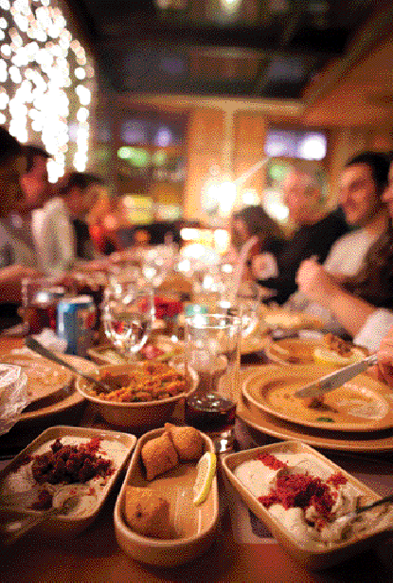
For some it is the smoky strips of blood-red basterma hanging in glass windows in Bourj Hammoud and filling the air with leathery, spicy scents, while others have a weakness for muhammara, rich with walnuts and pepper paste. More still grow misty-eyed at the thought of kafta, drenched in wild cherry sauce and strewn with cashew nuts and fried bread.

Most Beirutis with more than a passing interest in what goes on their plate will be able to name a favorite Armenian dish. But although people of Armenian origin have been in Lebanon for centuries, it’s only in the last few years that they have been drawing attention to themselves as restaurateurs.

The bulk of the Armenian diaspora in Lebanon are descendants of families from Cilicia, a region south of the Anatolian plateau, today in eastern Turkey and northern Syria. During the First World War, the Ottoman Turks pursued a campaign of ethnic cleansing that left some 1.5 million Armenians dead and drove tens of thousands into exile in the Levant; the survivors today in Lebanon are a 150,000-strong community known as much for their commercial industry as for their traumatic history. But if there is one way to pique interest in a people, it’s through food.

Aline Kamakian — co-author of the recent cookbook “Armenian Cuisine” and member of the family behind Mayrig restaurant — says that in her youth, going out to eat Armenian dishes would not have occurred to her. “It was everyday food. Traditionally, it’s always been Armenian mothers who cook.” But as second-generation families loosen up and intermarry, women have more time and independence.

Restaurants with an Armenian twist are therefore thriving on the skills of mothers who have time to spare — the kitchens at Mayrig and Seza are staffed by local women, not chefs — and who fill a need for labor-intensive traditional dishes. Madame Seza, who opened her restaurant a year ago, still idolizes the cuisine of her mother, who “did everything at home, and so well, to perfection.” Now, it is her children who have been re-enthused about the cooking of their forebears through the restaurant. “Before they asked for burgers, now they ask for manteh,” she says.

This flourishing of the cuisine in the public domain is also helping connect Armenians with their homeland and educate outsiders about Armenians and their history. As “Armenian Cuisine” demonstrates, with the recipes come memories, and many dishes — hummus with basterma here, pastries from Latakia there — are expressions of long geographical dislocation.

Rich variety and demand support flourishing restaurants across Beirut. There’s a familial welcome and bistro atmosphere at Onno in Bourj Hammoud, boutique design and ladies in lace headscarves at Seza in Mar Mikhael and seu beureg with a side of jazz at Razz’zz in Hamra. Now two of the more long-standing (and pricey) outfits — Mayrig and Al Mayass — are expanding, taking Cilicia’s heritage global. Kamakian is plotting a central kitchen in Europe that will be able to supply branches in Paris and beyond with food as skillfully produced as it is at Mayrig in Beirut, where “everything is handmade, mum’s doing it.” Al Mayass has had a branch in Kuwait since 2008, and is introducing four more outlets in the UAE and New York next year.

And so the cuisine of Cilicia, which tells the story of a country lost and countries gained through smoky meats and spices, is taking on new commercial and cultural significance. “When you’re eating the food and someone is telling you this is Armenian but the name is in Turkish,” says Kamakian, “the first question is, ‘Why? What happened?’ You’re opening a door for a million people to smell, taste, listen to what is Armenia. You’re moving all the senses through a simple dish.”

January 28, 2012 0 comments
0 FacebookTwitterPinterestEmail
Economics & Policy

For your information

by Executive Editors January 28, 2012
written by Executive Editors

Paying the bill

Lebanon’s banks made an uncharacteristically political move last month when they decided to fund Lebanon’s contribution to the controversial Special Tribunal for Lebanon. The move follows a decision by Prime Minister Najib Mikati to fund the tribunal in late November through the Higher Relief Council. The decision to pay Lebanon’s share of approximately $32 million was announced by the Association of Banks in Lebanon (ABL) and will see the country’s top 12 banks, which sit on its board, put up the money. Each bank will pay a share proportionate to their assets, according to the ABL. The ABL justified the move by saying that it would protect depositors’ funds, maintain political stability and help the investment climate in the country. The banks on the ABL’s board are Byblos Bank, BLOM Bank, Bank Audi, BankMed, Fransabank, Banque Libano-Française, Crédit Libanais, Bank of Beirut, SGBL, BBAC, the Lebanese Swiss Bank and Fenicia Bank. Hezbollah criticized the move to fund Lebanon’s portion of the tribunal but said it will not create a political issue out of it. 

Digging deeper deficits

Lebanon’s trade balance (exports minus imports) and balance of payments (or BOP, the measure of money coming in and out of the economy) have hit their greatest deficit levels to date, according to the latest data released by customs and the Banque du Liban (BDL), Lebanon’s central bank. By the end of October the trade deficit had widened to $13.35 billion, up 18.4 percent year-on-year, even while exports increased by 3.3 percent to $3.6 billion during the period. In October alone, the trade deficit was $2.2 billion, 107 percent higher than the same month in 2010. The BOP deficit increased accordingly to $2.13 billion in October, compared to a surplus of $2.8 billion in 2010. October’s BOP deficit, $589.8 million, was up from September’s $301.7 million figure. The two largest factors weighing into the BOP were the BDL’s net foreign asset surplus of $1.8 billion, and the $3.9 billion deficit in the payments of commercial banks and financial institutions.

Minimum wage, maximum anger

Much to the ire of trade unions, Labor Minister Charbel Nahas and his Free Patriotic Movement party, the cabinet voted last month to amend the minimum wage decree that was previously rejected by the Shura Council, Lebanon’s highest court. After a debate that has lasted months, the cabinet decided to increase the minimum wage from LL 500,000 ($331.67) to LL 600,000 ($398.00) and institute various other raises on other brackets. Teachers then held a strike shortly after the decision, which they called “humiliating”. The General Labor Confederation (GLC), the country’s largest labor union, also called for a nation-wide strike on December 27. When the measure came to a vote in cabinet, some of the labor minister’s recommendations were incorporated and the minium wage was raised to LL868,000 ($575.78), which includes LL 236,000 in transportation allowances added to the basic salary. Salaries between LL 1.5 million ($995) and LL 2.5 million ($1,658) will get a further 10 percent raise (above the intial 18 percent) while with anything above LL 2.5 million rises by LL 370,000 ($245). The raise is retroactive on a monthly basis as of December 1, 2011. Prime Minister Najib Mikati stated that the raise may hurt the economy and the GLC was considering calling off the strike as Executive went to print.

Dropping less calls

The typical Lebanese annoyance of having your phone conversation cut short because of the country’s infamously low quality cellular phone services is set to change in the next eight months, according to the telecommunications ministry. Last month the ministry unveiled a plan to invest some $110 million in a project to upgrade and modernize the country’s two cellular networks. The National Quality of Services plan will be implemented by the two privately owned operators Alfa and MTC, and could start showing results in as little as two to three months, according to the ministry. The first phase of the plan was to determine the geographic and technical weakness of the networks and as such the ministry has committed to purchasing 400 new antennas to support areas where reception is weak or non-existent. A further 20 mobile stations will provide backup support in densely populated areas. The ministry will also buy around 120 repeaters to install in areas where people have installed their own equipment to enhance signal strength.

Eating out

Known for their ability to throw a party and have a good time, the Lebanese spend around one-seventh of their income on eating out, according to a new study. A survey released last month compiled by the global credit card company MasterCard showed that the Lebanese spend an average of $105 per month on dining out and that 20 percent of consumers spend between $101 and $200 every month on restaurants. The highest spenders by age bracket were seen to be seniors over 55, while consumers with an annual household income over $30,000 spent around $169 every month eating out. The survey said that more than half of respondents eat out on average five times a month at mid-range family restaurants or cafes and six times per month at fast food restaurants; 32 percent went to food courts while 16 percent went to fine dining establishments in both hotels and standalone restaurants.

Labor makeup

New figures released by Lebanon’s official statistics agency have shed light on the makeup of employment across the nation. According to the Central Administration for Statistics, which used the International Labor Organization’s standards to measure the job market, Lebanon’s employment rate stood at 44.6 percent in 2009, the latest year studied by the agency. Of the total, 77 percent of the labor force is male and 23 percent is female. Around a quarter of workers were shown to hold university degrees, while another quarter had completed intermediate-level education, with 4.2 percent of workers deemed to be illiterate. The survey showed that 36.9 percent of workers are employed in the services sector, 27 percent in trade, 12.1 percent in industry, 8.9 percent in construction, 6.3 percent in agriculture and just 2 percent in financial intermediation and insurance.

Tentative growth prospects

Barclays Capital has forecast Lebanon’s gross domestic product growth at 3.6 percent this year after an estimated 1.8 percent growth in 2011. The firm said that an escalation of sanctions against Syria would pose downside risks for any economic growth and hurt the economy due to close economic ties between the neighboring countries. It also cautioned that the capital inflows enjoyed previously could be a thing of the past if the situation in Syria continues to worsen. The firm added that if the budget is passed as is presented by the finance ministry it would reverse previous fiscal gains due to higher and haphazard spending. It indicated that this increase in spending might not be absorbed by the ministries, which would entail a waste of public funds and inefficient spending. Barclays also cautioned that if the economic situation continues to deteriorate, this year could see political risk spill over onto banks’ balance sheets. It urged the government to support an orderly budgetary process, something that has not occurred since the last budget was passed by parliament six years ago. The government has until the end of this month to pass a yearly budget under the constitution. As Executive went to print the cabinet had yet to pass its version of the budget onto the parliament for debate and ratification.

January 28, 2012 0 comments
0 FacebookTwitterPinterestEmail
Real estate

For your information

by Executive Editors January 28, 2012
written by Executive Editors

Changing hands in Cannes

Eight months after Lebanese investor Toufic Aboukhater bought a string of seven InterContinental Hotels in Europe from Morgan Stanley Real Estate Fund, including the Carlton Hotel in Cannes, the same hotel has been sold to Qatari national Ghanim bin Saad al-Saad for $586 million, according to AFP. Starting in August 2012, the hotel will undergo previously planned renovations for a period of 10 months, its first major renovation since being established in 1911. In 2006, Morgan Stanley paid $826 million for the same portfolio. The December AFP report said the Qatari investor was also interested in other hotels belonging to the InterContinental chain, including those in Vienna, Rome and Madrid. In similar news, Saudi Arabian businessman Sheikh Mohamed bin Issa al-Jaber concluded a “100 percent equity” deal on December 14 to buy back the Scotsman Hotel Group, after it fell into the hands of creditors during a lengthy legal showdown with Standard Bank Group. The group accused him of reneging on $150 million worth of loans due but later settled out of court, in a deal that indirectly cost him a total of $1.55 billion, according to Jaber and reported by Arabian Business. Though the deal signed by Jaber’s hospitality firm, JJW Group, to buy the hotel properties out of administration was left undisclosed, Jaber’s December 15 statement said the hospitality firm would see an investment close to $100 million in 2012. The portfolio includes luxury hotels in Leeds, Edinburgh and Paris. Jaber’s MBI group originally bought the Scotsman Hotel Group, the hotel operator, for $98 million in 2006.

Red-hot healthcare

A partnership between Beirut’s Red House Group, a real estate investor, and Rizk Healthcare, has created the newly formed Rizk Red House Healthcare (RRHH) to deliver 10 hospitals in Saudi Arabia, a deal worth $1.35 billion. RRHH will work in partnership with the Saudi Arabian investment firm, Ebram, to complete the projects, which will see nearly 3,000 hospital beds added to the kingdom’s healthcare industry. “Today’s announcement of our partnership with Red House is a great example of how we continue to invest in the healthcare industry and of our commitment to provide healthcare services not only in Lebanon but also on the regional platform,” added Sami Rizk, chief executive officer of RRHH, which will be headquartered in Beirut with an office in Riyadh.

Lights on in Ajman

Originally announced in 2007, Al Zorah Development Company has re-launched its mixed-use tourism development, covering 5.4 million square meters in the northern emirate of Ajman in the United Arab Emirates. Solidere International, registered at the Dubai International Financial Centre, and the government of Ajman are behind the joint venture, with Sheikh Rashid bin Humeid al-Nuaimi as chairman of Al Zorah.  The project’s strategy has been restructured so that 70 percent of the land area will have resorts or tourism-related entities on it, 14 percent will be for residences or mixed-use plots, while offices and retail will take up 7 and 6 percent of land area respectively. The project leaders said the first phase will see delivery of a five-star resort, as well as a luxury hotel, with 160 rooms and 300 rooms, respectively. A luxury golf course and a community of villas and townhouses will round out the first phase, which should be complete by 2014. Speaking at the launch, Al Zorah’s Chief Executive Officer Imad Dana said 1.2 billion dirham ($140 million) worth of contracts have already been issued, but confirmed that management is still deciding on international hotel operators. Infrastructure work has started and completion of the roads and the four marinas is due by 2012. The total project comprises five developments, with nearly 5,000 hotel rooms in total. Regarding financing, Solidere Chairman Nasser Chamaa said the project had enough cash to fund its first phase without resorting to bank finance, but admitted that paid-up capital for the venture had halved to $234 million.

Lebanese buy into London

Ireland’s National Asset Management Agency has reportedly sold a property in London to an unnamed Lebanese developer for a hefty sum. Regarding the plot on the Isle of Dogs, where a 62-storey apartment block was to be built, the Irish Independent newspaper said in a November 30 article that: “It has been bought by a Lebanese developer for around £50 million [$78 million],” without naming the developer. The agreement is part of four deals concerning London properties, which will generate some $117 million for the group. In related news, M1 group, a private investment firm based in Beirut, has made headlines in recent years for some of the largest property deals in the British capital. The group’s real estate arm, based in Monaco, bought Victoria House in Bloomsbury in 2010 for $295 million and Credit Suisse’s headquarters in Canary Wharf in 2009 for $242 million. A December 7 BBC article quoted M1’s Executive Director of Real Estate, Mustapha el-Solh, as saying: “The system in London is very investor-friendly with transparent legal structures… and it has fiscal benefits in terms of tax and capital gains which give it a certain advantage.”

Luxury still sells

Despite the political instability in the region in 2011, Dubai-based developer Damac said a third of its luxury apartments in its Beirut high-rise have sold. “In Lebanon, we mobilized the site in 2010, we launched in June 2010, and so far, although being a very premium project in an area which is still under a lot of political turmoil, our sales are very good,” said General Manager Ziad el-Chaar in a December 5 statement reported by Arabian Business. The 28-story Damac Tower, situated near the Phoenicia Hotel and featuring interior design by Italian fashion house Versace Interiors, is the first residential project in Lebanon for Dubai’s largest luxury homes builder. In Dubai, a number of Damac’s projects have stalled, though the firm has delivered 21 buildings in total. Speaking of those investors who bought off-plan in the Palm Springs residential project on the now-stalled offshore island, Chaar said: “We have offered them a full refund in staged payments [or] a lump sum [70 percent] immediate payment, which is unprecedented in the market.” He added that there are no plans to launch future projects in Dubai in the foreseeable future.

Kuwait teams up with REAL

In a December 11 workshop titled “Mechanism of Real Estate Investments in Lebanon,” Chairman of the Kuwait Real Estate Association Tawfiq al-Jarrah said Kuwaiti investments in the Lebanese real estate sector were growing steadily. The workshop was the first formal cooperation with the Real Estate Association of Lebanon (REAL), headed by Chairman Massaad Fares, since the Kuwaiti team signed a ‘cooperation protocol’ with the former in November to help “remove hurdles facing Kuwaiti businesses” in Lebanon, according to the Kuwait News Agency.  REAL’s agreement means it will help register land plots bought by Kuwaiti businesses with the relevant Lebanese departments. In addition to legal and administrative council, the group will provide names of accredited companies, dealers, engineers, brokers and lawyers in Lebanon. In previous statements to Executive, Fares said the organization aims to promote reputable companies and eliminate or reduce the expanded number of non-professionals who enter the industry.

January 28, 2012 0 comments
0 FacebookTwitterPinterestEmail
Banking & Finance

Lebanese capital markets

by Executive Editors January 28, 2012
written by Executive Editors

Equity update

 16/12/201118/11/2011  % change
BLOM Stock Index1,189.411,174.81     1.24
Daily Average Traded Volume 513,17369,186      641
Daily Average Traded Value$1,945,930$766,177      154

The payment of Lebanon’s $32.6 million share of the annual funding for the Special Tribunal for Lebanon boosted activity on the Beirut Stock Exchange (BSE) in the latter part of November. The BLOM Stock Index (BSI) climbed by more than 4% during the period to 1,224 points, before retreating to 1,189 points by the end of the fourth week (December 12-16). Hence, the BSI advanced 1.2% from its previous close on November 18, with total losses in 2011 at 19.39%. The daily average volume per month rose more than seven-fold to 513,173 shares, up from 69,186 shares in the preceding four-week period, due largely to 6.8 million shares in Byblos’s common stock being traded on 16  December.

On the regional front, the BSI managed to outperform both the MSCI Emerging Market Index and the S&P Pan Arab Composite LargeMid Cap index. The former fell between November 18 and December 16 by 6.5% to 897 points, reflecting fears over the European debt crisis and signs of economic slowdown in China and South Korea. The S&P index followed suit, retreating 1% to 106 points.

Most banking stocks ended the four week-period in the red, affected by Moody’s Investors Service Outlook‘s downgrade for local banks to ‘negative’ from ‘stable.’ In fact, BLOM’s global depositary receipts lost 2.5% and BEMO common stock retreated by 4.9% to $7.70 and $2.35 respectively. Bank of Beirut stocks followed suit as its common stock declined by 1.3% to $19.20, while its preferred Class D lost 0.4% to $26. Bank Audi stocks also drew back, with its GDR losing 2.3% to $6.29. Its listed stock fell 2.2% to $5.85 and its preferred Class D decreased by 0.5% to $10.30. Byblos common stock was the sole gainer among banking stocks, rising 3% to settle at $1.65.

Solidere stocks A and B, which accounted for around 42% of total value traded, rallied during the first three weeks to hit $16, their highest level since mid-August 2011, before closing at $14.5 each on December 16 with a monthly increase of 6% and 7.5%, respectively.

Within the manufacturing sector, Holcim stock grew 1.5% to $16.15, whereas Ciment Blancs Nominal Class witnessed a single trade of 2,496 shares, lifting its price by 40% to $2.41, its highest level since inception.

Eurobond bulletin

 16/12/201118/11/2011Change
BLOM Bond Index (BBI)110.70111.09 -0.35%
Weighted Yield4.88%4.69%  19bps
Weighted Spread413400  13bps

The Lebanese Eurobonds market remained subdued over the past four weeks, sending the BLOM Bond Index (BBI) down 0.35% to settle at 110.7 points. Thus, the portfolio-weighted effective yield advanced 19 basis points (bps) to 4.88% and the spread against the United States benchmark yield widened 13bps to 413bps. Lebanon’s credit default swap (CDS) for five years — a proxy for a country’s default risk — reached 440-466bps, compared to 402-432bps on November 18. Comparatively, in regional markets, Dubai and Saudi Arabia CDSs were quoted at 449-465bps and 123-130bps, respectively.

January 28, 2012 0 comments
0 FacebookTwitterPinterestEmail
Banking & Finance

Financial quotes of the month

by Executive Editors January 28, 2012
written by Executive Editors

“Let us not hide it, Europe may be swept away by the crisis if it doesn’t get a grip, if it doesn’t change. We don’t have the right to let such a disaster happen.”

Nicolas Sarkozy, French president

“The economic situation is worse than anyone imagines.”

Kamal al-Ganzouri, Egyptian prime minister

“Acting like everyone who’s been successful is bad and that everyone who is rich is bad — I just don’t get it.”

Jamie Dimon, chief executive officer of JP Morgan

“Iran is a major oil producer and any sanctions on our oil export will definitely harm the global market.”

Rostam Qasemi, Iranian oil minister

“Rick, I’ll tell you what: $10,000 bucks? Ten thousand bet?” 

Mitt Romney, Republican presidential candidate, to rival Rick Perry while arguing over whether Romney had once supported nationalized healthcare

“There is no truth to what has been said of an intention to restructure part of debts that are due on [Dubai government-related] companies in 2012.”

Sheik Ahmed bin Saeed al-Maktoum, chairman of Dubai’s Supreme Fiscal Committee

“I simply do not know where the money is.”

Jon Corzine, former chief executive officer of MF Global, in his testimony to Congress regarding $1.2 billion in missing customer funds

“Between 2010 and 2011, lending to the private sector surpassed investments in treasury bills.”

Riad Salameh, Lebanon’s central bank governor, on commercial bank lending

“We think this will encourage the establishment of more new companies in Dubai because it makes the regulations and business environment more attractive for foreign investors.”

Hamad M Buamim, director general of the Dubai Chamber of Commerce and Industry, on the new UAE company law

“It means that Libya’s government will now have full access to the significant funds needed to help rebuild the country.”

William Hague, Britain’s foreign secretary, on the UN Security Council’s unfreezing of Libyan central bank assets

January 28, 2012 0 comments
0 FacebookTwitterPinterestEmail
Banking & Finance

Investment guide MENA stock tips

by Executive Editors January 28, 2012
written by Executive Editors

After a turbulent 2011, investors hoping for relief in 2012 are likely to be disappointed, with little prospect of a solution in Europe, an election year in the United States and a prolonged lack of stability in the Arab world. This month Executive asks Najib Semaan, assistant general manager and head of global markets at Bank of Beirut (BOB), and Yves Rahme, head of equities unit at Byblos Bank, for insights on where to invest in these challenging times.

Najib Semaan

Bullish or bearish? Semaan is cautious on prospects for global markets due mainly to the European sovereign debt crisis, but he does believe that “the end of the tunnel is near”. He expects the markets to reach their bottom toward the end of the first or second quarter of 2012.

Will politics drive the markets in 2012? The Middle East and North Africa region will be affected by the political situation. In Europe, as there are several decision makers wanting to influence the final decision to their own personal interest, politics will be a driver of the markets as well. In the United States, 2012 will be about growth, which will be better than 2011, while equities will also be in better shape. Semaan very shortly expects to see a bottom in US equities.

Favorite assets? Semaan will buy large cap equities and avoid small caps, as BOB cannot afford further pressure on their balance sheets. Large caps, on the other hand, might see lower volumes but they can afford another bad year. He also likes German government bonds and those of large European corporations.

Thoughts on the MENA region? Semaan expects the unrest in the region to remain for another two to three years. Within the MENA region, he has a preference for Qatar and Saudi Arabia and has enormous confidence in Lebanon. He believes that the Lebanese central bank’s monetary policy has created confidence in the economy but he stresses that it is critical that the government steps in to “restructure the debt and put in place a plan for growth”.

Thoughts on Lebanese securities? “Interest rates on Lebanese bonds are now close to their bottom and we can’t afford lower interest rates, as they are no longer justified relative to our fundamentals,” he says. He expects Lebanon to afford another one to two years of interest rates at these levels but in the long run, without restructuring, he expects rates to go up. As for the Beirut Stock Exchange, he doesn’t expect much as “Lebanese investors are short-term oriented” and since many Arab investors lost substantial funds during the revolutions, they are not taking new positions.

Top picks globally? Semaan would buy US large-cap stocks such as General Electric and well-capitalized US banks and oil companies globally. He would also buy German government bonds and bonds from large European corporations, such as Électricité de France.

Yves Rahme

Bullish or bearish? Rahme would prefer to wait for dips before buying into the markets. He highlights that the real losses in the markets are in Europe and the MENA region, as the US markets recovered their losses in 2011. The problems in Europe have not been resolved yet and although European policymakers “have helped Greece, it’s just like putting on a band-aid, they didn’t dig deeper”.

Will politics drive the markets in 2012? In the MENA region, “it will take a year or maybe more to put in place real governments after 40 years of dictatorship”, so politics will still drive the markets, according to Rahme. He fears that in Europe the main issue has not been resolved yet. Rahme believes that each European country should try to resolve its own deficit. He is concerned by the lack of coordinated action from Eurozone policymakers in taking “a bold step to show all the markets and investors that they will do whatever it takes to save the euro”. As for the US, Rahme believes the markets will be driven by politics, as 2012 is an election year.

Your favorite asset classes? Rahme would buy stocks in defensive sectors such as telecommunications, consumer retail and healthcare, or companies such as Visa and American Express, and would also recommend companies exposed to emerging markets. Rahme also likes companies such as McDonalds, which are not much affected by the net worth of people.

Thoughts on the MENA region?  Rahme likes Saudi Arabia and Qatar. He would invest in Saudi Arabia as it is an oil-rich economy with a large current account surplus and enjoys a growing GDP. As for Qatar, he would be investing there due to upcoming infrastructure investments driven by the World Cup in 2022 and Qatar Vision 2030, the country’s long-term strategy for economic growth.

Investment picks in MENA region? Rahme would invest in a Qatari bank as the developers of the large infrastructure projects need liquidity. His top pick in Qatar would be Qatar National Bank. In Saudi Arabia, he would buy National Industrialization Company, also known as Tasnee.

Your thoughts on Lebanese stocks? The issues with Lebanese equities at the moment are mainly political, according to Rahme. For Solidere, its depressed value is mainly due to local politics. For the banks, it is due to both local and regional politics, as the most traded banks have branches in Syria and Egypt. Rahme also highlights that Arab investors are selling their stocks everywhere, which is not helping Lebanese equities. For a long-term investor willing to wait two to three years for a return on his money, Rahme would buy Solidere. He would also look at Lebanese banks as they are conservative, they are doing well and they offer attractive dividends.

“It will take a year or maybe more to put in place real governments after 40 years of dictatorship”

Recommended stocks

Qatar National Bank, the country’s first Qatari-owned commercial bank, has 40 percent of the

market share in Qatar and is one of the largest financial institutions in the MENA region. It is up 13 percent year to date and has a $26 billion market capitalization. Qatar Investment Authority owns 50 percent and the remaining shares are listed on the stock exchange. Its regional presence has grown through stakes in several banks in the MENA region: 35 percent in Jordan-based Housing Bank for Trade and Finance, 24 percent in UAE based Commercial Bank International, 50 percent in Tunisian-Qatari bank, 23 percent in Iraqi-based Mansour Bank and 51 percent in QNB-Syria, a private stock company.

National Industrialization Company, also known as Tasnee, is a Saudi-based holding with worldwide industrial projects. It operates in five sectors: petrochemicals, chemicals, metals, diversified (includes plastic and batteries) and it also provides industrial services. It is the first Saudi joint stock company fully owned by the private sector. It has a market capitalization of $6 billion and is up 36 percent year to date.

January 28, 2012 0 comments
0 FacebookTwitterPinterestEmail
Banking & Finance

For your information

by Executive Editors January 28, 2012
written by Executive Editors

Syria unrest sparks Lebanon banking downgrade

Moody’s downgraded its outlook on Lebanon’s banking system to “negative” from “stable” due to weak economic growth and regional political unrest. Moody’s is concerned by the political uncertainty in Syria, as well as the exposure of local banks to countries such as Jordan and Egypt with slower economic growth or political turmoil. The ratings agency expects the profitability of Lebanese banks to come under pressure in 2012 and also predicts the trend of non-performing loan improvement that spanned from 2006 to 2010 to be reversed. Moody’s is also worried by the banking system’s heavy exposure to Lebanon’s sovereign debt, estimated at more than $50 billion, rendering it highly geared to the performance of the government. Moody’s highlighted the solid liquidity and the resilient deposit base as alleviating the downside risks.

New UAE company law to raise international investor interest

The UAE has approved a draft company law that will raise the limit on foreign ownership above the current limit of 49 percent. The current law obliges foreigners who wish to establish a business outside a free zone to find a local partner to hold a majority stake. The new law will also introduce unified accounting standards for all businesses and mandatory corporate governance principles for joint stock and limited liability companies, and modify the requirements for share offerings in local capital markets to encourage listings by private companies. If passed, the changes will be the biggest in the country in 30 years, though no date has been set for the final approval of the law. “We think this will encourage the establishment of more new companies in Dubai, because it makes the regulations and business environment more attractive for foreign investors,” said Hamad Buamim, director general of the Dubai Chamber of Commerce and Industry.

Solidere and BLOM listed on S&P Arab Index

Standard & Poor’s Indices partnered with the Arab Federation of Exchanges (AFE) to launch the S&P AFE 40, designed to measure the performance of leading companies from the pan-Arab region. The S&P AFE 40 is made up of the 40 largest stocks, measured by float-adjusted market capitalization, from Bahrain, Egypt, Jordan, Kuwait, Lebanon, Morocco, Oman, Palestine, Qatar, Saudi Arabia, Tunisia and the United Arab Emirates. Each stock must have at least $50 million in value traded over the last 12 months, there can be no more than 10 stocks per country and at least one stock from each country must be included. “We are building a benchmark now for funds to invest in the region when the economy improves and oil prices pick up,” said Fadi Khalaf, the secretary general of the AFE. For Lebanon, Solidere and BLOM Bank have been included in the index.

UAE and Qatar stuck at frontier market status

MSCI, Morgan Stanley’s influential index compiler, postponed for the third time their decision on whether to upgrade the United Arab Emirates and Qatar to emerging markets from frontier markets status, a disappointment for local investors expecting an increase in volumes traded on the back of the upgrade. Both countries will be reviewed again in June 2012. The MSCI Emerging Market index is used as a benchmark by fund managers and the markets of countries that are upgraded can benefit from billions of dollars in extra liquidity. With respect to the UAE, MSCI cited investor concern over the newly established Delivery versus Payment (DvP), a security settlement system. The DvP system was a key requirement by the MSCI for the countries to be considered for an upgrade. With respect to Qatar, MSCI cited concern over foreign ownership limit, which currently stands at 25 percent.

Lebanese companies growing fast

Twelve Lebanese companies were among Arabia 500’s fastest growing companies in the MENA region, Pakistan and Turkey. Semsom Restaurant, ranked 27th, is the fastest expanding Lebanese company, enjoying 218 percent growth between 2008 and 2010. Jordan leads the high-growth companies in the Levant, followed by Lebanon. The average growth for the 12 companies identified was 83 percent between 2008 and 2010, and the average number of employees stood at 89. The survey also identifies two start-ups to keep an eye on: ecoSolutions, a consulting firm specialized in developing solutions to build green buildings, and Cleartag, a web and graphic design firm. It also concludes that within the Levant region, Lebanon has the highest percentage of fastest-growing companies owned by women.

BDL’s $4 billion treasury buy

Banque du Liban (BDL), Lebanon’s central bank, bought more than $4 billion of treasury bills in the first three quarters of 2011 to keep interest rates at their current levels, according to BDL Governor Riad Salameh. Commercial banks favored the more liquid certificates of deposits over T-bills due to the political instability, according to the Association of Banks in Lebanon. This led the BDL to intervene, with its share of local public debt increasing from 27 percent as of the end of December 2010 to 32 percent as of the end of September 2011. Salameh recently highlighted that lending to the private sector by Lebanese commercial banks has exceeded their investments in treasury bills so far this year.

Banque Saudi Fransi exiting BEMO

Banque Saudi Fransi wants to sell its 10 percent stake in Banque BEMO, a Lebanese commercial bank, and its 27 percent stake in BEMO’s affiliate in Syria, Banque BEMO Saudi Fransi Syria. Its decision is based on concern regarding the increasing financial risks in Syria and follows sanctions imposed on the country by the Arab League. The directors representing Banque Saudi Fransi immediately submitted their resignation from the board of both BEMO Saudi Fransi Syria and BEMO Lebanon. “We received offers. But it is too early to make any commitment to anyone as long as the regulatory authorities in Lebanon and Syria do not approve selling these shares yet,” said Samih Saadeh, general manager of BEMO. Banque BEMO reported profits of $7 million for the first nine months of 2011, a 2 percent rise compared to the same period last year. Banque BEMO Saudi Fransi was launched in January 2004 and with 36 branches in Syria is considered one of the country’s leading banks.

UN to return Libya’s booty

The United Nations Security Council lifted its sanctions on assets of Libya’s central bank and its subsidiary, Libya Foreign Bank. The council in March froze Libya’s assets abroad, estimated at $150 billion, to put pressure on the government of Muammar Qadhafi. Once the sanctions had been lifted the United States unfroze more than $30 billion in Libyan government assets but not those held by Qadhafi’s family and members of his former government. The United Kingdom is also unfreezing more than $10 billion. By late November, only $18 billion, a fraction of the assets held abroad, had been released, with UN officials claiming only $3 billion reached Tripoli due to legal problems. The move by the UN Security Council was cited as being a move to assist the new government in rebuilding Libya after eight months of civil war.

January 28, 2012 0 comments
0 FacebookTwitterPinterestEmail
Editorial

The banks must be proactive

by Yasser Akkaoui January 28, 2012
written by Yasser Akkaoui

Since the Israeli assault in the summer of 2006 we have known that the next war on Lebanon would likely be one of economics, not arms, and that the targets would not be bridges and bunkers, but the pillars upon which all commerce in the country depends — the banks.

In response to this new reality, how has the banking industry responded? Has the Association of Banks in Lebanon (ABL) formed a standing committee or task force to confront threats as they arise? Has the ABL made efforts to organize an effective lobby in Washington to push its interests at the heart of where, unquestionably, the greatest threat of sanctions lies? The answer to both is a resounding ‘No’.

At best, the banks have adapted ad hoc to circumstances that have arrived — case in point is the ABL’s last-minute deal to fund Lebanon’s $32 million obligation to the United Nations Special Tribunal investigating the assassination of former Prime Minister Rafiq Hariri, which allowed the country to dodge possible retaliation at the UN Security Council. The banks’ move had two other important consequences: it immerses them in the country’s political morass — which invariably comes with its own risks — while at the same time illuminating how crucial they are in preserving the country’s security.

Instead of their reactive tendency, however, is it not of immense importance to adopt a unified, pro-active approach in identifying the foreseeable dangers ahead of time and taking steps to mitigate the menace before it reaches crisis levels?

When the United States Department of the Treasury labeled Lebanese Canadian Bank (LCB) a money laundering threat earlier last year — effectively cutting LCB off from US dollar transactions in the international finance system and forcing its sale to Société Générale de Banque au Liban — fear coursed through Lebanon’s banking boardrooms about how exposed each institution was to being targeted next. Now 11 months on, it is far from clear that Lebanese banks have adopted any meaningful, collective strategy to build a firewall protecting them from the next disaster. And with Western countries tightening sanctions on Syria, Lebanon is falling ever more under the international magnifying glass for being a possible route for the regime in Damascus to circumvent the censure.

The banks failing to adopt a new approach would be an obscene negligence for which we would all end up paying.

January 28, 2012 0 comments
0 FacebookTwitterPinterestEmail
Economics & Policy

Make your own militia

by Sami Halabi January 26, 2012
written by Sami Halabi

On the side of a busy street Abu Imad stands in front of his warehouse that appears much the same as any other. Inside, the air is humid and Abu Imad’s products are stacked in boxes from floor to ceiling. Just inside the entrance is a display area for customers who wish to view the goods on offer. But Abu Imad is not in the business of peas and carrots; he is one of the many arms dealers that have been making a killing off rising demand for weapons both inside Lebanon and next door. 

The smell of white chalk and sawdust from newly opened boxes full of M16s are telltale signs that the trade is booming, as is Abu Imad’s smile as he brags about his best selling items and Lebanon’s history of armed struggle. With a tinge of nostalgia in his voice he explains how collectors items and handguns, such as the Glock 17 and Sig “Swiss” P210, no longer drive demand. Now the market is dominated by M16s, AK47s, Zakharov machine guns (smaller versions of the AK47) and rocket-propelled grenade (RPG) launchers. 

Asked how and when prices began to rise, Abu Imad scratches his head and replies that between 2005 and 2008 prices were seen to have risen by some 100 to 150 percent on average, only to level out after the Doha accords. Back then he claims weapons were being bought by “the Salafis”, a terms he throws around liberally to describe anyone who opposes the Syrian regime. Then, with the onset of political tension in 2010 and the Syrian uprising last year, prices began to skyrocket on the back of an increase in demand and a cut in supply [see table]. Recently he says supply from Iraq has been disrupted, as has an intermittent supply from Jordan that actually came through Syria. 

If you’ve got the money

Most of Abu Imad’s weapons used to come from Iraq, as he claims many of the police and army were selling off their firearms in exchange for much-needed cash. But recently he claims there has been an inflow of older M16s into the market. He suspects these are coming from sources that had access to US-made weapons through America’s allies during the Lebanese Civil War — when the boxes are opened a plume of white dust emerges, a sign they have never been cracked before; the M16s themselves have a thinner barrel than the more recent models, an indication the weapons have been in storage for a while. If true, this would lend credibility to the rumor that the current arms supply is being fed by parties selling off stockpiles to take advantage of rising prices. 

One area where he is certain arms are being sold is the infamous village of Brital, just west of Lebanon’s ‘handle’ between Zahle and Baalbek. Brital has long been known as a hub for all types of organized crime: from guns, to drugs, to stolen cars. “Usually the Shia sell to Shia, the Sunni sell to Sunni, but those bastards in Brital sell to anyone, they just want money,” Abu Imad says, releasing a slew of Arabic curses aimed at various members of his competitors’ families. 

As for buyers, he says that most in the market these days are the Syrian “Salafis”, but adds that “there is one guy, who comes around and buys up everything from all the middle men.”  

According to Abu Imad, the most popular smuggling routes to Syria are through Akkar in the north, Arsal east of Baalbek and another area called Jurit Al Araseleh through Marsharia Al Qaa, which has become the most recent causeway for his precious and deadly cargo. 

Asked about the Lebanese authorities’ attempts to stem arms smuggling to Syria, Abu Imad almost falls off his chair laughing. After composing himself he agrees that there have been more efforts and a few more checkpoints on the border but, he says, it is usually the Syrians, and not the Lebanese authorities, who catch the smugglers. The Ministry of Interior did not respond to Executive’s request for comment. 

“They are useless,” Abu Imad says about the Lebanese security services because no matter what they do “it’s impossible to seal the border.”

January 26, 2012 0 comments
0 FacebookTwitterPinterestEmail
The Buzz

The idle hands of youth

by Gareth Smith January 26, 2012
written by Gareth Smith

Nearly three years ago, Ayatollah Ali Khamenei, Iran’s rahbar (leader), announced a five-year plan for 2010-15 with a target of 8 percent annual economic growth. But while the International Monetary Fund projects growth of 2.5 percent in 2011 and 3.4 percent in 2012 — arguably reasonable given international sanctions — this is well below enough to produce jobs for all the young people at the center of political unrest following the disputed 2009 presidential election.

The Middle East is a region of young people. Overall, 60 percent of Arabs are under 25, and the median age of the Arab world is 22, compared with 28 worldwide, ranging from 31.6 in Qatar to 17.4 in Yemen. 

But while Iran has a median age of 27.1, fully 35 percent of its population is aged between 15 and 29, the world’s highest recorded ratio of a group keen to move into jobs and forward with careers. This demographic anomaly follows a baby boom in the early years following the 1979 revolution and during the 1980-1988 war with Iraq, followed by successful population control beginning around 1989. For some years, conservative political strategists in Tehran looked with hope at the ageing baby boomers. They felt they would become concerned with the economic issues of settling down with a family and abandon demands for social reform that was such a persistent problem for former President Mohammad Khatami. Djavad Salehi-Isfahani, professor of economics at Virginia Polytechnic Institute and State University, has studied Iran’s ‘youth bulge’ in depth and believes the conservatives should have been more careful in what they wished for.

“It is not clear the government is better prepared to deliver on jobs than it was on social freedoms,” he told Executive. “In fact, providing greater social freedoms is easy in a way because it requires doing less, whereas providing jobs requires doing more.” Salehi-Isfahani believes Iran’s population changes are readily visible. “A visitor to Iran in the 1980s would have easily noticed the prevalence of children,” he wrote in a recent paper. “After 1995 [as the baby-boomers aged] the proportion of youth began increasing… To a visitor today, youth instead of children would be the most noticeable in Iran’s streets.”

The demographics mean that between 1996 and 2006, Iran’s working population (15-64) grew by 3.9 percent annually, over twice the rate of overall population growth. “Although the economy enjoyed robust growth during this period, it was unable to keep up with the rapid inflow of new workers,” wrote Salehi-Isfahani. “The economy grew by about 5 percent per year and created 5.9 million new jobs… but the overall unemployment rate increased from 9.8 percent to 12.7 percent.”

It is an interface between economics and demographics, rather than a youth bulge in itself, that tends to fuel frustration and unrest. “Youth bulges in East Asia have produced high economic growth rather than protests,” Ragui Assaad, professor of planning and public affairs at the University of Minnesota, told Executive. “A youth bulge becomes a problem only in combination with other factors, in particular economic policies that discriminate against youth and result in them not being able to find jobs.”

In Iran, improved education opportunities after the 1979 revolution hardly helped. Rather than serving as a route to well-paid jobs, education helped produce an imbalance between the supply of graduates and the demand for graduate-level skills.

Setting aside oil money

With a large state sector funded by oil income, the country has failed to develop vibrant companies in the private sector. The 2010-15 five-year plan envisaged “eliminating the government’s dependence on oil and gas revenue for current expenditure” by 2015, but last year income from oil exports at $73 billion equaled half of government revenues, according to the United States Department of Energy.

The five-year plan also envisaged ring-fencing 20 percent of oil income. While successive governments have pledged to ring-fence oil revenues for soft loans to the private sector, in practice the monies have proved too tempting a treasure chest for governments and parliament to fund pet projects or meet budget shortfalls. Under President Mahmoud Ahmadinejad, the government has become more opaque. Tighter sanctions and talk of American and Israeli infiltrators have led officials to treat figures for two ring-fenced funds as a security secret. The first fund, the Hesabe Zakhireye Arzi, the Foreign Exchange Reserve Fund (FERF, but known also as the Oil Stabilisation Fund), was established under President Khatami. A second fund, the Sandoghe Tose’e Melli (National Development Fund, NDF) was established in 2010, and as so often in Iran, there is factional fighting over its control.

“There is ambiguity about the future of FERF, since its balance is supposed to be turned to the new Sandoghe Tose’e Melli (NDF),” a leading Iranian business journalist told Executive. “Plus, it’s caught up in politics. The NDF was originally designed by [Akbar] Rafsanjani [the former president and critic of Ahmadinejad] and his friends to parallel FERF, away from the control of the president. But who knows? Perhaps Ahmadinejad will control the NDF as well.”

Government critics have alleged that not all ring-fenced money has gone into either fund. At the time the current budget was introduced (for the Iranian year ending March 2012) Jafar Qaderi, deputy chairman of parliament’s planning and budget committee, claimed $11.7 billion was unaccounted for. 

Entering ‘wait-hood’

Lack of investment in productive sectors, and the retention of government jobs by older workers, restricts opportunities for labor-market entrants. In human terms, the result is what academics call ‘wait-hood’, or, in other words, people forced to live at home with their parents.

“One in five youth in their late 20s is unemployed and one in two is unmarried and lives with his or her parents,” wrote Salehi-Isfahani. “After spending their school years in gruelling preparation for various national exams, they are told they must wait several more years before they can take full advantage of the opportunities that their nation offers its adult citizens and to be able to actively participate in running their country.”

The good news for Iran’s authorities is that the ‘youth bulge’ — unlike in many Arab countries — will gradually become a bulge of the middle-aged. By 2020, Iran’s youth ratio will fall to under 25 percent, a level found in economically advanced countries. Even by 2015, the 20 to 24 age group will have shrunk by 75 percent, to 5.2 million.

Even so, the lasting effects of ‘wait-hood’ are unknown. In his paper Salehi-Isfahani wondered how Iranian youth are to be prepared to take over their society without training: “As they wait to climb into the driver’s seat, are they gaining the necessary experience for the tasks that lie ahead, or are they instead slowly losing not only their skills but also their hope and optimism?”

One answer is to increase productive investment, but Salehi-Isfahani is skeptical. “This depends partly on how sanctions develop, as any tightening makes it difficult to see how investment can take off,” he said. But he suggests it also depended on how Iran’s domestic political struggles play out, especially with a presidential election due in 2013. “If the election is not credible and someone like Ali Larijani [a close ally of Ayatollah Khamenei] is elected [or] selected, then chances are not good for the private sector.”

Improvement, Salehi-Isfahani suggested, requires a better international situation and a more adaptable president, like Tehran mayor Mohammad-Bagher Ghalibaf: “The good scenario would be if sanctions level off or are lessened, and someone like Ghalibaf is elected president in an atmosphere of national reconciliation.”

January 26, 2012 0 comments
0 FacebookTwitterPinterestEmail
  • 1
  • …
  • 348
  • 349
  • 350
  • 351
  • 352
  • …
  • 686

Latest Cover

About us

Since its first edition emerged on the newsstands in 1999, Executive Magazine has been dedicated to providing its readers with the most up-to-date local and regional business news. Executive is a monthly business magazine that offers readers in-depth analyses on the Lebanese world of commerce, covering all the major sectors – from banking, finance, and insurance to technology, tourism, hospitality, media, and retail.

  • Donate
  • Our Purpose
  • Contact Us

Sign up for our newsletter

    • Facebook
    • Twitter
    • Instagram
    • Linkedin
    • Youtube
    Executive Magazine
    • ISSUES
      • Current Issue
      • Past issues
    • BUSINESS
    • ECONOMICS & POLICY
    • OPINION
    • SPECIAL REPORTS
    • EXECUTIVE TALKS
    • MOVEMENTS
      • Change the image
      • Cannes lions
      • Transparency & accountability
      • ECONOMIC ROADMAP
      • Say No to Corruption
      • The Lebanon media development initiative
      • LPSN Policy Asks
      • Advocating the preservation of deposits
    • JOIN US
      • Join our movement
      • Attend our events
      • Receive updates
      • Connect with us
    • DONATE