• Donate
  • Our Purpose
  • Contact Us
Executive Magazine
  • ISSUES
    • Current Issue
    • Past issues
  • BUSINESS
  • ECONOMICS & POLICY
  • OPINION
  • SPECIAL REPORTS
  • EXECUTIVE TALKS
  • MOVEMENTS
    • Change the image
    • Cannes lions
    • Transparency & accountability
    • ECONOMIC ROADMAP
    • Say No to Corruption
    • The Lebanon media development initiative
    • LPSN Policy Asks
    • Advocating the preservation of deposits
  • JOIN US
    • Join our movement
    • Attend our events
    • Receive updates
    • Connect with us
  • DONATE
Comment

Inching toward equality

by Nadya Khalife February 3, 2012
written by Nadya Khalife

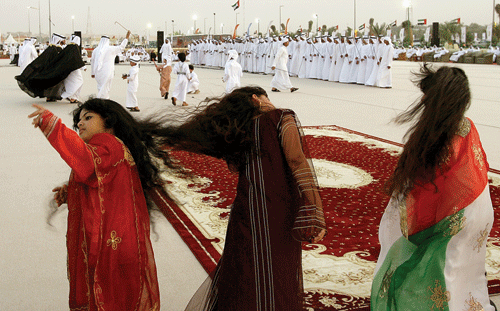
Sheikh Khalifa bin Zayed al-Nahyan, president of the United Arab Emirates, made an important move in November for the rights of women in the region. He proposed changing the law that long discriminated against Emirati women married to foreigners by denying them the right to pass on their citizenship to their children. “Children of female citizens married to foreigners should be treated as citizens,” he said.

The president’s proposal signals an important policy shift in a region that has long discriminated blatantly against women. The policy in many countries in the region — Lebanon, Jordan, Syria, Qatar, Oman, Kuwait and Saudi Arabia — flows from fears over race, ethnicity and demographics. Children of Emirati women married to foreign or stateless men remain noncitizens — even if they are born in the UAE and never leave. As in most Arab countries, the UAE’s citizenship laws specify that it is the father’s nationality that determines the child’s, not the mother’s or both parents’. 

The proposed reform in the UAE would make the children concerned eligible for citizenship only when they reach the age of 18. But they would be able to get the better education and health care benefits available for Emirati children earlier. And when they are older and granted citizenship they would be able to enroll in a university and apply for government posts, options now denied to them.

One key issue would be whether the children of Emirati women married to Bidun — the estimated 20,000 to 100,000 people considered stateless who have been historically neglected in the UAE — would qualify. Media reports have said that this measure will probably include their children but the government’s position is not yet clear. On December 14, the UAE set up a committee to compile a list of eligible children who would benefit from this new measure. 

The issue of the Bidun children is critical because only about 12 percent of UAE residents are Emirati nationals, with foreign residents and stateless Bidun making up the rest. The number of Emirati women marrying foreigners also rose 15 percent from 2009 to 2010, from 643 to 737, according to the UAE’s National Bureau of Statistics. 

The lack of citizenship has had a direct impact on children of Emirati women because under the current law, these children do not get the generous state benefits available to citizens under 18, and they often have access only to second-rate education and health care. The UAE offers free primary education to Emirati children. In some emirates, non-citizen children can enroll in public schools at no cost only if they score 90 percent on their entrance exams. Those with resources can attend private schools, but many children of Emirati women, particularly those married to Bidun men, cannot afford the tuition. The net result is that there are children of Emirati women who simply do not attend school. 

Families whose children are not citizens also must pay for routine health care for their children, even basic care such as immunizations, while health care is free for Emirati children with citizenship. Bidun children, because of their stateless status, cannot travel outside the country, which further limits their families’ options.

While the number of children who will benefit from the UAE’s change remains to be seen, Sheikh Nahyan’s pronouncement was a step in the right direction, and he has painted an optimistic picture for Emirati women married to foreign husbands and their children. The hope now is that other Arab countries that discriminate against women and their children this way will follow his lead.  

Every day in our region, women pay the price for discriminatory laws, but the UAE has made the moral choice, and in the long run the UAE will benefit because its children will be healthier and better educated. The progressive leadership it is showing in the region for the rights of women and children will also be recognized around the world. If the UAE, a country deeply worried about its demographics, can make this decision, it is high time that other Arab states follow suit.

February 3, 2012 0 comments
0 FacebookTwitterPinterestEmail
Comment

The tipping point

by Jihad Yazigi February 3, 2012
written by Jihad Yazigi

After months resisting the pressure, the Syrian pound dived in January against the United States dollar and other international currencies, forcing the central bank to announce that it would begin a managed float of its currency in a dramatic departure from a five-decade-old policy of strictly regulating foreign exchange transactions. 

While the American dollar traded at around 60 pounds in black market dealings at the end of December, it quickly rose to 63 pounds in the first days of the year before crossing the 70 pound mark by mid-January. Since the beginning of the popular uprising in March 2011, Syrian analysts have been predicting the collapse of the national currency. However, contrary to the most pessimistic projections, the pound managed to stand its ground for months, falling to only 51 pounds per dollar in August, five months after the beginning of the protests — a decline of roughly 8 percent relative to its pre-crisis level of 47 pounds.

The relative strength of the currency for this extended period of time was a consequence of a number of factors including an aggressive strategy by the central bank, which by August had reportedly spent some $2 billion, or 10 percent of its foreign reserves, to defend its currency. Other factors were sensible policy choices by the bank, including a rise in interest rates and restrictions on the sale of foreign exchange by money traders, as well as a decline in imports resulting from a strong contraction in investment and spending, which partly helped offset the decline in export earnings. Still, the last weeks of 2011 saw a rapid increase in the rate of decline. The combined impact of the general downturn in business, poor economic policy and international sanctions had taken its toll on the currency. Another key factor was likely the beginning of the application of the European Union embargo on oil exports in November. Indeed, oil revenues made up in 2010 some 20 percent of Syria’s total foreign currency earnings and a much larger share of the government’s export revenues. 

One other factor, however, also explains the rapid deterioration witnessed at the beginning of this year. In an interview on Syrian TV early January, Minister of Economy Nidal al-Shaar said that the government’s priority was to “preserve the country’s foreign reserves and not to defend the currency.” These few words alone may have triggered the rush to the greenback.

By declining to go too far in the defense of the currency, Shaar was echoing the advice of many economic analysts: if the international value of the pound must be defended, it must not be done at any cost — i.e. at the expense of the foreign currency assets.

Indeed, Syria’s foreign reserves, painfully accumulated during the country’s short oil boom of the 1990s, will be almost impossible to recover once they are spent, given that Syrian oil fields have been largely depleted, while by selling its foreign assets now the government would be mortgaging the country’s future.

Also, in spite of the serious consequences it will have on the purchasing power of the population, already largely dented by decades of poor growth, the devaluation of the pound can provide new opportunities for Syrian exporters and make local manufacturers better able to compete with imports. Finally, the fall in the value of the currency is a natural consequence of the political stalemate and of the economic crisis faced by the country, and in a certain sense more accurately reflects the real status of the economy.

By deciding to partially float the currency, the central bank may ease the supply of foreign currencies in the market and help reduce pressure on the pound. However, there is little doubt the fall in the value of their currency will have a serious psychological impact on Syrians. Indeed, the majority of them still remember the dark days of the 1980s when a serious economic and foreign currency crisis led, in less than two years, to a precipitous decline in the value of the pound from 3 pounds to 50 pounds per dollar.

The period marked the beginning of the end for Syria’s middle class. Twenty-five years later, the Syrian population is helplessly taking a second hit and wondering how difficult the years ahead will be.

February 3, 2012 0 comments
0 FacebookTwitterPinterestEmail
Society

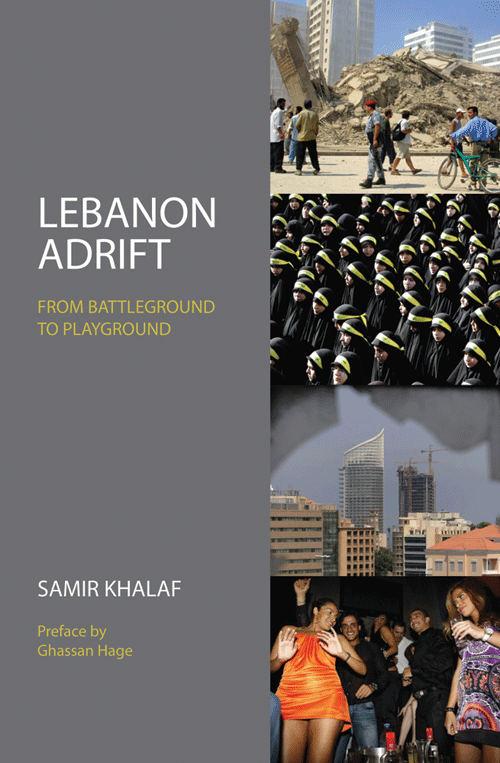
Lebanon Adrift – A book by Samir Khalaf

by Ellen Hardy February 3, 2012
written by Ellen Hardy

Something strange often happens to first year medical students, confronted by textbooks listing reams of sinister symptoms: they all come down with galloping hypochondria, seeing brain tumors in every headache and consumption in every cough. Something similar might happen to a Beiruti reading “Lebanon Adrift” — though instead of physical ailments, readers will look up from the pages and see, in every poster, traffic jam or flutter of false eyelashes, a society in torment. “Lebanon Adrift” is a wide-ranging diagnosis of Lebanon’s contemporary pathology as a culture of unrestrained excess, narcissism and escapism, indicative of political, moral and social alienation.

Author Samir Khalaf is a distinguished sociologist and professor at the American University of Beirut. “Lebanon Adrift” is a book full of “personal indignation and outrage” — the sum of a lifetime of observation of a land he loves, in which he attempts to theorize those grating features of Lebanon’s social landscape that will be familiar to anyone with more than a passing acquaintance with the country, from pervasive littering and smoking to the gaudy wedding season with its antisocial firework displays. Via a whistle-stop tour of Lebanese history and politics, peppered with social thought from the Frankfurt School to Zygmunt Bauman, Khalaf explores theories of modern consumerism turned to mindless commodification of kitsch and prestige items in the pursuit of social status.

Lebanon’s post-war society, Khalaf suggests, rejects the usual trappings of restraint and sobriety typical for countries recovering from long periods of civil conflict. Rather, the Lebanese, with their history of mercantilism and aptitude for playfulness, have responded to political inaction, social and geographical stratification, unresolved tensions and an uncertain future by unreservedly embracing the numbing attractions of conspicuous consumption. With everything from ‘super nightclubs’ to the latest Porsches, they are replacing creative industry and functional social cohesion with a Durkheimian “social state in which society’s norms can no longer impose effective control over people’s impulses,” resulting in a damaged landscape of environmental degradation, corruption and incivility.

By designating a range of social features as part of Lebanon’s movement from a battleground to a “playground”, where the dark sides of the nation’s Janus-faced liberty, playfulness, enterprise and conviviality are taking over, Khalaf is offering a constructive way of thinking about social malaise. Through consumption, he suggests man gained freedom, “but not the positive sense [of] freedom to mobilize this liberation in creative and purposive forms of participation in the public sphere.”

But like those medical students, the temptation to see everything around one as the manifestation of an illness can obscure other realities. Khalaf proposes the use of “ideal types” to pin down “essential elements” of a social reality as a constructive “tool for analysis”. Yet in his scattergun and often rambling tour of the tribulations of contemporary Lebanon, his “average Lebanese” is invariably hugely wealthy, indolent, monstrously superficial and male. That such people exist is indisputable, but to give them the status of standard-bearer for the modern Lebanese identity is dangerous. There is little attempt to differentiate his central analysis by class, age, gender, religion or geography, and at times his personal outrage reaches the point of parody, decrying Lebanon’s “houses of ill-repute, casinos, gambling parlors, nightclubs, discos, bars, escort bureaus and other abodes of wickedness… Such aberrant features blemish the country’s national character.” Further, by identifying a general and unattractive tendency of the Lebanese for excessiveness and locating so many evils within it, Khalaf neglects a rigorous taking to task of the politicians and lawmakers who are allowing so many damaging transgressions free rein. 

There is much to admire in “Lebanon Adrift”, which also sees possibilities for redemption, making an assessment of non-governmental organizations, architects and political movements that give hope for an active and engaged civil society. Khalaf sees within consumerism possibilities of creativity and resistance. With luck, the debate over Lebanon as a “playground” will act as a spur to action and an encouragement to the “avant-garde and counter-culture” who are sidelined by Khalaf’s “average Lebanese”.

February 3, 2012 0 comments
0 FacebookTwitterPinterestEmail
Comment

The ugly side of man

by Sami Halabi February 3, 2012
written by Sami Halabi

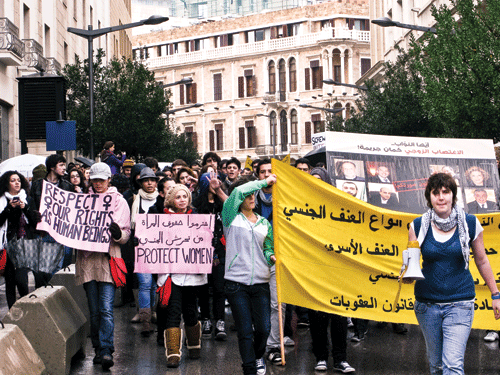
Misogyny is the vulgar indulgence of ignorant men, and it is a shame upon this nation that the men who head our government so openly display this flaccid form of intellect. They began to give it expression early in their term, by forming a cabinet devoid of women, and continued through their denial of nationality rights to the children of Lebanese women and their spouses, then ignored a parliamentary initiative to enact laws targeting men who beat their wives and, more recently, a refusal to criminalize marital rape — these are just some of the more obvious affronts. 

With such exemplary leaders, it is no wonder why the slighting of women is so pervasive in our society, reaching even inside their bodies to reproductive choices. 

Even though abortion is widely available in Lebanon, it remains technically illegal and therefore unregulated and often unsafe. While forms of emergency contraception, in particular what is commonly known as the ‘morning after pill’, are not officially barred, pharmacies across the country were not stocking it on their shelves through December and January.  

Emergency contraception in the form of a pill does not induce an abortion; it is a preventative measure that releases hormones to prevent fertilization during the time it takes sperm to reach the egg, usually between 24 and 72 hours after intercourse. Only one brand of emergency contraception, called Norlevo, has legal access to the Lebanese market, but for reasons unbeknownst supplies of the drug were “cut off” according to the more than 20 pharmacies that were contacted last month. 

Calls to the local distributor, Union Pharmaceutique d’Orient, enquiring as to why, were met with denials that there was even a shortage and officials for the company refused to comment further. The manufacturer in France, HRA Pharma, also declined to comment. The head of the Syndicate of Pharmacists in Lebanon said he was unaware of the issue when asked, but promised to follow up on the matter — all further calls to his phone were left unreturned.

The underlying issue here is that there are no consequences for private companies who take away a woman’s right to choose and even put their lives at risk. The worst thing that usually happens with the morning after pill is a horrible mood swing, but little or no pain. But the alternative to proper emergency contraception for, say a 16-year-old girl who has been raped, is resorting to drugs such as Misoprostol, intended for use in the prevention of ulcers, but also having the ‘side effect’ of technically inducing miscarriage.

So instead of a relatively painless hormonal procedure to prevent pregnancy, women are forced to endure an excruciating process whereby eggs are expelled after contractions in a pool of blood and then, “you just pray,” according to one pharmacist, that fertilization has not taken place. There is no guarantee with Misoprostol that an embryo is expelled, as it is possible that a life threatening ectopic pregnancy might occur, where the embryo implants outside the uterus. Other complications of Misoprostol can include potentially fatal toxic shock syndrome. 

This shortage of Norlevo on the market is directly related to Lebanon’s economic aberration of exclusive agents, which disallows any other company from importing the same brand of medicine. So, in the interests of companies’ product monopolies that keep retail prices high, and the structure of our economy dependent on a few rich and powerful men, women are suffering.

Reproductive rights, and the recognition that women are entitled to the same opportunities and protections as men in a society, are not trivial policy matters — they are issues of human rights that leaders with any claim to morality need to address. 

Misogyny in Lebanon is as societal as it is systemic, rooted in a lack of education with regards to the issues and perpetuated by regressive laws and lawmakers. For the sake of treating half the population — including our sisters, wives, mothers and daughters — with a minimum of respect, we cannot allow our leaders to sit so comfortably with their inhumanity.

February 3, 2012 0 comments
0 FacebookTwitterPinterestEmail
Finance

MENA stock tips

by Maya Sioufi February 3, 2012
written by Maya Sioufi

Envisioning the start of 2012, investors across the Middle East probably could not have conceived of a more nightmarish scenario if they tried. The European debt crisis, Arab revolutions and election year posturing in the United States are just some of the many monsters ready to jump from the closet and under the bed as they lay awake at night. For advice on how to keep your cash safe from these creatures of havoc, Executive spoke with Tareck Farah, chief executive of MENA Invest, and Amin el-Kholy, head of asset management at Arqaam Capital.

 
Tareck Farah 
 
Bullish or bearish? “Cash is king,” says Farah as he explains his bearish stance towards the financial markets. He prefers to hold cash, especially in the first six months of 2012. Within developed markets, he prefers to be exposed to the United States where there is at least some confirmation of growth relative to Europe, which faces a “deleveraging process that might take longer than we imagine.” He believes that investor confidence could still go lower as the European crisis deepens. In emerging markets, Farah believes there will be a squeeze in liquidity in the first half of the year but expects this to ease towards the end of the second quarter, and would start picking stocks in these markets then.
 
Favorite asset classes? While Farah stresses that he would keep a high level of cash in these uncertain times, he likes the corporate credit of solid US and European companies and would stay away from sovereigns and financials. On the equity side, he recommends the US healthcare sector for its defensiveness and likes Medtronic, United Health Corporation, Johnson & Johnson, Élan Corporation and Boeing in the heavy industry sector. He also recommends the US telecommunications sector on the back of the social network boom this year, with major initial public offerings expected, such as the much-hyped Facebook offering. In this space, he highlights Constant Contact, a provider of social media tools.
 
Thoughts on the MENA region? Farah is not particularly hot on any MENA market, with the only one he would consider investing in – if it falls to lower levels – being Saudi Arabia for its solid growth potential, high global oil prices, significant government spending in 2012 and population growth. His favorite sectors are cement and petrochemical.
 
Thoughts on Lebanon? Farah would not invest in Lebanon’s financial markets. He is concerned about the exposure of the Lebanese banking sector to Arab countries facing turmoil. On Solidere, he believes it is not expensive at $14 and if it falls further, it becomes a no brainer. As for Lebanon’s debt, he finds it expensive relative to global market conditions and it does not reflect the Lebanese reality. Farah believes rates should be higher given that Lebanon is “not a producing country, has a single B credit rating and 100 percent of its [territorial] frontiers have issues.”
 
Top pick globally? He stresses on cash as he says, “The intelligent investor would be the one who can better manage his cash.” 
 
 
Amin el-Kholy
 
Bullish or bearish? Kholy is neither overly bullish nor bearish. He is selective in these uncertain markets, as he believes that we are now facing a binary scenario. He stresses that in these markets it is essential to be selective and able to react quickly as we get more clarity on the possible scenarios. Kholy is not too concerned about the Arab political situation as “the risk is already out there.” He is more worried about what the new normal will look like once the European debt crisis and the global uncertainties are resolved, and how it will impact the commodity space, emerging markets and the MENA region. He also highlights the geopolitical risk in Iran as a key issue to be resolved before he can be more bullish on the MENA markets. 
 
Favorite asset class? Kholy believes that both fixed income and equities present attractive opportunities. He is particularly interested in solid names in the MENA region, which offer high dividend yields. He likes the Gulf Cooperation Council region, as it enjoys a favorable economic environment.
 
Thoughts on MENA markets? Kholy would be bullish but selective in trying to find interesting opportunities. The only factor that could impact his stance in the region is geopolitical risk stemming from the Iranian situation. His favorite countries to invest in would be Saudi Arabia and for a slightly contrarian pick, he would recommend the United Arab Emirates. In Saudi Arabia, he would invest in the retail and banking sectors. In the UAE, he would also look into investing in the banking sector.
 
Top global picks? Kholy likes gold or US dollars, but which depends on the scenario that pans out over the course of the year. In a more favorable scenario in which inflation picks up, he expects gold to be popular again. In a less favorable scenario, he would invest in the US dollar, especially via high-yielding GCC fixed income.
February 3, 2012 0 comments
0 FacebookTwitterPinterestEmail
Economics & Policy

A rush to power

by Joe Dyke February 3, 2012
written by Joe Dyke

If the many announcements coming out of the energy ministry last month translate into reality then the country’s electricity sector is on the verge of major change. In a few short days the government announced the start date for the increasing of the country’s energy capacity, the winners of a number of crucial contracts and even plans to control the price of illegal generators.

But if anybody has learned to be wary of the difference between presentations and performance it is the Lebanese. There are significant obstacles in the path of Energy Minister Gebran Bassil, among them political infighting, lawsuits and even allegations of corruption looming over the ministry’s head. 

At present, Lebanon’s consumption of power far outstrips supply. Including generation and imports the country has around 1,500 megawatts (MW) of electricity available, but demand reaches as high as 2,500 MW at peak times, leading to blackouts of over 6 hours a day in some parts of the country.  Late last year the government came close to collapse over the $1.2 billion electricity plan, which aims to add 700MW to the country’s grid, with Free Patriotic Movement (FPM) leader Michel Aoun threatening to pull his ministers from the cabinet if Bassil’s plan was not accepted. 

This cabinet collapse was averted and in January a government circular announced that the projects — including the redevelopment of Jiyye and Zouk power plants, a new gas pipeline and floating electricity-producing barges — are due to begin in March. Yet the infighting continues, with allegations that the finance ministry is preventing the transfer of the $1.2 billion. Cesar Abu Khalil, advisor to the Minister of Energy and Water, admitted that there have been “unnecessary” delays and confirmed that they are still waiting for the funding to be released.

“Technically no, I cannot confirm they [the funds] have been transferred but they have been allowed for by a law. It can be delayed but it cannot be stopped,” he said. “Sometimes it gets delayed in some administration but inevitably we will get our $1.2 billion.”

Unperturbed, the ministry plans to begin the tenders on the 700MW project in March and has begun announcing the winners of other contracts. One project that has been given the go-ahead despite a cacophony of criticism is the distribution service providers (DSPs). Under the scheme Lebanon is to be divided up into three sections, with one private consortium in each area allocated electricity distribution, maintenance and collection operations for a four-year period, with each contract worth more than $100 million. Last month the contracts were awarded, with Butec due to administer the north, Arabian Construction Company (ACC) dealing with Beirut and Debbas in the south.

Potential conflicts of interest are, however, apparent. Butec’s founder and majority stakeholder, Nizar Younes, ran for the Aoun/Franjieh alliance in the 2005 election in Batroun, alongside the energy minister. Meanwhile the ACC is run by the Qatari Prime Minister Hamad bin Jassim bin Mohammed al-Thani, whose country is known to have close relations with the FPM. Furthermore, while all of the companies are well respected, none have experience as energy distribution units in Lebanon.

One of the losing bidders in the north was E-Aley, a company that has been distributing energy in the country for more than 80 years. Following the decision to overlook them in favor of Butec, deputy general manager Albert Khoury confirmed that they have begun legal proceedings against the ruling. Khoury did not wish to discuss the bidding process for fear of jeopardizing the legal proceedings, but said: “electricity is more about politics in this country than about kilowatts and hertz; this is my conviction and this is how it is being played today.”

Mohammed Qabbani, head of parliament’s Public Works, Transport, Energy and Water Committee, says he believes the project is not permitted by Lebanese law, which grants powers exclusively to Électricité du Liban (EDL). “It is a completely illegal project. I will be asking the President of the Republic and the Prime Minister to stop [the minister] from continuing his illegal preparations for these service providers,” he said.

However Khalil denies all accusations of wrongdoing or political favoritism, welcoming legal challenges from those who believe there have been nefarious dealings. “There have been many allegations in the media and we don’t respond to these allegations. We waited for justice to issue its verdict and the verdict of justice is our response to all these allegations,” he said. Given the backlog of cases in Lebanon’s courts, justice may be a long time coming. 

Punishing success?

E-Aley is not the first company to take the government to court over their plans. Last month the ministry won a case brought by Électricité de Zahle (EDZ) over plans to reduce concessions for independent providers of electricity. 

Under the current scheme EDZ, and other firms that have exclusive concession agreements, receives electricity cheaper than cost price. The ministry claims Zahle is provided electricity at LL50 per kilowatt (KW), with others mostly around LL75, while average prices are around LL127. A ruling from the council of ministers in January upheld the decision that the cheapest price going forward will be LL95 per KW, a price Zahle owner Assaad Nakad claims will squeeze him out of business.

“It will be impossible for us to continue our services, and this will lead to the total liquidation of EDZ,” he said. He added that EDZ had been providing a similar service to the distribution service providers for decades. “I really do not understand why they want to destroy such a successful example while they do not know yet the outcome of the DSP project.”

But Khalil points out that these concessions add to the deficit of EDL, which ranges anywhere from $1.2 billion to $2 billion a year depending on oil prices, and are therefore paid for by the Lebanese people. “These concessions are some kind of feudalism, out of the Middle Ages. They try to portray themselves as a success story for Zahle and others,” he said. “If you got a kindergarten kid and put him in these conditions — where he has a fixed cost and a fixed selling price and exclusivity on people with 150 percent in profit — he will be a success story.”

Generating a regulator or regulating generators?

While announcing sweeping changes in almost every part of the industry, the government has remained tight-lipped about one issue; the creation of an independent regulator. Lebanon has been due a financially and politically independent body to organize and control the development of the sector since it was promised as part of Law 462 in 2002. 

Roudi Baroudi, Lebanon secretary at the World Energy Council, believes a regulator is the most important step toward increasing confidence in the energy sector. “The regulatory authority would make the market very transparent and honest; it would create competitiveness and a modern platform for private investors to have more of a stake in the industry,” he said. “And finally somebody would be liable for failures; the consumer will be able to pursue companies for mistakes.”

Yet successive energy ministers have proved unwilling to relinquish absolute power in their fiefdoms and the current one appears little different. Khalil claims the minister is open to the idea of a regulator but is waiting on the outcome of an amendment to Law 462, something a cabinet committee formed during the electricity crisis last September promised to create within three months — yet it has still not come to fruition.

“Whenever there will be a need for this body we will work on creating it,” said Khalil, though many in the private sector would claim the need has been clear for more than a decade. 

Perhaps the most bizarre of the ministry’s many announcements in January was the ‘directive’ on the price of private generators. Under Lebanese law only EDL is allowed to distribute electricity, but the power cuts that plague the country have led many to rely on illegal private companies, or ‘neighbourhood generators’ as they are more commonly known, to provide them with energy when the lights go out. 

The government has long turned a blind eye to such practices but has become concerned by the growth in companies exploiting their monopolies and overcharging customers. So a recent circular announced that the minister was introducing a ‘maximum price’ that generators are allowed to charge at LL400 ($0.26) per hour per five amperes, seemingly ignoring the fact that the industry is outside the law.

Khalil explains that whilst the whole issue is outside the rule of the law they do have tools at their disposal to make the generator owners comply. “Last week two generator companies were shut down by the municipalities; for those who will not abide by this tariff the municipalities, along with EDL, can ask them to remove their cables from EDL installations.” 

What Khalil is admitting, in effect, is that the government has begun to regulate an illegal industry. Whilst it may be commendable to face up to the elephant in the room there are serious concerns that without a regulator to ensure best practices, this process is open to abuse. The relationships shared between local officials have the potential to become more important than the service they provide.

“He [Bassil] is indirectly legalizing generators in the villages and streets. Why do it this way?” asked Qabbani. “Create a regulatory body and this body would have the right to give licenses for the production and generation of electricity. What can you deduce when somebody wants to monopolize illegal authority? What could it mean except corruption?”

The bottom line

When all this squabbling is over and done with, the average Lebanese customer cares about two things: whether they have electricity and how much it costs. The minister’s plan of 2010 aims to “gradually increase the (EDL) tariff” as the additional 700MW is introduced onto the grid over the coming years, thus reducing consumers’ reliance on expensive illegal generators. Yet the government has admitted that demand continues to grow by between 100 to 200 MW year-on-year. Therefore the 700MW, spread over three or four years, could only match the increase in consumption, meaning any increase in price will burden the Lebanese consumer without offering a tangible return.

Qabbani questions whether the plans will be able to counteract the growing gap between supply and demand. “They might be able to stabilize the inclination downward but I don’t think they can have any appreciable increase.”

The flurry of announcements suggests that at least something is happening. After years of deadlock, with electricity reform constantly overlooked, any news may be good news. Yet Riad Chedid, professor of electrical engineering at the American University of Beirut, believes for all its announcements the government is facing an uphill battle. “One should not underestimate the difficulties of trying to fix the electricity sector. It is multi-character: technical, political, human resources, financial. This is what the ministry has been doing so far, but you are dealing with 40 or 50 years of neglect.”

February 3, 2012 0 comments
0 FacebookTwitterPinterestEmail
Society

A damn fine dram

by Paul Cochrane February 3, 2012
written by Paul Cochrane

It is one of the oddities of globalization that while Diageo’s Johnnie Walker is the ninth-best selling whisky in the world, and number one in Lebanon, it will not be found in any pub in Scotland. A drinker in need of a dram of Pernod Ricard’s Chivas Regal, also one of Lebanon’s most consumed whisky brands, would equally struggle to find a bottle in whisky’s homeland. But in Lebanon’s maturing drinks market, distributors think it is high time to take whisky consumption to another level, emphasizing value over volume by pushing single malts, whisky from a single distillery, as opposed to the more popular blended varietries. 

Ever since drinkers moved away en masse from local spirit arak for Scotch, whisky has been the number one spirit at around 450,000 cases (of 9 liters) imported every year, out-pacing the world’s fastest-growing spirit category, vodka, with 150,000 cases imported last year. But of all those crates of whisky coming into Lebanon every year the bulk are blends, with only 8,000 cases brimming with the more premium whiskies and single malts making up a mere 1,500 cases.

Not surprising given that the most popular brands are made specifically for export. In fact, there are only two Scotch whiskies in the top 10 brands worldwide, Johnnie Walker and Pernod Ricard’s Ballantine’s, according to a 2011 report by Drinks International. Last year’s winner of the “Best Single Malt Whisky” category in the 2011 World Whiskies Awards was not a Scotch, but Japan’s Yamazaki.

Realizing that a bottle of single malt will cost customers at least $30 at retail prices, distributors  are looking to make a “personal connection” with customers, according to Gordon Dron, managing director of Europe, Middle East and Africa for William Grant & Sons, manufactuers of Glenfiddich. “We’re not big into mainstream advertizing that’s not really our strategy at all, so it’ll be primarily word of mouth and direct one-to-one connections.” 

Thier local distributor Gabriel Bocti have held single malt tasting nights at hotels, while Etablissements Antoine Massoud (EAM) hosted “The Malt Gallery” tasting nights at art galleries throughout last year. There is clearly demand potential, with an EAM auction of a 55-year-old Macallan in a Lalique decanter — one of 420 released — going for $12,500 in November.  

“We want to create a culture of single malts; Lebanon has a big spirits market, and whisky is the most consumed category,” said Anthony Massoud, managing director of EAM. “The treatment of malts is like fine wines, with different expectations from each bottle. But people have little knowledge about malts or appreciation, so we want to transfer this culture and history to Lebanon and, very humbly, we are trying to make this a category available to the public. The aim is for sales of malts to go from 1,500 cases a year to 10,000.”

For malts to hit this figure and a single malt culture to develop, it will have to occur through a collective marketing boost by all the major distributors, namely Diageo, Vincenti & Sons (distributor of Label 5 and Glen Moray), Fattal (distributor of Dewar’s), as well as Bocti (distributor for Grant’s). Carlo Vincenti of Vincenti & Sons, for instance, believes this growth can only occur through greater evolution of on-trade sales of premium brands, “as you can’t launch a 16-year-old whisky in a supermarket.”

Global drinks giant Diageo will focus on premium blended scotch, launching Johnnie Walker Double Black (a variant of Black Label), but it also aims to bolster sales of its single malt brands Singleton of Dufftown, Talisker and Glenmorangie, to have a foothold in the category. 

Raising a glass to the region

However, Lebanon is just the tip of the ice cube for distributors’ regional ambitions. “Lebanon doesn’t have a big population, but its influence over the whole region is significant,” said Dron. “Because of the relatively liberal [alcohol] policy here it makes this market a good place to connect with consumers.”

Lebanon is clearly key to such regional growth, yet with prises rising briskly, distributors could face a hard time selling premium whiskies in a depressed market, with overall drinks sales in 2011 down on the previous year. But as Massoud emphasized, “it is not about volume, but value. In the malt category price is irrelevant when there is a passion for the taste.” 

February 3, 2012 0 comments
0 FacebookTwitterPinterestEmail
Economics & Policy

Cure or curse?

by Zak Brophy February 3, 2012
written by Zak Brophy

There’s nothing like the promise of untold wealth to wash away the winter blues, and as the nation awoke to a new year of crippling debt, power cuts, falling buildings and gloomy economic forecasts, it was in need of some good news. What better palliative then, than the prospect of opening a hydrocarbon jackpot under the Lebanese ocean floor?

In the wake of its neighbors’ success in tapping the Eastern Mediterranean’s resources, Lebanon is finally pushing forward efforts to exploit its share of the seabed in search of the spoils of oil and gas. While politicians may promise immeasurable riches for one and all to share, the sage among the crowd will be observing developments with more than a hint of healthy cynicism. What lies trapped underground offshore is far from assured and a bountiful find could easily turn from a blessing to a curse for the country’s economy and body politic.

The potential stakes

In its first meeting of the year on January 4, the Council of Ministers passed an implementation decree pertaining to Lebanon’s Offshore Petroleum Resources Law (Law 132), which will enable the country to move forward into the exploration stage. The move has been a long time coming and was precipitated by the enviable finds in other areas of the Eastern Mediterranean. 

“Of course there is a race to explore and drill because Israel and Cyprus are already ahead of us,” explains the Acting President of the Lebanese Economics Association (LEA) and Associate Professor of Economics at the American University of Beirut (AUB), Jad Chaaban.  

Research has long hinted at the potential for hydrocarbons in the region’s waters, with a 2010 report by the United States Geological Survey estimating an average of 1.7 billion barrels of recoverable oil and 3.5 trillion cubic meters of recoverable gas in the Levant Basin Province, a geological formation in the Eastern Mediterranean extending from Syria to the Sinai. 

Whilst Lebanon lags behind in terms of exploration and drilling, it has commissioned a number of the rather coarse two-dimensional and more refined three-dimensional seismic surveys from the firms Geco-Prakla, Spectrum Geo and most recently Petroleum Geo-Services (PGS). The findings indicate a number of unexplored potential hydrocarbon hotspots including the Syrian Arc, the Levant Basin Province and the Levant Margin in the 20,000 square kilometers of deep water in Lebanon’s Exclusive Economic Zone (EEZ) — the ocean area the country can claim ownership over with regards to resources from oil to oysters. 

Houston-based Nobel Energy has been operating in Israeli waters since 1998 and has tapped into two massive fields in recent years. In 2009, Tamar, a 237 billion cubic meters (BCM) gross natural gas field, was successfully drilled and an additional 453 BCM of natural gas were discovered in the Leviathan field in late 2010 — the world’s largest deep water gas discovery in the last 10 years. With successful drilling in December 2011 into what could amount to 226 BCM of natural gas in the Aphrodite field in Cyprus’ maritime waters, the Eastern Mediterranean has very much aroused the attention of international oil companies (IOCs). 

Hype vs. reality

Opposition Member of Parliament (MP) and Head of the Parliamentary Energy and Public Works Committee, Mohammad Qabbani, expresses an optimism shared by many when he says, “There is oil and gas five kilometers south of our borders — do we think God created a wall between us and Palestine? All of this area is rich in the Levantine basis.”

However, successful drills in Israeli and Cypriot waters are no assurance that there is actually any commercially recoverable gas or oil in Lebanese waters. AUB’s Chaaban is skeptical about the hype surrounding the industry and argues, “They are being too optimistic… It is a political statement to say the oil sector will be booming and to talk of all these revenues.” 

Even with extensive and promising seismic surveys, and multiple regional discoveries, attempts to quantify what is actually below the Lebanese seas are merely educated guesses at this point. “All a seismic survey tells you is that there are certain subsurface structures but they could be full of water; you have to have drilling going on to find out what is down there,” explains David Aran, founder and owner of London-based Petroleum Development Consultants Limited (PDC).

The bureaucratic botch

Nonetheless, encouraged by the regional finds and goaded on by the fact that it is now years behind neighboring countries’ efforts, Lebanon is finally moving toward drilling the seabed to see what is actually there. The first incremental step came on August 17, 2010 when the Lebanese parliament passed the Offshore Petroleum Resources Law, drafted by the Ministry of Energy and Water (MoEW) with assistance from the Norwegian Agency for Development Cooperation (NORAD).

However, due to the idiosyncrasies of the Lebanese political and legal systems, the law does not actually come into effect until the necessary implementation decrees are passed by the Council of Ministers, Lebanon’s cabinet. 

The January 4 edict was one such decree — there are more than two dozen in total — enacting the creation of the Petroleum Administration, a prerequisite for the cabinet to enact the subsequent decrees for managing the sector, known as the Petroleum Activities Regulations (PAR). 

The next hurdle to developing Lebanon’s offshore ‘play’ — an industry term describing the activities associated with petroleum development in an area — will be in the formation of the Petroleum Administration. Determining the exact role of this body, who will staff it and its level of independence will have a sizeable impact on the evolution of the sector as a whole. Consensus is far from assured. 

As Executive went to press the six members of the Petroleum Administration’s board had not been selected, but the MoEW stated cabinet would appoint the posts by the end of January based on proposals from the Minister of Energy and Water, Gebran Bassil. 

The law stipulates that the Petroleum Administration “shall enjoy financial and administrative autonomy with the Minister exercising tutelage authority,” but Cesar Abou Khalil, advisor to Minister Bassil, says, “The funding is already in the budget of 2012, which has an allowance for their salaries and the minister of energy and water allows it from his budget. This is a body inside the Ministry of Energy and Water.” 

This raises questions regarding the independence of the Petroleum Administration.

There is also uncertainty over its role in relation to the MoEW. In a presentation by the ministry at the Lebanon Petroleum Exploration Forum 2011 last summer, the authority was labeled as a ‘regulatory body’ (along with the ministry). But, Abou Khalil argues: “It is not a regulatory body. It is purely consultative and is under the minister and nobody else.”        

Opposition MP Qabbani responds to this with an excoriating critique of Minister Bassil, claiming he seeks hegemonic control of the industry, going so far as to compare his managerial style to that of Hitler. “The minister wants to control the signature of everything,” says Qabbani. “The minister is going to do his best to make sure he controls the [Petroleum] Administration and we will do our best to make sure that he can’t do that.” 

Considering the prospect that this embryonic sector could precipitate a tectonic shift in Lebanon’s economic, political and social landscapes, its governance and institutional frameworks are of primary importance. Abou Khalil claims there is sufficient governance within a three-tier system, whereby the Petroleum Administration makes suggestions to the minister who will then enact them if he is able to, and if not he will send them to the cabinet. 

“The Petroleum Administration, the Council of Ministers and the Minister of Energy and Water will all regulate one another,” he reasons. As for the prudence of creating an independent body to regulate the sector he simply asks: “Why do you need a regulatory body?”

Once the Petroleum Administration is appointed by the cabinet, it can begin the process of passing further implementation decrees to move the country into the early stages of the exploration phase, where companies prospect for oil or gas in Lebanese waters. The MoEW has laid down targets to enter into the first licensing round of the tender process within the first quarter of 2012, and to sign the first contracts by the end of the year. 

All prospective companies will have to pass through a pre-qualification phase and only consortiums of three or more companies in an unincorporated joint venture can actually bid for tenders. Successful applicants will be granted exploration and production agreements (EPAs), allowing them to explore specific areas, called ‘blocks’, for potential black gold. 

Lacking tools for the task

According to the law, the Petroleum Administration’s role in this crucial phase will be to draft invitations for bids, assess the qualifications and capabilities of applicant IOCs and assist the minister in negotiating exploration and production agreements. AUB’s Chaaban, however, frets that the Petroleum Administration will be ill-equipped to fulfill its mandate. 

“We definitely won’t have a qualified team to run [the Petroleum Administration]… The ministry will probably end up choosing the companies, which is not a good thing,” he says. “You need an independent authority that has the ability to choose on a technical and sound basis who will get the contracts.” 

Not only does Chaaban raise concerns over the potential for the co-opting of the tender process by political and business interests, but he also argues that Lebanon is in a weak position to negotiate good contractual terms with prospective companies. 

“I don’t think any rational investor will opt for arrangements that are favorable to the local government,” he says. One of the several justifications Chaaban offers for his skepticism is rooted in what he says is the Lebanese government’s terrible track record in honoring its contractual agreements. He cites the telecommunications debacle in the early 2000s — the last time the networks were up for privatization — when France Telecom was awarded $266 million by an international court that found Lebanon in breach of contract.

Still interested?

“Lebanon’s bad reputation is true,” says Salah Khayat, chief executive officer of the nascent firm Petroleb, the local partner in a consortium that is being put together for a potential bid in Lebanon’s offshore play. But, he adds, “that has a lot to do with who was running the country in the past. There is a huge difference now and things are being done right this time.”

Salah’s uncle Tahseen Khayat is a media magnate who has had an openly caustic relationship with the previous governments of both Rafiq, and later Saad Hariri. Khayat says, however, that this is not reflected in his assessment of the current Lebanese administration. “We are very business orientated, we do not look at any political side of the story… Does my uncle have anything to do with this? We have his full blessing,” he stresses. 

Khayat says his own prospective consortium, whose members he declined to name specifically, includes a major company from  the Gulf — where his immediate family have decades of experience in the petroleum industries — and three other international players. He argues there has been a high level of global interest in the incipient sector which is confirmed by Sverre Strandenes, executive vice president multi-client for PGS (the company that has conducted the most detailed seismic studies of Lebanon’s seabeds). He says, “There has been good interest [in data on Lebanon’s fields].”

Minister Bassil has also alluded to “serious interest” from Chinese, European, American and Russian firms, while the Iranian news agency Fars has reported that Tehran is seeking greater cooperation with Lebanon in the energy sector, especially regarding exploration. 

Negotiating the nitty-gritty

Whilst the IOCs are now analyzing their data, forming their alliances and devising their strategies, they will soon knock on the door for access to Lebanon’s waters. When this happens the government will find itself at the bargaining table with some seasoned and incredibly powerful players. In the coming months the PA and the MoEW will be detailing the mechanisms by which the prospective consortiums and the government will divvy up the spoils of any discoveries using a combination of royalties, concessions and Product Sharing Agreements (PSA) — the method of sharing extracted resources between the government and oil companies.  

PDC’s Aran shares Chaaban’s view that Lebanon will have to play smart if it is to seal deals that will ultimately benefit the nation. “PSAs are like any market with a buyer and a seller. Lebanon is a seller so they have got to attract the companies. They will need to have low taxes and low royalties. If you are [the government] sitting in Angola, the Gulf or Khazakstan, somewhere very highly prospective, you are going to say virtually all of the money is going to come to us. Lebanon is in a weaker position,” he argues.

Aran does however also argue that Lebanon has some trump cards it can wield to lure in prospective companies. Perhaps most important is an easily accessible and sizeable market for any future production. As Petroleb’s Khayat explains, “Gas infrastructure is rather expensive. The price of gas is in its transportation.”  

Lebanon is itself in dire need of cheaper more efficient fuel supplies for its dysfunctional energy sector, which is almost entirely dependent on fuel imports. In the first ten months of 2011 alone the Ministry of Finance reimbursed Electricité du Liban (EDL) LL2.1 trillion ($1.37 billion) for fuel and gas purchases, marking a 44 percent increase on the same period the previous year. Making matters worse, the finance minister has predicted the total deficit of EDL at $2 billion. 

To service this domestic market Lebanon already has the infrastructure in the Beddawi and Zahrani plants to burn natural gas, and for the export of any excess reserves it is connected to the Arab Gas Pipeline (although the viability of this depends on political and security developments in Syria). 

Development of the natural gas infrastructure features highly in a 2010 policy paper for the MoEW. The establishment of a Liquified Natural Gas (LNG) terminal, the conversion or building of most power plants to run on natural gas and the construction of a coastal natural gas pipeline running between Beddawi power plant in the north and Zahrani power plant in the south are among the projects planned. 

Lebanon’s somewhat colorful history of internal strife and regional conflagrations is always going to sit pretty high on a prospective investor’s risk assessment, which is further compounded by Lebanon and Israel’s disagreement over where the boundaries of their EEZs fall. Add to this a lack of proven reserves and questions over governance,  and “there are enough reasons not to invest,” in the words of consultant Aran. In such an environment the attractive markets for future discoveries are a strong bargaining chip. “It’s a sales job. You are in competition for exploration dollars. It’s like selling a house. If you have a small garden you say, yes but it’s a lovely view,” he reasons.

Casting a glance several years down the line beyond the exploration phase lie perhaps the greatest uncertainties and potential for ruin. Whilst the fate of any drilling expeditions cannot be realistically foretold, the prospect of a massive hydrocarbon windfall is very real. Based on a price of $120 per barrel, independent energy consultant and Secretary General of the World Energy Council’s (WEC) Lebanon Member Committee, Roudi Baroudi, predicted in a 2008 study that Lebanon could expect to enjoy a bounty of LL211 trillion, ($140 billion dollars) over a 20-year period from its offshore oil and gas reserves. 

Oil’s curse 

For a country with a national debt of more than $50 billion — exceeding 130 percent of gross domestic product — and a near complete reliance on fuel imports to meet its energy needs, the discovery of oil or gas might sound like a panacea. The pitfalls of transitioning into a resource dependant economy, however, are significant.

The major worry is that Lebanon may catch a variant of what is called ‘The Dutch Disease’, which, broadly speaking, is the decline of other economic sectors — usually manufacturing and agriculture — associated with the increased exploitation of natural resources. The basic premise is that increased resource revenue will inflate the value of the local currency and make other exports less competitive, while at the same time economic emphasis in that one area will undermine development in other sectors. 

“The economy will be geared towards one sector which will absorb all the resources and expertise and the attention of policy makers, which would make investments in industry and agriculture even less than now,” says economist Chaaban. 

Nigeria is among the textbook examples of a resource boom gone wrong: narrow economic focus on oil exploitation through the later half of the last century led to a steep decline in agriculture and other economic sectors, such that today the country’s GDP is actually in the range of what it was in the 1960s. So while there has been little net gain in overall national wealth, what has happened is wealth and wealth generation have become highly concentrated in and around the oil industry, leaving the vast majority of the country much worse off than they were before the resource boom. 

Securing the piggy bank

Abou Khalil at the MoEW says the ministry has incorporated the creation of a sovereign wealth fund (SWF) into the Offshore Petroleum Resources Law so as to counter the threat of Dutch Disease, fiscal profligacy and political manipulation of the revenue. 

In a January 23 meeting with the Association of Banks in Lebanon, Prime Minister Najib Mikati announced that the revenues from the fund will go towards reducing the public debt-to-GDP ratio to 60 percent — it currently exceeds 130 percent — before  fulfilling any other expenditures. While the stipulation for an SWF is welcomed across the board as a necessary measure, the politicians are in no hurry to realize its creation. 

“It isn’t a very imminent question… I strongly believe we have time,” says Abou Khalil, and in a rare note of agreement opposition MP Qabbani states: “There won’t be any funds for the coming six or seven years, why fight over [the SWF] if there won’t be any funds in that time.”

Their aversion to tackling the thorny questions over the nature of the SWF and its management is understandable due to the political wrangling that is bound to ensue. Deciding where such a potentially handsome hoard of cash will reside and under whose purview will certainly set a cat amongst the pigeons in the circus of Lebanese politicians. So, to get the current Offshore Petroleum Resources Law passed, the issue has essentially been kicked into the long grass.

Some argue, however, that the creation of the SWF is a pressing concern that should not be avoided. Energy consultant, Baroudi, says, “The most important [decree] is to pass a law to create the sovereign wealth fund. This should not wait. It is not important just to explore and produce but you need to protect the wealth.”

Ashby Monk, a visiting research associate at the University of Oxford School of Geography and the Environment and co-director of the Oxford SWF project, is a global authority on SWFs. He concedes that while it is not necessary to have people “twiddling their thumbs” at the SWF now, “You would want the legal framework set up before hand. That is an ideal. The earlier you articulate the regulatory framework, where it is going to be housed, etcetera, the better.” 

An SWF is also not a cure-all for potential abuses derived from hydrocarbon revenues, as there are ample examples globally of mismanaged SWFs. In compiling a SWF scoreboard for his book, ‘Sovereign Wealth Funds: Threat or Salvation?’, Edwin Truman found that around 57 percent of the funds had guidelines integrating the use of their earnings, but only around a quarter consistently followed them. 

The prospective future

Even in the most optimistic assessments, Lebanon will not be reaping the fruits of its labor in the hydrocarbon sector for two to three years, and in reality it is more likely to be five to 10 (assuming there are actually commercially viable fields to be drilled). 

The allure of the petrodollars may be a dizzying prospect, but its capacity to further empower corruption in the nation’s politics and blight other sectors of the economy are grave threats that cannot be ignored. As the nation careens ahead on its hydrocarbon adventures there is an urgency to ensure that the ship is setting sail on course. There will be no second chance.

February 3, 2012 0 comments
0 FacebookTwitterPinterestEmail
Society

Another go round

by Nadim Mehanna February 3, 2012
written by Nadim Mehanna

Recent years have seen big brand car manufacturers suffering fits of nostalgia, digging through their archives for earlier success stories deserving of a second life. These highly popular updated classics might well have taken inspiration from Porsche, who has had consistent success for nearly five decades with the famous 911 model, born in Zuffenhausen in 1963. Today, just one year shy of its 50th anniversary, Porsche has launched another all-new 911 Carrera. More distinctive, elegant and powerful than ever, it has also made moves toward environmental friendliness, proving that the marriage between vintage style and contemporary technology is a durable one.

Completely redesigned, the 2012 Carrera is wider, longer and flatter than previous versions, and has an ideal height-to-width ratio that sketches its sportier, more athletic curves. Weight reduction was a priority in its development, with doors, luggage and engine compartment lids made of aluminum, highlighting the Porsche’s ‘Intelligent Performance’, merging high functionality with reduced emissions and better fuel efficiency. It has the world’s first seven-speed manual transmission for a passenger car, with the dual clutch automated-manual Porsche Doppelkupplungsgetriebe gearbox, better known as the PDK, coming as standard.

But the 2012 911 is only the latest in a string of strong historical reissues from various brands, many of which, unlike the 911, have spent time out of production.

With over 21 million vehicles manufactured, the VW Beetle holds the record for the longest production run of a single car. It has weathered the storms of a world war, coal and material shortages, and weak buying power throughout its history – its secret? Good performance in all climatic conditions and on any type of terrain, and a global supply of replacement parts. The Beetle made its comeback in the early 1990s with a modernized design of the classic model that won several awards, such as “Design of the Century Award” from the Industrial Designers of America. 

Another globally recognized car, born in 1959, is the classic Morris Mini-Minor with its 848 cc engine and 4-speed manual gearbox. With its distinctive profile, strong performance and mass-market appeal, Mini quickly developed into an icon that enjoyed worldwide popularity. By March 1965, one million vehicles had been produced. In 1994, BMW Group acquired Mini, and by 2001 the new version was on the roads: larger and heavier, it had shifted from a city car to a compact car but was still true to the iconic design. Very different from the Mini, the Chevrolet Camaro is one of the most popular sport coupés in the automotive industry – muscular, aggressive, powerful and loud. Born in 1967, it was famed for being beautiful, practical and affordable, with a performance that could rival European Gran Turismos. The first Camaro was powered by a 3.2 liter V6 engine that produced 155 horsepower (hp), with the option of a 5.4 liter V8 engine that delivered 275 hp. Production of the classic sport coupe was steady for 36 years until the discontinuation of the fourth generation in 2002. Eight years later, the all-new Chevrolet Camaro made its comeback with a modern design, and more engine power (standard Direct Injection 3.6L V6 engine, 323 hp, SS version’s 6.2L V8 engine, 462 hp).

Finally there was the Dodge Challenger, the quintessential muscle car: bold, stylish, handsome and powerful, with its legendary V8 426 Hemi engine that yielded a mighty 425 hp. But because of rapidly rising insurance premiums and gas shortages, and the oil crisis following the 1973 war in the Middle East, demand for muscle cars decreased and production of the Dodge Challenger ended in 1974. The year 2008, however, saw the Challenger’s comeback. Styled like the original 1970 to 1974 generation, the new muscle car was taller, bulkier, heavier, and packed with luxury features as well as new technologies. Powered by a 6.1 liter 425-hp Hemi V8 engine, it did zero to 100 kilometers per hour in 5.1 seconds. 

Whatever the story behind the model, these remakes allow their manufacturers to tap into a valuable market that spans brand loyalty and adds a contemporary spin, allowing them to sell an updated idea at premium prices. Be it a facelift or something more, the remakes will probably keep on coming for yet another ride.

February 3, 2012 0 comments
0 FacebookTwitterPinterestEmail
Economics & Policy

The dreary dawn of 2012

by Fabio Scacciavillani February 3, 2012
written by Fabio Scacciavillani

More than four years after a wave of delinquencies on subprime mortgages in the United States triggered the gravest financial crisis of modern times, the global economy is still reeling from the fallout, with no end in sight. At the beginning of 2011, hopes of a gradual strengthening of the macroeconomic outlook were nurtured by exceptional policy measures, central bank interest rates in major developed economies being either virtually at zero or slightly above, and the balance sheets of the US Federal Reserve, the European Central Bank (ECB) and the Bank of England expanding massively to flood the banking system with liquidity.

Yet, one after the other, the economies of all major developed countries stalled in early 2011 following disruptions in the global supply chain from the earthquake and tsunami in Japan, the Fed announcing the end of its second round of ‘quantitative easing’ in the US and the jump in energy prices following the Arab uprisings. Even emerging markets, which had been tightening their monetary policies to counter inflationary pressure, suffered the consequences on their growth rates.

Contrary to their rosy expectations, financial market professionals have come to realize that the emergency fiscal and monetary measures had only temporary effects. The rhetoric of the “soft patch” gave way to the reality of an epochal fiscal crisis on both sides of the Atlantic, and Japan. Stock markets wobbled and after weeks of heightened volatility started a declining trend, which is still firmly in place entering 2012. Concerted efforts by policy makers to bring the situation under control, within the framework of the G20, have so far shown only ephemeral results. Deeper cooperation to reach a long-lasting solution has been elusive. 

A growing transatlantic divergence has materialized in recent months and seems to have widened at the turn of the new year. The US economy was gaining traction in the fourth quarter and is entering 2012 on an upbeat note. Gross domestic product growth is expected to be above 2 percent, with monthly private sector job growth having averaged 155,000 over the past five quarters (though some of this has been seasonal and temporary employment). By contrast the Euro area is on the brink of a recession, due to government austerity measures and a credit crunch triggered by anxious banks saddled with suspect sovereign debt and loan provisioning. In the emerging world, Latin America is doing marginally better (for instance Brazil and Colombia), but Eastern Europe is looking very sick, with Hungary in default and mired in a deep political crisis. Asia is somewhere in the middle, but appears to be following more the track of Europe than the Americas; China may be the exception, though economic data there shows progressive weakening, while Japan does seem to have rolled over anew – the much touted ‘reconstruction effort’ recovery is feebler than expected. 

In the Gulf, balanced public finances and sovereign backing of the banking system have so far mitigated much of the impact of the second phase of the Great Recession — indeed, thanks to higher energy prices the net effect has been positive. Governments have maintained a steady course, reiterating the objective of developing a diversified economy and broadening employment for the large young cohorts entering the labor market.  

Looking ahead, the illusion of a quick fix has given way to the awareness that overcoming the Great Recession will probably take several years: the major mature economies need to undergo a painful process to purge their financial system of toxic assets and reduce the unsustainable level of leverage in their banking system. At the same time fiscal excesses have to be reined in. 

Crucially, prospects for 2012 have little to do with economics and a lot to do with politics. In particular the two largest economies, the US and China, will undergo a defining moment almost at the same time. In the US the November presidential and Congressional elections will be the dominant factor driving major fiscal policy decisions. 

In China, presumably in October, the 18th Congress of the Communist Party, held every five years, will pick a new Central Committee that in turn will “elect” a new Politburo of about 25 members. For the first time in 20 years, President Hu Jintao and the Prime Minister Wen Jiabao will not be part of it. And when, in 2013, they retire from active politics, the process will have produced the most radical change of leadership in a decade. Combined with the appointment of a new chief executive in Hong Kong and the presidential elections in Russia, the repercussions for Asia could hardly be more momentous.

Earlier in the year France will hold the presidential elections, which might considerably change the equation in the balance of power within the European Union. A new Socialist president will be less inclined to step in sync with German Chancellor Angela Merkel’s European stewardship. And the EU will indeed be the major focus because of the delicate battle still underway to redefine the governance of the Eurozone and the EU in general. The Latin profligacy will confront German (and Nordic) austerity in a showdown involving the rewriting of the fundamental treaties and the mandate of the ECB. The process will be neither quick nor painless as the dozens of “summits” held so far on the topic demonstrate. 

While the political and electoral dust settles, the prevailing baseline scenario is another year of mild global slowdown, with hopes of a potential positive surprise from the US. Nevertheless, financial markets will remain in high alert mode due to two tail events that, although highly remote, would have such a devastating impact as to push the world economy into a worse recession than 1929. One is the breakup of the euro – which nobody wants but could be set in motion by a snowball effect originating from the default of a major bank – while the other, less talked about, is a collapse of the real estate market in China and/or the explosion of the local government debt, which on the current trajectory is unsustainable. In truth the gravity-defying real estate prices in China have constituted a major concern for years if not decades. But this observation might not be of much comfort: it was also the case for the housing bubble in the developed world before 2007.

February 3, 2012 0 comments
0 FacebookTwitterPinterestEmail
  • 1
  • …
  • 347
  • 348
  • 349
  • 350
  • 351
  • …
  • 686

Latest Cover

About us

Since its first edition emerged on the newsstands in 1999, Executive Magazine has been dedicated to providing its readers with the most up-to-date local and regional business news. Executive is a monthly business magazine that offers readers in-depth analyses on the Lebanese world of commerce, covering all the major sectors – from banking, finance, and insurance to technology, tourism, hospitality, media, and retail.

  • Donate
  • Our Purpose
  • Contact Us

Sign up for our newsletter

    • Facebook
    • Twitter
    • Instagram
    • Linkedin
    • Youtube
    Executive Magazine
    • ISSUES
      • Current Issue
      • Past issues
    • BUSINESS
    • ECONOMICS & POLICY
    • OPINION
    • SPECIAL REPORTS
    • EXECUTIVE TALKS
    • MOVEMENTS
      • Change the image
      • Cannes lions
      • Transparency & accountability
      • ECONOMIC ROADMAP
      • Say No to Corruption
      • The Lebanon media development initiative
      • LPSN Policy Asks
      • Advocating the preservation of deposits
    • JOIN US
      • Join our movement
      • Attend our events
      • Receive updates
      • Connect with us
    • DONATE