• Donate
  • Our Purpose
  • Contact Us
Executive Magazine
  • ISSUES
    • Current Issue
    • Past issues
  • BUSINESS
  • ECONOMICS & POLICY
  • OPINION
  • SPECIAL REPORTS
  • EXECUTIVE TALKS
  • MOVEMENTS
    • Change the image
    • Cannes lions
    • Transparency & accountability
    • ECONOMIC ROADMAP
    • Say No to Corruption
    • The Lebanon media development initiative
    • LPSN Policy Asks
    • Advocating the preservation of deposits
  • JOIN US
    • Join our movement
    • Attend our events
    • Receive updates
    • Connect with us
  • DONATE
Economics & Policy

For your information

by Executive Editors November 25, 2011
written by Executive Editors

Syria stutters

As Syria comes under further strain as a result of the ongoing uprising and government crackdown, a series of announcements last month reflected the effects on the country’s economy. In an interview with Bloomberg in late October, Adib Mayaleh, the governor of Syria’s central bank, said the country had spent $3 billion of a $5 billion emergency fund since the start of the uprising in March in order to defend its currency from devaluation and to finance trade. The fund’s existence was revealed in August when Mayaleh announced that $2 billion had already been spent. Mayaleh also noted that foreign currency reserves held by the central bank amount to around $18 billion.  European Union sanctions on oil imports from Syria are scheduled to start this month and are expected to deprive the government of an essential foreign currency source, accounting for 25 percent of total annual revenue. Last month Mayaleh also hinted the country may transition away from the euro towards the Russian ruble if the EU bans the country from dealing in their currency. “In the near future we will agree on parameters for switching to close cooperation with Russian banks and using the ruble for international settlements,” he told Bloomberg.  This year Syria’s economy is expected to contract by 2 percent, according to the International Monetary Fund. Other predictions are even worse for the Levantine state, with the Institute of International Finance positing a 3 percent decline. Syria’s finance minister announced in September the country was expecting gross domestic product growth to slow to around 1 percent this year from 5.5 percent in 2010. [See Dithering in Damascus]

Draft budget released

Last month Lebanon’s finance ministry proposed its draft budget for the year 2012, in accordance with the constitutional deadline for doing so. The budget proposed a series of new taxes including an increase in value added tax (VAT) from 10 percent to 12 percent, while removing VAT refunds on a series of fixed assets used to perform activities such as educational services, activities of non-profit organizations and manufacturing of books, newspapers and magazines. Last month Neemat Frem, president of the Association of Lebanese Industrialists, told Executive that industries have not been receiving their refunds from the VAT administration for over 18 months. “They are borrowing from the private sector without asking us, by force,” he said. The increase in VAT is expected to rake in around $262 million in 2012, according to the draft budget. However, last month Finance Minister Mohamad Safadi told a local radio station that the revenues from the VAT increase would  total $364 million. A 3 percent tax on sales of real estate was also proposed in anticipation of a tax on real estate profits by 2013. The budget also proposed raising the tax on gasoline by LL2,000 ($1.32) per jerry can (1 jerry can = 20 liters) after it was reduced by LL5,000 ($3.25) earlier this year. The budget also proposes a tax on the thorny issue of illegal privately owned maritime properties built on public land, without specifying the amount. The budget predicted real gross domestic product growth in 2012 at 4 percent with inflation expected to hit 5 percent. The total deficit was estimated to reach $4.1 billion, or 29.7 percent of total expenditure. Total debt servicing was estimated to come in at $3.86 billion, an increase of around $24 million on 2010. Other items proposed included exemptions from some fees for non-polluting vehicles and reducing late fines imposed on municipal fees by 70 percent for years prior to 2009. The budget did not account for the increase in minimum wage, decided upon by the cabinet last month, which Safadi stated would cost the government at least $700 million. The budget will have to be approved by cabinet and then sent to parliament to be debated before it is passed into law. Lebanon has been without a budget since 2005.

Lebanon gets thumbs up and down

A series of global economic rankings released last month provided a mixed outlook for Lebanon’s relative position in the region and globally. The World Bank/International Finance Corporation’s “Doing Business Report 2012”, released last month, ranked Lebanon in 104th place amongst the 183 countries surveyed, a drop of one place in the global rankings. The report is compiled according to a composite index of 10 sub-indices including availability of electricity, registering property, paying taxes and enforcing contracts, all of which are major problem areas in Lebanon. The country fared worse than the previous year in terms of getting credit, protecting investors and starting a business. Resolving insolvency was deemed to take around four years and 22 percent of a debtor’s total estate value on average, compared to 3.5 years and 14 percent in the region respectively.  Balancing this grim assessment was the right-wing Fraser Institute, based in Canada, which measures competitiveness and government intervention in global economies and praised Lebanon’s economic freedom, ranking the country second amongst 16 countries in the region last year, the same position as in 2009. The index measures five broad factors of economic freedom and 18 variables.

FDI down

Lebanon is experiencing a downturn in foreign direct investment (FDI) and will continue to do so for the rest of this year, in line with the regional situation brought on by this year’s uprisings across the Middle East. According to the Kuwait-based Arab Investment and Export Credit Guarantee Corporation (AIECGC), total FDI in Lebanon will fall by 39.5 percent this year, from $5 billion in 2010 to $3 billion. Thirteen of the 21 Arab countries will experience a downturn this year, according to the organization, with the Arab world tipped to experience an FDI contraction of 17 percent in 2011 to $55.1 billion. Countries which have recently experienced uprisings were particularly affected by FDI contraction, with Egypt expected to see a 92 percent slide to just $500 million this year. Tunisia is expected to receive 21 percent less FDI year-on-year in 2011, Syria’s figure will fall by 65 percent and Libya’s is expected to see an 87 percent plummet. A total of seven Arab countries were tipped to see growth in FDI, including Saudi Arabia with $29 billion (up from $28 billion in 2010) and Iraq, which should see investment inflows of $3.5 billion this year according to the AIECGC. 

3G prices and legal problems

Last month Telecommunications Minister Nicolas Sehnaoui revealed the pricing structure for Third Generation telecommunication services (3G), tipped to be launched in February. Users will be charged $19 dollars by the ministry for every 500 megabits (Mb) of data they use over the service. Mobile operator Alfa also released their pricing scheme for the service last month saying that the service will be introduced in the ”coming few months”.  The ministry is still embroiled in a court case at the Shura council, Lebanon’s highest court, with the private data service provider Cedarcom over licenses to operate the service. The council ordered the ministry to halt execution of the 3G project on September 15 for one month pending the submission of a request for information by the court. Sources close to the proceedings told Executive that the government had submitted the requested documents, which stated that the mobile operators do not need a license because they are government-owned. When it came to pricing the service, which for public companies would require a cabinet decision, the sources said the ministry intended to treat the mobile operators as commercial entities able to set their own prices.

Hunt again for energy

The cabinet seemed intent to restart on the road to hydrocarbon wealth last month as it prepared for a proposed bidding round at the start of 2012. Last month the cabinet authorized the launch of a tender process to survey onshore hydrocarbon prospects. It also recommended a new draft law to regulate onshore oil and gas exploration similar to the one passed in August covering offshore exploration. The energy ministry also revealed that it has launched a tender process to reassess the seven existing onshore wells drilled between the 1930s and 1960s.

November 25, 2011 0 comments
0 FacebookTwitterPinterestEmail
Real estate

For your information

by Executive Editors November 25, 2011
written by Executive Editors

Property sales taxed

The Lebanese government intends to introduce a 3 percent capital gains tax on real estate sales. The proposals come as part of the Ministry of Finance’s efforts to raise government revenues and increase next year’s expenditure by 13 percent, as revealed in the draft budget on October 4. In an interview in mid October, Finance Minister Mohammad Safadi said that the real estate tax, in principle, is acceptable as long as it is below 15 percent. In June 2010, under former Minister of Finance Raya al-Hassan, a draft budget proposed a hike on property registration fees from 5 percent to 7 percent on real estate valued over $500,000 as an alternative to a tax on real estate sales. It was not implemented before the collapse of the government in January 2011.

10 new levels of luxury

A Saudi Arabian firm, Al Shegrey Group KAS Investment, has opened the doors to its newly completed boutique hotel in the Beirut Central District, according to the group’s October 3 press release. Le Dix Hotel, named after the 10 suites which each occupy their own floor, was built at a cost of $25 million, and includes luxury amenities such as private butler service and limousine transport to and from the airport. Arguably built at the highest cost per room key for a hotel in Lebanon, the large suites include two or three bedrooms, kitchen and balcony with an unblocked sea view. Chief Operating Officer of the firm’s hospitality division, Abdulkader A. Hankir said in the press release,”We invite presidents, ministers, ambassadors and businessmen from all over the world to visit Le Dix and have a look at one of the most luxurious hotels in the Arabic region.”

Summerland’s back

The Summerland Village – Residential Apartments was launched October 20, as part of the mixed-use Summerland Hotel & Resorts Kempinski development in Ramlet al Baida, Beirut. Kempinski is the hotel operator, while the developer is London-based Sanbar Development Corporation, the architects are Samir Khairallah & Partners, and the main contractor is Gruppo Rizzani de Eccher. Set to open its doors in spring of 2013, Summerland Hotel will encompass 22,000 square meters of private land with 5000 square meters of private beach, a village composed of 73 residential apartments and a 60-boat-capacity marina. The original Summerland Hotel, which closed in 2001, was created by Société Générale d’Entreprises Touristiques SAL in 1967.

Saudi, king of construction in 2011

Saudi Arabia is dominating the Middle East and North Africa (MENA) construction market this year, having amassed $17 billion worth of new contracts in the first nine months of the year, a 152 percent increase from the same period last year, according to a Bank of America Merrill Lynch Emerging Markets report released October 20. The United Arab Emirates, meanwhile, experienced the steepest fall in new contracts for the same period, down 55 percent compared to the same period last year. For the whole MENA new contracts are up 19 percent year-on-year, but third quarter results were disappointing as contract awards were down 18 percent to $17.2 billion for the quarter. The report pointed out that major UAE construction firms like Drake & Scull International and Arabtec had succeeded in diversifying away from UAE markets, but that Arabtec’s “construction margins are weakening due to low contribution from high-margin projects reaching the end of their cycle and mobilization delays.”

Hilton to manage Habtoor

Al Habtoor Group, the Dubai-based construction giant, announced on October 17 that Hilton Worldwide will take over the management of the group’s two hotels in Lebanon.  The handover of the running of the Habtoor Grand and the Metropolitan Palace will be completed in early 2012. Although a Hilton Hotel in Beirut Central District has been ready for visitors for more than a year it is awaiting the necessary permits to open.  The deals between Hilton’s chief executive officer Christopher Nassetta and Habtoor’s chairman and founder Khalaf al-Habtoor were signed at a media conference in Dubai, where they also revealed that Habtoor’s upcoming 324-room hotel on Palm Jumeirah would be run by Hilton under their luxury Waldorf Astoria brand when complete in 2013. It will be the second Waldorf in the United Arab Emirates after the Ras Al Khaimah property is complete in 2012. Habtoor’s remaining four hotels in Dubai will remain under in-house management, but both speakers said they hope to conclude more contracts together in the future. “We have experience in running our own hotels and we did a great job ourselves, but now we thought it is the right time to hand over this new project to the people who are professional, who have more experience than us, who can provide worldwide experience and also to promote our property,” said Khalaf al-Habtoor.

Cement industry’s slower build

Cement deliveries in Lebanon reached 3.7 million tons in the first eight months of 2011, showing a 4.8 percent increase compared to the same period last year, according to Lebanon’s central bank. However, this growth is more modest than the 5.5 percent growth during that period in 2010, and the whopping 20.5 percent growth in that period of 2009. In August, cement deliveries reached 451,000 tons, indicating a year-on-year growth of 6.2 percent, according to Bank Audi. As for the major players in the local industry, Holcim Liban declared net profits of $19.9 million in the first half of 2011 versus $18 million for the first half of 2010, according to a Byblos Bank report. Net sales were at $97.1 million for the first half of 2011 compared with $92.7 million for the first half of 2010. Société Libanaise des Ciments Blancs recorded net profits amounting to $1.4 million for the first six months of 2011 versus $1.5 million in the first half of 2010. Sales revenues were $6.9 million in the first half of 2011 compared to $7.5 million for the same period in 2010. These figures indicate that after a slightly slower start this year compared to 2010 the rate on construction is finally picking up to its 2010 autumnal levels.

November 25, 2011 0 comments
0 FacebookTwitterPinterestEmail
Banking & Finance

Lebanese capital markets

by Executive Editors November 25, 2011
written by Executive Editors

BLOM Stock Index (BSI)

Weighted effective yield of Eurobonds

Equity update

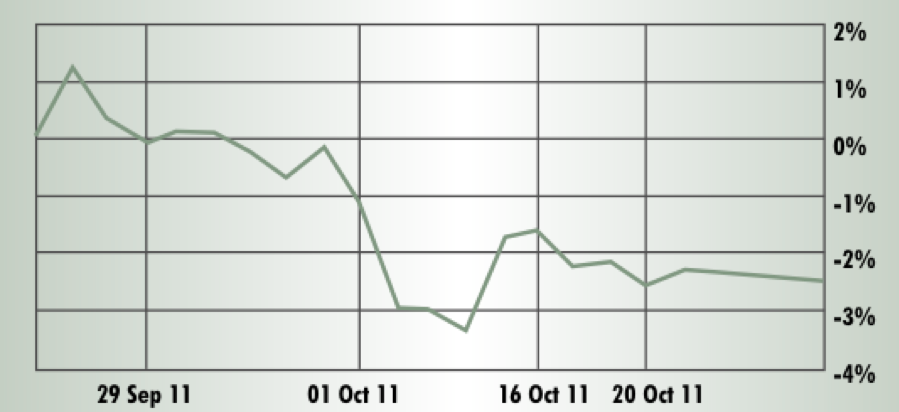
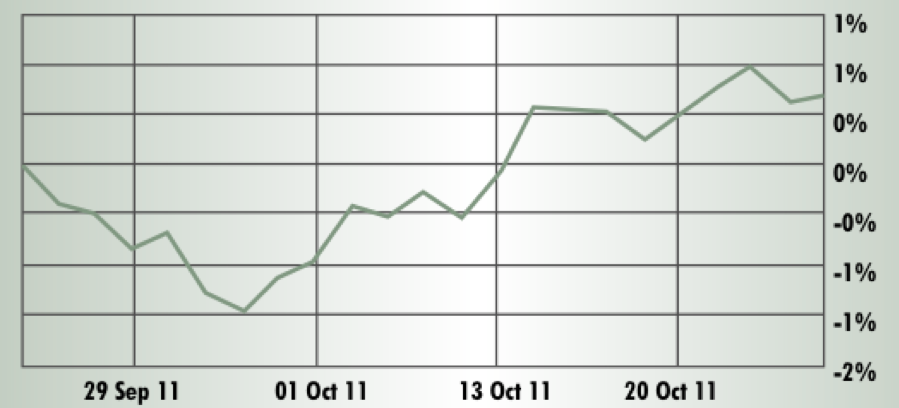
The shivering political situation in the Arab region, the gloomy economic situation in Lebanon and fears of another global recession weighed negatively on investors’ appetites for equities. This was reflected by the relatively low daily average volume of 150,811 shares valued at $1.02 million during the four-week period between September 16 and October 14, as opposed to an average 182,811 shares worth $1.72 million traded daily during the preceding four-week period. The BLOM Stock Index (BSI) hovered between a lower threshold of 1,205 points and a higher band of 1,244 points, before closing at 1,220 points on Friday, October 14, its lowest close since June 2009. The BSI closed around 2 percent lower than on September 16, and 17.3 percent lower than its value on December 30, 2010. 

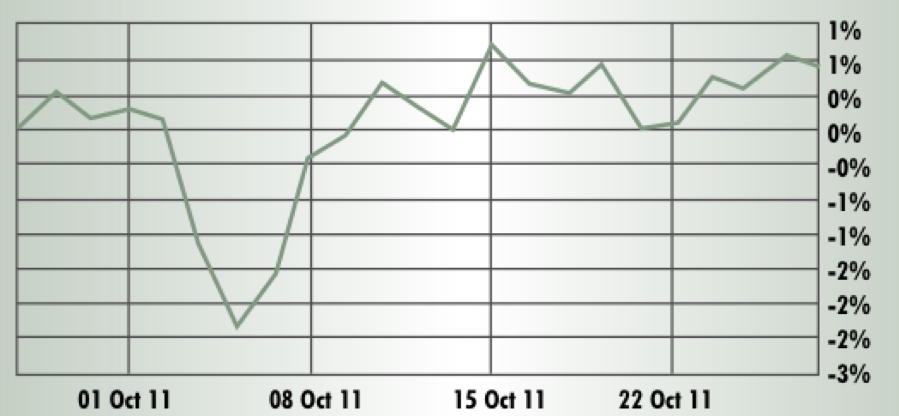
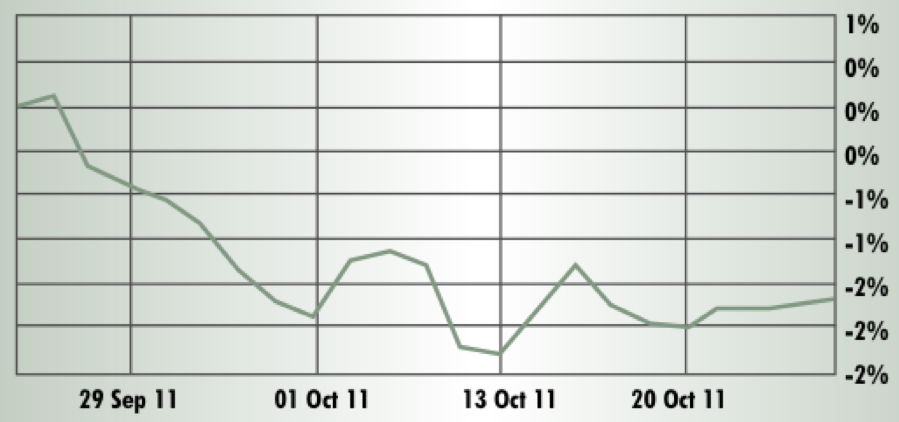
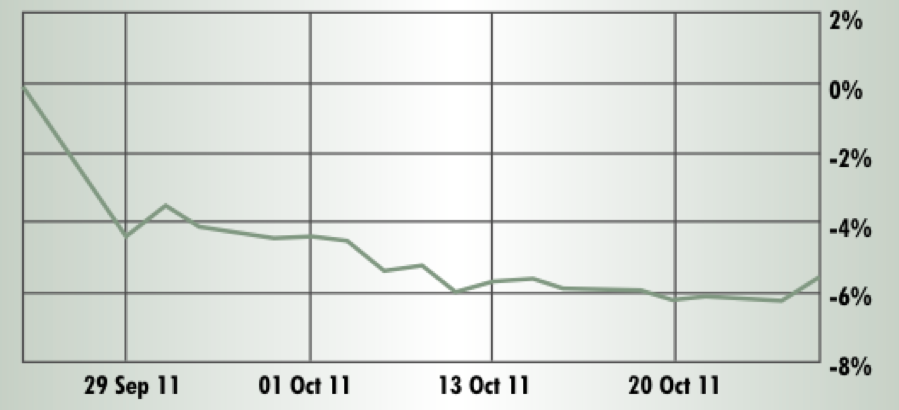
On the regional front, the BSI outperformed the Morgan Stanley Emerging Market Index (MSCI), which lost 3.5 percent, during the four-week period, to settle at 930 points after distressing economic developments in  Europe at the end of September. As for the S&P Pan Arab Composite LargeMidCap Index, it fell by 1.2 percent to 106 points.  

Banking stocks captured the bulk of trade between September 16 and October 14, representing 63 percent of the total value traded. BLOM Bank stocks retreated during the period, as its Global Depository Receipts (GDR) lost 3.9 percent to hit $7.85 and its listed stock declined by 4.7 percent to settle at $7.80. However, BLOM Preferred 2011 added 0.1 percent, to settle at $10.12. Bank Audi listed stock dropped 3.55 percent to $5.98, while its GDR reversed the trend, adding 0.15 percent to reach $6.83. Both Audi and BLOM common stocks touched their lowest values since their respective stock splits in May and October 2010. It is worth noting that Bank Audi listed an additional 1 million GDRs on the Beirut Stock Exchange that were converted from Audi listed stocks as of September. Byblos and BEMO common stocks decreased a respective 1.2 percent and 3.9 percent to $1.63 and $2.47, whereas Bank of Beirut common stock gained 1.2 percent to hit $19.50.

In the real estate sector, Solidere A and B edged below their support level of $15, losing 1.3 percent and 2.6 percent to stand at $14.95 and $14.9 respectively, their lowest level in more than two years.

In the industrial sector, cement manufacturer Holcim Liban added 1.7 percent to reach $16.99 after revealing an 11 percent year-on-year growth in profits. Ciment Blanc Class B hit $3.25, its highest level since March 1998.

Eurobond bulletin

The Lebanese Eurobond market saw some selloffs on profit taking from foreign investors during the last two weeks of September, in order to cover some of their losses incurred in emerging markets. The BLOM Bond Index slipped 0.15 percent to 111.07 points. The portfolio weighted yield remained almost unchanged at 4.77 percent, whereas the spread against the US benchmark yield widened 16 basis points (bps) to 388bps as investors rushed for fixed income instruments. Lebanon’s credit default swap (CDS) for five years — a proxy for a country’s risk of default — reached 402-432bps compared to 395-425bps on September 16. Comparatively, in regional markets, Dubai and Saudi Arabia CDSs were quoted at 453-464bps and 111-118bps respectively.

November 25, 2011 0 comments
0 FacebookTwitterPinterestEmail
Banking & Finance

Market bulletin

by Executive Editors November 25, 2011
written by Executive Editors

Beirut SE  

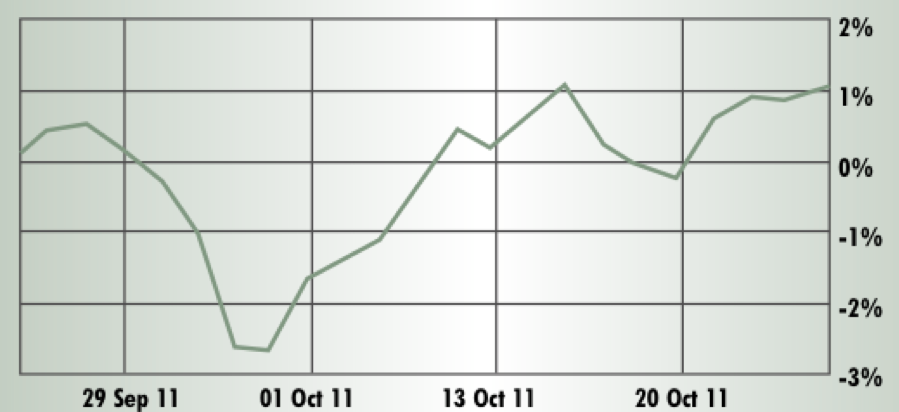
>  Review period:  Closed October 24 at 1,212.74 points   Period Change: -1.69%

The Beirut Stock Exchange was a ghost town in October as investors hid from uncertainty in Syria and worrying indicators for the outlook of the Lebanese government, economy and banking sector. In the meantime, a raise in the minimum wage united business owners and employee syndicates against the government but did little to attract investors desperate for stability. Class A shares of Solidere, the developer of Downtown Beirut, fell 2.05 percent during the period while Bank Audi, which reported its slowest growth in net profit since 2007, held its ground.

Amman SE  

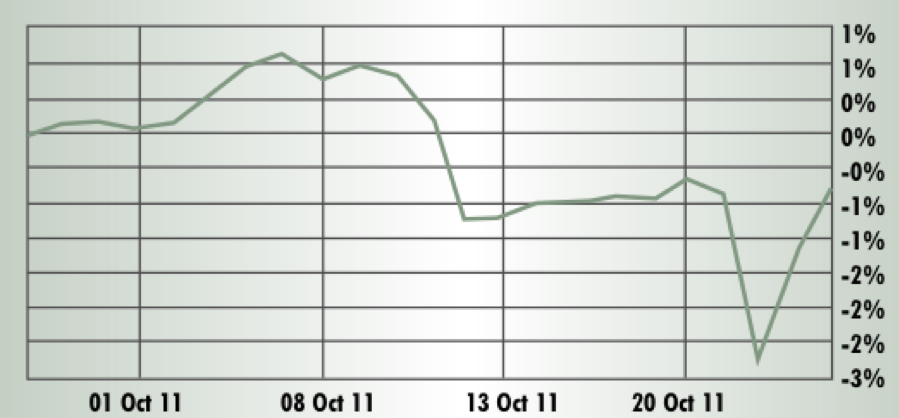
>  Review period:  Closed October 24 at 1,955.62 points   Period Change: -1.81%

A positive mood reigned over Amman stocks in October with a new political leader promising reforms even more feverishly than his predecessor. To investors, however, the ride back looks bumpy at best, but the 1.8 percent rise from the low point on October 10 is a good start. Regional instability is making it tough for the market, given the economy’s dependence on declining tourism. Royal Jordanian shares plummeted 7.8 percent on large full-year loss estimates but management and trading in banks was light, with Arab Bank falling 2.3 percent during the period.

Abu Dhabi Exchange  

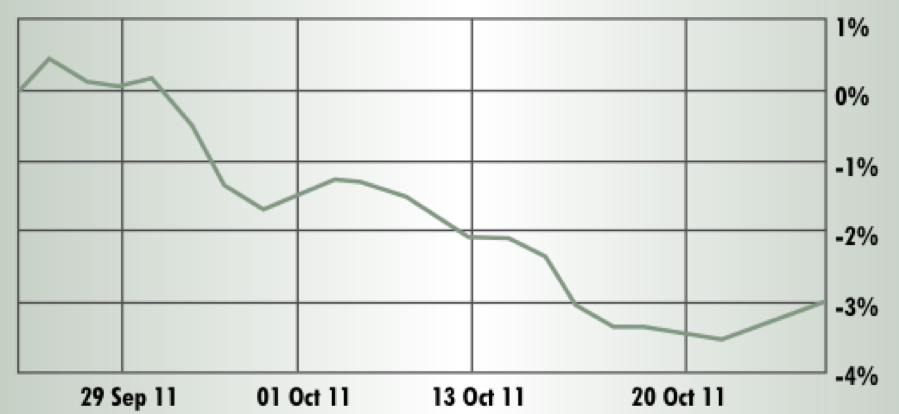
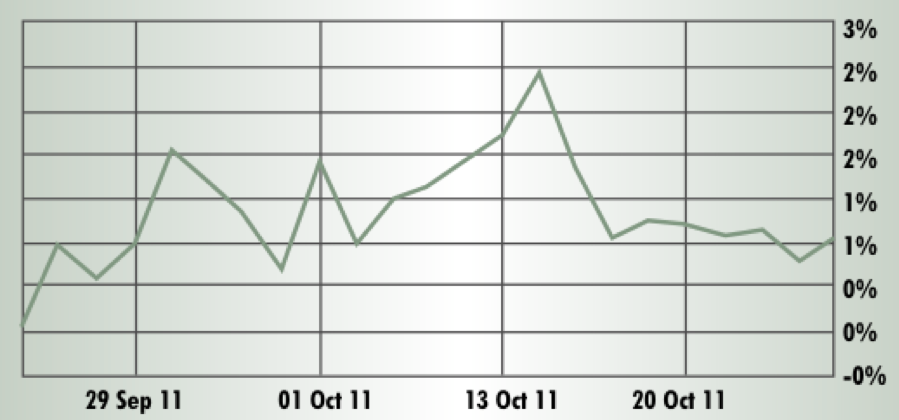
>  Review period: Closed October 24 at 2,446.71 points   Period Change: -3.42%

The Abu Dhabi Exchange’s dismal performance in October proved that money can not always buy investor happiness. Abu Dhabi stocks, previously considered safe from the Dubai debt crisis, plummeted to a 30-month low as risk-aversion emanating from Europe left investors watching from the sidelines. Although the National Bank of Abu Dhabi reported strong third quarter earnings, the bank’s shares were met with little cheer at empty exchange hallways, leaving the stock to tumble to 5.2 percent, a minor loss relative to real estate developer Sorouh’s 15.7 percent plummet before reporting results.

Dubai FM  

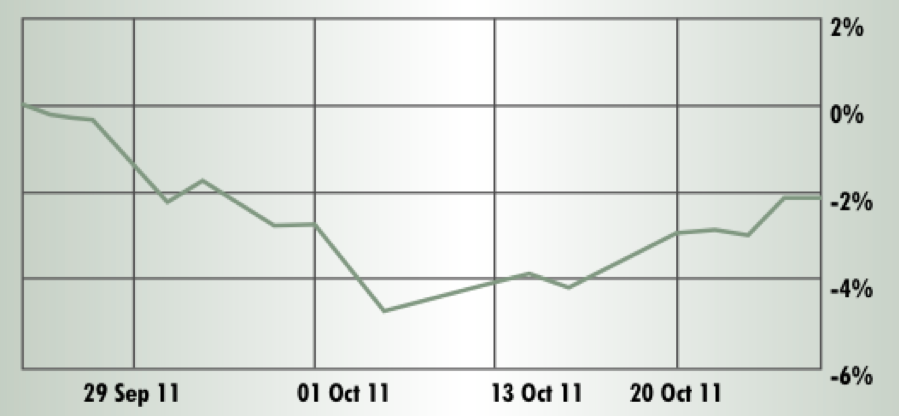
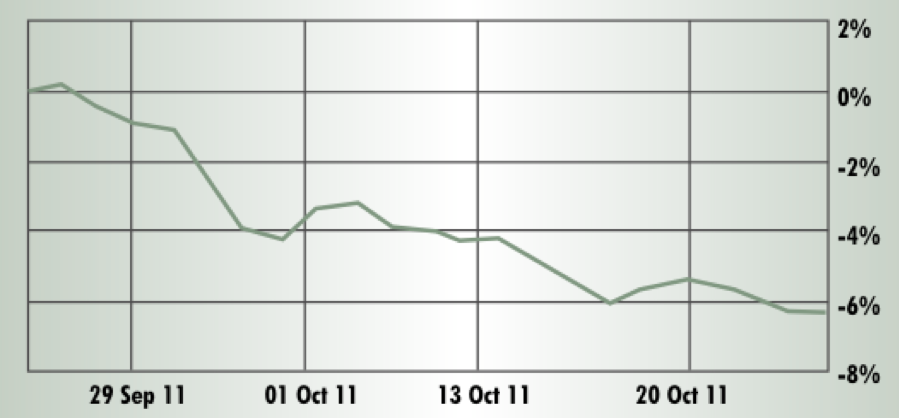
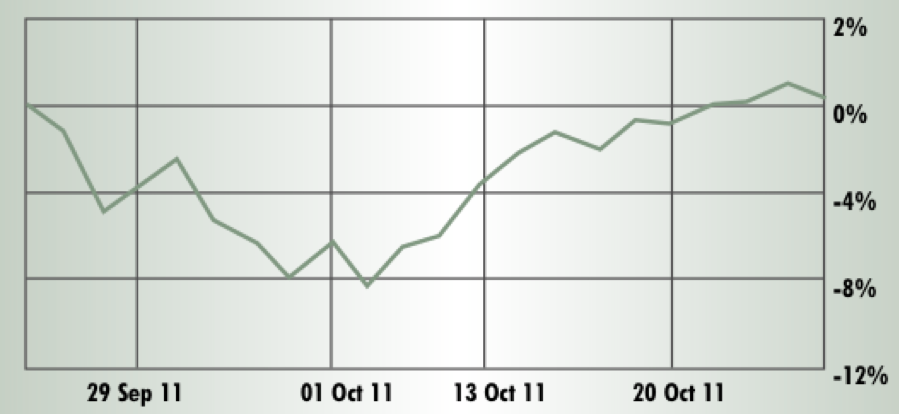
>  Review period: Closed October 24 at 1,359.77 points   Period Change: -5%

Dubai may be safe from Arab uprisings but local woes proved enough to upset the markets. The Dubai FM index was the region’s worst performer during the period as rumors surfaced that the exchange would not be upgraded to MSCI Emerging Markets status in December 2011. If that were not enough, Emirates NBD, which was forced to take over fallen Dubai Bank, said profits fell more than half in the third quarter, sending its stock down 8.5 percent. Real estate developer Emaar fared even worse ahead of earnings, down 9.8 percent.

Kuwait SE  

>  Review period:  Closed October 24 at 5,918.5 points   Period Change: +1.46%

Kuwait’s market recorded another month of positive growth, as a new wave of optimism came from an increase in real estate transactions: National Real Estate witnessed an outburst of trading that drove the stock up 56.8 percent. Banks suffered the fate of their peers elsewhere in the region as National Bank of Kuwait reported dismally flat third quarter earnings and floated 3.78 percent upwards on low volumes. Ahli United Bank struck down investors with a 10.6 percent scorcher ahead of earnings.

Saudi Arabia SE  

>  Review period:  Closed October 24 at 6,132.25 points   Period Change: +0.33%

It appears nothing can shake the Saudi mammoth exchange, including the cancellation of the Zain Saudi Arabia takeover or the 53 percent drop in the company’s third quarter profit. Zain’s shares fell only 9.6 percent but the market remained buoyantly in positive territory. Banking stocks took the rudder, and with tailwinds of double digit growth in net profits in the third quarter, they brought in 2.3 percent from their bottom on October 4.

Muscat SM  

>  Review period:  Closed October 24 at 5,538.75 points   Period Change: -1.1%

The comeback from the end of September/early October slide was more difficult than expected for Muscat securities. Investors welcomed leaping profits at Bank Muscat, sending the stock up 3.4 percent, but kept National Bank of Oman flat despite increased third quarter earnings. The exchange’s newest comer, SMN Power, also received a warm welcome and a 3.6 percent rise over its subscription price. But the excitement remains limited by downbeat trading volumes, prompting brokerage firms to petition the Capital Markets Authority for more flexibility with margin trading rules.

Bahrain Bourse  

>  Review period:  Closed October 24 at 1,144.4 points   Period Change: -1.83%

Bahrain investors can take a breather from a marathon year of record losses. Mixed third quarter earnings kept some traders interested, but the cold pause in domestic politics and the rising tensions between Saudi Arabia and Iran do not bode well for the average capitalist. Arcapita’s rating was also downgraded and kept on negative watch by Moody’s as Gulf International Bank saw its profit dwindle 13 percent in the first nine months. Aluminum Bahrain fell 10 percent despite reporting growth in production, on fears of rising production costs and weaker global demand.

Qatar SE  

>  Review period:  Closed October 24 at 8,457.95 points   Period Change: +0.76%

It is not all good news for Qatari stock traders, but the worst is probably behind them. After an initial flop following rumors that the Qatar Exchange would not be upgraded to MSCI Emerging Market status in December 2011, stocks took comfort in strong profits at most companies and rallied 3.7 percent from their low point on October 5. Qatar National Bank, Qatar International Islamic Bank, Masraf Al Rayan and Commercial Bank of Qatar all bucked the MENA loss trend and reported healthy earnings, with the latter’s shares inching up 1.5 percent during the period.

Tunis SE  

>  Review period:  Closed October 24 at 4,538.41 points   Period Change: -2.74%

The victory of Islamic ‘renaissance’ party Ennahdha in Tunisia’s polls meant anything but a renaissance for Tunisian stocks. Although party leaders promised not to impose Sharia law or retract women’s rights, investors were cautious after several months of optimism. With lower tourist numbers, a crisis in nearby Europe and another round of elections in a year preceded by a re-drafting of the constitution, stocks fell. Tunis Air dropped 2.9 percent and Carthage Cement fell 3.8 percent during our review period through October 24.

Casablanca SE  

>  Review period:  Closed October 24 at 11,333.9 points   Period Change: -1.1%

Investors contemplated Moroccan stocks as they watched the forthcoming November 25 parliamentary elections on the horizon. A debate erupted over the construction of the country’s high speed train linking Tangiers to Casablanca. In choppy trading, Attijariwafa Bank, an exchange heavyweight, was off 3.42 percent during the period while Itissalat Al Maghreb held its ground. With the key tourism sector suffering, hopes are high for Gulf support after being promised full GCC membership.

Egypt SE  

>  Review period:  Closed October 24 at 4,311.88 points   Period Change: +4.22%

Egyptian stocks are again fertile land for investment. The resumption of negotiations with the IMF and World Bank over a subsidized $3 billion loan and 10 times more in promised funds by the G8 sent Egyptian stocks soaring to the top of MENA exchanges during the review period. The prisoner swap between Egypt and Israel and the recommencement of gas flows at revised prices boded well, and drove Orascom Construction Industries up 5.9 percent and Commercial International Bank up 12 percent.

November 25, 2011 0 comments
0 FacebookTwitterPinterestEmail
Banking & Finance

Financial quotes of the month

by Executive Editors November 25, 2011
written by Executive Editors

“The biggest headwind the American economy is facing right now is uncertainty about Europe.”

Barack Obama, president of the United States

“Lebanon will not be affected by a recession in Europe as the Lebanese economy essentially is dollarized.”

Riad Salameh, governor of the Lebanese central bank

“You want to look for countries with relatively clean balance sheets, with AAA types of ratings and with the ability, importantly, to print money.”

Bill Gross, founder of Pacific Investment Management Co (PIMCO), the world’s biggest bond fund

“This is the most serious financial crisis at least since the 1930s, if not ever.”

Mervyn King, governor of the Bank of England

“It was a wrong decision.”

Khalaf al-Habtoor, chairman of Al Habtoor Group, on their decision to acquire a stake in British lender Barclays in 2008

“We are open to any investment opportunities in all parts of Europe.”

Mustapha al-Shamali, Kuwait’s finance minister

“Don’t be a dick.”

What an investor apparently told Glencore’s CEO Ivan Glasenberg after he asked about the possibility of a last minute increase in the list price of its $10 billion IPO

“They [the IMF] have very substantial resources that are uncommitted.”

Timothy Geithner, United States Treasury Secretary, on the US’s refusal to inject more funds into the IMF

“We do not look opportunistically at distressed assets or special assets that come up one way or the other.”

Mohamad al-Jasser, governor of Saudi Arabia’s central bank, when asked about buying European sovereign bonds
November 25, 2011 0 comments
0 FacebookTwitterPinterestEmail
Banking & Finance

For your information

by Executive Editors November 25, 2011
written by Executive Editors

Beirut Stock Exchange trades thin

Trading activity on the Beirut Stock Exchange (BSE) is dire so far this year. The total volume traded stood at 64.2 million shares as of the end of September, a 54 percent year-on-year decrease. Turnover stood at $467 million, down a whopping 72 percent from September 2010, and the BSE’s market capitalization decreased 14 percent to reach $10.6 billion. While the Lebanese equity market is being hit, the spreads on the country’s credit default swaps (CDS) — effectively the market’s perception of a county’s default risk — have been outperforming global peers. Spreads on Lebanon’s CDS have widened just 22 percent in the third quarter and stood at 429.7 basis points according to CMA Datavision, a CDS and bond-pricing firm. This is a much better performance than the widening of spreads in Denmark (216 percent), The Netherlands (176 percent), Italy (165 percent) and Austria (160 percent). Only the United States, Venezuela and Ireland performed better than Lebanon in the third quarter.

Merrill Lynch and Barclays recommend Lebanese Eurobonds

Merrill Lynch upgraded its rating on Lebanon’s external debt to “Overweight” from “Market Weight” within its emerging markets portfolio, placing Lebanon in the same category as Abu Dhabi, Qatar, Jordan, South Africa, the Philippines and Uruguay. The upgrade is driven by the low beta correlation of Lebanese Eurobonds to the international markets, due largely to an increased risk aversion. Merrill Lynch also raised Lebanon’s allocation in its portfolio to 3.9  percent from 3.5 percent and highlighted that Lebanon’s external debt returns were the only ones in positive territory among the 42 emerging economies in the portfolio. Barclays Capital maintained its “Market Weight” recommendation on Lebanese Eurobonds in its emerging markets credit portfolio but raised Lebanon’s allocation to 2.8 from 2.4 percent.

Tier one capital ratio to hit 12 percent

Lebanon plans to raise its tier one capital ratio, the core measure of a bank’s financial strength, to 12 percent within seven years, more than required by BASEL III, a new global regulatory standard on bank capital adequacy. Basel III requires banks to hold a tier one capital of 6 percent, up from 4 percent, by 2015. According to Riad Salameh, governor of Banque du Liban (BDL), Lebanon’s central bank, the new capital requirement imposed on Lebanese banks would place them “among the highest in terms of capital adequacy.” BDL will soon issue a directive requesting a 10 percent target for tier one capital within four years, rising to 12 percent three years later. During meetings at the International Monetary Fund, Salameh indicated that he does not expect Lebanese banks, which have an insignificant exposure to European sovereign debt, to be affected by the European crisis. He added that current regulations encourage solvency and liquidity in line with Basel III.

Gulf investors drop bid for Zain Saudi

Kingdom Holding, own- ed by Saudi billionaire Prince al-Waleed bin Talal, and Bahrain Telecommunications (Batelco) dropped their $950 million bid to buy a 25 percent stake in Zain Saudi, the kingdom’s third-largest mobile phone company which is owned by Zain, Kuwait’s biggest mobile phone company. The failure of the deal follows the collapse of two previous attempts to acquire a 46 percent stake in Zain: one in March for $12 billion by the United Arab Emirates’ operator Etisalat, and one in September 2009 for $13.7 billion by India’s Vavasi Group and Malaysian billionaire Syed Mokhtar al-Bukhary. Zain Saudi’s third quarter results showed accumulated losses of $2.5 billion, pushing the company to focus on capital restructuring. Zain Saudi recently appointed Khalid al-Omar as chief executive officer after the resignation of Saad al-Barrak. As of October 13, Zain Saudi’s stock price was down 27 percent on the year.

Commercial bank assets up

The total assets of Lebanese commercial banks stood at $138.1 billion as of the end of August 2011, a 10 percent year-on-year increase. Private sector deposits also increased 10 percent year-on-year and stood at $113 billion. Deposits in Lebanese lira stood at $37.8 billion, down 1.7 percent year-on-year while deposits in foreign currencies rose 17 percent to reach $75.2 billion. The dollarization rate of deposits rose to 66.6 percent, up from 62.6 percent a year ago. Loans to the private sector increased 17 percent year-on-year and amounted to $39 billion, of which $5.6 billion went to the non-resident private sector.

Emirates NBD takes over Dubai Bank

Emirates NBD, the largest lender in the United Arab Emirates, has taken over the struggling Islamic lender Dubai Bank for an undisclosed amount on the orders of Sheikh Mohammed bin Rashid al-Maktoum, the ruler of Dubai. The Dubai government, which holds a 55.6 percent stake in Emirates NBD, had acquired Dubai Bank in May after it was hit hard by the financial crisis. Before the takeover it was owned by both Dubai Holding, with a 70 percent stake, and Emaar properties, with a 30 percent stake. In an emailed statement, the government’s media office said the takeover was “in line with Dubai government efforts to enhance the banking sector in the emirate.”

Iraqi Telecommunications IPO delayed

Iraq’s three telecommunications operators, Korek Telecom, Zain Iraq and Asiacell, missed their planned deadline for floating on the Iraqi Stock Exchange (ISX). The companies were expected to be listed by the end of August 2011 but will not be penalized for missing their targets and now seem unlikely to launch an initial public offering (IPO) until the middle of 2012. The operators are first required to change from private companies to shareholding firms, which is expected to take a month to complete. The Iraqi exchange’s market capitalization stands at just $4 billion, with the average daily volume traded just $2 million — yet, technically, it is one of the world’s best performing markets this year. Taha Abdulsalam, chief executive of the ISX, expects the current market capitalization to double when operators list on the Iraqi bourse.

Qatar investing in gold and Luxembourg banks

Qatar Holding, a subsidiary of the gulf state’s sovereign wealth fund, the Qatar Investment Authority (QIA), is planning to create a standalone investment vehicle called “Qatar Gold” to invest in gold companies. It began by acquiring a 10 percent stake in British mining company European Goldfields at a cost of $775 million, of which $600 million will finance mine development in Greece. The Qatari royal family is also buying two banks in Luxembourg previously owned by troubled Belgian banks, Dexia and KBC. Precision Capital, a Qatari-backed firm based in Luxembourg, agreed to buy KBC’s private banking unit, KBL European Private Bankers, for $1.4 billion. Following the break up of Dexia by the French and Belgian governments, the Qatari royal family agreed to acquire Dexia’s troubled unit in Luxembourg, Dexia Banque Internationale Luxembourg (BIL), for an undisclosed amount. Qatar National Bank, which is 50 percent owned by the QIA, is in talks to buy the Turkish division of Dexia, Denizbank, in a deal that could potentially be worth $6 billion.

November 25, 2011 0 comments
0 FacebookTwitterPinterestEmail
Feature

Revolution reaches for the next level

by Executive Editors November 25, 2011
written by Executive Editors

Since February 11, Tahrir has been taken to the factories,” says workers’ rights activist and blogger Hossam al-Hamalawy. “The barometer for progress has been [thought of as] how many people gather in Tahrir, but that’s not true. The labor strikes that have taken place after former president Hosni Mubarak’s fall are phase two of the revolution.” 

Egypt has witnessed more than 120 different labor strikes since March this year, according to data from the Egyptian non-governmental organization (NGO) Awlad El Ard Association for Human Rights. This is in addition to over 490 sit-ins, demonstrations and protests. Experts estimate that roughly half a million workers participated in strikes in August and September alone.

The current wave of labor actions found its roots in December 2006, when the nation’s center of textile production in the industrial city of Mahalla El Kubra saw an outbreak of wildcat strikes. These protests in many ways helped pave the way for this year’s 18-day uprising and its perceived success after workers took to the streets during the final days of the revolution, ensuring Mubarak’s dethroning.

“The organization and awareness of workers is in itself outstanding… I think in the future, these workers will lead the way to change”

Unions unquelled

Labor agitation escalated in mid-September, most significantly when tens of thousands of teachers descended on downtown Cairo as part of a larger strike calling for increased wages. That same week, hundreds of thousands of doctors, nurses and health technicians walked out of public hospitals, while transportation networks ground to a crawl when workers from 25 bus depots across Greater Cairo staged a partial strike.

“The organization and awareness of workers is in itself outstanding,” says labor activist and journalist Moustafa Basyouni. “I think in the future, these workers will lead the way to change.”

Egypt’s labor force is more than 25 million people and worker protests have affected all sectors of the economy, most occurring in the public sector. Acting government officials eventually negotiated with teachers and transport workers. However, other strikers have been completely ignored.

“It just depends on the power of the strike,” says Hamalawy. “Look at the aviation workers; you can’t mess with them. They brought Cairo to a halt.” When air traffic controllers went on partial strike in early October, hundreds of flights were delayed and travelers stranded, forcing officials to address their concerns.

In what human rights activists consider among the more troubling responses to the strikes, workers have been arrested and tried in military courts. Many cite the authorities’ failure to address workers’ concerns in a consistent manner as an obstruction to a return to normalcy, wreaking havoc on the economy.

The government’s projected 3.5 percent economic growth rate for 2011-2012 is unrealistic given the unstable political and social environment, according to Magda Kandil of the Egyptian Center for Economic Studies.

“We know that growth rate has slowed to 1.8 percent,” she says, “and I’m not confident at this point that it’s back on track. The private sector remains at a standstill and foreign investors are concerned [about financial risk], so they’ve scaled down involvement.”

“The military is not dealing well with the labor strike movement,” she adds, referring to the Supreme Council of the Armed Forces (SCAF), the ruling junta that rose to power following Mubarak’s ousting.

“I think the frustration in the labor movement reflects [the fact] that many people are not happy,” says Kandil. “The best thing the ruling council can do is ensure a swift transition.” Parliamentary elections are slated to begin on November 28, but SCAF says it will retain power until a new president is elected, with this ballot now expected as late as 2013.

The number of civilians subjected to military tribunals by the ruling council exceeds the total number of people tried this way under Mubarak’s 30-year rule

SCAF’s bludgeon of ‘justice’

Within the confines of a military prison, Khamis Mohammad was stripped and beaten brutally. “I was treated as an enemy of the country, as if I was the reason for the poor economy,” says the young Egyptian who is one of many arrested on charges of public assembly in violation of an anti-strike law.

After being plucked from a 200-man sit-in outside Cairo’s petroleum ministry, Mohammad remained in a dingy jail cell for weeks until he was given a one-year suspended sentence by a military — not civilian — court. Such trials are just one aspect of post-revolution governance by the ruling military council that human rights organizations claim undermine a smooth transition to democracy.

“Military trials are a way of intimidating the opposition and are counter-revolutionary by nature,” says Shahira Abu Leil of the human rights group No Military Trials for Civilians. “The revolution was about freedom of expression and free speech. And the military has tried people who were exercising these rights.”

“SCAF is doing this because it’s a way to put people back into a disciplined state,” she adds.

Some 12,000 Egyptians have appeared before military courts since the start of the revolution; roughly 8,000 remain in prison and 4,000 have been released, according to Abu Leil. Courts have acquitted 795 of the total number of cases, equating to a conviction rate of 93 percent, Human Rights Watch (HRW) said in a September 2011 report; 1,836 individuals, like Mohammad, were released on suspended sentences.

“The judges are in a clear hierarchy, so one of the concerns we’ve had with the military justice system is there have been cases of clear political instruction,” says Heba Morayef of HRW. “In your average [civilian] courts judges make independent decisions, but in these cases SCAF is making the decisions.”

The ruling council has held their ground on the judicial system refusing calls to end military tribunals, citing increased crime rates and the need to prosecute baltageya — or thugs — who have been on the prowl since the January uprising.

“Military trials are easy and efficient,” Morayef says. The average length of each trial is between twenty and forty minutes and civilians are sometimes tried and sentenced in groups. “But decisions are often not based on proper examination of the evidence,” she argues.

The number of civilians subjected to military tribunals since the ruling council rose to power on February 11 exceeds the total number of people tried this way under Mubarak’s 30-year rule. Those convicted range from laborers to activists, such as blogger Maikel Nabil who went on a hunger strike after being sentenced to three years in jail for “spreading false information” and “insulting the military establishment”.

In early October, seven demonstrators were plucked from a protest in the Nile Delta city of Shabin El Koom while demanding improved factory conditions and increased job stability for workers at the Turkish textile company, Mega Textile. Those arrested were given 15-day jail sentences while investigations took place, an act allowed under Egypt’s Emergency Law.

“This needs to be changed because the people are considered guilty until they’re proven innocent,” says Egyptian lawyer Mohammad Hassan as he stands among a group of workers in the city.

Egypt’s widely reviled Emergency Law has long been a hot-button issue for activists because it gives the military government the right to detain people without charge and criminalize mass gatherings. Emergency law was to expire at the end of September but was renewed following a violent attack on the Israeli Embassy in Cairo.

“The recent crackdown is on political protests, labor protests,” HRW’s Morayef says, “and from a freedom of assembly standpoint, that’s very serious.”

SCAF is refusing to repeal emergency law despite requests not only by enraged activists but also by the Obama administration. United States Defense Secretary Leon Panetta raised concerns about the Emergency Law while visiting Egypt in October, and US President Barack Obama is urging Field Marshal Hussein Tantawi to repeal the action and put an end to military trials. As part of the widening crackdown, SCAF has placed a firmer grip on civil society, restricted press freedoms and carried out arbitrary arrests — all characteristics of Mubarak’s regime.

The Egyptian cabinet announced in September that more than 30 Egyptian NGOs are being investigated for receiving foreign funding without being properly registered. Should these groups be found guilty of “treason”, Egypt’s human rights network could effectively be shut down.

“The recent crackdown is on political protests, labor protests… and from a freedom of assembly standpoint, that’s very serious”

Silencing the press

Additionally, the military council is censoring media following months of relative press freedom. In mid September, plainclothes police  stormed the offices of Al Jazeera’s Mubasher Misr Channel , taking equipment and rouging up staff. Two weeks later, an edition of the weekly Sawt Al Umma and the daily Rose Al Youssef were prevented from going to print allegedly over controversial stories. In a subtler form of censorship, a writer at a popular Cairo-based magazine says management was told specifically not to write articles that criticize the military, or they would face punishment.

Most severely, military forces clashed with civilians on October 9 during a demonstration by Coptic Christians, leaving 24 dead and hundreds injured. The same evening, the US-funded Al Hurra television station was raided by military forces brandishing automatic weapons. Telephone, electricity and Internet services were also cut to one of Egypt’s leading newspapers, according to the Committee to Protect Journalists.

November 25, 2011 0 comments
0 FacebookTwitterPinterestEmail
Editorial

Shooting blind, from the hip

by Yasser Akkaoui November 25, 2011
written by Yasser Akkaoui

The current Lebanese government is, in economic terms, as dangerous as a blind man with a loaded gun and an itchy trigger finger.

To date, it has shown little to no leadership in guiding Lebanon’s floundering economy back to prosperity, offering no comprehensive strategy to promote sustainable growth across the different job-creating industries — be they financial, service-related, manufacturing or agricultural. Instead what the government has offered is ill-considered, quick-fix patches. Cabinet’s commitment last month to raise wages for workers in lower income brackets by an arbitrary amount would be in the same category, if it were not also actually counter-productive to the ends it is purportedly trying to meet.   

First, let’s be clear: With the rising prices it has become effectively impossible to achieve a descent standard of living earning the current minimum wage. However, the equation for setting the new optimal minimum wage requires knowing a few basics numbers ­— none of which the government has: It has developed no capacity to monitor wage rates or income distribution across the country, has no labor force or household surveys and no employer surveys. In other words the government has no idea what the optimal wage increase would be, and no clue as to the impact of its proposed minimum wage increase on either employees or employers.

Concurrently, since the beginning of this new government’s term, the country has experienced zero economic growth, meaning private sector businesses are already struggling. Forcing them to raise wages 40 percent overnight without offering the prospect of recouping these costs through new growth will result in employee layoffs and employer insolvencies.

What Lebanon needs is a comprehensive plan to address the fundamental flaws in the structure of the economy to boost growth, create jobs and raise the general standard of living — including setting the minimum wage at a level that is fair for employees and feasible for employers. What the country does not need is major policy decisions that affect millions of Lebanese and the economic stability of their country taken by shoot-from-the-hip politicians who, to date, have show themselves utterly unqualified to hold office.  

November 25, 2011 0 comments
0 FacebookTwitterPinterestEmail
Finance

Rolling out the net of risk management

by Executive Staff November 3, 2011
written by Executive Staff

Lebanon’s insurance sector is approaching, ever so slowly, a time where global and regional macroeconomic enablers could provide the scale of economics that the industry has been chasing unsuccessfully for at least a decade. 

Driven by the tectonic shift from developed insurance markets into emerging ones, the most optimistic forecasters hope for an increase of about 150 percent in domestic insurance penetration in the coming years, a leap forward in the use of insurance as risk management in financial markets and a surge in Arab and Muslim interest in insurance through social media and networking.     

Scenarios for global insurance migration from saturated developed markets to those less well served are being discussed in the consulting houses trying to plot a future for the industry. A current study by PricewaterhouseCoopers (PwC) on the insurance industry predicts that in 2020 the big changes experienced by the sector in the early 21st century are likely to accelerate further in the next decade. It argues these will bring ‘STEEP’ changes, meaning “Social, Technical, Environmental, Economic and Political”.

In the Middle East and North Africa (MENA) one is inclined to add demographics to the list of agents of change that could boost the regional insurance industry from its current status as the least successful market in the world, in terms of average spending on insurance.

While the industrialized countries still accounted for 85 percent of global insurance premiums in 2010 — $3.69 trillion versus $650 billion in emerging markets — the double-digit growth outside the industrialized markets has finally made a noticeable dent in that disparity. According to the Sigma report by global reinsurance firm Swiss Re, the share of emerging markets in global premiums last year grew by two full percentage points to 15 percent of worldwide insurance spending.

Yet it is still clear that the entire non-industrialized world is under-insured when compared with the insurance penetration range of between six and 13 percent in individual industrialized countries.

Expressed in total share of gross domestic product, the gap between individual MENA countries and the world average of 6.9 percent spans from four to over six percentage points, depending on which MENA country is reviewed. Lebanon ranks among the leaders in insurance penetration in MENA.

Yet this gap has not drastically diminished in the past decade and other MENA countries have generally recorded only minute annual improvements in insurance penetration. For positive business thinkers, the long-term perspective on being the global insurance laggards cannot but translate into a possible space for growth. The search is on for new opportunities where regional insurers can branch out and balloon their business.

Credit lines and risk management

One very interesting range of activity in times of global turmoil and regionally peaking political risk is credit insurance, yet it must be examined with care. Although a simple sounding term, it can refer to two very different financial safeguards.

The first one, better called consumer or retail credit insurance, describes policies that consumers buy to protect themselves against the eventuality of defaulting on payments for their Bahaman vacation loan, or for the 144-piece Louis XIV-style Christofle silverware they bought on the eve of the latest financial crisis in 72 installments of $700 each.

The second one, which is specified as trade or business credit insurance, is a risk management cover that a trading, manufacturing or services company obtains to insure receivables from its business partners.

What both credit insurance variants have in common is that they are extremely hard to find in the MENA.

“We are most probably the only private entity in Lebanon and the Middle East that does the business we do,” says Karim Nasrallah, general manager of the Lebanese Credit Insurer (LCI), a Beirut-based trade credit insurance specialist whose policies are tailored to cover international and domestic receivables for mainly MENA-based, corporate clients with invoice periods extending up to six months.

According to other senior Lebanese insurance managers, the coverage of credit risk is an activity for very few specialists. “The market of credit insurance can show growth but the actors are very rare and they are very specialized people,” Elie Nasnas, general manager of AXA Middle East Insurance, tells Executive.

In his view, trade credit insurance growth would not lead to a wide increase in the commodity most sought-after by the local insurance community — insurance awareness among the customer base. For Nasnas, “The people targeted by credit insurance are already tuned in to insurance. It might generate some business but it won’t spread insurance awareness.”

Credit insurance is a field where established companies focusing on the provision of general insurance services will not easily find opportunities, agrees Max Zaccar, chairman and general manager of Commercial Insurance. Before advanced insurance and risk management products can be viable in the Lebanese market, Zaccar believes the companies must first obtain the standard covers that they are often dodging today, in areas such as liability or other employee-related insurance.

Such experience-based reservations reflect the fact that financial insurance and other sophisticated insurance products have long faced hurdles of viability in the small Lebanese market.

The reservations do not imply that ideas such as consumer credit insurance should be written off here. Yet before insurance for retail credit contracts and other financing agreements can be considered a serious tool for protection against individual or business bankruptcy, changes will have to be implemented in a number of areas.

Firstly on the legislative and regulatory side of banking, credit check and consumer protection will have to be brought up to international standards. Secondly, changes must occur in the mindsets and expectations of business people, consumers and consumer advocates, by way of embedding awareness that an insurance contract is mutually based on the insurer’s diligence in servicing his policy obligations and the insured’s prudent efforts to avoid careless or even reckless handling of risks.    

According to Nasrallah, the business of trade credit insurance, while admittedly a niche product, has yielded excellent performances in the past three to four years. He tells Executive that LCI has been growing annually at percentage rates in the high double digits over the past three years, including a doubling of results from 2009 to 2010.

Therefore LCI’s exposure to risk has been increasing but it is not a reason to worry the insurer whose business it is to accept and manage corporate risk. “Any day when I go to sleep at night I go to bed with about $350 million to $360 million at risk, which represents a turnover of almost $1 billion a year so far,” says Nasrallah. “We have risks in Syria, in Jordan, in Egypt and all what has been happening [in the region] has not really contributed to diminishing our risk appetite; however, we use a little more caution in the distribution of our insurance capacity.”

Buying trade credit insurance carries a relatively low cost but enables a manufacturer or trader to manage the risk of having to achieve new sales equal to a multiple of the profit that he foregoes when a buyer defaults. While corporations are more likely to use trade credit insurance than small firms or startups, Nasrallah thinks the service is neglected by corporations in the MENA.

“Credit insurance is a very interesting branch and the main obstacle to developing this branch is the lack of awareness,” he says, adding, “The awareness that we have to create is about the added value of credit insurance not only as a protection of receivables but also as a management and marketing tool.”

A handful of government-sponsored export credit agencies exist in the region and offer insurance backing for trade and investment deals that meet their usually narrow requirements. However, the risk management potential of this and other financial insurance specialty lines is hampered rather severely by the lack of focus on risk management in the region’s business community. According to surveys over the past five years, large numbers of corporate decision-makers regard insurance as a necessary evil more than as logical investment.    

An Arab insurance spring?

Looking further into the future for regional insurance companies, the shift from developed to emerging markets is highly probable. However, the shift of global insurance markets could happen in many ways, and those companies who want to benefit from new opportunities will have to be nimble and open to what could be some very specific concepts that turn their relations with customers upside-down.

In the PwC ‘Insurance 2020’ scenario paper, options for development in the next 10 years include the politico-economic consequences of a global downturn and a global recovery spearheaded by emerging markets. In other words, everything could happen, but in PwC’s view, today’s insurance companies will be strongly affected in at least three areas over the next few years and will need to adjust or wholly revamp their business models, their value chains and their talent management.

On the technical side, one PwC scenario postulates a shift of economic decision-making towards the customer, “with virtual social networks acting as trusted networks for insurance purchase or self-insurance.”

This suggests new realities in insurance marketing, realities that must benefit from the ideas and tools which the “Arab Spring” has come to be associated with. At a conference for Arab insurance brokers, held at the end of last month in Beirut, a youthful local insurance industry manager spoke about the idea.

According to Roger Zaccar, marketing manager of Lebanon’s Commercial Insurance, social media should have a marketing role for insurance in Arab countries and enable insurance providers, “…to understand what the consumer needs. Social media should act as a bridge between the insurance company and the consumers. It is a tool that gives consumers a voice and we are not listening. As insurance companies and banks we are not as active as we should be in social media,” he says.

As he presented the concept of social media as a crucial element in the interaction of insurance companies and clients, Taghreed Yehia, an equally youthful Egyptian insurance advisor, becomes enthused. “I have started to use interactive media because this makes the client open up and be more open-minded to communicate with the insurance company or broker freely and tell his opinions in a free way that can also make us reply in a free way that satisfies the client.”

In Yehia’s view, using social media will reduce fear barriers among the region’s insurance customers who have been turned off by pushy sellers. Yet she also warns that awareness of social networking “is not yet present in insurance companies. I started developing a personal interactive website and am going to publish this website shortly, aiming, inshallah, to have good responses from my clients. Most of my personal clients are waiting for such social media because it facilitates the communication between us.”

It is no surprise that the next generation of leaders in Arab insurance companies are excited about the potential for social networking in the industry. But it also begs the question on how much time will have to pass before an Arab insurance spring will see the light of day. For the moment at least, insurance companies in Lebanon — many of which 10 years ago said they embraced the idea of using online channels for insurance marketing — seem to have turned their online channels to low maintenance, as there is not a ‘tweet’ or Facebook link to be seen on many a provider’s website.

November 3, 2011 0 comments
0 FacebookTwitterPinterestEmail
Comment

Syria fires on a fickle border

by Nicholas Blanford November 3, 2011
written by Nicholas Blanford

Nasri Khoury, the long-serving head of the Lebanese-Syrian Higher Council, may have been a tad hasty in stating last month that the Syrian army “has not made any incursions onto Lebanese territory” and that the town of Arsal in the eastern Bekaa might in fact be in Syria rather than Lebanon.

First of all, despite the declared withdrawal of Syrian forces from Lebanon in April 2005, there remains a large number of Syrian troops in the hills south of Deir Al Ashayer and east of Kfar Qouk in the district of Western Bekaa. The locations of these Syrian military positions are clearly visible on Google Earth. The United Nations team charged with confirming the withdrawal of Syrian troops noted in its May 2005 report that there was a discrepancy over the delineation of the Lebanon-Syria border south of Deir Al Ashayer.

“As a result, the team was unable to verify whether the Syrian military unit in the Deir Al Ashayer area was in Syrian or Lebanese territory,” the report concluded.

Days before the UN issued its report, I was invited by a congenial Syrian officer onto the battalion-sized army base at Deir Al Ashayer to examine his military map to prove his contention that the location was inside Syria. According to his map we were indeed some 150 meters inside Syrian territory.

But Lebanese army maps, standard international maps of Lebanon and the claims of Deir Al Ashayer’s residents placed the officer and his men approximately one kilometer inside Lebanon. The issue has never been resolved between Beirut and Damascus, so the Syrian troops remain billeted in the hills between Deir Al Ashayer and Kfar Qouk and Lebanese army checkpoints prevent anyone going too close to the area.

Khoury’s other contention — that Arsal lies inside Syria — is manifestly incorrect. Arsal lies approximately 15 kilometers west of the border. The border in this remote tract of the frontier is supposed to follow the watershed of the Anti-Lebanon Mountains. However, the border east of Arsal has long been a zone of confrontation between Lebanese and Syrian farmers, the latter having encroached onto Lebanese territory to grow orchards of apricots and almonds on the barren western slopes of the mountains.

In early October, Syrian troops probed up to five kilometers into Lebanese territory east of Arsal, according to local residents. One Syrian was killed and a building attacked during the cross-border forays. On a recent trip to Arsal, I could go no further east than the isolated farmsteads five kilometers short of the border because local residents said it was too dangerous due to the Syrian soldiers in the area.

The residents believe that the incursions are due to Syrian concerns that arms are being smuggled from Lebanon through the rugged mountains into Syria. Certainly, the Sunni residents of Arsal do not disguise their hostility toward the regime of Bashar al-Assad and support for the opposition protest movement. Furthermore, smuggling is a way of life for Arsal, like many other villages along the eastern border. But smuggling goods — be it diesel, cement or weapons — across this section of the border is only really possible with the cooperation of both Lebanese and Syrian parties. The barren nature of the terrain east of Arsal and the long distances involved (unlike the northern border where a 10-second stroll through the ankle-deep water of the Kabir River takes you from one country to the other) would make smuggling hazardous if Syria chose to seal the border and deploy troops.

The crackdown by Syrian security forces in mid-October in the area south of Homs, 30 kilometers north of the border with Lebanon, gave rise to further reports of cross-border incursions, this time in the Qaa Projects near the Qaa-Jusiyah frontier crossing, a Sunni-populated area where sympathies for the Syrian opposition run deep.

Anecdotally at least, arms smuggling from Lebanon to Syria is increasing, although it still appears to be on an individual basis rather than a more organized transfer of arms. The bulk of the smuggling occurs in Sunni-populated areas along the border, the north in particular. The escalating arms smuggling and the porosity of an ill-defined border suggest that Syrian army incursions into Lebanon will continue as the uprising in Syria intensifies and grows more violent.


NICHOLAS BLANFORD is the Beirut-based correspondent for The Christian Science Monitor and The Times of London. His book “Warriors of God: Inside Hezbollah’s Thirty-Year Struggle Against Israel” was published by Random House in October

November 3, 2011 0 comments
0 FacebookTwitterPinterestEmail
  • 1
  • …
  • 357
  • 358
  • 359
  • 360
  • 361
  • …
  • 696

Latest Cover

About us

Since its first edition emerged on the newsstands in 1999, Executive Magazine has been dedicated to providing its readers with the most up-to-date local and regional business news. Executive is a monthly business magazine that offers readers in-depth analyses on the Lebanese world of commerce, covering all the major sectors – from banking, finance, and insurance to technology, tourism, hospitality, media, and retail.

  • Donate
  • Our Purpose
  • Contact Us

Sign up for our newsletter

    • Facebook
    • Twitter
    • Instagram
    • Linkedin
    • Youtube
    Executive Magazine
    • ISSUES
      • Current Issue
      • Past issues
    • BUSINESS
    • ECONOMICS & POLICY
    • OPINION
    • SPECIAL REPORTS
    • EXECUTIVE TALKS
    • MOVEMENTS
      • Change the image
      • Cannes lions
      • Transparency & accountability
      • ECONOMIC ROADMAP
      • Say No to Corruption
      • The Lebanon media development initiative
      • LPSN Policy Asks
      • Advocating the preservation of deposits
    • JOIN US
      • Join our movement
      • Attend our events
      • Receive updates
      • Connect with us
    • DONATE